Last updated 2026-07-26
TL;DR
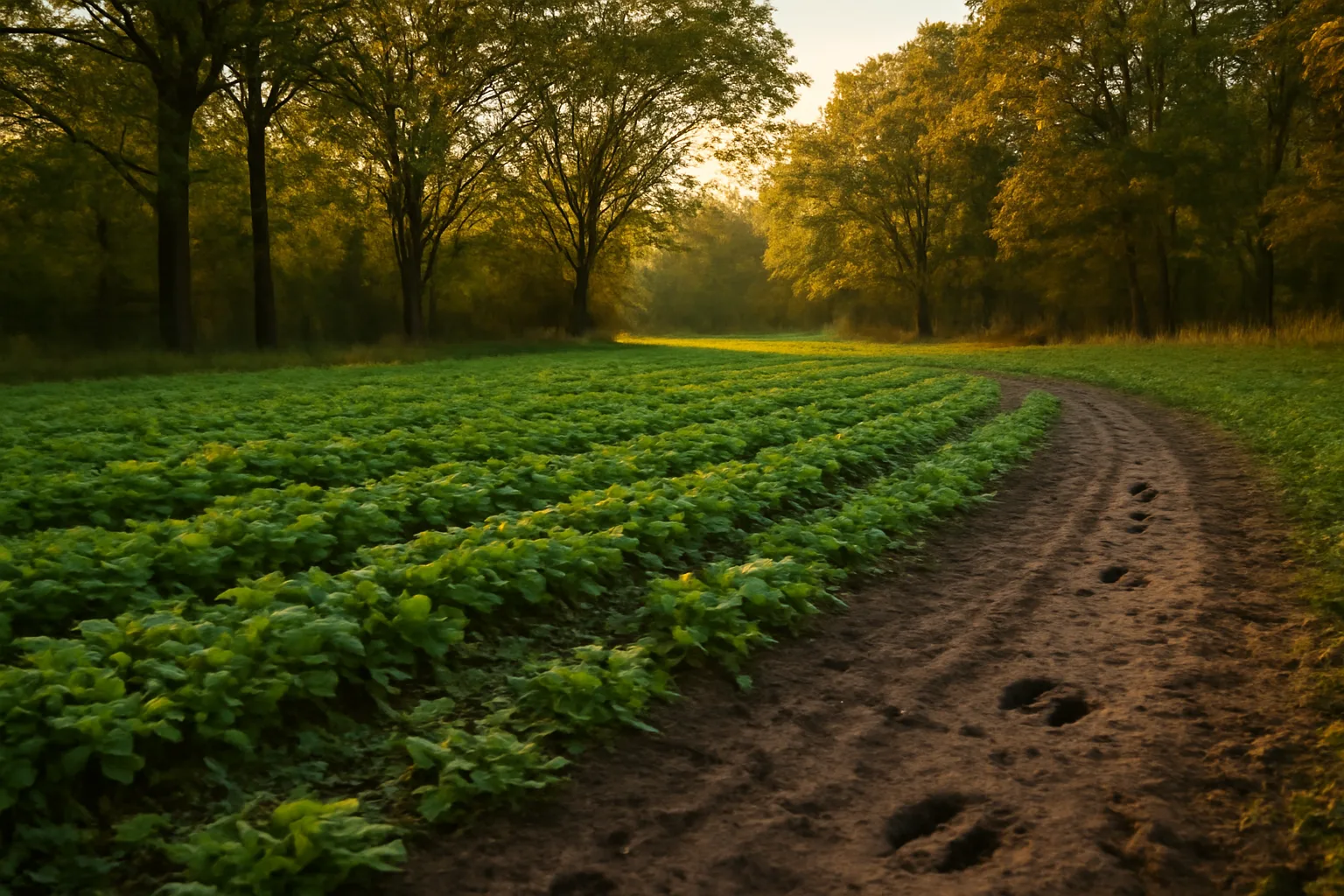
Food plot seed is any plant species (clover, brassicas, cereal grains, sorghum, beans, and mixes) planted specifically to feed deer and other wildlife or to draw them into range. Choice depends on your soil, region, and whether you want summer growth, fall attraction, or winter tonnage. Most of the country plants cool-season plots from late August through October and warm-season plots from April through June.
what is a food plot?
A food plot is a planted patch of ground, usually somewhere between a quarter acre and several acres, put in specifically to feed deer or other wildlife and to give hunters a place to watch and hunt. It's not the same as a farm field, even though the equipment and seed can overlap. A soybean field planted for grain sale is agriculture. That same soybean field planted small, in a clover-shaped opening in the timber, with a stand hung on the downwind edge, is a food plot. Food plots exist because native browse alone often can't support the deer density landowners want, especially late in the season when natural forage quality drops. Cooperative extension programs across the whitetail range treat food plots as a habitat management tool, not a magic bullet. The USDA Natural Resources Conservation Service treats food plots and wildlife plantings as one practice within a larger wildlife habitat management plan, alongside prescribed burning, timber stand improvement, and native forage management, not a standalone fix. NRCS Conservation Practice Standard 645 (Upland Wildlife Habitat Management) lists food and cover establishment as one of several tools used to meet wildlife habitat objectives on a property [1]. There are two rough categories: hunting plots (small, secluded, meant to draw a deer past a stand at the right moment) and nutrition or destination plots (larger, meant to add tonnage and support herd health through summer and winter stress periods). Good plans usually use both. For a broader breakdown of plot types and how they fit a property, see food plot whitetail.
what actually counts as food plot seed?
Food plot seed is any seed sold or selected specifically because deer (or turkey, or other game) will eat it. That covers several plant families, and none of it is exotic. Most food plot seed is the same genetics used in agriculture, just marketed and packaged for small-acreage wildlife plantings. The main categories: - Legumes: clover (red and white), alfalfa, soybeans, cowpeas, lablab
- Brassicas: turnips, radishes, rape, canola
- Cereal grains: oats, wheat, rye, triticale
- Warm-season grasses/grains: sorghum, corn, milo
- Blends: mixes combining several of the above for extended attraction or a nurse-crop effect Seed tags matter here. USDA seed labeling rules require every bag of agricultural seed sold across state lines to list germination rate, purity, noxious weed content, and the crop year tested, under the Federal Seed Act (7 U.S.C. 1551 et seq.). The Act's labeling requirements are codified in the implementing regulations at 7 CFR Part 201, which spell out exactly what has to appear on the tag [2]. A bag with 65% germination sitting on a shelf for two years is a bad buy at almost any price. Check the tag before you check the marketing photo. For a rundown of specific seed products and how to pick between them, see deer food plot seed and food plot seed.
what are deer's favorite food plot plants?
There's no single universal favorite, deer preference shifts by season, region, and what's available naturally. But research and decades of field observation point to a short list that consistently outperforms in preference trials. Clover is close to the top of that list almost everywhere it grows well. It's high in crude protein (often 20-25% on a dry matter basis depending on maturity and fertility), regrows after grazing, and deer hit it hard from spring through fall. Soybeans and cowpeas run a close second in summer, when deer need protein for antler growth and lactation. In fall, brassicas and cereal grains take over as preferred forage, partly because cold weather converts starches to sugars in turnips and radishes, making them sweeter and more palatable after a few frosts. A lot of "favorite food" answers change by pressure and abundance too. A deer herd on a property with acorns everywhere might barely touch a plot in October, then hammer it in December once mast is gone. That's normal, not a plot failure.
do deer like clover?
Yes, clover is one of the most consistently preferred food plot forages across the whitetail's range, and it's the closest thing to a default recommendation for a perennial plot. White clover (Ladino and similar varieties) and red clover both hold up well under grazing pressure and come back year after year if maintained. Clover's appeal comes down to protein and availability. It stays palatable through the growing season, tolerates mowing, and fixes its own nitrogen through root nodules, which cuts fertilizer costs over time. The University of Tennessee Extension notes that white clover "is one of the most palatable and nutritious forages available for white-tailed deer" and recommends it as a foundational species in perennial wildlife plantings when soil fertility is managed correctly [3]. The catch is soil pH. Clover struggles below a pH of about 6.0, and most food plot failures blamed on "bad seed" are actually acidic soil the clover couldn't establish in. A soil test before planting isn't optional here, it's the difference between a stand that lasts five years and one that dies in one.
do deer eat sorghum?
Yes, deer eat grain sorghum (milo), and it plays a specific role rather than a starring one. Deer will browse young sorghum shoots and eat the seed heads once they mature, but sorghum isn't typically a first-choice forage the way clover or soybeans are. Where it earns its place is as a screening and standing-grain crop for late season. Tall sorghum (often 4 to 6 feet) creates visual cover that makes deer more comfortable moving through in daylight, and left standing into winter it provides a carbohydrate source when other food is scarce. It's also more drought tolerant than corn, which matters in parts of the whitetail's range with sandy or dry soils. Some hunters plant sorghum specifically to break up sightlines around a smaller, more attractive plot, using it as a screen rather than the main draw. If your goal is pure attraction and tonnage, sorghum ranks below soybeans, corn, and brassicas in most preference studies. If your goal includes cover and late-winter standing feed, it's worth a strip.
do deer like honey?
This one needs separating into two different questions, because the phrase gets used two ways. Deer are not drawn to honey the way they are to browse. There's no meaningful field evidence or extension research showing deer seek out honey as a food source, and it's not part of any legitimate food plot seed mix. What people usually mean is "honey locust" or products branded with "honey" in the name (some commercial attractant sprays use honey or molasses as a scent/sugar carrier, not as a plot crop). Honey locust trees (Gleditsia triacanthos) do produce pods deer will eat, especially the sweet pulp inside, and that's a legitimate native browse source in some regions, distinct from planted honey itself. Bottom line: honey isn't food plot seed, and pouring honey or syrup on the ground isn't a real strategy. If you saw this searched or suggested somewhere, it's likely confusion with molasses-based mineral licks or honey locust, not an actual planting option. Also worth noting: many states regulate or ban baiting and supplemental feeding for deer, so check your state wildlife agency's current rules before using any attractant, syrup-based or otherwise, near a hunting area.
when to plant food plots for deer?
Timing splits into two windows almost everywhere in the whitetail range: a cool-season window (roughly late summer into fall) and a warm-season window (spring into early summer). Exact dates shift by region and first/last frost dates, which is why a zone-based calendar matters more than a single national date. As a rough framework: - Warm-season plots (soybeans, cowpeas, corn, sorghum, lablab): plant after your last spring frost, typically April through June depending on latitude
- Cool-season plots (clover, brassicas, cereal grains): plant roughly 60-90 days before your first fall frost, typically mid-August through October across most of the Midwest and South, sometimes into November in the Deep South The National Oceanic and Atmospheric Administration's National Centers for Environmental Information publishes freeze/frost probability data by station, giving 10%, 50%, and 90% probability dates for spring and fall frost that are far more precise for planting decisions than a generic regional guide [4]. Your local extension office also publishes frost date tables specific to your county, and that's a reliable planting trigger too.
when to plant oats for deer?
Oats go in during the cool-season window, generally late August through mid-October depending on latitude, aiming for 6 to 8 weeks of growth before a hard frost slows them down. Oats germinate fast (often within 5 to 10 days in good soil moisture) and put on visible green growth quickly, which makes them a favorite for hunters who want a plot looking good by opening weekend of archery season. In the Deep South, oats can go in as late as November and still produce usable fall and winter forage since freezes arrive later and are less severe. In the northern tier, an August planting date is safer, since oats need to get established before the ground locks up. Oats are also commonly used as a nurse crop mixed with clover. The oats grow fast and give deer something to eat while the slower clover establishes underneath, then the oats die back over winter and the clover perennial stand takes over the following spring. That combination is one of the most reliable, low-cost plot strategies out there.
when to plant turnips for deer?
Turnips, like other brassicas, go in during the same late-summer window as oats, typically 80 to 90 days before your first expected hard frost. That usually lands somewhere between late July and early September depending on region, since turnips need more total growing time than oats to bulb out. The payoff comes after frost, not before it. Turnip greens are palatable earlier, but deer often ignore the bulbs until repeated frosts convert starches to sugars, which is why turnip plots frequently see the heaviest deer use in December and January rather than October. If you plant turnips expecting an October magnet, you may be disappointed. Plant them expecting a late-season food source and they usually deliver. A common mistake is planting turnips too late, after the true 80-90 day window, which leaves undersized bulbs with little tonnage. Clemson Cooperative Extension guidance on brassica forage plots for deer recommends planting in this same late-July-to-early-September window across most of the Southeast for exactly this reason [5].
how do I choose the right food plot seed for my land?
Start with a soil test, not a seed catalog. Your local extension office or a private ag lab will tell you pH, phosphorus, potassium, and organic matter, and that report is the actual authority on what your ground needs, not a seed bag's marketing copy or a general article like this one. Lime takes months to fully adjust pH, so testing early, ideally in spring for a fall planting, gives amendments time to work. After soil, match seed to purpose. A quarter-acre bow-hunting plot tucked in timber wants something deer will hit at dusk in October, like clover, oats, or brassicas. A larger destination field wants tonnage and season-long draw, which usually means soybeans or corn in summer and a cereal grain/brassica blend in fall. Sun exposure, drainage, and equipment access matter as much as seed choice. A shade-tolerant clover blend in a plot getting four hours of sun a day will still struggle. Match the seed to the site, then the site to your goals, in that order. A $99 Custom Food Plot Plan can shortcut a lot of this by matching species and timing to your zip code, soil test numbers, and equipment on hand, though it's general guidance built from regional data, not a site visit, so your soil lab's specific lime and fertilizer recommendations still take priority. Start one at /plot-plan-builder.
single-species plots vs. blends: which is better?
| Approach | Pros | Cons | |
|---|---|---|---|
| Single species (e.g. pure clover) | Simple to manage, easy to identify problems, cheaper per acre in bulk | No backup if that species fails or gets hit hard early | |
| Blend (e.g. oats + clover + brassica) | Extends attraction across the season, nurse crop benefits, hedges against one species failing | Costs more per bag, harder to fine-tune fertilizer for mixed needs | Neither is objectively correct. Small hunting plots in wooded settings often do better with blends, since they extend the draw across archery, gun, and late season. Larger fields meant for tonnage and easy management sometimes do better as clean single-species stands, especially perennial clover or alfalfa, because they're simpler to mow, spray, and fertilize correctly. For more on choosing between destination fields, kill plots, and screening strips, deer food plots and deer for food cover the layout side of this decision in more depth. |
what mistakes ruin food plot seed before it even grows?
Planting too deep is the single most common failure. Clover and brassica seed is tiny, often needing no more than a quarter inch of soil coverage, sometimes just pressed into the surface with a cultipacker. Bury it an inch deep like you would corn and it simply won't emerge. Skipping the soil test is the second most common. Seed doesn't fail because the bag was bad, it usually fails because the pH was 5.2 and clover can't take up nutrients it needs in that range no matter how good the genetics are. Other recurring problems: planting into a weed-choked seedbed instead of spraying or tilling first, planting right before a dry spell with no rain in the forecast, and using old seed with a germination tag from three years ago. None of these are exotic mistakes. They're the boring, repeatable reasons plots fail, and avoiding them matters more than which specific seed brand you buy.
Frequently asked questions
What is a food plot, exactly?
A food plot is a small planted area, usually a quarter acre to several acres, seeded specifically to feed deer or other wildlife and to give hunters a spot to hunt over. It differs from a farm crop mainly in scale, placement, and purpose: attraction and nutrition rather than harvest for sale.
Do deer eat sorghum?
Yes. Deer browse young sorghum shoots and eat mature seed heads, though it's not usually their top preference compared to soybeans or clover. Sorghum's biggest value is as a screening crop and standing late-season food source, since its height (4-6 feet) blocks sightlines and holds up through winter.
Do deer like clover?
Yes, clover ranks among the most consistently preferred food plot forages nationwide. It offers high crude protein, regrows after grazing, and stays palatable through most of the growing season, which is why University of Tennessee Extension calls white clover one of the most palatable and nutritious forages available for white-tailed deer.
When should I plant food plots for deer?
Warm-season plots (soybeans, corn, sorghum) go in after your last spring frost, typically April through June. Cool-season plots (clover, brassicas, oats, wheat) go in roughly 60-90 days before your first fall frost, typically mid-August through October across most of the country.
Do deer like clover more than other forages?
In most preference studies and field observation, clover ranks at or near the top, especially in spring and summer, thanks to its high protein content and season-long regrowth. Deer preference does shift seasonally though, with brassicas and grains often becoming more attractive after fall frosts.
When should I plant oats for deer?
Plant oats roughly 6-8 weeks before your first fall frost, typically late August through mid-October in most regions, later in the Deep South. Oats germinate quickly, often within 5-10 days, and are commonly used as a nurse crop mixed with slower-establishing clover.
When should I plant food plots, cool-season vs warm-season?
Cool-season annuals and perennials (clover, oats, wheat, brassicas) go in late summer to early fall so they establish before frost. Warm-season annuals (soybeans, corn, sorghum) go in after the last spring frost. NOAA frost-date data and local extension frost-date tables are the most reliable triggers for exact timing.
When should I plant turnips for deer?
Plant turnips 80-90 days before your expected first hard frost, usually late July through early September depending on region. Deer often ignore turnip bulbs until repeated frosts sweeten the starches, so turnip plots tend to peak in use during December and January, not early fall.
What is a food plot used for besides feeding deer?
Beyond nutrition, food plots give hunters predictable locations to place stands, create huntable edge habitat, and can serve as screening or travel corridors when planted with tall species like sorghum. They're one tool within a broader habitat plan, not a standalone strategy.
What are deer's favorite foods in a food plot setting?
Clover and soybeans rank consistently high across most regions and seasons, with brassicas and cereal grains gaining preference after fall frost. Preferences shift by season, regional forage availability, and natural mast crops like acorns, so there's no single universal favorite.
Do deer like honey?
No, honey isn't a real food plot attractant and there's no research showing deer seek it out. The confusion usually comes from honey locust trees, whose sweet pods deer do eat, or from molasses-based mineral products, which are separate from planted food plot seed.
Is food plot seed the same as farm seed?
Often, yes, the genetics are frequently identical or very similar to agricultural varieties of soybeans, oats, and clover. Food plot seed is typically packaged and sold in smaller quantities specifically marketed for wildlife plantings, but the seed itself follows the same Federal Seed Act labeling rules as farm seed.
Do I need a soil test before choosing food plot seed?
Yes, strongly recommended. Soil pH and nutrient levels determine which species will actually establish, and your soil test lab's specific lime and fertilizer recommendations should take priority over any general planting guide, since they reflect your exact ground, not regional averages.
Sources
- USDA Natural Resources Conservation Service, Conservation Practice Standard 645, Upland Wildlife Habitat Management: Food plots and wildlife plantings function as one practice within a larger wildlife habitat management plan, alongside prescribed burning and native forage management, not a standalone fix.
- Federal Seed Act labeling requirements, 7 CFR Part 201: Agricultural seed sold in interstate commerce must be labeled with germination rate, purity, noxious weed content, and test date.
- University of Tennessee Institute of Agriculture Extension, Clover for Wildlife (SP731-C or related forage publication): White clover is one of the most palatable and nutritious forages available for white-tailed deer and is recommended as a foundational species in perennial wildlife plantings.
- NOAA National Centers for Environmental Information, Freeze/Frost Probability Data: Freeze and frost probability data by station location can be used to determine typical last spring frost and first fall frost dates for planting timing.
- Clemson Cooperative Extension, Brassicas for Deer Food Plots: Brassica seed for deer food plots should generally be planted in the late-July-to-early-September window across most of the Southeast.
- USDA Agricultural Marketing Service, Federal Seed Act overview: The Federal Seed Act (7 U.S.C. 1551 et seq.) governs labeling of agricultural seed moving in interstate commerce, including germination and purity disclosure.