Last updated 2026-07-26
TL;DR
For most of the whitetail's range, a brassica blend (turnips, radish, rape) mixed with cereal grains like oats or winter wheat gives you the best fall food plot. Clover works too but takes longer to produce tonnage. The right pick depends on your zone, soil, and how late into winter you need the plot to feed deer.
what is a food plot, exactly
A food plot is a planted area, usually somewhere between a quarter acre and a few acres, seeded with forage that deer and other wildlife will eat. That's the whole definition. It's not a garden, and it's not decoration. It's a managed piece of ground meant to put nutrition on the landscape at a time deer need it, whether that's spring green-up, summer antler growth, or the fat-and-protein scramble before winter. Most state wildlife agencies and university extension programs treat food plots as a wildlife habitat management tool, not much different from prescribed burning or timber stand improvement. Penn State Extension describes food plots as a way to "provide supplemental nutrition" for deer and other wildlife, supplementing what's already available in the woods rather than replacing it. That supplemental part matters. A one-acre plot on a 200-acre property isn't going to carry a deer herd through winter. It's a magnet and a nutrition boost, not a feedlot. Fall food plots specifically serve two jobs. First, they attract deer during hunting season, since a plot planted in something deer actively want to eat in October and November draws traffic. Second, in the northern half of the whitetail's range, fall plots carry over into a winter food source when natural browse gets scarce and snow covers everything else. Those two jobs sometimes want different plants, which is why the "best" fall plot really depends on what you're solving for. If you want to go deeper on plot categories before picking a seed, the food plot whitetail guide breaks down annuals versus perennials and the tradeoffs of each.
so what is the best fall deer food plot to plant
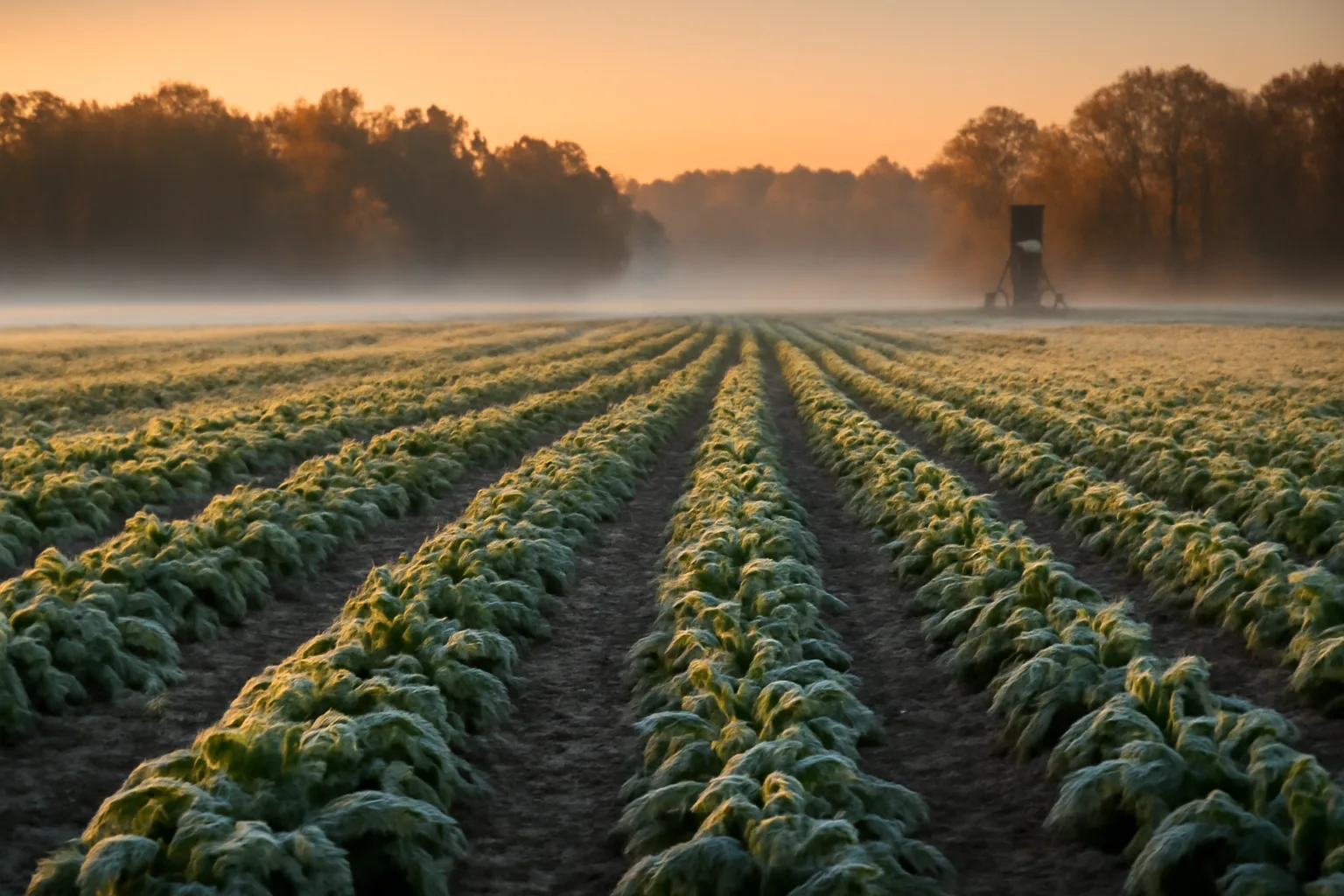
For most hunters, a brassica and cereal grain blend is the best all-around fall food plot. Something like turnips or forage radish mixed with oats or winter wheat covers early season attraction, late season volume, and cold tolerance in one planting. Here's the logic. Brassicas like turnips, radish, and rape produce a ton of tonnage per acre and actually get sweeter after a hard frost, because the plant converts starches to sugars as a cold defense. That's not folklore, it's basic plant physiology that several university extension programs describe when explaining why deer hit brassica plots harder in late November and December than in September [1]. Cereal grains like oats and wheat germinate fast, tolerate cold better than most legumes, and give you green, palatable forage while the brassica bulbs are still sizing up. Clover is the other serious contender, and it's genuinely the best food plot for total annual tonnage and protein if you're willing to wait a full season for it to establish and you're in a region with mild enough winters that it stays green. But clover is a perennial that takes real time to get going, and it's not the strongest pure fall attractant compared to a fresh brassica plot, especially once acorns are dropping and deer have other options. There's no single "best" seed that wins everywhere. Zone, soil pH, rainfall, and how long you need the plot to produce all change the answer. The rest of this article walks through those variables so you can make the call for your ground, and if you want a plan built around your specific soil test and location, that's exactly what the $99 Custom Food Plot Plan is for.
do deer like clover, and is it worth planting
Yes, deer like clover a lot, and it's one of the most studied food plot forages there is. White clover and red clover both show up constantly in whitetail diet studies as high-preference, high-protein forage, often tested at 20 to 25 percent crude protein in vegetative growth stages [2]. The catch with clover for a fall-specific plot is timing and durability. Clover is a perennial, so a plot seeded in late summer needs time to establish a root system before frost, and it won't hit full production until the following spring. Once it's established, though, a good clover stand can produce for three to five years with proper mowing and fertility upkeep, which makes it one of the better long-term investments per dollar per acre compared to replanting an annual every single year. In colder zones, clover growth slows dramatically once temperatures drop into the 40s and goes dormant under snow. That's the main reason clover alone isn't the top pick for a strict late-season fall plot in the northern tier. Hunters in the Southeast and mid-South, where winters stay milder, get a lot more mileage out of clover as a true fall and winter food source because it keeps producing longer into the season [3]. Most experienced plotters run clover as their perennial base plot and pair it with an annual brassica or grain plot elsewhere on the property for fall specifically. That combination shows up again and again in extension publications and in the deer food plots planning guides, because it spreads risk across plant types instead of betting everything on one species.
do deer eat sorghum
Yes, deer eat sorghum, both the grain heads and the leaves, but it's more of a secondary food plot crop than a primary fall attractant for most hunters. Sorghum (grain sorghum, sometimes called milo) is more commonly planted as a cover crop, a screening plant to block wind and sightlines, or as a component in a wildlife food plot blend rather than a standalone deer plot. Sorghum's real strength is drought tolerance and standing cover. It grows tall, holds up through dry summers better than corn in a lot of regions, and the grain heads that mature in fall can pull in deer along with turkey, quail, and dove. USDA NRCS lists grain sorghum among the summer annual crops suited to wildlife food plot use in warmer and drier regions, particularly the southern Great Plains and parts of the Southeast. If you're deciding between sorghum and something like corn or soybeans for a fall plot, understand that sorghum generally won't pull the same concentrated late-season deer traffic that a brassica or standing bean field does, at least based on how most food plot managers and extension agronomists rank forage preference. It's a fine screening and diversity crop. It's not the plant to build your whole fall plot strategy around.
what are a deer's favorite foods, in general
Deer are opportunistic browsers, and their favorite food changes by season, region, and what's actually available. There's no single universal favorite, but research consistently shows a short list of high-preference categories: acorns and other hard mast, legumes like clover and soybeans, and a range of soft mast (apples, persimmons, and similar fruit) rank at or near the top wherever they're studied. Acorns deserve special mention because they show up in nearly every whitetail diet study as a fall staple, sometimes making up more than 50 percent of a deer's diet by volume in good mast years, according to research summarized by the Mississippi State University Deer Lab. That's part of why a food plot next to an oak flat performs so differently than the same plot in an open field with no mast nearby. Deer will often bypass a planted plot for acorns when the acorns are dropping heavy, then swing back to the plot once mast runs out. Among planted forages, soybeans and clover routinely test as the highest-preference food plot plants in university feeding trials and camera studies, both for crude protein content and for how consistently deer select them over other options when given a choice [2]. Brassicas rank a notch below those two in early fall but climb fast in preference after the first hard frosts sweeten them up. The honest answer for "favorite food" really depends on what's on the landscape. A hunter managing 40 acres surrounded by row crop agriculture has a completely different "favorite food" problem than someone managing timber ground in the Northeast. That's a big part of what the species-and-strategy content on this site tries to sort out region by region.
do deer like honey (and does it actually attract deer)
There's no research support for the idea that honey attracts deer, and it's not a practice recommended by any wildlife agency or extension program. Deer diets are studied extensively, and sugar sources that show up in that research are natural ones like fruit, mast, and forage sugars in frosted brassicas, not honey poured on the ground or on scrapes. The honey idea seems to come from deer scent and attractant marketing, where sweet-smelling additives get pitched as attractants. But pouring actual honey in the woods runs into a bigger problem before it even gets to whether deer like it: many states classify placing food substances to attract deer as baiting, and honey would likely fall under that definition depending on how the state's baiting statute is written. Baiting and supplemental feeding rules vary enormously by state. Some states allow baiting for hunting outright, some ban it everywhere, and some ban it only in certain counties because of chronic wasting disease concerns. Michigan, for example, restricts baiting and feeding statewide in the Lower Peninsula and in specific Upper Peninsula counties as part of its CWD response, with exceptions spelled out in state regulation [4]. Wisconsin similarly bans baiting and feeding in counties where CWD has been detected [5]. Before you put out anything, honey included, check your state wildlife agency's current baiting and feeding regulations, since they change year to year and often county to county.
when to plant food plots for deer, by region
| Northern (Zones 3-4) | Late July to mid-August | Early to mid-September [6] | |
|---|---|---|---|
| Upper Midwest/Northeast (Zone 5) | Early to late August | Late September to early October [6] | |
| Transition zone (Zones 6-7) | Late August to mid-September | Mid to late October [6] | |
| Deep South (Zone 8+) | Mid-September to October | November or later [6] | Those windows are general guidance, not gospel. Your actual local frost date, soil moisture, and forecast rain matter more than a calendar date. Check your state extension office's frost date tables or the NOAA climate normals for your county before locking in a planting day [6]. |
The short answer: fall food plots generally go in the ground somewhere between late July and mid-September, and the exact window depends heavily on your USDA Plant Hardiness Zone and expected first frost date. The general rule extension agronomists use is to plant fall annuals 60 to 90 days before your area's average first frost date, giving brassicas and cereal grains enough time to establish before growth slows. In northern states (Zones 3-5), that often means planting in late July through mid-August. In the transition zone and mid-South (Zones 6-7), late August through mid-September usually works. In the Deep South (Zone 8 and warmer), you can push planting into late September or even October since frost comes much later or not at all. | Region (USDA Zone) | Typical fall plot planting window | First frost reference |
when to plant oats for deer
Oats for fall deer plots should generally go in 6 to 10 weeks before your first expected frost, which lines up with roughly August in northern states and September in the transition zone and mid-South. Oats germinate fast, often within 7 to 10 days in warm soil, and they produce palatable green forage quickly, which makes them one of the better cereal grains for early fall attraction. Oats aren't as cold-hardy as winter wheat or cereal rye. In a hard winter, straight oats can winterkill, which is fine if you only need fall and early winter production, but it means oats alone won't carry a plot into late winter the way winter wheat or rye will. Because of that, a lot of food plot mixes pair oats with a small amount of winter wheat or rye, so you get the fast early growth of oats and the winter survival of the small grain if the oats die back. Soil temperature matters more than the calendar date. Oats germinate reliably once soil temps are consistently above about 50 degrees Fahrenheit, based on general small grain planting guidance from land-grant agronomy programs. If you're planting into hot, dry August ground, don't be surprised if germination lags until a rain event cools and moistens the soil.
when to plant turnips for deer
Turnips and other brassicas should be planted 80 to 100 days before your first hard frost, since they need that much time to grow both leafy top growth and a bulb worth eating. That typically means late July to early August in the North, and mid-August to early September through the transition zone. This is one of the most common food plot planting mistakes: planting turnips too late. A turnip plot seeded in early September in a Zone 5 area might grow decent leaves but never size up a bulb before frost shuts growth down, and deer will eat the tops but skip the small or absent bulbs. Get the timing wrong and you end up with a plot that looks green in October but doesn't have the tonnage to matter in December. Brassica seed is also tiny and needs good seed-to-soil contact at a shallow depth, generally a quarter inch or less. Broadcasting onto a clean, firm seedbed and rolling or dragging it in works better than trying to drill it too deep. Deer often ignore brassica plots for the first month or two after planting, then hit them hard once frost sweetens the leaves and bulbs, which is exactly the pattern several university extension brassica trials describe [1]. Don't panic if deer aren't hammering the turnip plot in September. That's normal, not a failure.
picking between brassicas, cereal grains, and clover for your fall plot
| Fast early-fall attraction | Oats or winter wheat | |
|---|---|---|
| Late-season tonnage through winter | Brassica blend (turnips, radish, rape) | |
| Multi-year perennial base plot | White or red clover | |
| Highest protein, if acreage allows | Soybeans (several acres minimum) | |
| Screening/cover plus light forage | Grain sorghum | If you're weighing seed options directly, the deer food plot seed and food plot seed guides compare specific product-level choices in more depth. |
If you had to build one fall plot, blending a brassica (turnips or radish) with a cereal grain (oats or winter wheat) covers the most bases: early attraction from the grain, late-season tonnage and sweetness from the brassica, and decent cold tolerance from both. That's why so many commercial fall blends and extension-recommended mixes use exactly that combination [1]. Clover earns a spot as a perennial base plot rather than the primary fall plot, especially if you're willing to give up a planting season to let it establish and you're farther south where it stays productive into winter. Soybeans, where deer density and plot size allow them to survive browse pressure, are the single highest-protein fall standing crop, but they need real acreage, usually several acres minimum, or deer mow down the plants before they ever produce beans. Sorghum plays a support role, useful for screening and drought-prone ground, not a primary attractant. And skip the honey. Here's a simple way to think about it based on your main goal: | Your goal | Best fit |
soil test, pH, and why the best seed still fails on bad ground
None of this seed selection matters much if your soil pH and fertility are off. Brassicas and clover in particular are sensitive to low pH, and most university guidance recommends a soil pH between 6.0 and 7.0 for optimal nutrient uptake in food plot forages . Below that range, lime applications become the fix, and your soil test report (not a general article like this one) is the actual authority on how much lime and fertilizer your specific ground needs. A basic soil test through your county extension office typically costs somewhere in the $10 to $20 range and tells you pH, phosphorus, potassium, and organic matter, which is enough to make a real fertility decision instead of guessing. Skipping the soil test is one of the most common ways a food plot budget gets wasted, since seed cost is often the smallest line item compared to lime and fertilizer. This is also where a general article like this one has to stop and hand things off to your actual soil report. Your soil test lab is the real authority on lime and fertilizer rates for your specific field. If you want a planting plan that factors in your zone, your soil test numbers, and your acreage, that's what the $99 Custom Food Plot Plan is built to do; it's general regional guidance layered on your numbers, not a replacement for your lab's site-specific recommendation.
putting it together: a simple fall plot decision
If you only remember one thing from this article, remember this: plant a brassica-and-grain blend 80 to 100 days before your local first frost, on ground that's been soil tested and limed to somewhere near pH 6.5, and you'll have covered the majority of what makes a fall plot work in most of the whitetail's range. From there, adjust for your specific situation. Farther south, add clover as a perennial complement since it stays productive longer into winter. If you've got several open acres and low deer density, soybeans are worth the gamble for pure protein and tonnage. If you're screening a field edge or working sandy, dry ground, sorghum earns a spot in the mix even though it's not the headline attractant. The seed matters less than most marketing suggests. Soil fertility, planting timing tied to your frost date, and matching the plant to what your specific property can support matter more. Get those three right and almost any reasonable fall blend will produce.
Frequently asked questions
Do deer eat sorghum?
Yes, deer eat both sorghum grain heads and leaves, but it's usually planted as a cover or screening crop rather than a primary attractant. USDA NRCS lists grain sorghum as a summer annual suited to wildlife plots in warmer, drier regions, though it typically ranks below brassicas and soybeans for pure deer preference.
Do deer eat clover?
Yes, clover is one of the most preferred whitetail forages, testing at 20 to 25 percent crude protein in university feeding studies. It works best as a multi-year perennial base plot rather than a strict fall-only planting, since it needs time to establish and grows slower once cold weather sets in.
When should I plant deer food plots?
Fall plots generally go in 60 to 100 days before your local first frost date, which is roughly late July to mid-August in northern states and late August into September in the transition zone and mid-South. Check your county's average first frost date before locking in a planting day.
Do deer like clover more than other forages?
Deer show strong, consistent preference for clover in feeding studies, often ranking it alongside soybeans as a top choice when multiple forages are available. Preference shifts seasonally though; deer favor acorns heavily in fall mast years and brassicas more once frost sweetens them.
When should I plant oats for deer?
Plant oats 6 to 10 weeks before your first expected frost, roughly August in the North and September farther south. Oats germinate fast in warm soil but aren't very cold-hardy, so many blends pair them with winter wheat or rye for late-season survival.
When should I plant turnips for deer?
Plant turnips and other brassicas 80 to 100 days before your first hard frost so they have time to grow both leaves and a usable bulb. Planting too late is a common mistake; deer will eat the tops but the bulbs never size up.
What exactly is a food plot?
A food plot is a planted area seeded specifically to provide supplemental forage for deer and other wildlife, usually ranging from a quarter acre to several acres. Penn State Extension describes plots as supplemental nutrition, meant to add to natural browse, not replace it.
What are a deer's favorite foods overall?
There's no single universal favorite; it shifts by season and region. Acorns dominate fall diets in good mast years (sometimes over 50 percent of intake by volume), while soybeans and clover consistently rank highest among planted food plot forages in preference studies.
Do deer like honey?
There's no research supporting honey as a deer attractant, and it's not recommended by any extension program or wildlife agency. Placing food substances like honey to draw deer may also count as baiting under many state regulations, so check your state's rules first.
What's the best fall food plot if I can only plant one thing?
A brassica and cereal grain blend, like turnips or radish mixed with oats or winter wheat, is the most reliable single fall plot choice for most regions. It gives fast early attraction from the grain and heavy late-season tonnage from the brassica after frost.
Is clover better than brassicas for a fall plot?
It depends on your goal and region. Clover produces more consistently across years and stays productive longer in mild-winter climates, but brassicas usually pull harder late-season attraction in colder zones once frost sweetens the leaves and bulbs.
How much does a soil test cost before planting a food plot?
A basic soil test through most county extension offices costs around $10 to $20 and reports pH, phosphorus, potassium, and organic matter. That's enough information to set lime and fertilizer rates correctly instead of guessing, which extension programs consistently point to as the biggest factor in plot success.
Sources
- University of Tennessee Extension, Brassicas for Deer Food Plots: Brassica forage quality and palatability improves after frost due to starch-to-sugar conversion
- University of Georgia Extension, Wildlife Food Plots: Clover growth and productivity through winter in milder Southeastern climates
- Michigan Department of Natural Resources, Baiting and Feeding Regulations: Michigan restricts deer baiting and feeding statewide in the Lower Peninsula and specific Upper Peninsula counties due to CWD
- Wisconsin DNR, Baiting and Feeding Regulations: Wisconsin bans baiting and feeding in counties where CWD has been detected
- NOAA National Centers for Environmental Information, Climate Normals: First frost date averages by region used to time fall food plot planting
- University of Kentucky Extension, Establishing Wildlife Food Plots: Recommended soil pH range of 6.0 to 7.0 for optimal food plot forage nutrient uptake