Last updated 2026-07-26
TL;DR
The best food plot isn't one species, it's a mix matched to your goals and calendar. Clover and alfalfa give season-long protein, brassicas and cereal grains deliver fall and late-season energy, and soybeans work where deer density won't wipe them out first. Soil test, plant a mix, and stagger planting dates by species.
What is a food plot, exactly?
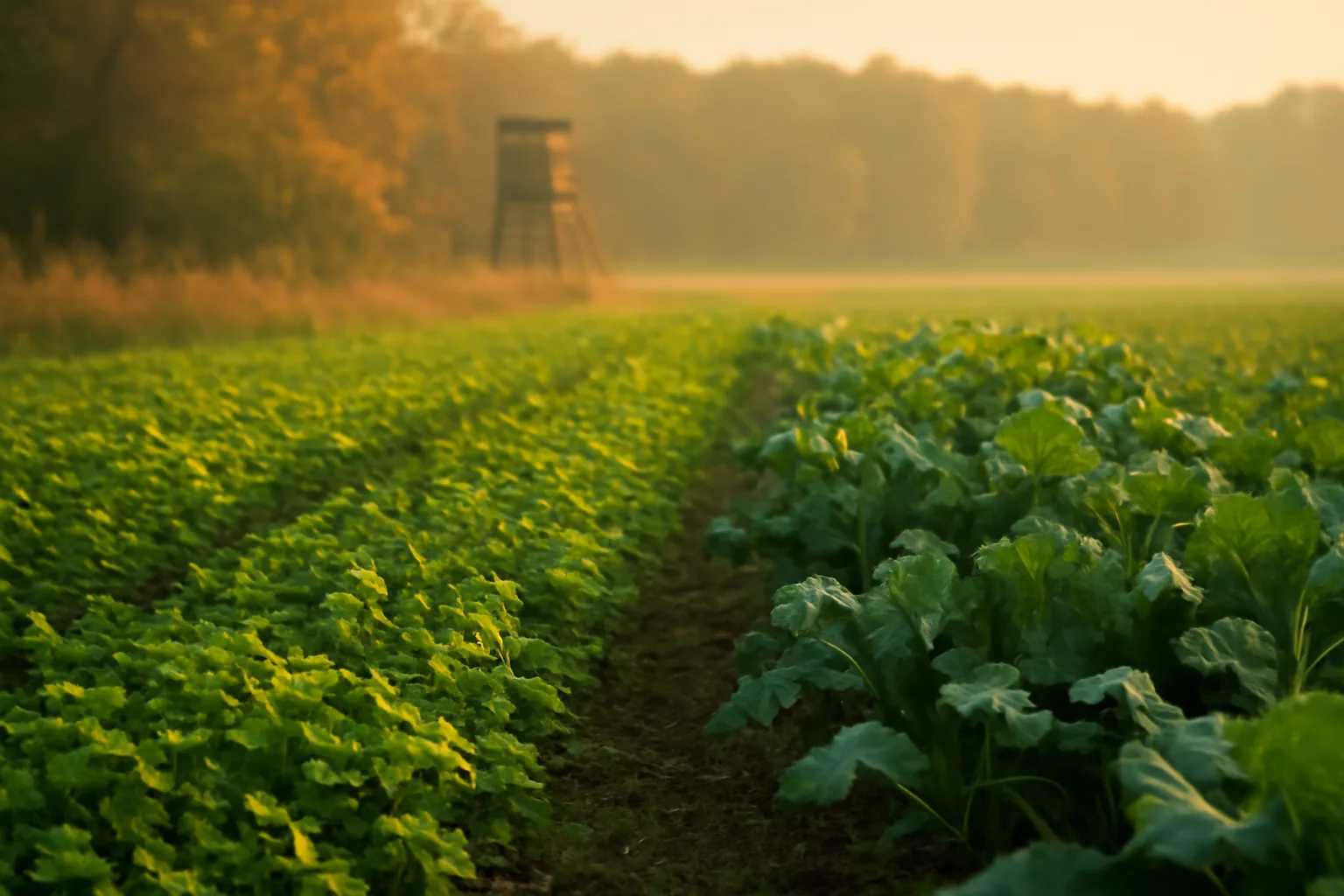
A food plot is a planted patch of forage on hunting land, built to feed deer, hold them on the property longer, and give hunters a spot to watch or hunt over. Most run anywhere from a quarter acre to several acres, though plenty of good ones are smaller. Food plots aren't a wildlife feeder and they aren't the same thing as baiting in most states, but the line matters legally. A food plot is a standing crop planted in the ground; baiting usually means piling loose grain, minerals, or feed on the surface. Rules on baiting and supplemental feeding vary a lot by state, and some states also restrict feeding because of chronic wasting disease concerns, so check your state wildlife agency's regulations before you do anything beyond planting a crop in dirt [1]. The idea behind a plot is simple: give deer a reliable, high-quality food source that beats what the surrounding woods and ag fields offer during specific windows of the year. Done right, a plot rotation covers spring green-up, summer growing season, the pre-rut into rut, and late winter stress. No single plot species covers all four windows well, which is the real answer to "what's the best food plot." It depends which window you're trying to fill. If you want a plan built around your specific acreage, soil test results, and region instead of guessing, that's exactly what a food plot whitetail plan is for.
So what is the single best food plot for whitetail deer?
| White clover / Ladino | Spring or late summer | Spring through fall | 3-5 years (perennial) |
|---|---|---|---|
| Chicory | Spring | Summer through fall | 3-5 years (perennial) |
| Soybeans | Late spring | Summer, then pods in fall | Annual |
| Brassicas (turnip, radish) | Late summer | Fall through winter (post-frost) | Annual |
| Oats | Late summer or early fall | Fall | Annual, winterkills in cold zones |
| Winter wheat / cereal rye | Fall | Fall through winter/spring | Annual (rye can be biennial-ish) |
| Sorghum (grain) | Late spring/early summer | Summer growth, fall/winter seed heads | Annual, warm-season |
If you can only plant one thing, most experienced plot managers land on a clover and chicory mix, because it's perennial, cheap to maintain, and deer hit it from spring through fall. But "best" changes by season and by region, and that's the honest answer. Clover works because it's a perennial legume that comes back year after year with just mowing and a top-dress of nitrogen or a boron/sulfur blend depending on your soil test. University of Tennessee Extension notes that white clover varieties like Durana and Ladino are among the most planted perennial forages for deer because of their tolerance to grazing pressure and their long growing window [2]. But clover alone won't get you through late season in the Midwest or Northeast when snow covers it or growth stops. That's where brassicas (turnips, radishes, rape) and cereal grains (oats, winter wheat, winter rye) come in, because they hit peak attraction in October through December when deer are keying on carbohydrates and sugars to build fat for winter. So the real best-practice answer: plant a perennial clover/chicory plot for spring-summer-fall attraction and nutrition, and plant an annual brassica or cereal grain plot for late season. If you have room for three plots, add soybeans or a warm-season annual for summer tonnage. That's the rotation most extension programs and experienced land managers point to, not a single silver-bullet seed. Table: common food plot species by primary season | Species | Best planting window | Peak attraction | Longevity |
Do deer like clover, and is it worth planting?
Yes, deer readily eat clover, and it's one of the most consistently used food plot forages across the whitetail's range. White clover and red clover both show up as preferred forage in browse studies, and clover's crude protein content, often in the 25-30% range when actively growing, makes it valuable during spring antler growth and lactation [3]. Clover's biggest advantage is the growing season length. Once established, a good clover stand feeds deer from green-up in early spring all the way into late fall, and it comes back the next year if you maintain pH and fertility. Mississippi State University Extension recommends maintaining soil pH between 6.0 and 6.5 for clover, and notes that clover stands can produce for three to five years with proper mowing and fertilization [3]. The downside: clover struggles in drought, doesn't tolerate standing water, and needs mowing two to four times a year to stay in a vegetative, high-protein state instead of going to seed and getting woody. It also gets hammered hard in high-deer-density areas. A half-acre clover plot surrounded by heavy deer pressure can get grazed down to nothing before it ever gets a chance to bounce back. If you're planting clover, plan for roughly 3 to 5 acres of plot per square mile of huntable ground as a rough starting benchmark in moderate deer density areas, though this varies enormously by region and deer numbers, and your state wildlife agency or extension office can help you calibrate for local herd density.
When should you plant food plots for deer?
Timing splits into two windows: spring/early summer for perennials and warm-season annuals, and late summer through fall for cool-season annuals. Get the window wrong and germination suffers or the plot never reaches maturity before frost or grazing pressure wipes it out. Spring plantings (roughly April through June depending on latitude) are for clover, alfalfa, chicory, soybeans, and warm-season grain crops like sorghum or corn. Soil temperature matters more than the calendar date. Most clover and chicory germinate well once soil hits the mid-50s°F, while soybeans want soil closer to 60°F and consistent frost-free conditions. Late-summer to fall plantings (roughly late July through September in northern states, into October in the South) cover brassicas, oats, winter wheat, and winter rye. These are planted specifically so they mature and peak in palatability during hunting season and into winter. Regional timing varies enough that a blanket calendar doesn't work well. A grower in Alabama and a grower in Minnesota are planting brassicas six to eight weeks apart. Cooperative extension offices publish planting date guides by state, and that's the most reliable free resource for nailing your specific window. General rule of thumb: count backward from your first expected hard frost. Brassicas need 80 to 100 days to mature and sweeten up (frost converts starches to sugars, which is why deer often hit turnips harder after the first freeze). Oats and winter wheat need less, often 60 to 90 days to reach good grazing height.
When should you plant oats for deer food plots?
Plant oats 60 to 90 days before your first expected fall frost, which usually lands in late August through mid-September across most of the whitetail's range, adjusted earlier for northern states and later for the Deep South. Oats germinate fast, often within 5 to 10 days in warm, moist soil, and put on rapid leafy growth that deer hit hard through fall. Oats are a cool-season annual cereal grain, and they're one of the most attractive early-fall food plot options because the leaves stay tender and sweet longer than wheat or rye in warmer climates. The tradeoff is cold tolerance. Oats generally winterkill once temperatures drop into the teens or lower for sustained periods, so in northern states oats give you a strong September-through-November plot and then die off, while winter wheat or cereal rye in the same plot would keep producing into winter and next spring. A lot of plot mixes blend oats with wheat, rye, and brassicas specifically to get the fast early attraction from oats plus the winter hardiness from the other cool-season grains and brassica bulbs. Iowa State University Extension's Ag Decision Maker guidance covers oats among common small grain options for wildlife plantings, noting quick establishment and strong early palatability [4].
When should you plant turnips for deer?
Plant turnips 80 to 100 days before your first expected hard frost, typically late July through August in most of the Midwest and Northeast, and into early September in the South. Turnips need that long runway because the real payoff, the bulb, needs time to size up, and the plant needs a frost or two to convert starches to sugar and become genuinely sweet to deer. Here's the pattern hunters see constantly and get confused by: deer often ignore turnips completely in October, then hammer the tops and dig up bulbs in December and January. That's not a fluke. Frost triggers a starch-to-sugar conversion in brassica bulbs and leaves, and deer preference shifts hard toward turnips exactly when other food sources (acorns, ag fields, green browse) are drying up or getting picked clean. This makes turnips one of the best late-season food plot options, not an early-season draw. Soil needs a pH close to 6.0 to 7.0 for good brassica growth, and turnips are nitrogen-hungry, so a soil test matters more here than with almost any other plot species; under-fertilized brassica plots produce small, weak bulbs that don't deliver the tonnage you're expecting. If you've got a soil test in hand already, that's the single best piece of information for dialing in a turnip plot, better than any generic seed bag instructions.
Do deer eat sorghum?
Yes, deer eat both the grain heads and the young green growth of sorghum, and it's planted as a summer food plot option in warmer regions, though it's more commonly known as a dove field and deer/turkey attractant combo crop than a dedicated deer plot staple. Grain sorghum (milo) produces seed heads deer and other wildlife feed on into fall and winter once the heads mature and dry down. Sorghum is a warm-season annual, drought-tolerant, and it grows well in soils that struggle to support clover or soybeans, which makes it a decent option in sandier or drier Southern Plains ground. Texas A&M AgriLife Extension's grain sorghum production guidance covers the crop's drought tolerance relative to corn, a trait that carries over to its use in wildlife plantings [5]. The catch: sorghum isn't a preferred forage the way soybeans, clover, or brassicas are. Deer will eat it, especially once the grain matures and other food gets scarce, but it's rarely the plot deer beeline to first when better options are nearby. Most plot managers use sorghum as a secondary or dove-field crop rather than a primary deer attractant, or blend it into a diverse summer plot rather than planting it as a monoculture.
What are deer's favorite foods, on a food plot or otherwise?
Deer are opportunistic browsers, and their favorite foods shift with the season and with whatever's most digestible and available. In spring and summer that's often forbs, soft browse, and high-protein legumes like clover and soybeans. In fall, acorns and other mast often out-compete anything you plant, and in late winter it's whatever still has calories left, woody browse, brassica bulbs, waste grain. Acorns deserve a callout because they beat almost every food plot crop when they're on the ground. White oak acorns in particular are lower in tannin and higher in palatability than red oak acorns, and in years with a strong mast crop, deer will often abandon food plots for standing timber. Among planted crops, soybeans are frequently cited as one of the most preferred food plot species where deer density allows a stand to survive, both for the leafy summer growth (high protein, often 25-30% crude protein in vegetative stage) and the pods that persist into fall and winter as a dense energy source. The tradeoff is that soybeans get destroyed by browsing pressure in small plots; a half-acre bean plot in a high-density area can get grazed to stubble by July. Bottom line on "favorite food": there isn't one universal answer, because it depends on the region, the season, and what's competing with your plot that year. That's exactly why experienced managers diversify; a mix of deer food plot seed species spreads your risk across weather, deer pressure, and timing instead of betting everything on one crop.
Do deer like honey, or anything sweet, and does that matter for plots?
Deer don't seek out honey the way people imagine, but the underlying idea, that deer are drawn to sugar and carbohydrates, especially in fall and winter, is accurate and it's the whole mechanism behind late-season brassica and cereal grain attraction. Deer aren't raiding beehives, but they absolutely respond to increased sugar content in forage. This is the same biology behind why frosted turnips or frost-sweetened brassica tops suddenly become a magnet in December. Cold temperatures trigger plants to convert stored starches into simple sugars as a natural antifreeze mechanism, and deer key in on that sugar spike hard. It's less "deer like sweet things" in an abstract sense and more "deer need calories and sugar-converted starches are an efficient, palatable calorie source right when natural browse quality is dropping." There's no legitimate research suggesting deer forage for honey in the wild, and using honey, syrup, or sugar products to attract deer crosses straight into baiting in states that regulate it, which is a different legal category from a standing food plot in most states' codes. Check your state wildlife agency's specific baiting and feeding definitions before adding any supplemental attractant to a plot [1].
How do you decide what to plant, plot by plot?
Start with your soil test, then match species to your goal for that specific plot (spring nutrition, fall hunting draw, or late-season food source), then check your region's realistic planting windows before you buy seed. Your soil test is the actual authority here, not a seed bag or a blog post, including this one. Lime and fertilizer recommendations depend on your specific pH, phosphorus, and potassium levels, and your test provider (state extension lab or a private ag lab) will give exact application rates for your dirt. Most state extension soil labs run $10 to $20 per sample and turn results around in one to two weeks [6]. Once you know your soil chemistry, match species to purpose: - Spring/summer nutrition and antler growth: clover, chicory, alfalfa
- Fall hunting draw plots: brassicas, oats, winter wheat blends
- Late-season food source: turnips, radishes, cereal rye (all improve after frost)
- High-tonnage summer feed where deer density allows: soybeans, cowpeas
- Drought-prone or sandy ground: sorghum, cowpeas, or drought-tolerant clover varieties If you're staring at a soil test result and a seed catalog and not sure how to turn that into an actual planting plan for your specific acreage, that's the exact gap a Custom Food Plot Plan is built to close, a $99 one-time plan mapped to your soil test, region, and goals instead of generic bag instructions. It won't replace your soil lab's lime and fertilizer recommendations, and nobody can promise deer activity or a harvest, but it does turn raw data into a planting calendar.
What equipment do you actually need to plant a good plot?
At minimum you need a way to kill or clear existing vegetation, a way to work the seedbed, a way to broadcast or drill seed, and a way to pack it in for seed-to-soil contact. You don't need a $40,000 tractor to grow a good plot, but you do need those four steps covered. Small plots (under an acre) are commonly worked with an ATV/UTV, a pull-behind disc or harrow, a broadcast spreader, and a cultipacker or drag. Larger operations often step up to a compact tractor with a disc, no-till drill, and a boom sprayer for herbicide burndown ahead of planting. Many brassica and clover failures trace back to poor seed-to-soil contact, not bad seed or bad timing. Small seeds like clover and brassica need to be pressed into the top quarter-inch of soil, not buried. A cultipacker before and after broadcasting solves this cheaply. If you're weighing what to buy first versus what to rent or borrow, that decision usually comes down to how many plots you're running and how often, which is a separate equipment-and-methods conversation from species selection, but it directly affects which species are realistic for your setup. A no-till drill, for example, opens up planting into standing cover crops without a full tillage pass.
Frequently asked questions
What is the best all-around food plot for whitetail deer?
There isn't one perfect species. A clover/chicory perennial mix gives the longest season of use (spring through fall), while brassicas and cereal grains cover late season. Most experienced managers plant both types across different plots rather than picking a single best food plot.
Do deer eat sorghum in food plots?
Yes, deer eat sorghum grain heads and young growth, and it's a drought-tolerant warm-season option, especially in Texas and the Southern Plains. It's not typically a top-preference forage compared to soybeans or clover, so it's more often used as a secondary crop or dove-field combo.
Do deer like clover, and how long does a clover plot last?
Yes, clover is one of the most reliably eaten food plot forages, with crude protein often 25-30% during active growth. A well-maintained white or Ladino clover stand can produce for 3 to 5 years with mowing and periodic fertilization, per Mississippi State University Extension guidance.
When is the best time to plant food plots for deer overall?
Spring (April through June) for perennials, soybeans, and warm-season crops; late summer through fall (late July through September, later in the South) for brassicas, oats, and winter wheat. Exact timing depends on your first frost date, so check your state extension's regional planting calendar.
When should you plant oats for a deer food plot?
Plant oats 60 to 90 days before your area's first expected fall frost, generally late August through mid-September in most whitetail range. Oats germinate fast and give strong early-fall attraction, but they usually winterkill in sustained cold, so pair them with wheat or rye for winter-long coverage.
When should you plant turnips for deer?
Plant turnips 80 to 100 days before your first hard frost, typically late July through August in the Midwest and Northeast, early September in the South. Turnips need that runway to bulb up, and frost converts their starches to sugar, which is why deer often prefer them most in December and January.
Do deer like clover more than soybeans?
Both rank as top-tier food plot forages, and preference often comes down to what's available and the season. Clover offers season-long, lower-maintenance protein; soybeans deliver more total tonnage and fall pod energy but need larger acreage to survive heavy browsing pressure.
What is a food plot, in plain terms?
A food plot is a planted patch of forage, usually clover, brassicas, grains, or beans, established specifically to feed deer and attract them to a piece of land. It differs legally from baiting, which typically involves piling loose feed on the ground; baiting rules vary by state.
What are deer's favorite foods when acorns are available?
Acorns, especially white oak acorns, often out-compete planted food plots when a strong mast crop is on the ground, because they're lower in tannins and higher in fat than red oak acorns. Deer will frequently abandon plots for timber during a heavy acorn drop.
Do deer actually like honey or sweet food attractants?
Deer don't seek out honey specifically, but they do respond strongly to sugar, which is why frost-sweetened brassicas and cereal grains become highly attractive in late fall and winter. Using honey, syrup, or similar sweeteners as an attractant can qualify as baiting in states that regulate it.
How big should a deer food plot be?
There's no single right size; quarter-acre plots work fine in low-pressure areas or as hunting-specific kill plots, while destination or nutrition plots often run one to five acres or more. Deer density, plot purpose, and available acreage all factor in more than a fixed rule.
Do I need a soil test before planting a food plot?
Yes, strongly recommended. Most plot failures trace back to wrong pH or missing nutrients rather than bad seed. A soil test, usually $10 to $20 through a state extension lab, tells you exact lime and fertilizer needs instead of guessing from a seed bag label.
Sources
- Michigan Department of Natural Resources, Baiting and Feeding Wildlife Order: Baiting and feeding regulations for deer vary by state and are separate from food plot planting
- University of Tennessee Institute of Agriculture Extension, Wildlife Food Plots publication (SP731): White clover varieties are among the most planted perennial forages for deer food plots due to grazing tolerance
- Mississippi State University Extension, Publication 2111, Wildlife Food Plots: Establishment and Management: Clover crude protein content and its role in spring/summer deer nutrition
- Iowa State University Extension and Outreach, Ag Decision Maker, Oats (File A1-16): Oats are commonly used in fall wildlife food plots due to fast establishment and strong fall palatability
- Texas A&M AgriLife Extension, Grain Sorghum Production in Texas: Grain sorghum is used as a wildlife food plot option valued for drought tolerance in Texas
- USDA Forest Service, Southern Research Station, General Technical Report SRS-247, Oak Regeneration and Mast Production: Acorn mast availability affects deer use of food plots and browse patterns during fall
- University of Missouri Extension, publication G9110, Soil Testing: Typical cost range and turnaround time for state extension soil test services