Last updated 2026-07-26
TL;DR
Spring food plots work best with perennial clover, chicory, and warm-season annuals like soybeans or forage sorghum planted after your last frost date. Skip brassicas and oats now; those are fall crops. Test soil first, plant clover 4-6 weeks before last frost, and hold beans until soil hits 60-65°F.
what is a food plot, exactly
A food plot is a planted patch of forage on hunting or wildlife ground, meant to feed deer (and often other game) while giving hunters a predictable spot to observe or hunt over. It's not the same as a garden or a farm field, though the agronomy overlaps a lot. Size ranges from quarter-acre kill plots tucked in timber to multi-acre destination fields meant to hold deer through a whole season. The basic idea goes back to farm wildlife management practices that predate the modern hunting industry, but it got popularized as a distinct hobby/industry in the 1980s and 90s. Land-grant universities now treat food plots as a legitimate wildlife habitat tool. Extension wildlife programs generally describe food plots as plantings established to provide supplemental forage for deer and other wildlife, not to replace natural browse [1]. That supplemental part matters. A food plot is not a substitute for real habitat, bedding cover, and natural browse. It's an addition. Extension biologists at multiple land-grant schools generally recommend plots cover somewhere around 1 to 5% of total property acreage for deer, with more emphasis on quality and diversity than raw square footage. Check your state's rules before you plant anything. Some states classify certain food plot practices as baiting or supplemental feeding once deer season opens, and the definitions vary a lot by state and even by public/private land. Your state wildlife agency's hunting regulations page is the only source that matters here, not a forum thread.
when to plant food plots for deer (spring vs fall)
| Deep South (Zone 8-9) | Feb-March | April-May | April-May | |
|---|---|---|---|---|
| Mid-South (Zone 7) | March-April | May | May | |
| Midwest/Mid-Atlantic (Zone 6) | April-May | Late May-early June | Late May-June | |
| Upper Midwest/North (Zone 4-5) | April-May | Late May-June | June | Those zone bands follow the USDA Plant Hardiness Zone Map framework [2], though food plot timing tracks soil temperature and frost-free dates more directly than hardiness zone alone. Your state's cooperative extension planting guide is worth pulling up before you buy seed. |
Spring food plots and fall food plots are different projects with different goals, and mixing up the timing is the single most common mistake new plotters make. Spring plantings are almost always about growing season-long forage, building soil, or getting a perennial established before summer heat. Fall plantings are about timing tonnage to hunting season. Spring planting windows run from your local last frost date through late May or early June, depending on species and latitude. Perennial clovers and chicory get planted early spring, often 4 to 6 weeks before your last frost, so the frost-tolerant seedlings can establish before summer stress hits. Warm-season annuals like soybeans, cowpeas, and forage sorghum need soil to warm up first, generally 60°F or warmer at planting depth, so those go in after frost risk passes, sometimes not until May or even June in northern states. Here's a rough national framework, though your county extension office has the actual dates for your zip code: | Region | Clover/chicory | Soybeans/cowpeas | Forage sorghum |
which food plot species actually work in spring
Spring plot species split into two groups: perennials you're establishing for years of forage, and warm-season annuals you're planting for tonnage through summer and into early fall. Clover (white clover, red clover, and blends) is the default spring perennial for a reason. It's cheap, it fixes its own nitrogen, and deer hit it hard from green-up through frost. University extension forage programs note that well-managed clover food plots can persist 3 to 5 years with proper mowing and periodic reseeding, making it one of the better costs-per-year options in the plot lineup [3]. Chicory is often blended with clover. It's deep-rooted, drought-tolerant, and holds up better than clover alone in a dry July. Soybeans and cowpeas are the warm-season workhorses for anyone with acreage and equipment to plant a real annual field. Soybeans need real acreage (2+ acres minimum in most cases) because deer will hammer small plots down to nothing before the plants ever get tall enough to produce pods. If you're working a small plot under an acre, beans usually aren't worth the seed cost; the deer eat the whole thing at the cotyledon stage. Forage sorghum and grain sorghum work as a warm-season option too, especially in the South and in drought-prone soils where corn struggles. More on that below since it's one of the most asked-about spring species.
do deer eat sorghum
Yes, deer eat sorghum, both the grain heads and the leafy forage, and it's a legitimate warm-season food plot option, especially in the South and Midwest. Grain sorghum (milo) produces a seed head deer will feed on into fall and winter, similar to how they use standing corn. Forage sorghum and sorghum-sudangrass hybrids are grown more for bulk green forage and cover than for grain. Sorghum's real advantage is drought tolerance. It handles dry, sandy, or heat-stressed ground better than corn does, and it costs less per acre in seed. The tradeoff is that sorghum doesn't have the same reputation as a pure deer magnet that corn or soybeans have; deer will eat it, but it's often planted as a drought-insurance crop or a cover/screening plant more than a primary attractant. If you're choosing between corn and sorghum on marginal soil with no irrigation, sorghum is usually the safer bet. On good bottomland with normal rainfall, corn or soybeans will usually out-produce it in tonnage deer actually prefer.
do deer eat clover, and do they actually like it
Yes. Clover is one of the most consistently preferred forages in the whitetail diet across nearly every region deer researchers have studied, and it's often the first plant deer key in on when a new plot greens up. Multiple state wildlife agencies and university extension programs list clover among the top food plot recommendations for exactly this reason. The preference isn't just anecdotal. Clover runs high in crude protein, typically 25-30% in actively growing white clover, which matters most in spring and summer when does are lactating and bucks are growing antlers [4]. That protein window lines up almost perfectly with the spring planting season, which is part of why clover dominates spring plot recommendations. The catch: clover needs decent soil pH to perform. Most clover species want soil pH in the 6.0 to 7.0 range, and Extension soil labs routinely find food plot ground running well below that, especially on acidic timber soils in the Southeast and Appalachians. If your soil test comes back at 5.2, clover will survive but it won't produce anything close to its potential until lime brings that pH up. This is where a soil test earns its $10 to $20 cost many times over before you spend money on seed.
when to plant oats for deer (and why that's mostly a fall question)
Oats are planted in late summer to early fall for deer food plots, generally August through October depending on region, not in spring. Oats are a cool-season annual that deer hit hard in fall and into winter while the plant is young and tender; they don't handle summer heat and typically die back or bolt to seed once temperatures climb, so a spring-planted oat crop gives you a short window of use before it's done. Some plotters do plant a spring oat crop specifically as a fast-growing nurse crop or quick cover while a perennial clover establishes underneath it. That's a legitimate technique. Oats germinate fast, shade out some weed competition, and get grazed off or mowed once the clover takes hold. But if your goal is a standalone spring food source, oats aren't the right tool; save the seed for your fall planting instead. Oats are classified agronomically as a cool-season cereal grain, and most Midwest agronomy guides place their best forage and cover crop use in the fall window rather than as a standalone spring planting [5].
when to plant turnips for deer
Turnips get planted in late summer, typically July through early September depending on your frost date, not in spring. Turnips (and other brassicas like radishes and rape) need 60 to 90 days to bulb up and reach peak palatability, and that palatability actually improves after a hard frost, which converts starches to sugars in the bulb and leaf tissue. Planting turnips in spring wastes the crop; deer generally ignore turnip foliage in summer heat, and the plant will bolt and go to seed before it ever bulbs properly. If you want a brassica option to plant right now in spring, you're mostly out of luck. Brassicas are a fall-and-winter food source by design, timed to hit peak sugar content right when hunting season and the late-winter food gap both need it most. University extension forage guidance generally places brassica plantings in the same late-summer window as other fall annuals, specifically because of that frost-triggered sugar conversion . So if your spring plot planning includes turnips, shift that seed bag to your calendar for July or August instead, and use one of the true spring species covered above for right now.
what are deer's favorite foods, and does that change by season
Deer preference shifts by season, and no single plant tops the list year-round. In spring and summer, deer key in on high-protein forages: clover, soybeans (as a growing plant, more than the bean), alfalfa, and natural browse like new leaf growth and forbs. In fall, acorns often become the dominant preferred food where oaks are present, sometimes pulling deer completely off food plots for weeks at a time. In late winter, deer shift to whatever's left standing and calorie-dense: standing corn, brassica bulbs, and woody browse. Acorns deserve a specific mention because they routinely beat food plots in deer preference studies during fall mast years. This is genuinely frustrating for plot managers who spend money and effort on a fall plot only to watch deer disappear into the timber during a heavy acorn drop. It's not a plot failure; it's just deer being deer. Protein and energy needs also change with the deer's biology. Lactating does in late spring and bucks growing antlers need more protein, which is exactly why clover's 25-30% crude protein content matters so much in that window [4]. In fall, deer shift toward energy-dense carbs (corn, acorns, soybeans as dry grain) to build fat reserves before winter. There's no universal 'favorite' because deer are opportunistic browsers responding to what's available, what's most nutritious for their current life stage, and what's easiest to access without exposing them to predation risk.
do deer like honey
This one usually comes up because of 'honeysuckle,' not actual honey, and it's worth clearing up since it gets searched a lot. Deer don't eat honey; it's not part of their diet and isn't something they forage for in the wild. What deer do eat heavily is Japanese honeysuckle (Lonicera japonica), an invasive vine that deer browse year-round, especially in winter when other green forage is scarce. If someone's asking about honey specifically, it's not a food plot species and doesn't belong in a planting plan. If they mean honeysuckle, that's a wild browse plant, not something you'd typically seed into a food plot, though its presence on a property is a decent sign of accessible winter browse for deer already living there.
how do you actually plan a spring food plot from scratch
Start with a soil test, not a seed bag. Pull soil from 6 to 8 spots across the plot at a 4 to 6 inch depth, mix it in a clean bucket, and send a sample to your state land-grant extension lab or a private ag lab. Most state extension soil labs charge somewhere in the $10 to $20 range per sample and turn results around in one to two weeks . That report tells you your exact lime and fertilizer needs; it is the actual authority here, not a general article like this one. Once you know your pH and nutrient levels, match species to what your soil and equipment can realistically support. A no-till drill opens up options a broadcast-and-cultipack setup can't handle well, particularly for beans and sorghum planted at depth. If you're broadcasting into a disked seedbed with a cultipacker behind an ATV, clover, chicory, and small grains are the more forgiving choices. Then build a real calendar: what goes in this spring, what goes in this fall, and how the plot rotates over multiple years. A one-acre clover plot planted this April can run 3 to 5 years before it needs full renovation [3]. A soybean plot is an annual reset every single year. Mixing perennial and annual plots across a property spreads out labor and risk if one crop has a bad year. If you want a starting point without guessing at species and rates for your specific soil test numbers, PlotSeason's $99 Custom Food Plot Plan builds a general planting plan around your soil test, region, and equipment, though your soil lab's specific lime and fertilizer recommendations should always take precedence over any general plan, ours included.
what equipment do you actually need for a spring planting
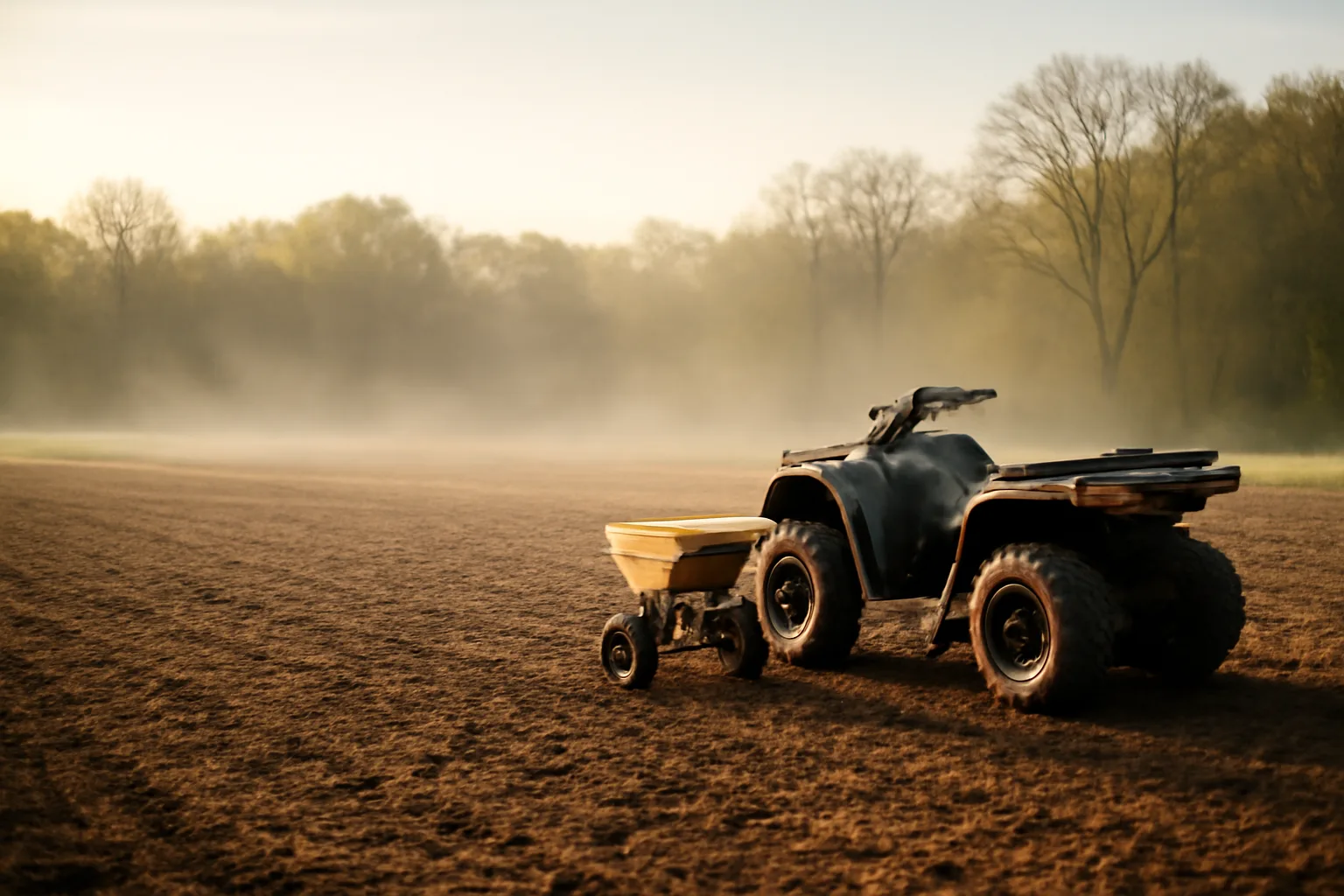
Minimum viable setup is a soil test, a way to kill existing vegetation or till it under, a broadcast spreader, and a way to firm the seed into contact with soil (a cultipacker, a drag, or even ATV tires in a pinch). That's genuinely enough to plant clover or chicory successfully on a small plot. For annuals like soybeans, corn, or sorghum, planting depth control matters a lot more, and a no-till drill or planter earns its cost fast if you're doing more than an acre or two. Renting or borrowing one from a co-op, a farm equipment dealer, or a hunting club is common and often cheaper than buying, especially for a first season. Don't skip a good sprayer if you're dealing with existing weed pressure or sod. A 15 to 25 gallon ATV or UTV sprayer with a boom or wand covers most food plot sizes without needing tractor-scale equipment. Related reading if you're still deciding what to plant this spring: check out guides on food plot whitetail species selection, a broader look at deer food plots strategy, specifics on deer food plot seed blends, and general food plot seed options if you're comparing brands and mixes before you buy.
Frequently asked questions
Do deer eat sorghum food plots?
Yes. Deer eat both grain sorghum heads and forage sorghum leaves, and it's a solid drought-tolerant warm-season option, especially in the South. It's not usually considered as strong a deer magnet as corn or soybeans, but it costs less and handles dry, marginal soil far better than either.
Do deer eat clover, and is it worth planting?
Yes, clover is one of the most consistently preferred whitetail forages, and it's the top spring perennial recommendation from most state extension programs. White and red clover run 25-30% crude protein when actively growing, which matters most for lactating does and antler-growing bucks in spring and summer.
When should I plant food plots for deer?
Spring plots (clover, chicory, soybeans, sorghum) go in from your last frost date through late May or June depending on species and region. Fall plots (brassicas, oats, cereal grains) go in July through October. Check your county extension office for exact frost dates and soil temperature thresholds for your zip code.
Do deer like clover more than other food plot options?
Deer show strong, consistent preference for clover in spring and summer specifically, though acorns often outcompete any food plot species during a heavy fall mast year. Clover's high protein content lines up with spring/summer nutritional demands, which is a big part of why it tests so well in preference studies during that window.
When do you plant oats for deer food plots?
Oats go in late summer to early fall, typically August through October, as a cool-season annual deer forage. Oats don't handle summer heat well and aren't a good standalone spring crop; some plotters use spring-planted oats only as a fast nurse crop to protect an establishing clover stand, not as a food source itself.
When do you plant turnips for deer food plots?
Turnips go in late summer, generally July through early September, not spring. They need 60-90 days to bulb, and a hard frost improves palatability by converting starches to sugars in the bulb and leaves. A spring-planted turnip crop will bolt to seed before bulbing and deer largely ignore the foliage in summer heat.
What is a food plot exactly?
A food plot is a planted area on hunting or wildlife land meant to supplement natural forage for deer and other wildlife, while giving hunters a predictable place to observe or hunt. It's a supplement to natural habitat and browse, not a replacement, and most extension programs recommend it cover roughly 1-5% of total property acreage.
What is a deer's favorite food overall?
There's no single favorite; preference shifts by season. Spring and summer favor high-protein forages like clover and soybeans. Fall often shifts to acorns where oaks are present, sometimes pulling deer off food plots entirely during a heavy mast year. Late winter favors energy-dense foods like standing corn and frosted brassica bulbs.
Do deer eat honey or honeysuckle?
Deer don't eat honey; it isn't part of their diet. The mix-up usually comes from Japanese honeysuckle, an invasive vine deer browse heavily, especially in winter. Honeysuckle isn't a food plot species you'd plant, but its presence on a property signals accessible wild browse deer are already using.
How big should a spring food plot be?
Most extension wildlife biologists suggest food plots cover roughly 1-5% of total property acreage, prioritizing plot diversity and quality over raw size. Soybean plots specifically need at least 1-2 acres minimum in most cases, since deer will graze small bean plots down before the plants ever mature past the seedling stage.
Can I plant clover and soybeans in the same spring plot?
Not in the same footprint effectively; they have different roles. Clover is a perennial best planted alone or with chicory in its own plot, run for 3-5 years. Soybeans are an annual that needs 2+ acres of dedicated space to survive early browsing pressure. Many properties run both, in separate plots.
Is it too late to plant a food plot in June?
Not necessarily. Warm-season annuals like soybeans, cowpeas, and sorghum can still go in through early-to-mid June in most regions, especially in the South and Midwest. Clover establishment gets riskier in June heat without irrigation; if you missed the early spring window, consider waiting for a late-summer planting instead.
Sources
- University of Missouri Extension, Food Plots for Deer and Other Wildlife: Definition of food plots as supplemental wildlife forage plantings
- University of Georgia Extension, Establishing and Managing Wildlife Food Plots: Clover food plots can persist 3 to 5 years with maintenance
- Noble Research Institute, Clover for Wildlife Food Plots: Crude protein content of actively growing white clover
- Oklahoma State University Extension, Small Grains Forage: Oats classified as a cool-season cereal grain suited to fall forage use
- University of Georgia Extension, Brassica Forages: Brassica plantings timed for late summer with frost improving palatability