Last updated 2026-07-25
TL;DR
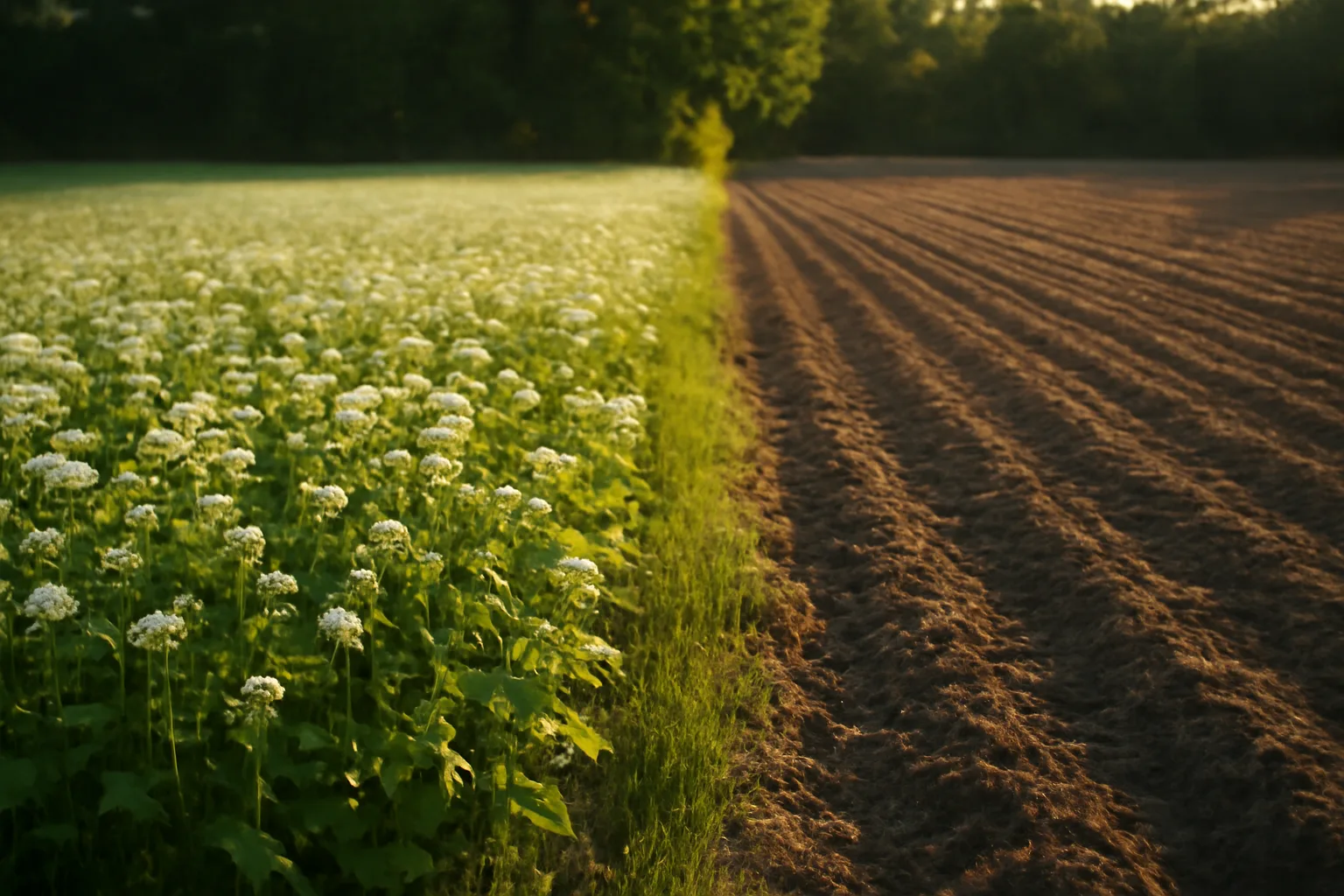
Buckwheat is a fast, cheap summer annual that germinates in days and matures in 70-90 days. Deer will browse the tender growth and forage on the seed once it drops, but it's not a preferred forage like clover or brassicas. Most hunters use it as a soil builder or nurse crop ahead of a fall planting, not as a standalone destination plot.
What is a food plot, and where does buckwheat fit in?
A food plot is a planted area on hunting land, usually somewhere between a quarter acre and several acres, designed to give deer and other wildlife a concentrated food source and give hunters a place to observe or hunt over. Plots range from small kill plots tucked into timber to large field-scale plantings meant to hold deer on a property through fall and winter. Buckwheat (Fagopyrum esculentum) is a broadleaf summer annual, not a grain in the wheat family despite the name. It's related to rhubarb and sorrel. Land-grant extension programs classify it as a warm-season smother crop and soil builder rather than a primary wildlife forage [1]. In a food plot rotation, buckwheat usually plays a supporting role. It's planted in late spring or early summer, grows fast enough to choke out weeds, and gets terminated or mowed before a fall seeding of clover, brassicas, or a cereal grain blend. Some hunters do plant it as a standalone summer plot for turkeys and deer, since the small black seeds are readily eaten by upland birds and deer will nibble the foliage, but it's rarely anyone's top choice when better summer options like soybeans or forage sorghum are available.
Do deer eat buckwheat, and how much do they like it?
Yes, deer will eat buckwheat, but it's considered a secondary forage rather than a preferred one. Deer browse the young leaves and stems readily in the first few weeks after emergence, and they'll clean up the seed once plants mature and drop grain in late summer. Purdue Extension notes buckwheat is used more as a quick cover and soil-improving crop in wildlife plantings than as a primary attractant [2]. Compared to soybeans, which whitetail research consistently ranks among the highest-preference summer forages, buckwheat is a step down. A widely cited Mississippi State University deer nutrition summary lists soybeans, cowpeas, and lablab as top-tier warm-season plantings for protein and palatability, with buckwheat mentioned mainly for its fast cover and pollinator value [3]. Where buckwheat earns its keep is speed. It germinates in 3 to 5 days and can flower within a month. If you need something green fast to cover bare dirt, suppress weeds, or bridge a gap between plantings, nothing beats it for turnaround time.
When to plant food plots for deer in general
Timing depends on whether you're planting a warm-season summer plot or a cool-season fall plot, and both depend heavily on your last and first frost dates. Most food plot calendars split the year into two windows: spring/early summer for warm-season annuals (soybeans, cowpeas, sorghum, buckwheat) and late summer/early fall for cool-season plantings (clover, brassicas, cereal grains). As a rough national guide, warm-season plots go in after soil temperatures hit the mid-60s and frost risk has passed, generally April in the Deep South, May in the mid-South and lower Midwest, and late May into June in the northern tier. Cool-season plots go in 6 to 10 weeks before your average first fall frost so plants have time to establish before growth slows. Your local NRCS office or state extension frost date tables are the most reliable source for your specific county, since first and last frost dates can shift by two to three weeks across a single state [4]. A soil test before either planting window tells you what lime and fertilizer you actually need. Your lab's recommendation is the final word on rates, not a generic chart.
When should you plant buckwheat specifically?
Plant buckwheat after your last spring frost, once soil temperatures are reliably above 50°F. It doesn't tolerate frost at all, so jumping the gun costs you the whole planting. In most of the whitetail range that means late May through June, though Deep South growers can go as early as April. Because it matures so fast, 70 to 90 days from seed to seed depending on variety and heat, you have flexibility. Cornell University's field crop guidance lists buckwheat maturity at roughly 10 to 12 weeks and notes it's often used as a short-season catch crop between other plantings [5]. That means you can plant it in early June, terminate or disk it under in August, and still have a full window to drill a fall clover or brassica blend before your first frost. A second buckwheat planting is possible in early to mid-summer if you want a second flush of cover or seed production before fall, as long as you leave enough runway (70-90 days) before your first expected frost.
How do you plant and manage a buckwheat plot?
Buckwheat wants a firm, shallow seedbed. Broadcast at 50 to 60 pounds per acre or drill at 45 to 50 pounds per acre, covering seed no deeper than an inch. It's not picky about soil, tolerating poor, acidic, or low-fertility ground better than almost anything else in the food plot lineup, which is part of why it's used as a soil conditioner on rough sites. It needs almost no fertilizer. Heavy nitrogen actually pushes leaf growth at the expense of flowering and seed set, so most extension guidance recommends light or no added nitrogen, with modest phosphorus and potassium if your soil test calls for it [1]. This is one of the few plot species where over-fertilizing hurts you. Mow or disk buckwheat before seed shatters if you want to prevent it from reseeding aggressively, or let it go to seed if you want the grain for birds and deer through late summer. It doesn't handle drought as well as sorghum or cowpeas, wilting hard in extended dry stretches, so it's a better fit for regions with reliable summer rain than for sandy, dry ground. If you're building out a full-season plan and want help sequencing a summer smother crop like buckwheat into a fall planting, a food plot whitetail strategy that maps both windows saves a lot of trial and error.
Do deer eat sorghum?
Yes, deer eat grain sorghum, both the leaves during the growing season and the seed heads once they mature in late summer and fall. Sorghum is a warm-season grass, drought-tolerant and cheap, often used as a standing grain crop or mixed into summer blends with cowpeas and soybeans for structure and cover as much as forage. Deer preference for sorghum is moderate. It's not a top-tier forage like soybeans or a fall brassica, but it holds up in dry, poor soil where other summer plantings fail, and the grain heads provide a late-season food source into fall when browsed by deer, turkeys, and other wildlife. Sorghum and buckwheat are sometimes planted as a mix precisely because one is drought-tough and the other is fast to establish, hedging against a bad summer.
Do deer like clover, and is it better than buckwheat?
Deer strongly prefer clover, and it's one of the most consistently high-ranking food plot forages in extension and wildlife research. Clover offers 20 to 30 percent crude protein in vegetative growth stages [6] and, unlike buckwheat, it's a perennial or biennial that keeps producing for two to five years depending on the variety and management. Clover and buckwheat aren't really competitors. Clover is a long-season investment: it takes a full growing season to establish well and rewards you for years if you mow and maintain it. Buckwheat is a short-term tool: fast cover, fast soil improvement, gone in 10 to 12 weeks. Some plot builders actually use buckwheat as a nurse crop ahead of a fall clover seeding, letting the buckwheat suppress weeds and then terminating it right before drilling clover in August or September. If you're choosing one plot type as your main destination food source, clover wins on preference and season-long value almost every time. For seed selection across both categories, deer food plot seed breaks down species by region and plot goal.
When to plant oats for deer
Plant oats in late summer to early fall, generally 6 to 8 weeks before your first expected frost, so the same window as most cool-season cereal grains. Oats germinate fast, often within a week, and put on lush, sweet forage that deer hit hard in September and October, especially after a light frost sweetens the sugars in the leaf tissue. Oats winterkill in most of the whitetail range once temperatures drop into the low 20s and below for sustained periods, so in northern zones they act as a fall-only attraction crop rather than a food source that lasts into late winter. In the South, oats can persist further into winter and even survive to produce grain the following spring. Pairing oats with winter wheat or cereal rye in the same blend hedges against an early hard freeze wiping out your plot's forage value.
When to plant turnips for deer
Plant turnips in late summer, roughly 60 to 90 days before your first fall frost, since they need that runway to bulb out and reach peak tonnage. In most of the whitetail range that lands somewhere between late July and late August, with southern growers able to push into early September. Turnips are a classic cool-season brassica play because deer largely ignore the bulbs and leaves through September and October, then switch hard to them after repeated frosts convert starches to sugars, usually in November and December. That late-season timing makes turnips one of the better options for hunters targeting the gun season or late bow season rather than early fall. Purdue and other extension brassica guides note this frost-triggered palatability shift is well documented across brassica species, not unique to turnips [2].
What are deer's favorite foods overall?
There's no single universal favorite, since preference shifts by season, region, and what's locally available, but research and extension summaries consistently point to a short list: acorns (especially white oak family), soybeans, clover, and cool-season brassicas rank at or near the top depending on time of year. Native browse like honeysuckle, greenbrier, and forbs also make up a large share of a wild deer's actual diet outside of plots. Acorns are arguably the single most sought-after natural food source in fall, and deer will often abandon a food plot entirely during a heavy white oak drop. Among planted forages, soybeans during the growing season and clover through spring, summer, and fall are the most consistently high-preference options backed by both crude protein data and observed feeding pressure in exclosure studies [3][6]. Buckwheat, sorghum, and most grains fall into the secondary tier: eaten readily, but not what deer seek out first when better options are nearby.
Do deer like honey, and does it matter for food plots?
Deer don't seek out honey in the wild, and there's no wildlife research suggesting it's a meaningful attractant. It sometimes shows up in homemade mineral or scent recipes and as a sweetener in some commercial attractant products, but that's a mock scent or supplemental attractant question, not a food plot planting question. Worth noting for plot planning: many states restrict or ban baiting and supplemental feeding for deer, and the definitions of what counts as bait (versus a planted crop) vary by state. Some states also treat sugar or molasses-based products as bait. Check your state wildlife agency's regulations before using any attractant, since rules differ widely and violations can carry real penalties . A planted food plot is generally legal everywhere; a pile of feed, mineral, or sweetened attractant is a separate legal category in a lot of states.
How does buckwheat compare to other summer plot options?
| Species | Days to maturity | Deer preference | Soil tolerance | Best use | |
|---|---|---|---|---|---|
| Buckwheat | 70-90 [5] | Moderate | Poor, acidic, low-fertility OK [1] | Nurse crop, quick cover, soil builder | |
| Soybeans | 100-120 | High [3] | Needs decent fertility | Standalone summer forage plot | |
| Grain sorghum | 90-120 | Moderate | Drought-tolerant, poor soil OK | Grain plot, drought-prone ground | |
| Cowpeas | 60-90 | High [3] | Moderate | High-protein summer forage | The honest takeaway: if you have one shot at a summer plot and decent soil, soybeans or cowpeas beat buckwheat on pure deer preference. If your ground is rough, your window is short, or you're using this as a stepping stone to a fall planting, buckwheat is hard to beat for speed and cost. Seed usually runs cheaper per acre than soybeans too, since it's a lower-input crop by nature. |
Building a full-season plot rotation with buckwheat
A common rotation looks like this: disk up a plot in late May or June, drill buckwheat as a smother crop, let it grow 6 to 8 weeks to choke out weeds and build organic matter, then terminate it in late July or August and drill a fall blend of clover, brassicas, and cereal grains. That single buckwheat cycle can save a full round of herbicide and tillage on a weedy field. If turkeys are part of your management goals too, letting a section of buckwheat go to seed gives you a grain source into September, since wild turkeys eat the small triangular seeds readily. Getting the sequencing right, what goes in first, how long you wait, and what fall blend follows, is where a lot of DIY plot plans go sideways. That's the exact kind of planning a $99 one-time Custom Food Plot Plan is built for: match your soil test and region to a rotation, rather than guessing at windows. You can start one at /plot-plan-builder. For broader species selection across both plot windows, deer food plots and species-and-strategy resources are worth reading alongside your soil test results before you commit to a full-acreage buy.
Frequently asked questions
Do deer eat sorghum in food plots?
Yes. Deer browse sorghum leaves during the growing season and eat the grain heads once they mature in late summer and fall. It's a moderate-preference forage, valued more for drought tolerance and cheap cover than for being a top attractant, and it's often mixed with cowpeas or soybeans in summer blends.
Do deer eat clover, and do they prefer it over other plots?
Deer strongly prefer clover. It offers 20-30 percent crude protein in vegetative stages and, as a perennial or biennial, keeps producing for two to five years with proper mowing and fertility. Among planted forages, clover and soybeans consistently rank as the highest-preference options in extension research.
When should you plant food plots for deer?
Warm-season plots (soybeans, buckwheat, sorghum) go in after your last spring frost, generally April to June depending on region. Cool-season plots (clover, brassicas, cereal grains) go in 6-10 weeks before your first fall frost, usually late July through September. Local NRCS or extension frost date tables give the most accurate window for your county.
When is the best time to plant buckwheat for deer?
Plant buckwheat after your last spring frost once soil temperatures are reliably above 50°F, typically late May through June in most whitetail range, earlier in the Deep South. It matures in 70-90 days, so you can plant into early summer and still terminate it in time for a fall planting.
When should you plant oats for deer plots?
Plant oats in late summer to early fall, roughly 6-8 weeks before your first expected frost. Oats germinate within about a week and provide lush fall forage, but they winterkill in most northern regions once sustained temperatures drop into the low 20s, acting mainly as a fall-only attraction crop there.
When should you plant turnips for deer?
Plant turnips 60-90 days before your first fall frost, usually late July through late August depending on region. Deer generally ignore turnip bulbs and tops until after repeated frosts sweeten the plant, which shifts heavy feeding into November and December, making turnips a strong late-season option.
What exactly is a food plot?
A food plot is a planted area, often a quarter acre to several acres, established on hunting land to provide a concentrated food source for deer and other wildlife and give hunters a place to hunt or observe from. Plots range from small hidden kill plots to large field-scale destination plantings.
What are deer's favorite foods?
There's no single universal favorite, but white oak acorns, soybeans, clover, and cool-season brassicas consistently rank highest in preference and crude protein research. Native browse also makes up a large share of a wild deer's actual diet. Buckwheat, sorghum, and most grains are eaten readily but rank as secondary forages.
Do deer like honey or honey-based attractants?
There's no wildlife research showing deer seek out honey specifically. It shows up mainly in homemade mineral or scent mixes, not as a planted forage. Many states restrict baiting or supplemental feeding, and definitions of bait vary, so check your state wildlife agency's regulations before using any sweetened attractant.
Is buckwheat a good standalone deer food plot?
It can work as a standalone summer plot, especially for turkeys and secondary deer browsing, but it's not a top-preference forage compared to soybeans or cowpeas. Most experienced plot managers use it as a fast nurse crop or soil builder ahead of a better fall planting rather than as the main event.
How much buckwheat seed do you need per acre?
Broadcast buckwheat at 50-60 pounds per acre, or drill it at 45-50 pounds per acre, covering seed about an inch deep. It needs a firm, shallow seedbed and tolerates poor or acidic soil better than most food plot species, so heavy lime or fertilizer inputs usually aren't necessary.
Does buckwheat need fertilizer to grow well in a food plot?
Very little. Buckwheat tolerates low-fertility soil and actually performs worse with heavy nitrogen, which pushes leaf growth over flowering and seed production. Most extension guidance recommends light or no added nitrogen, with modest phosphorus and potassium only if a soil test specifically calls for it.
Sources
- USDA NRCS, Plant Fact Sheet: Buckwheat: Buckwheat's use as a soil-building and smother crop and its low fertility needs
- Purdue University Extension, Food Plots for Wildlife: Buckwheat's role as quick cover in wildlife plantings and the frost-triggered palatability shift in brassicas like turnips
- USDA National Agricultural Library, Plant Hardiness Zone and Frost Date Resources: Frost date variability across regions relevant to plot timing
- Cornell University Cooperative Extension, Buckwheat Production Guide: Buckwheat matures in roughly 10-12 weeks and is used as a short-season catch crop
- Auburn University Extension, White-tailed Deer Food Habits and Nutrition: Clover's crude protein content in vegetative growth stages
- Example state wildlife agency baiting regulation page (verify per state): States regulate baiting and supplemental feeding of deer, with definitions varying by state