Last updated 2026-07-24
TL;DR
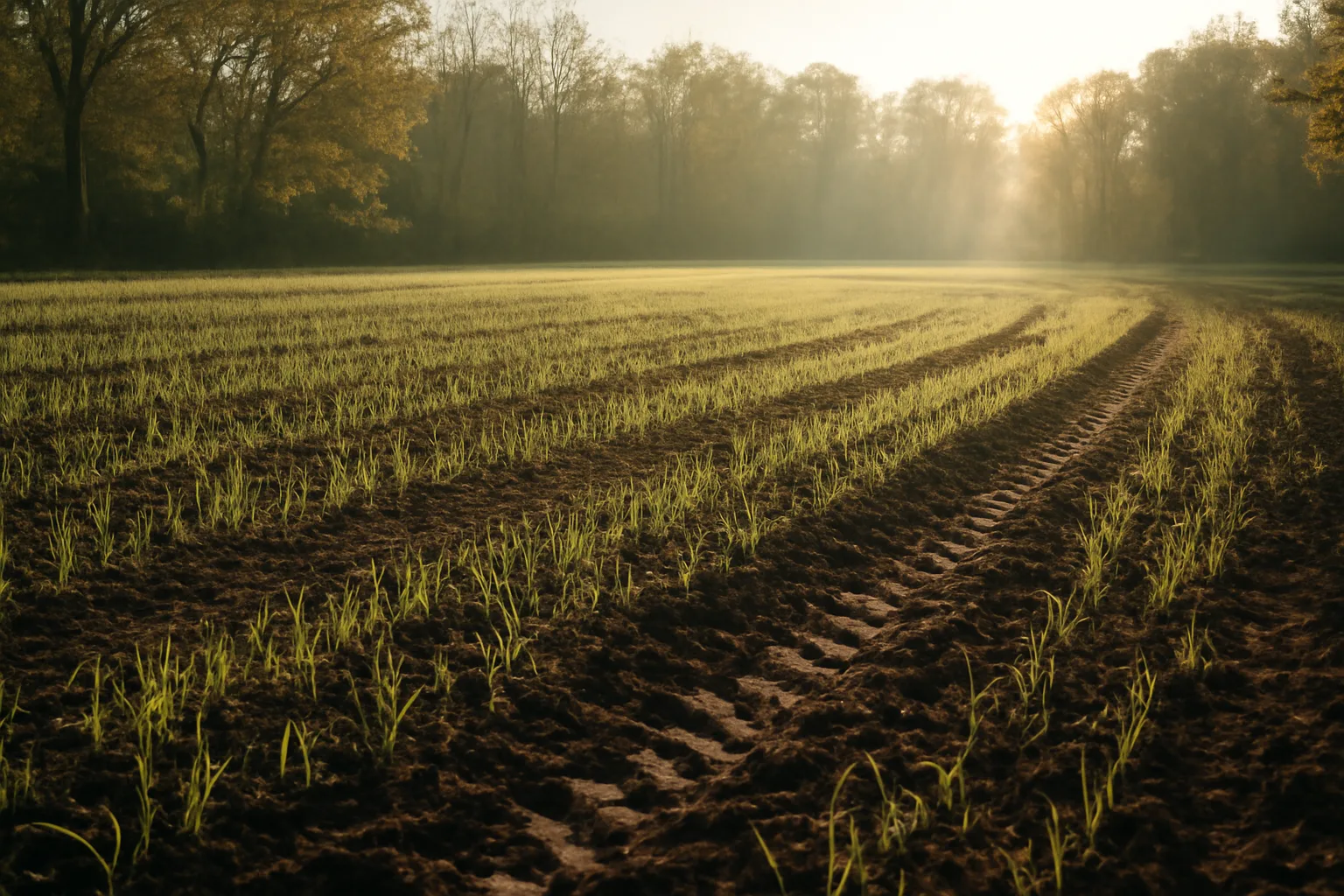
A biologic food plot is a planted, growing forage plot (clover, brassicas, cereal grains, or blends) that deer feed on naturally over weeks or months, as opposed to a mineral site or bait pile. Most are planted in late summer to early fall for cool-season species, or spring for warm-season species, timed to your first frost date.
what is a food plot, exactly, and what does "biologic" mean
A food plot is a planted area of forage, usually somewhere between a quarter acre and a few acres, put in specifically to feed and hold deer on a property. The word "biologic" gets used a lot in the industry. It's the name of a well known seed brand, BioLogic, owned by the Mossy Oak family of companies, and it's also used generically to mean "a living, growing food source" as opposed to a mineral lick or a corn pile. So when someone asks about a "biologic food plot," they usually mean one of two things: a plot planted with BioLogic-branded seed products, or more broadly, any planted forage plot that grows and regenerates rather than a static bait source. This article covers the second, broader meaning, since that's what actually matters for planning: species choice, soil prep, and timing. The practical distinction matters for legal reasons too. Baiting (piling corn, minerals, or other feed to attract deer) is regulated or banned outright in a lot of states, while planted food plots are almost universally legal because the deer are foraging a growing crop, not eating from a pile. Rules vary a lot by state and even by county in some cases, so check your state wildlife agency's current regulations before you assume anything is legal, especially if you're mixing plots with mineral sites or supplemental feed. A true forage plot also does more for deer than a bait pile does. It supplies protein and energy across weeks or months, more than a single feeding event, and cool season plots specifically help does recover from lactation and bucks rebuild body mass after the rut.
when to plant food plots for deer (by season and region)
Timing depends on what you're planting and where you live, but the short answer is: perennials and cool-season annuals go in late summer to early fall, and warm-season annuals go in late spring after your last frost. Cool-season plots (clover, brassicas, cereal grains like oats, wheat, and rye) are typically planted 60 to 90 days before your area's average first hard frost. That gives the plants enough time to establish a root system and canopy before cold weather slows growth. In the Upper Midwest and Northeast, that often means planting in August. In the transition zone and Mid-South, September into early October works. In the Deep South, you can push into November in some years. Warm-season plots (soybeans, cowpeas, sorghum, corn) go in after your last spring frost date, generally April through June depending on latitude, since these species are frost-sensitive and need a full growing season of heat to produce tonnage. Your local university extension office publishes frost date tables and planting windows specific to your county, and that's a better source than any generic national calendar. If you want a starting point built around your specific ZIP code and soil test, that's exactly the kind of thing a Custom Food Plot Plan is built to spit out for $99, though your extension office's frost tables are free and a fine substitute if you want to build the calendar yourself.
when to plant oats for deer
Plant oats 45 to 60 days before your first fall frost so they get 6 to 10 inches of growth before cold slows them down. In most of the whitetail's range that lands somewhere between mid-August and mid-September. Oats are one of the most reliably attractive cool-season annuals you can plant, and deer often hit a fresh oat plot within days of germination. They're also cheap relative to clover or brassica blends, and they establish fast, which makes them a good nurse crop mixed with slower germinating species like clover. Oats will winterkill in the northern half of the country once temperatures drop into the teens for extended stretches, so in Zone 4 and colder, oats are really a fall-focused plot, not a season-long food source. Further south, oats can survive light frosts and keep producing into winter. Oats are generally considered less winter-hardy than wheat or cereal rye among common small grains used in forage and cover crop systems, according to Kansas State University Research and Extension agronomy guidance on small grain forage selection [1]. So if you want green forage in January in a northern climate, wheat or a wheat/rye blend holds up better than oats alone.
when to plant turnips for deer
Turnips need 80 to 90 days from planting to reach full bulb size, so back-calculate from your first expected hard frost and plant in that window, typically late July through mid-August in the northern half of the whitetail range, and August into early September further south. Turnips are a brassica, and deer often ignore the plant almost entirely for the first month or two, then switch hard onto it after a couple of frosts. That's not random. Frost converts starches in the leaves and bulb into sugars, which is why turnip plots that look untouched in October can get hammered in December. This is one of the most common frustrations new planters have: they think the plot failed, when really the deer just haven't started eating it yet. One agronomic note worth knowing: turnips (like other brassicas) need a soil pH close to neutral, ideally 6.0 to 6.5, to take up nutrients efficiently, and they're heavy nitrogen feeders. A soil test is the only real way to know if your ground needs lime before planting turnips, and your soil test lab's specific lime and fertilizer recommendation should always take priority over any generic number in an article like this one, since soil chemistry varies field to field.
do deer eat sorghum
Yes, deer eat sorghum, both the grain heads and the young leaves, but it's rarely their first choice when better forage is available nearby. Sorghum works best as a summer annual for tonnage, cover, and a fall/winter grain source rather than as the single species in a plot. Grain sorghum (milo) produces heavy seed heads that mature in late summer and can stand through fall and winter, giving deer (and turkeys, and various birds) a starchy energy source when other food is scarce. It's drought-tolerant compared to corn, which makes it a reasonable substitute in dry regions or dry years. The catch is that sorghum alone isn't especially attractive to deer while it's actively growing; they'll browse the leaves some, but they generally prefer soybeans, cowpeas, or corn during summer if those are planted nearby. Sorghum earns its spot in a plot mix as a fall/winter standing grain and screening cover, not as the plot deer beeline to in July.
do deer eat clover, and do deer like clover
Yes, clover is one of the most consistently preferred forages in the whitetail's diet, and it's the single most planted perennial food plot species in North America for good reason. Deer eat it heavily from spring green-up through fall, and it holds up under repeated grazing better than almost anything else you can plant. White clover (Ladino type) and red clover are both common in food plot blends. Crude protein in clover forage commonly runs 25 to 30% during active growth, which is well above what most other forages provide, and it's part of why clover is such a strong option for lactating does in late spring and bucks growing antlers in summer. Clover's real advantage over annuals is persistence. A well-maintained clover stand, mowed periodically and limed to soil test recommendations, can produce for 3 to 5 years before you need to replant, which makes the per-year cost lower than annual replanting even though the seed itself costs more upfront. Mississippi State University Extension recommends white clover and red clover as core perennial and cool-season forage legumes for wildlife food plots because of their protein content and their ability to persist across multiple growing seasons when limed and fertilized correctly [2]. The tradeoff is establishment. Clover is slow out of the ground, sensitive to weed competition in its first weeks, and it needs a firm, well-prepared seedbed with good pH (most sources recommend 6.0 to 7.0) to really thrive. If your soil test comes back with a pH below 6.0, lime it according to your lab's recommendation before you plant clover, not after; lime takes months to fully react with soil.
what are deer's favorite foods, overall
There's no single universal "favorite food" ranking, because deer diet preference shifts by season, region, and what's locally available, but research consistently puts soft mast, legumes, and clover near the top when they're accessible. Acorns are frequently cited as one of the most preferred natural fall foods across the whitetail's range, and deer will often abandon a food plot entirely during a heavy acorn drop. Beyond mast, agricultural crops like soybeans and clover rank consistently high in preference studies, largely because of their protein content relative to native browse. Wildlife biology programs commonly describe whitetail seasonal forage use in roughly four categories: forbs and soft browse in spring, legumes and agricultural crops in summer, mast (acorns, especially) in fall, and woody browse plus any standing crops in winter when better options are gone. That seasonal pattern is really the core logic behind planting a mix of species instead of one single plot: you're trying to cover the months when natural forage quality drops, not compete with acorns in a good mast year.
do deer like honey (and does it belong in a food plot)
Deer aren't drawn to honey the way they are to sugars in browse and mast, and honey has no real role in food plot planning. There's no wildlife agency or extension guidance recommending honey as an attractant, and it's not a forage crop, obviously, so this isn't really a food plot question at all. Where this question usually comes from is confusion with commercial deer attractant sprays and mineral products that use sugar, molasses, or apple/anise scents, some of which contain small amounts of sweeteners marketed loosely as "honey scent" or similar. Those are attractant products, not food sources, and in a lot of states, spraying or pouring an attractant onto the ground crosses the legal line into baiting, even if a planted crop nearby is perfectly legal. Check your state wildlife agency's baiting definition before combining any attractant product with a food plot, since the definitions of "bait" vary significantly state to state and some agencies count scent products, others don't.
how do I choose the right species for my food plot
Pick your species based on three things, in this order: your goal (attraction in season, or nutrition across a broader window), your climate zone and frost dates, and your soil test results. Skipping any one of those three usually leads to a plot that either fails to establish or gets ignored once acorns drop. For early season bow hunting attraction, a fast-establishing annual like oats, winter peas, or a soybean/cowpea mix planted for summer tonnage tends to draw deer reliably as soon as it's up. For late season hunting, brassicas (turnips, radishes) planted to hit their sweetness after frost are the standard choice, since they're one of the few green food sources left once everything else has browned off or been buried in snow. For year-round herd health and holding power, a perennial clover stand is hard to beat, provided you're willing to mow it a few times a season and manage weeds. Most experienced planters end up running two or three plot types on a property rather than one: a perennial clover plot for spring/summer, an annual brassica or cereal grain plot for late season, and maybe a warm-season soybean or sorghum plot for tonnage and screening. That kind of layered planning is exactly where a soil test and a written planting calendar earn their keep, since guessing at species mix without knowing your pH and frost dates is how a lot of first-year plots underperform. If you'd rather have someone build that calendar and species mix around your specific soil test and location, that's the whole idea behind the Custom Food Plot Plan, a $99 one-time plan, though plenty of hunters do fine building their own plan from extension bulletins and a soil test alone.
how much does it cost to plant a food plot
Costs vary a lot depending on whether you're renting or borrowing equipment, buying premium blended seed versus straight commodity seed, and how much lime and fertilizer your soil test calls for, but a rough range for a half-acre to one-acre plot runs from around $150 to $500 per acre in seed, lime, and fertilizer, not counting equipment or fuel. Seed costs alone range widely: a bag of straight oats or wheat might run $15 to $25 per 50-pound bag and cover close to an acre, while a premium branded clover or brassica blend can run $40 to $90 for enough to cover a half-acre to full acre, depending on seeding rate. Lime is often the bigger line item than seed in a first-year plot on acidic soil; agricultural lime commonly costs $30 to $60 per ton delivered and spread in most regions, and a plot needing 2 tons per acre to correct pH (not unusual on newly cleared ground) adds real cost fast. This is another spot where your soil test lab matters more than any generic number here: your lab's report tells you exactly how much lime and which fertilizer analysis (like 19-19-19 or 0-20-20) your specific field needs, and that recommendation should always override a general estimate.
do I need a soil test before planting, and what does it tell me
Yes. A soil test is the cheapest, highest-leverage step in the entire process, and skipping it is the single most common mistake first-time plot planters make. Most state land-grant extension labs charge somewhere between $10 and $20 per sample and turn results around in 1 to 3 weeks. A standard soil test reports pH, buffer pH (which determines lime rate), and levels of phosphorus, potassium, and sometimes secondary nutrients like calcium and magnesium. From that, the lab (or extension bulletin paired with it) gives you a lime recommendation in tons per acre and a fertilizer recommendation in pounds per acre of N-P-K. Many food plot species, clover and brassicas especially, underperform badly on acidic soil below pH 6.0 even with adequate fertilizer, because low pH locks up phosphorus and other nutrients so plants can't take them up regardless of how much you've applied. Getting lime down 3 to 6 months before planting, since it needs time to react with soil, is one of the highest-value things you can do for a plot, and it costs a lot less than reseeding a failed plot the following year.
what equipment do I actually need to plant a food plot
At minimum you need a way to kill or clear existing vegetation, a way to work or disturb the soil surface, a way to spread seed, and a way to pack or cover it, though the exact tools scale a lot with plot size and budget. For small plots (under an acre), a lot of hunters get by with a UTV or ATV, a tow-behind disc or cultipacker, a hand-crank broadcast spreader, and a sprayer for herbicide. For larger plots, a tractor with a disc, drag harrow, and a PTO-driven seed drill or broadcast spreader speeds things up considerably and gets more consistent seed depth, which matters a lot for small-seeded species like clover that only need to go down a quarter inch. No-till drills are increasingly popular because they let you plant directly into standing residue or a killed cover crop without a full tillage pass, which saves erosion and moisture, though they cost more upfront or to rent. If you're planting for the first time on a budget, a disc, a spreader, and a cultipacker (or a drag section of chain-link fence dragged behind an ATV, which works surprisingly well) covers the basics for most annual and perennial plots.
Frequently asked questions
do deer eat sorghum
Yes, deer eat both the leaves and grain heads of sorghum, but it's usually a secondary preference behind soybeans, cowpeas, and clover when those are available. Sorghum's real value in a plot is as a drought-tolerant summer annual that produces standing grain into fall and winter, plus useful screening cover.
do deer eat clover
Yes, clover is one of deer's most consistently preferred forages, eaten heavily from spring through fall. Crude protein in actively growing clover commonly runs 25 to 30%, well above most native browse, which is a big reason land-grant extension programs list it as a top perennial food plot species for whitetail nutrition.
when to plant deer food plots
Cool-season plots (clover, brassicas, cereal grains) go in 60 to 90 days before your area's first fall frost, often August in the north and September into October further south. Warm-season plots (soybeans, sorghum, corn) go in after your last spring frost, typically April through June depending on latitude.
do deer like clover
Yes. Clover ranks among the most preferred food plot forages across whitetail range because of its high protein content and long grazing season. It's especially valuable in spring and summer when does are lactating and bucks are building antler mass, and a well-maintained stand can last 3 to 5 years before replanting.
when to plant oats for deer
Plant oats 45 to 60 days before your area's first fall frost, generally mid-August to mid-September across most of the whitetail's range. Oats establish fast and deer often hit them within days of germination, but oats are less cold-hardy than wheat or rye and can winterkill in Zone 4 and colder.
when to plant food plots for deer
Timing depends on species: cool-season annuals and perennials go in late summer to early fall (60 to 90 days before first frost), while warm-season annuals like soybeans and sorghum go in late spring after your last frost date. Your local extension office's frost date tables are the most reliable free planning tool.
when to plant turnips for deer
Plant turnips 80 to 90 days before your expected first hard frost, typically late July through mid-August in northern regions and August into early September further south. Deer often ignore turnips until after a few hard frosts convert starches to sugars, so slow early interest doesn't mean the plot failed.
what is a food plot
A food plot is a planted area of forage, usually a quarter acre to several acres, established specifically to feed and hold deer or other wildlife on a property. Unlike a bait pile or mineral site, a true food plot is a growing crop deer forage over weeks or months, and it's legal in states where baiting is restricted.
what are deer's favorite food
There's no single universal favorite; preference shifts seasonally. Acorns and other soft mast rank very high in fall when available, while clover and agricultural legumes like soybeans rank high in spring and summer due to protein content. Most wildlife programs describe a four-season pattern: forbs in spring, legumes in summer, mast in fall, browse in winter.
do deer like honey
Not particularly, and honey has no real role in food plot planning since it's not a forage crop. Confusion usually comes from commercial attractant sprays marketed with sugar or scent additives. Check your state wildlife agency's baiting definition before using any attractant product, since some states count scent or sugar products as illegal bait even near a legal food plot.
how big should a food plot be
Most hunting-focused food plots run a quarter acre to 2 acres for a small attraction plot near a stand, up to several acres for larger nutrition-focused plots meant to support a herd through a season. Size should match your goal, your equipment, and how much sunlight the site gets; a shaded quarter-acre plot often underperforms a sunny tenth-acre plot.
is planting a food plot legal everywhere
Food plots are legal in nearly all states since deer are foraging a growing crop rather than a bait pile, but baiting rules for minerals, corn, and attractant products vary a lot by state and sometimes by county. Always check your state wildlife agency's current regulations before combining a food plot with mineral sites or supplemental feed.
how often do I need to replant a clover food plot
A well-maintained white or red clover stand, mowed a few times a season and limed per soil test recommendations, typically produces for 3 to 5 years before thinning out enough to require replanting. That multi-year life is a big part of why clover often costs less per year than annual plots despite higher seed cost upfront.
Sources
- Michigan Department of Natural Resources, Baiting and Feeding Regulations for Deer Hunting: Michigan has a baiting and feeding framework for deer with specific exceptions, managed by the state wildlife agency
- Purdue University Cooperative Extension Service, Indiana Weather and Climate: Frost Dates (AY-238): Average first and last frost dates vary by region and inform food plot planting windows
- Kansas State University Research and Extension, Small Grains for Forage (MF3162): Oats are less winter-hardy than wheat or rye among common small grains used in forage and cover crop systems
- USDA Natural Resources Conservation Service, Plant Guide: Sorghum bicolor: Grain sorghum is a drought-tolerant warm-season crop used in wildlife plantings
- Noble Research Institute, Food Plots for White-Tailed Deer: Seasonal whitetail forage preference shifts through forbs, legumes, mast, and woody browse across the year