Last updated 2026-07-26
TL;DR
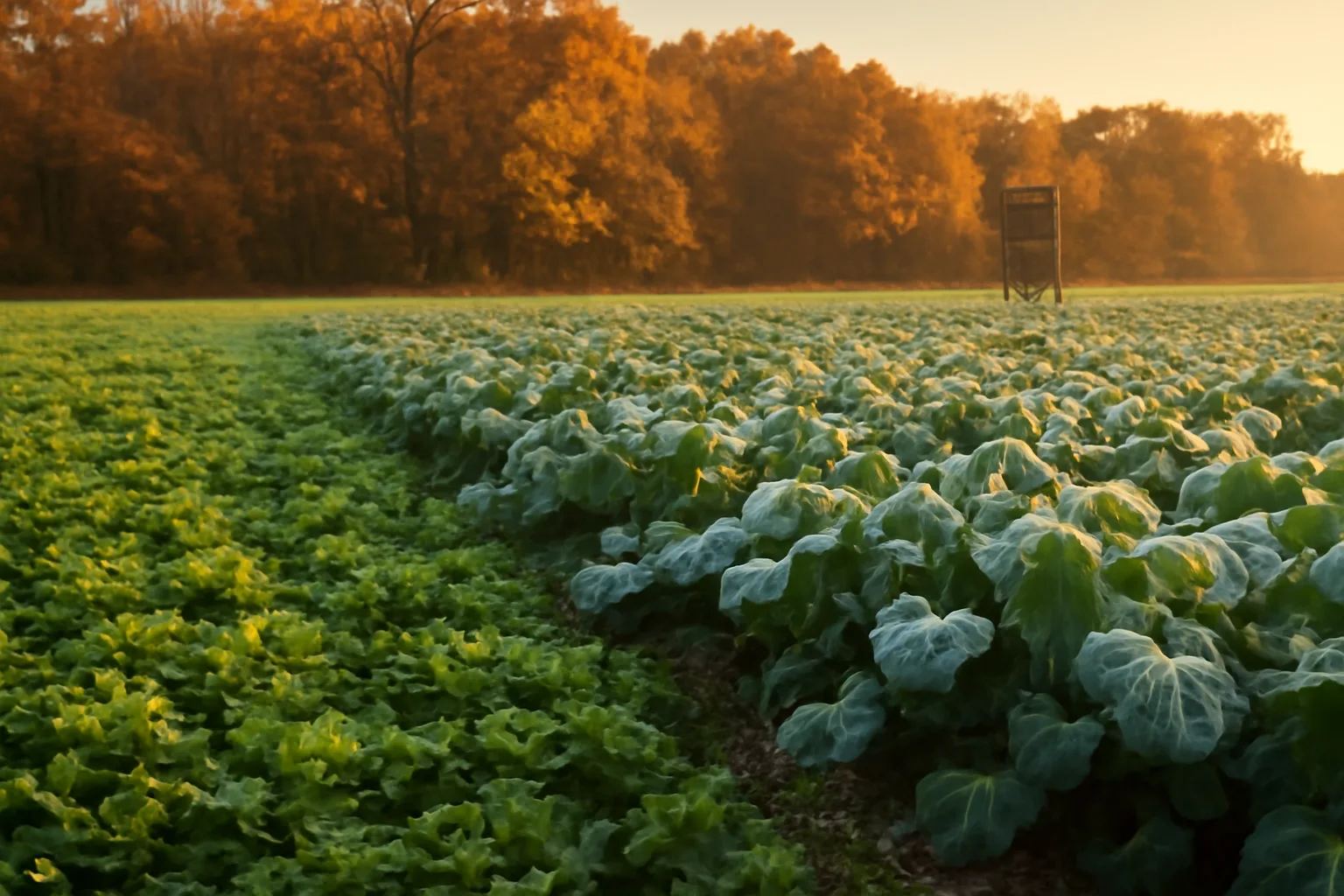
There's no one seed that feeds deer year round. The best "all season" approach pairs a perennial clover or chicory plot (spring through fall) with an annual fall blend of brassicas, oats, and cereal grain planted in late summer. Together they cover green growth, high-protein summer feed, and standing tonnage after frost.
What is a food plot, exactly?
A food plot is a planted patch of forage on hunting land meant to feed and hold deer, not a garden and not a crop field meant for harvest and sale. Most run anywhere from a quarter acre in a tight timber opening to several acres in a field corner. The goal is usually twofold: give deer a reliable, nutritious food source during stress periods (antler growth, lactation, pre-winter fat building) and give the hunter a place to see deer during shooting light. State wildlife agencies generally treat food plots differently from bait piles. Baiting rules (piling corn, minerals, or feed for the purpose of attracting deer to a spot) vary a lot by state, and some states restrict or ban it outright while others allow it with conditions [1]. A planted, rooted food plot is legal almost everywhere hunting is legal, but always check your state agency's current regulations before you plant near a stand, especially if you also run a mineral site or supplemental feeder nearby, because those rules are often separate from food plot rules. Extension programs describe food plots as a wildlife management tool, not a guarantee of more or bigger deer. Penn State Extension notes that plots "can improve the nutritional plane of local deer herds" but stresses that habitat, herd density, and hunting pressure all matter more than any single planting decision. Nobody, including us, can promise a plot will produce more deer sightings or a bigger buck. What a good plot reliably does is give deer better food than the surrounding woods offers during specific windows of the year.
Is there really a single 'best all season' food plot?
No, and any seed bag promising 365 days of attraction from one bag is oversimplifying. The honest answer is that "all season" coverage takes at least two plantings working together, usually a perennial base and an annual fall blend. Here's why. Clover and chicory are perennial, they green up in spring, hold through summer heat if you mow and manage weeds, and stay in the ground for 3 to 5 years before you need to reseed. But they slow way down or go dormant after hard frost in most of the whitetail range. Brassicas (turnips, radish, kale) and cereal grains (oats, wheat, rye) are annual, planted in late summer, and they peak in tonnage and palatability right after the first hard frosts convert starches to sugars, which is exactly when clover is fading. So the realistic "all season" plot plan is a rotation: a perennial clover/chicory field for spring through early fall, paired with a late-summer-planted brassica and cereal grain blend for the fall-through-winter window. If you only have room for one plot, a clover and chicory mix probably gives you the longest single-planting window, roughly April through October in most of the Midwest and Southeast, per Mississippi State University Extension variety trial data on white clover persistence [2]. But it will not carry you through a hard winter the way a brassica and grain blend will.
When should you plant food plots for deer?
| Deep South (zone 8-9) | Feb-Apr or Sep-Oct | Sep-Oct | |
|---|---|---|---|
| Mid-South / Lower Midwest | Apr-May or Aug-Sep | Late Aug-Sep | |
| Upper Midwest / Northeast | May-Jun | Mid-late Aug | |
| Northern tier / short season | May-Jun | Early-mid Aug | If you want a plan built around your actual property and frost window instead of a general regional guess, that's the exact gap the Custom Food Plot Plan is built to fill: you send your location and soil test, and get a planting calendar back instead of guessing off a bag label written for the whole country. |
Timing splits into two windows almost everywhere deer are hunted: a spring/summer window for perennials and warm-season annuals, and a late-summer window for fall annuals. Exact dates depend on your last and first frost dates, which your state land-grant extension office publishes for your county. Spring planting (perennial clover, chicory, alfalfa, or warm-season annuals like soybeans and cowpeas) generally runs from mid-April through early June in the Midwest and Upper South, and can start as early as March in the Deep South. University of Tennessee Extension recommends planting perennial clover blends in early spring once soil temperatures reach the mid-50s Fahrenheit, or in early fall as an alternative window [3]. Fall planting (brassicas, oats, wheat, rye, and other cereal grains) is timed backward from your first expected hard frost. Most extension guides say to plant 60 to 90 days before that frost date, which lands most of the Midwest and Northeast in the last two weeks of August, and the Deep South anywhere from mid-September into October. The Mississippi State University Extension deer food plot guide lists a planting window of August 15 through October 1 for cool-season annuals in that state, with earlier planting favored for brassicas that need a longer growing period to bulb out [2]. Here's a rough starting framework by general region. Always confirm against your own county's frost dates: | Region (general) | Perennial clover/chicory planting | Fall brassica/cereal grain planting |
Do deer like clover, and is it worth planting?
Yes. Clover is one of the most consistently preferred food plot forages across university trials, and it's the closest thing to a default answer if you can only plant one perennial. White clover and red clover both show up repeatedly in extension-recommended blends because they combine high crude protein (often 25 to 30 percent in vegetative growth) with strong regrowth after grazing pressure [3]. The reason clover works so well as a plot base is regrowth tolerance. Deer can hit a clover plot hard, and as long as you're not overgrazing it into the ground, it keeps sending up new leaves through the growing season. That's very different from a bean field, which deer can eat down to bare dirt with no bounce-back. Clover also handles mowing well, which helps you keep weed competition down and keeps the plant in a vegetative, high-protein stage instead of going to seed and getting stemmy. The tradeoff: clover needs decent soil drainage and a pH usually in the 6.0 to 6.5 range to really perform, and it will not carry a plot through a hard freeze the way brassicas or grain will. It's also slower to establish (a full season to get a mature stand) compared to annuals that you plant and hunt over the same year. If your soil test comes back with a pH under 6.0, expect thin, disappointing clover no matter how good the seed is, until you get lime worked in per your test's recommendation.
What are deer's actual favorite foods?
Acorns, soybeans, and clover routinely top the list in feeding studies and hunter surveys, but the honest answer is that deer preference shifts by season, region, and what's locally available. Deer are opportunistic browsers, and "favorite" changes a lot depending on what else is on the landscape. Acorns (especially white oak family acorns, which are lower in tannins than red oak acorns) are consistently one of the highest-preference natural fall foods where they're available, because they're calorie-dense and deer will often bypass planted forage for a good acorn drop. Soybeans and corn are heavily used where row-crop agriculture is nearby, both as summer forage (soybean leaves) and fall/winter grain. Among planted food plot options, clover, brassicas (turnip and radish tops and bulbs), chicory, and cereal grains like oats and winter wheat show up over and over in state wildlife agency and extension recommendation lists [2] [3] [4]. Worth saying plainly: there's no rigorous, controlled feeding-preference ranking that applies nationwide, because local food availability, deer density, and even individual herd habits change what shows up as "preferred." Extension guidance is built from regional trial plots and herd observation, not a single controlled taste test, so treat any specific ranked list (including this one) as a general pattern, not gospel for your farm.
Do deer eat sorghum?
Yes, deer will eat grain sorghum (milo) heads and, to a lesser degree, the leaves, but it's mostly used in food plot mixes as a cover crop or screening plant rather than a primary attractant. Sorghum's real value in a plot plan is structure: it grows tall and thick, giving deer bedding and travel cover right next to a food source, and the grain heads mature in fall right when deer need calories. Some plot mixes include grain sorghum blended with soybeans or cowpeas specifically so the legume gets some structural support to climb, and so the field has both a protein source (beans) and a fall carbohydrate source (sorghum grain) in one planting. It is not typically a first-choice standalone deer forage the way soybeans or clover are, and in areas with heavy blackbird or turkey pressure on grain heads, a lot of the sorghum can get eaten by birds before deer really work it. If your goal is a tall screen plus a late-season snack, sorghum earns its place. If your goal is a single best attractant plot, put your acreage into clover, brassicas, or beans first.
When should you plant oats for deer?
Oats go in the ground in late summer to early fall as a cool-season annual, timed the same way you'd time brassicas: roughly 60 to 90 days before your area's first hard frost. That generally lands in the last two weeks of August through mid-September across most of the whitetail range, and into late September or early October in the Deep South. Oats are a favorite fall food plot annual because they germinate fast (often visible in 5 to 7 days in warm soil), tolerate a wide pH range better than clover does, and put out tender, sweet forage that deer hit hard right when it's young. University of Tennessee Extension's food plot planting guide lists oats among the recommended cool-season cereal grains for fall plots, often blended with a brassica or a clover for a mixed-maturity stand [3]. One real limitation: oats are less cold-hardy than winter wheat or cereal rye. In a hard winter, an oats-only plot can die back and lose most of its forage value by January, while wheat or rye in the same plot keeps growing through cold snaps and green up again in late winter. If you want oats to carry you deep into winter, blend them with wheat or rye rather than planting oats alone.
When should you plant turnips for deer, and do deer eat them?
Yes, deer eat both the tops (leaves) and the bulbs of turnips, though the order matters: deer typically hit the leafy tops first in early fall, then switch to eating the bulbs later in the season, especially after a few hard frosts sweeten the starches into sugars. Turnips go in the ground in late summer, generally 80 to 90 days before your first expected hard frost, because the bulb needs real time to size up underground before deer start digging it out. Most of the Midwest and Upper South plants turnips between late July and mid-August. The Deep South can push planting into September. Mississippi State University Extension's food plot recommendations list brassicas, including turnips, as part of the fall cool-season annual planting window running roughly August 15 to October 1 in that state, with earlier planting favored specifically for brassica bulb development [2]. A common frustration: deer sometimes ignore turnip bulbs entirely in the first year on a new plot, especially in areas where deer have never encountered brassicas before. Extension agronomists and wildlife biologists have documented this "learned behavior" pattern, where deer need a season or two of exposure before bulb-digging becomes a habit in that herd. If your turnip plot gets hammered on the tops but the bulbs sit in the ground untouched into December, that's normal in year one, not a failed plot.
Do deer like honey, and does it belong in a food plot?
No, honey has no real place in a food plot and there is no meaningful body of research on deer and honey specifically, because it's not a plant, it's a bee product, and it's not something you'd plant or spread across acreage. Deer are not documented as honey feeders in wildlife research the way they are for browse, mast, and forbs. This question usually comes up because of scent and mineral attractant products that use honey, molasses, or other sweeteners as a carrier or additive, marketed for mineral sites or attractant sprays rather than food plots. Those products fall under a different set of rules than food plots in most states: many state wildlife agencies classify sweetened mineral or scent products used to draw deer to a specific spot under baiting or feeding regulations, separate from planted forage rules [1]. If you're using anything like that near a stand, check your state agency's current baiting and feeding definitions before you use it, because enforcement and legality vary widely and some states have tightened rules in response to chronic wasting disease concerns.
How do you build a real all-season plot plan on your land?
Start with a soil test, not a seed bag. Your local extension office or a private ag lab will test pH, phosphorus, potassium, and organic matter for somewhere in the range of $10 to $20 per sample depending on the lab, and the report will tell you exactly how much lime and fertilizer your specific field needs [5]. That report, not a seed tag or a article like this one, is the real authority on your lime and fertilizer rates. Skipping the soil test is the single most common reason a food plot underperforms; you can buy the best clover seed on the market and get a thin, yellow stand if your pH sits at 5.2 and nobody added lime. Once you know your soil chemistry, split your acreage (or rotate through it) across two plantings. Put your perennial clover or clover/chicory blend somewhere with decent drainage, because clover really doesn't like sitting in wet feet. Reserve another section, or plan to convert your annual plot each fall, for a brassica and cereal grain blend timed to your first frost date. A simple two-plot system covers most of the calendar: 1. Perennial plot: clover or clover/chicory mix, planted in spring or early fall, maintained with mowing and a maintenance lime/fertilizer application per your soil test every year or two, good from spring green-up through early fall. 2. Annual fall plot: brassica (turnip, radish) blended with oats or winter wheat, planted 60 to 90 days before first frost, good from early fall through late winter, with the brassica bulbs and cereal grain regrowth often holding value into February in mild winters. For a broader look at how these plantings compare across cost, effort, and season length, see food plot whitetail and deer food plots. If you're picking specific seed rather than a planting strategy, deer food plot seed and food plot seed break down species-by-species options.
What does an all-season plot actually cost per acre?
Rough per-acre costs vary a lot by region and seed source, but a reasonable range for a DIY plot, including seed, lime, and fertilizer, runs somewhere between $75 and $250 per acre for an annual planting, and a bit more upfront (often $150 to $300 per acre) for perennial clover establishment because clover seed itself is pricier per pound and you're building a stand meant to last 3 to 5 years. Lime is often the biggest surprise line item. If your soil test calls for 2 tons of lime per acre and your local ag lime costs $30 to $50 per ton delivered and spread, that alone is $60 to $100 per acre before you've bought a bag of seed. Skimping on lime to save money up front is one of the most common false economies in food plotting, because low pH locks up the phosphorus and potassium you did pay for, so the plants can't use it. Equipment cost is separate and highly variable depending on what you already own. A no-till drill rental, a broadcast spreader, or a small tractor with disk and cultipacker attachments can run from under $100 (a weekend drill rental at a local co-op) to several thousand dollars if you're buying gear outright. If you're planning your first year and want a cost and calendar built around your actual acreage and soil test instead of a rough national average, that's the specific problem the $99 one-time Custom Food Plot Plan solves: you get a species list, seeding rate, and timing built for your ZIP code and soil report instead of a one-size blend.
Do you need different plots for different deer seasons (early, rut, late)?
Not necessarily different plots, but different plant choices tuned to what deer need physiologically at each point in the year. Early season (late summer through opening bow season in most states) benefits from high-protein forage like soybeans, cowpeas, or clover, because deer are still finishing antler growth and does are nursing fawns. Rut-phase plots don't need to be nutritionally special; deer movement during the rut is driven by breeding activity, not food, so a plot's main job then is just still being green and attractive enough to pull deer through on their way somewhere else. Late season is where brassicas and cereal grains earn their keep. After a hard frost converts starches to sugars, turnip bulbs, radish, and standing wheat or oats become some of the highest-energy food sources left on the landscape, right when deer need calories most to get through winter. This is also usually the best rifle or late-muzzleloader season window in states that have one, so a good late-season brassica plot does double duty as both nutrition and a hunting location. If you're working with a small property and can only maintain one or two plots, prioritize a perennial clover plot for spring/summer/early fall coverage, then convert or add a fall annual blend for the late season. That two-plot combination is the closest realistic version of an "all season" plot system that actually exists.
Frequently asked questions
Do deer eat sorghum?
Yes, deer eat grain sorghum heads and some leaf material, but it's mainly used in plot mixes for cover and structure rather than as a primary attractant. It's often blended with soybeans or cowpeas so the beans have something to climb, giving both a protein source and a fall grain source in one field.
Do deer eat clover?
Yes, clover is one of the most consistently preferred food plot forages in university trials, offering 25 to 30 percent crude protein in vegetative growth. It tolerates repeated grazing and regrows well, which is why it's a common perennial base for food plots across most of the whitetail range.
When to plant deer food plots?
Perennials like clover generally go in during spring (April-June in most regions) or early fall. Annual brassicas and cereal grains are planted 60 to 90 days before your area's first hard frost, which lands in mid-to-late August across most of the Midwest and later into September or October in the Deep South.
Do deer like clover more than other forages?
Clover ranks consistently high in extension trial data and hunter observation, largely because of its protein content and regrowth after grazing. But 'favorite' shifts seasonally; deer often prefer acorns or soybeans when available, and brassicas take over in preference after frost sweetens the sugars.
When to plant oats for deer?
Plant oats in late summer to early fall, roughly 60 to 90 days before your first expected hard frost. Oats germinate fast, often within 5 to 7 days, but are less cold-hardy than wheat or rye, so blend them with a hardier cereal grain if you want forage to last deep into winter.
When to plant food plots for deer overall?
Split planting into two windows: spring (mid-April through early June in most regions) for perennials and warm-season annuals, and late summer (mid-August through September, later in the Deep South) for fall brassicas and cereal grains. Exact dates depend on your county's frost dates from your local extension office.
When to plant turnips for deer?
Plant turnips 80 to 90 days before your first hard frost, generally late July through mid-August in the Midwest and Upper South, and into September in the Deep South. The extra lead time lets bulbs size up underground before deer start digging them out later in fall.
What is a food plot?
A food plot is a planted area of forage on hunting land intended to provide supplemental nutrition for deer and give hunters a place to observe or hunt them. It's distinct from a bait pile; most states regulate baiting separately from planted forage, so check your state wildlife agency's current rules.
What are deer's favorite foods?
Acorns (especially white oak family), soybeans, and clover are consistently high-preference foods in extension and wildlife agency data, but preference shifts by season and region based on what's locally available. There's no single nationwide ranked list; local food availability changes what deer actually favor.
Do deer like honey?
There's no meaningful research on deer and honey specifically, and it has no place in a food plot planting plan. The question usually comes from sweetened mineral or scent attractant products, which many states regulate separately under baiting and feeding rules, not food plot rules.
Is there one single seed blend that feeds deer all year?
No. The realistic all-season approach pairs a perennial clover or clover/chicory plot (spring through early fall coverage) with a fall-planted brassica and cereal grain blend (fall through late winter). No single annual or perennial planting covers the full calendar on its own.
How much does an all-season food plot cost to plant?
Roughly $75 to $250 per acre for an annual fall blend including seed, lime, and fertilizer, and $150 to $300 per acre to establish a perennial clover stand meant to last 3 to 5 years. Lime is often the biggest line item if your soil test calls for 2 tons or more per acre.
Why won't deer touch my turnip bulbs the first year?
This is a documented pattern: deer in areas without prior brassica exposure often eat the leafy tops first and ignore the bulbs entirely in year one, needing a season or two to learn to dig them up. It's normal, not a sign of a failed planting.
Sources
- Various state wildlife agencies, baiting and feeding regulations summaries: Baiting and feeding rules for deer vary by state and are regulated separately from food plot planting
- Mississippi State University Extension, Establishing Wildlife Food Plots: Recommended fall cool-season annual planting window and clover persistence guidance for Mississippi
- University of Tennessee Extension, Wildlife Food Plots publication: Recommended clover planting soil temperature and cool-season cereal grain fall planting guidance
- Mississippi State University Extension Deer Program publications: State extension recommendations for clover, brassica, and cereal grain species in deer food plots
- University of Missouri Extension, Soil Testing for Lawns, Gardens, and Small Farms: Typical soil test cost range and the role of soil testing in determining lime and fertilizer needs