Last updated 2026-07-26
TL;DR
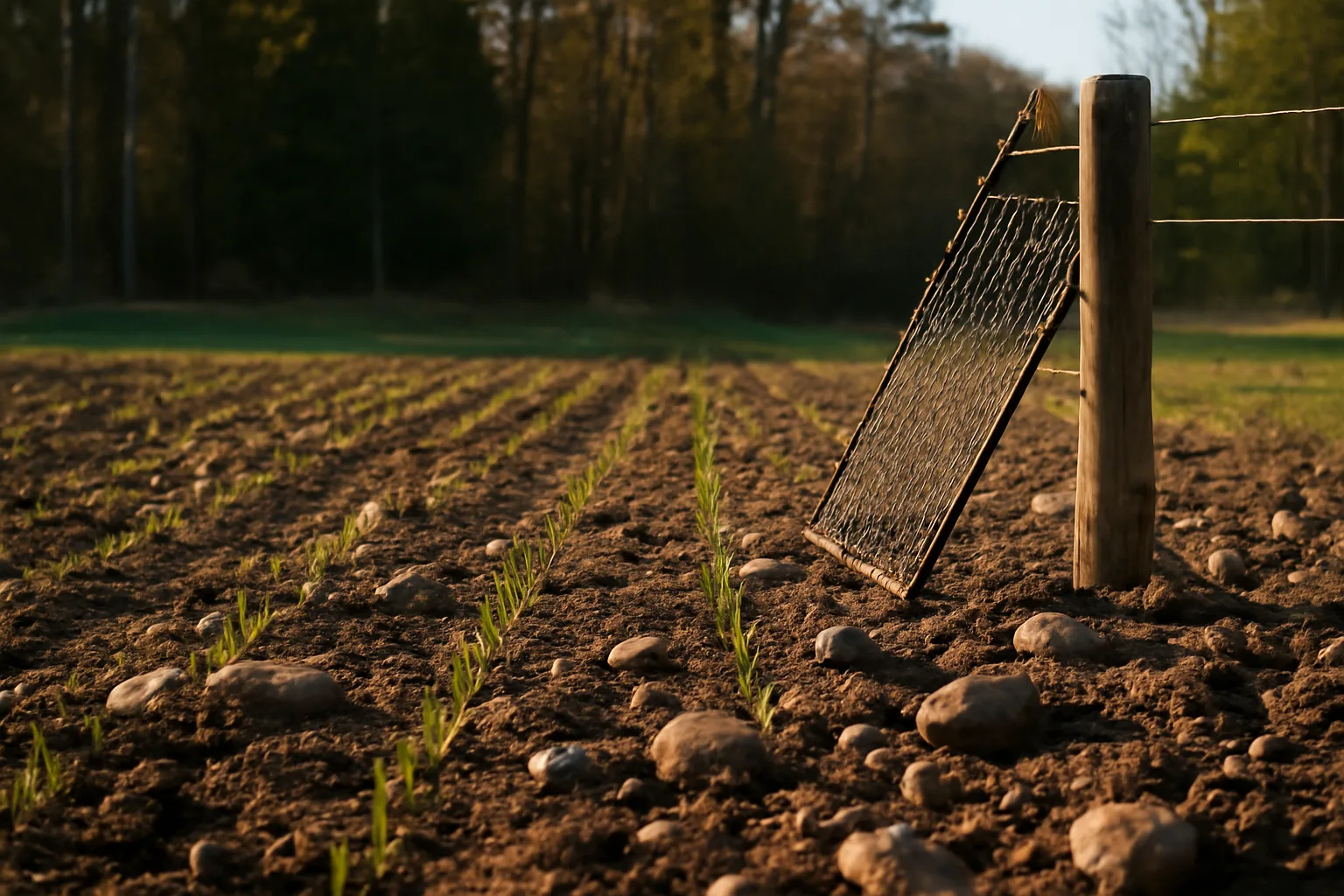
For rocky soil, plant cereal grains (oats, winter rye, wheat) and clovers first; they tolerate shallow, low-fertility ground better than brassicas or beans. Skip anything needing deep tillage. Broadcast into a raked seedbed, roll or drag it, and let a soil test (not guesswork) set your lime and fertilizer rates.
why is rocky soil so hard to plant a food plot in
Rocky ground fights you in three ways: it wrecks tillage equipment, it drains too fast for moisture-hungry seeds, and it's usually thin on topsoil, which means low organic matter and low nutrient-holding capacity. Disk a rock-studded hillside and you'll either shear a bolt or leave the seedbed lumpy and uneven, which kills germination rates before you even plant. The fix isn't better equipment first. It's picking species that don't need a perfect seedbed. Cereal grains and clovers germinate fine in rough, shallow-tilled or even no-till conditions. Brassicas like turnips and radishes want a finer seedbed and deeper root run; they'll struggle in ground that's basically gravel six inches down. Soil testing matters more on rocky ground, not less, because thin soils swing on pH and nutrient levels fast. Your state land-grant extension office or a private ag lab can run a test for somewhere in the range of $10 to $20 per sample [1]. That test, not a guess, should set your lime and fertilizer rates. Your lab's recommendation is the actual authority here; treat any general planting guide, including this one, as a starting point.
what food plot seed grows best in rocky soil
| Winter rye | Excellent | Minimal, broadcast OK | Most cold and drought tolerant cereal grain | |
|---|---|---|---|---|
| Oats | Good | Minimal | Fast germination, winterkills in cold zones | |
| Winter wheat | Good | Minimal | Slower growth than rye, more palatable early | |
| Red/white clover | Good | Light disk or rake | Perennial, 2-5 year stand life [2] | |
| Turnips/radishes | Fair, pocket-dependent | Needs 8-10 inch tillable depth | Struggles on true shelf rock | |
| Soybeans | Poor | Needs deep, workable soil | High fertility and drainage demands | |
| Corn | Poor | Needs deep, workable soil | Not practical outside bottomland pockets | If you want species picked and sequenced for your specific acreage and region, that's exactly the kind of decision a Custom Food Plot Plan is built to sort out. The table above will get most rocky-ground plots most of the way there on its own. |
Cereal grains are the top pick for rocky ground. Winter rye, in particular, tolerates poor, acidic, and shallow soils better than almost anything else planted for deer, and it's also extremely cold hardy, per Penn State Extension guidance on cover crops. Oats and winter wheat are close behind: both germinate quickly, need minimal seedbed prep, and don't demand deep, rock-free root zones. Clovers are the second workhorse. Red clover and white clover (including ladino) tolerate a wider pH range than most legumes and can persist for two to five years once established, according to university forage extension guidance [2]. They need decent seed-to-soil contact but don't require deep tillage, just a rake or light disking pass and a roller or drag afterward. What to avoid or use with caution: soybeans and forage beans want deeper, well-drained loam and struggle in shallow, gravelly spots. Brassicas (turnips, radishes, rape) can work but only in pockets with at least 8 to 10 inches of tillable soil; on true rock-shelf ground they'll bulb out stunted or not at all. Corn is mostly a non-starter on rocky ground unless you've got real bottomland pockets, since it needs deep root anchoring and heavy fertility. Here's a rough comparison for rocky, thin-soil sites: | Species | Rocky soil tolerance | Seedbed needed | Notes |
what is a food plot, exactly
A food plot is a planted area, usually a fraction of an acre to a few acres, established specifically to grow forage that deer and other wildlife will eat. Food plots serve a few different jobs depending on the season and species planted: cereal grains and clover provide early-season and year-round forage plus attraction for hunting season, brassicas and other cold-hardy plants provide high-carbohydrate late-season food when natural browse is gone, and some plots are planted purely as a nutrition supplement to help does and growing bucks through summer stress. Baiting and supplemental feeding rules vary a lot by state, and a standing food plot is usually treated differently than a pile of corn or a mineral station. Check your state wildlife agency's current regulations before hunting over or near any planted plot, especially if you're combining it with a feeder or mineral site.
do deer eat sorghum
Yes, deer will eat sorghum, particularly the grain heads in fall and winter, but it's not a top-tier food plot choice on its own for most rocky-ground hunters. Sorghum is more commonly planted as a screening or cover crop, or blended into a wildlife mix, than as a primary forage. On rocky soil specifically, grain sorghum has moderate drought tolerance and can handle thinner ground better than corn, which makes it a reasonable filler in a mixed planting. But if you're choosing one or two species for a small, rocky plot, cereal grains and clover will out-produce sorghum for deer attraction and are easier to establish with minimal tillage.
do deer eat clover, and do deer like it
Yes, clover is one of the most consistently preferred forages for whitetail deer, and it's a staple recommendation across nearly every state extension and wildlife agency food plot guide. Deer will hit clover hard from spring green-up through fall, and it regrows after grazing better than almost any other plot forage, which is part of why it holds up under heavy pressure. Clover's protein content, often cited in the 25 to 30 percent range for quality forage clover depending on growth stage and soil fertility, makes it valuable for antler growth and lactation in does during spring and summer [2]. On rocky ground, red clover tends to establish a bit more reliably than white clover because it's less finicky about seedbed prep, though both need decent sun and won't thrive in dense shade. The catch with clover on rocky soil is fertility. Thin, rocky soils often run low on phosphorus and potassium and can swing acidic, and clover specifically wants a pH close to neutral (roughly 6.0 to 6.5) to fix nitrogen efficiently through its root nodules. That's another spot where a soil test earns its cost. Guess at lime rates on rocky ground and you'll either underlime and stunt the stand or overlime and waste money.
when to plant food plots for deer
Timing splits into two windows: spring plots (May through June in most of the whitetail range) for warm-season forages like clover, soybeans, and some brassica blends, and late-summer plots (mid-July through early September) for fall cereal grains and brassicas. Your exact dates depend heavily on latitude and first-frost date. A practical rule from land-grant extension planting guides: brassicas and cereal grains should go in roughly 60 to 90 days before your area's first hard frost, so they have time to establish before cold weather shuts down growth [3]. In the northern whitetail range (say, Minnesota, Wisconsin, Michigan) that often means planting in late July or August. In the mid-South and lower Midwest, you can push into September. Clover is more flexible. Many hunters plant it in spring for summer nutrition or in late summer alongside cereal grains for a fall/winter mix, since clover establishes slowly and benefits from a nurse crop of oats or winter rye to shade it and hold moisture while it gets going. For a broader breakdown of what to plant when across the whole season, see food plot whitetail and deer food plots.
when to plant oats for deer
Plant oats 4 to 8 weeks before your area's average first frost date, which for most of the whitetail range lands somewhere between late July and early September. Oats germinate fast, often within 5 to 10 days in warm soil, and deer will hit young oat shoots almost immediately. Oats do winterkill in genuinely cold climates once temperatures drop into the teens and below for extended stretches. In the upper Midwest and Northeast they function best as a fall attraction and early-winter food source rather than a plant-once, feed-all-winter crop. If you want winter-long grain-crop forage in cold zones, winter rye or winter wheat will outlast oats because both can survive hard freezes and resume growth in spring. On rocky soil, oats are one of the easiest species to establish because they tolerate a rough, shallow-tilled seedbed and don't need the fine, deep tilth that brassicas want.
when to plant turnips for deer
Turnips should go in the ground 80 to 100 days before your first expected hard frost, which typically means mid-July through mid-August across most of the whitetail range, according to widely cited university forage-brassica planting windows [3]. Turnips need that long runway because the bulb and leaf mass take time to build, and a frost too early in their development stunts the crop. A hard point for rocky-soil hunters: turnips want a reasonably fine seedbed and at least 8 to 10 inches of workable soil to bulb properly. On a site that's mostly shelf rock a few inches down, turnips will grow leafy tops but the bulbs won't develop, cutting into the late-season food value that makes turnips popular in the first place. If your rocky plot has pockets of deeper soil, plant turnips there and put cereal grains or clover on the shallower rock-studded sections. Deer often ignore turnip bulbs until after a few hard frosts convert starches to sugars, so turnips are primarily a late-season, post-frost food source, not an early-fall draw.
what are deer's favorite foods overall
Deer are opportunistic browsers, and their preferences shift by season, region, and what's locally available, so there's no single universal favorite. That said, forage research and extension browse studies consistently show a short list of foods deer seek out when available: acorns (especially white oak), clover, soybeans, and other legumes rank near the top for palatability and nutrition [2]. In food plot terms, clover and soybeans are usually the most consistently preferred plantings across regions, with clover winning on rocky or marginal ground because it's easier to establish and survives repeated close grazing better than soybeans. Brassicas (turnips, radishes) rank high specifically as a late-season, high-carbohydrate food once cold weather sweetens them. Acorn availability in a given fall (a heavy mast year versus a light one) can swing deer activity on planted plots noticeably; in a big mast year, deer may largely ignore even a well-grown plot in favor of oak flats. That's not something a plot design can control, and no legitimate food plot article should promise otherwise.
do deer like honey
There's no meaningful body of wildlife research on deer and honey specifically, and it's not a food plot or feeding consideration in any practical sense. Deer are herbivores built around browse, forbs, mast, and agricultural forage; honey isn't part of their natural diet or any established supplemental feeding program from a state wildlife agency or extension office. If this question comes up, it's usually confusion with "honey hole" (hunter slang for a great stand location) or with mineral and molasses-based attractants, which are a different category and regulated separately from food plots in many states. Check your state wildlife agency's baiting and feeding regulations before using any mineral, salt, or scent-based attractant, since rules on these vary widely and some states restrict or ban them entirely.
how do you fix rocky soil enough to get a decent stand
You don't need to remove every rock; you need to work around them. Start with a soil test to get real numbers on pH, phosphorus, and potassium rather than guessing [1]. Rocky, thin soils are often more acidic than they look, and lime takes months to fully react in the soil, so apply it as early as possible relative to your planting date. For tillage, a chisel plow or heavy disk harrow set shallow will move less rock than a moldboard plow or tiller trying to go deep. Many rocky-ground hunters skip tillage almost entirely and go no-till: spray to kill existing vegetation, broadcast seed, then drag a section of chain-link fence or a cultipacker over the site to press seed into the soil. This works especially well for cereal grains and clover, both of which tolerate broadcast seeding into rough ground far better than brassicas do. Add organic matter where you can. Even a thin layer of compost, aged manure, or leaf litter worked into the top couple inches helps rocky soil hold moisture and nutrients longer, which matters most in dry spells when shallow soil dries out fast. For equipment-specific tips on working ground you can't deep-till, see deer food plot seed and food plot seed for broadcast and no-till approaches that fit rocky, small-equipment situations.
how much should a rocky-ground food plot cost to plant
Seed cost is the smallest piece of the budget on most small plots. A basic clover or cereal grain blend typically runs somewhere in the range of $15 to $40 per acre-equivalent bag depending on brand and blend, though exact pricing varies by retailer and year, so check current pricing before budgeting. Lime is often the bigger line item on rocky, acidic soil. Agricultural lime can run several hundred dollars a ton delivered and spread, and a rocky, low-pH plot may need 1 to 2 tons per acre to correct pH into a workable range, per typical land-grant extension lime recommendations [3]. If you're planning multiple plots across a property with mixed soil types (some rocky, some not), a one-time planning service like PlotSeason's $99 Custom Food Plot Plan can save you from buying the wrong seed for the wrong ground, since it factors your soil test results and site conditions into species and timing choices rather than a one-size-fits-all bag mix. It's general guidance built from your numbers, not a substitute for your soil lab's specific lime and fertilizer recommendation, which should always be the final word on rates.
what planting method works best on rocky ground
Broadcast seeding, followed by a drag or roller pass, beats drilling or deep tillage on most truly rocky sites. A seed drill's disk openers can hit buried rock and either skip or jam, leaving gaps in your stand, while a simple broadcast spreader (even a handheld one for small plots) doesn't care what's under the surface. After broadcasting, seed-to-soil contact still matters for germination. Dragging a chain-link section, a piece of cyclone fence, or running a cultipacker over the broadcast seed presses it into the loose soil without needing to till deep. For small or oddly shaped rocky plots, an ATV or UTV with a drag harrow attachment covers ground faster than doing it by hand and is a reasonable equipment investment if you're planting more than an acre or two. Rolling or dragging matters most for small seeds like clover, which can dry out and fail to germinate if left sitting on top of bare, rocky soil. Larger seeds like oats and winter rye are more forgiving of imperfect coverage.
zone-based timing quick reference
Exact dates shift by year and by your specific frost dates, so treat these as starting points, not locked calendars. Northern zone (Minnesota, Wisconsin, Michigan, Maine, and similar): plant cereal grains and brassicas late July to mid-August; plant spring clover in May. Middle zone (Ohio, Missouri, Pennsylvania, Kentucky, and similar): plant cereal grains and brassicas mid-August to early September; plant spring clover late April to May. Southern zone (Tennessee, Georgia, Alabama, and similar, and lower elevations): plant cereal grains and brassicas September into early October; spring clover plantings often run March to April, and many southern hunters also get a viable fall clover planting window into October. These windows come from general land-grant extension planting guidance rather than a single national source, since planting dates are inherently regional [3]. Your county extension office will have the most locally accurate frost-date and planting-window numbers for your specific area.
Frequently asked questions
Do deer eat sorghum?
Yes, deer eat sorghum grain and browse the plant, especially in fall and winter, but it's usually planted as a screening or cover crop rather than a primary food plot forage. Cereal grains and clover typically out-attract sorghum in a dedicated food plot, especially on rocky or thin soil where sorghum offers no real establishment advantage.
Do deer eat clover, and do deer really like it?
Yes, clover is one of the most consistently preferred deer forages across nearly every region and soil type. It offers high protein, often cited around 25 to 30 percent in quality stands, regrows quickly after grazing, and tolerates a wider pH range than most other legumes, making it a strong pick even on marginal, rocky ground.
When should I plant food plots for deer?
Spring plots (clover, soybeans, warm-season blends) generally go in May through June. Fall plots (cereal grains, brassicas) go in roughly 60 to 90 days before your area's first hard frost, which is late July through early September in most of the whitetail range, later in the South. Exact timing depends on your latitude and local frost dates.
When should I plant oats for deer?
Plant oats 4 to 8 weeks before your first expected fall frost, typically late July through early September depending on your region. Oats germinate fast, often in 5 to 10 days, but they winterkill in genuinely cold climates, so pair them with winter rye or wheat if you want forage that survives into deep winter.
When should I plant turnips for deer?
Plant turnips 80 to 100 days before your first hard frost, usually mid-July through mid-August across most of the whitetail range. Turnips need that long window to build bulb mass, and they need at least 8 to 10 inches of workable soil depth, which limits them on true shelf-rock ground.
What is a food plot?
A food plot is a planted area, from a fraction of an acre to several acres, established to grow forage for deer or other wildlife. Most state agencies treat a standing planted crop as habitat management, distinct from baiting or supplemental feeding, though rules vary by state and you should check your local wildlife agency's regulations.
What is deer's favorite food overall?
There's no single universal favorite; it shifts by season and region. Clover, soybeans, and other legumes rank consistently high in preference and nutrition, and acorns (especially white oak) are a major seasonal draw when mast is falling. Brassicas rank high specifically as a late-season, cold-sweetened food source.
Do deer like honey?
There's no real wildlife research or established feeding practice around deer and honey. It's not part of a normal food plot program. The question usually stems from confusion with "honey hole" hunting slang or with molasses-based mineral attractants, which are a separate, differently regulated category from planted food plots.
What's the best food plot seed for rocky soil specifically?
Winter rye, oats, and winter wheat are the most rocky-soil tolerant food plot seeds because they germinate in rough, shallow-tilled ground with minimal fertility. Red and white clover come next, needing only light seedbed prep. Brassicas and row crops like soybeans and corn generally need deeper, finer soil than most rocky sites offer.
Can I no-till plant a food plot on rocky ground?
Yes, and it's often the better approach on rocky sites. Spray to kill existing vegetation, broadcast cereal grain or clover seed, then drag a chain-link section or run a cultipacker to press seed into the soil. This avoids the equipment damage and uneven seedbeds that deep tillage causes on rocky ground.
How do I know how much lime my rocky food plot needs?
Get a soil test through your state land-grant extension office or a private ag lab, typically $10 to $20 per sample. Rocky, thin soils are often more acidic than expected, and your test results, not a general guide, should set the exact lime rate, since needs vary from under a half ton to 2 tons per acre or more.
Will brassicas like turnips grow at all in rocky soil?
Only in pockets with at least 8 to 10 inches of tillable soil depth. On true shelf rock, turnips will grow leafy tops but the bulbs won't develop properly, cutting into the late-season food value. Plant brassicas in your plot's deeper soil pockets and put cereal grains or clover on the shallower, rockier sections.
Sources
- University of Massachusetts Amherst Soil and Plant Nutrient Testing Laboratory, Fee Schedule: Soil testing typically costs around $10 to $20 per sample through a land-grant lab
- USDA NRCS Plant Fact Sheet, Red Clover (Trifolium pratense L.): Red clover stand persistence and its value as forage, and clover's role as a preferred deer forage
- 16 U.S.C. 3839bb-1, Food Security Act conservation definitions (wildlife habitat practices): Planted wildlife forage practices are treated under federal conservation program definitions distinct from supplemental feeding or baiting
- Mississippi State University Extension Publication P2850, "Establishing and Managing Wildlife Food Plots": Fall cereal grain and brassica planting windows relative to first frost date, and lime/fertility recommendations
- University of Wisconsin-Madison Extension, "Forage Legumes for Wisconsin" (A3517): Clover protein content and stand life expectations for red and white clover