Last updated 2026-07-26
TL;DR
A Plotter's Choice planter is a pull-behind, no-till style unit built for ATVs, UTVs, and small tractors that opens a seed slot, drops seed, and packs it in one pass. It works best on prepared or lightly disked ground, and it still needs a soil test and the right planting window for your seed to pay off.
What is a Plotter's Choice food plot planter?
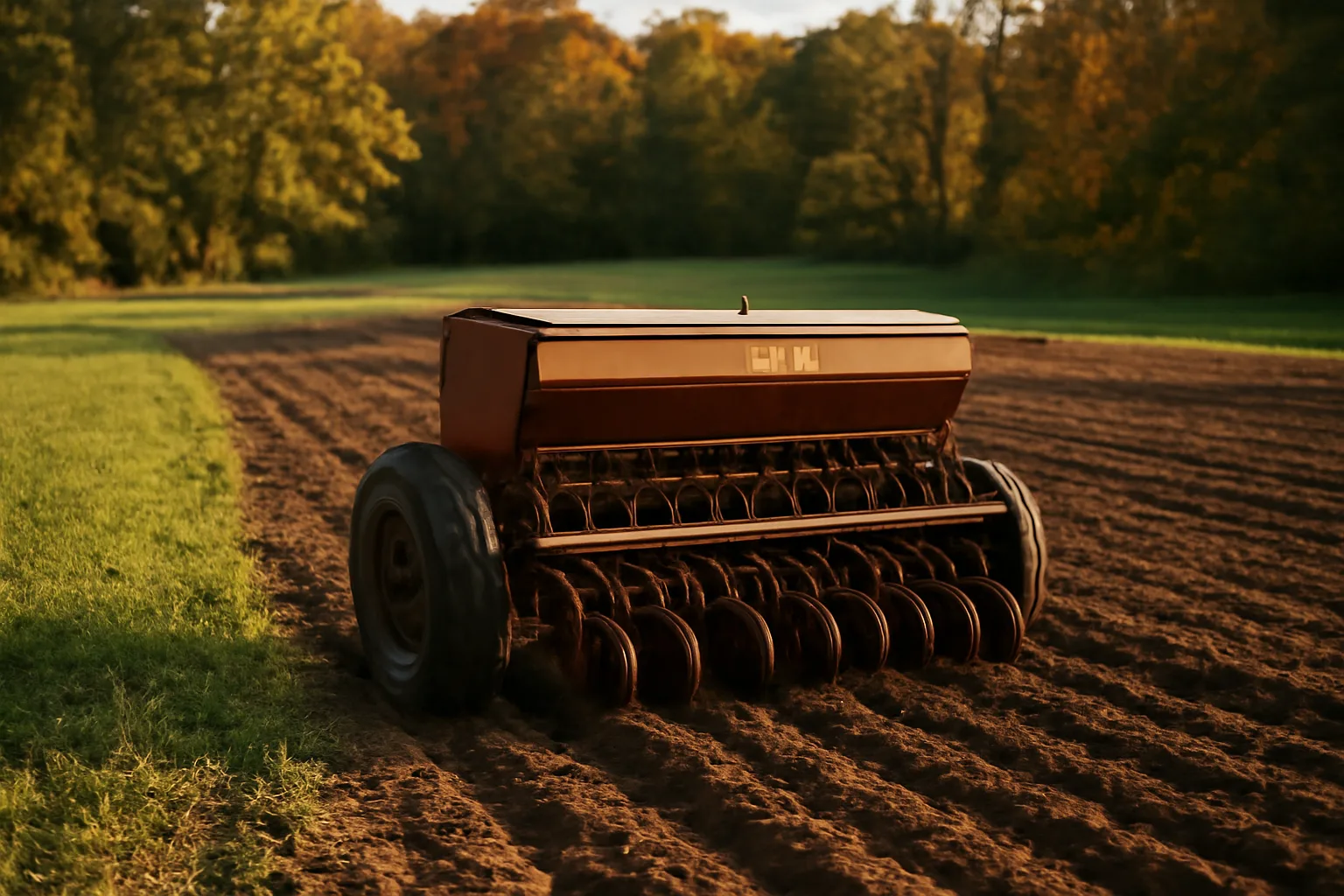
A Plotter's Choice planter is a compact pull-behind implement designed to plant food plot seed in one pass instead of three or four. Most models combine a seed hopper, a set of disc openers or coulters, and a rear roller or packer wheel, so you're cutting a shallow slot, dropping seed at a set rate, and pressing it into contact with soil all in one trip across the field. That matters because seed-to-soil contact is one of the biggest factors in germination for small-seeded species like clover and brassicas. USDA plant materials guidance on wildlife plantings points to firm seedbeds and correct planting depth as a major factor separating a thick stand from a thin, weedy one [1]. These planters are built for hunters running ATVs and UTVs, not full-size ag tractors, though some models scale up. They're marketed as a middle step between hand-broadcasting seed (cheap, but uneven and shallow) and a true grain-drill setup (precise, but expensive and heavy). For a guy planting one to five acres a year across a couple of plots, that middle step is where most Plotter's Choice buyers land. If you're still deciding what to plant before you worry about the machine, start with food plot seed basics and deer food plot seed selection, then come back to equipment.
How does a food plot planter actually work in the field?
You hook it behind an ATV, UTV, or small tractor, fill the hopper, set the seed metering gate for your species, and drive across ground that's already been disked, sprayed, or at least mowed down tight. The unit's front discs or coulters cut a shallow furrow, seed drops through a metering wheel or gravity feed, and a rear roller or drag chain closes the slot and firms it. Ground speed and metering setting drive your seeding rate more than anything else. Too fast and seed gets thrown wide or buried too deep; too slow and you waste seed piling it up. Most manufacturers publish a speed range (commonly 3 to 5 mph) and a metering chart for common species like clover, oats, and brassicas. This is the same principle land-grant extension programs teach for any drill: match rate to species and depth to seed size, because oversized planting depth is one of the most common reasons a clover or brassica plot fails to come up thick. A lot of buyers assume a no-till style planter means you can skip ground prep entirely. You can't skip it, you can just do less of it. Most manufacturers and extension bulletins still recommend killing existing vegetation with glyphosate or a disk pass first, especially on ground with heavy grass or weed pressure, because these planters are built to place seed, not fight through six inches of thatch.
What is a food plot, and why does the planter matter for it?
A food plot is a planted area, usually somewhere between a quarter-acre and a few acres, that's seeded with forage crops to attract and hold deer and other wildlife, and often to supplement their diet through parts of the year when natural browse is thin. State wildlife agencies generally treat food plots as a habitat management practice distinct from baiting, though the line between the two is legally important and varies by state. Pennsylvania's game code, for example, separates supplemental feeding restrictions from habitat plantings under its wildlife feeding rules. The planter is just the tool that gets seed into the ground correctly. A great seed blend planted too shallow, too deep, or into a rough seedbed with poor seed-to-soil contact will underperform a mediocre blend planted right. That's the entire case for spending money on a dedicated planter instead of a hand spreader: consistency. You're trying to remove the variables you can control (depth, rate, packing) so the variables you can't control (rain, deer pressure, frost timing) get a fair shot at working in your favor. For background on plot goals and layout before you get to planting mechanics, see food plot whitetail and deer food plots.
When should you plant food plots for deer?
Planting windows split into two broad seasons: spring/summer plots (usually warm-season annuals and perennials like clover, soybeans, or sorghum) and late-summer/fall plots (brassicas, oats, cereal grains, and winter blends). The exact calendar dates depend entirely on your USDA plant hardiness zone and your local frost dates, so a date that works in south Georgia can be six to eight weeks off from what works in Michigan. As a rough national pattern: spring plot species go in after your last frost date and once soil temperatures warm, typically April through May in the Midwest and Northeast, earlier in the South. Fall plots, especially brassicas and cereal grains, generally go in 60 to 90 days before your average first hard frost so plants have time to establish before growth slows. Your state or regional extension office publishes frost date tables and planting calendars specific to your county, and that's a better source than any generic national chart, because a Zone 5b spot in Iowa and a Zone 6a spot 200 miles away can still differ by two or three weeks.
When should you plant oats for deer food plots?
Oats are almost always a fall planting, going in as a late-summer to early-fall cereal grain that deer hit hard once the weather cools, usually alongside brassicas or in a straight stand. Most extension planting guides put oats in the ground 6 to 10 weeks before your first expected frost, which lines up with late August through September across most of the whitetail's range, and a few weeks earlier in the northern tier. Oats germinate fast, often in 7 to 10 days under decent soil moisture, and they green up quickly, which is part of why they're a go-to for guys who want a plot looking good by opening weekend of archery season. They don't survive hard winters like winter wheat or rye can, so in the Upper Midwest and Northeast, oats are more of an early-fall attraction crop than a plot that carries deer through January. A Plotter's Choice-style planter handles oats well because it's a larger seed that tolerates the discs and rollers on these units better than fine seed like clover does. Set your depth around 1 to 1.5 inches, which matches standard small-grain seeding depth recommendations from state extension small-grains guides [2].
When should you plant turnips for deer food plots?
Turnips go in as a fall brassica planting, and timing is less flexible than most people think, because turnips need a real stretch of cool growing weather to bulb up and sweeten before deer will hammer them. Most extension and university forage guides recommend planting turnips 70 to 90 days before your first killing frost, which usually lands in late July through August depending on your zone. Here's the part that trips people up: turnips are famous for the 'deer won't touch it until after frost' phenomenon. Cold temperatures convert starches in the bulb and leaves to sugars, which is why plots that look untouched in October can get hammered in December. If you plant turnips too late, you get a thin, small plant that never bulbs and never gets that sweetness shift, so late planting is the single most common reason a turnip plot underperforms. A planter with a fine-seed metering setting is worth having for turnips, since seed size is closer to clover than to oats or beans. Planting too deep is the second most common turnip failure; guidance generally recommends a seeding depth of just a quarter to half an inch.
Do deer eat sorghum, and is it worth planting?
Yes, deer eat sorghum, both the grain heads and the young forage growth, though it's more commonly planted as a summer cover and screening crop, or as a component in a wildlife blend, than as a stand-alone premium attraction crop. Grain sorghum matures late in the season and can hold seed heads into fall and winter, which gives you a food source when a lot of other summer annuals have already been grazed out or gone dormant. Sorghum is a warm-season crop, planted after soil temperatures reach the mid-60s Fahrenheit, generally the same planting window as corn and soybeans in a given region. It's also drought-tolerant compared to corn, which is a real advantage in dry summers or on sandy ground that won't hold moisture. If your main goal is pure attraction during archery season, sorghum by itself isn't usually the first pick. Most plotters lean on brassicas, clover, or beans for that instead. But as a screening plant, a component in a diverse summer blend, or a late-season grain source, it earns a spot in the rotation.
Do deer eat clover, and do they actually like it?
Yes, deer eat clover heavily, and it's one of the most consistently preferred forages across whitetail range, largely because it's high in protein and stays palatable through a long window from spring green-up through fall. Clover regularly shows up at or near the top of deer preference studies and extension forage comparisons, and its combination of high crude protein (commonly cited in the 20 to 25 percent range for quality stands) and long growing season is why it's the default perennial plot choice for so many hunters. Clover's biggest practical advantage is that it's a perennial, so a well-established stand can produce for three to five years with proper mowing, weed control, and fertility upkeep, instead of needing to be replanted every year like an annual brassica or cereal grain plot. That lowers your long-term cost per acre even though the seed itself isn't cheap up front. The catch with clover in a Plotter's Choice-style planter is seed size and depth. Clover seed is tiny, and planting depth should generally stay at or under a quarter inch, sometimes described as barely covered at all. Most planter manufacturers include a specific fine-seed metering box or reduced-rate setting for exactly this reason, because running clover through a standard grain metering wheel wastes seed and buries far too much of it too deep.
What's the difference between clover and other 'deer favorite' crops?
| Clover | Perennial, spring-fall | Very high, high protein | Long-season staple plot | |
|---|---|---|---|---|
| Soybeans | Warm-season annual | Very high while in vegetative stage | Summer attraction, high tonnage | |
| Brassicas (turnips, radish) | Fall annual | Low until frost, then very high | Late-season, post-frost draw | |
| Oats | Fall annual | High, fast green-up | Early-fall attraction | |
| Grain sorghum | Warm-season annual | Moderate, grain and forage | Cover, screening, late grain source | A planter that can handle both a fine seed like clover and a larger seed like oats or sorghum through adjustable metering is genuinely more useful than one built for a single seed type, if you're planting a rotation across multiple plots. |
There's no single scientifically ranked 'deer's favorite food' list that applies everywhere, because preference shifts by region, season, and what's available naturally. That said, extension and wildlife agency forage guides repeatedly put a handful of species at the top: clover, soybeans, cowpeas, and brassicas in fall, plus natural browse like honeysuckle, greenbrier, and acorns depending on mast availability. Acorns deserve a special mention, because in a heavy mast year deer will often walk past a food plot to hit a white oak flat, and that's not a plot failure, it's just deer behaving like deer. A lot of hunters see a quiet plot in a big acorn year and assume they did something wrong. Usually they didn't; the woods just won that year. Here's a quick comparison of common plot species and where they fit: | Species | Season | Deer preference | Best use |
Do deer like honey, or is that just internet noise?
There's no real evidence deer seek out honey as a food source, and it's not part of any established food plot strategy. Deer are herbivores built to digest plant fiber through a four-chambered rumen system, and their natural diet runs through browse, forbs, mast, and agricultural crops, not sugars from a beehive. Some hunters have tried using sweet liquid attractants or scent products marketed as containing honey or molasses-type ingredients, but that's a mineral/attractant category question, not a food plot planting question. It's also worth remembering that a lot of states restrict or outright ban baiting and supplemental feeding, including sweet attractant piles, so check your state wildlife agency's regulations before using anything like that near a stand. Pennsylvania, for instance, regulates feeding of wildlife directly under its game code . If you're trying to boost attraction on a real plot, the better lever is species selection and timing, not novelty additives. A well-timed brassica plot post-frost or a thick clover stand in July does more legitimate work than any bottled additive.
How do you match a Plotter's Choice planter to your ATV, UTV, or tractor?
Weight and hitch type are the two things to check before anything else. Most compact food plot planters in this category run somewhere between 150 and 400 pounds empty, and they add hopper weight on top of that once loaded with seed, so a mid-size ATV in the 400 to 700cc range can usually handle the smaller units, while heavier multi-row versions are better suited to a UTV or compact tractor with a category 1 three-point hitch or a pull-type drawbar setup. Check the manufacturer's tow rating and your own machine's rated towing capacity, more than what looks about right. An ATV rated for 1,000 to 1,500 pounds of towing is fine for most single-unit planters, but once you add a cultipacker or a second implement behind it, you can get close to that limit faster than people expect, especially on hills or soft ground. The other fit question is turning radius and plot shape. A pull-behind unit with a single hitch point turns tighter than one with a rigid tongue and wide wheelbase, which matters a lot on small, oddly shaped plots carved out of timber versus large, square agricultural fields.
What ground prep does a planter still need before you use it?
Even a no-till style planter isn't a magic fix for rough ground. Every credible extension planting guide starts with the same sequence: kill or suppress existing vegetation, then plant into a firm, mostly clean seedbed. For an existing plot with light weed pressure, that might mean a glyphosate application two to three weeks ahead of planting. For a brand-new plot cut out of woods or a fallow field, you're looking at disking, possibly liming and fertilizing per your soil test results, and then planting. Your soil test is the one piece of this nobody should skip, and it's also the piece a planter can't fix for you. Soil pH below about 6.0 locks up a meaningful amount of the phosphorus in an added fertilizer application, according to long-standing land-grant soil fertility guidance, which means you can plant perfectly with the best equipment on earth and still get a thin, yellow stand if your lime is years overdue . Send a sample to your state's soil testing lab or a private ag lab before you finalize your plan; the lab report is the actual authority on how much lime and fertilizer your specific field needs, not a generic blog rule of thumb. If you want a starting point for putting species, timing, and rough plot layout together before you get into the equipment weeds, a Custom Food Plot Plan built around your zone, plot size, and soil test results is a fast way to get a written plan for $99 one-time, though it's general guidance layered on your own soil test results, not a substitute for your lab's specific lime and fertilizer recommendations.
Is a Plotter's Choice planter worth the money compared to broadcasting or a full drill?
For someone planting one to five acres a year across a couple of plots, a compact planter usually pays for itself in seed savings and stand quality within a few seasons, mainly because broadcasting wastes seed to birds, uneven depth, and poor germination. A full ag drill is more precise and can be cheaper per acre if you're already renting or borrowing one, but it's often overkill in weight and cost for small food plot acreage, and a lot of them are sized for row-crop fields, not the tight, timber-adjacent plots most hunters actually have. The honest tradeoff: broadcasting is cheapest up front (a hand spreader costs a fraction of a planter) but wastes more seed and gives you a rougher stand, especially with small seed like clover and brassicas. A dedicated planter costs more up front but gives you consistent depth and seed-to-soil contact, which is where germination rates actually improve. If you're planting the same plots year after year and seed cost is adding up, the math tends to favor the planter within two or three seasons. For more on choosing seed blends before you finalize equipment, deer for food and domain food plot seed cover species-side decisions that pair with whatever planting method you land on.
Frequently asked questions
Do deer eat sorghum?
Yes. Deer eat both the grain heads and young forage growth of sorghum, though it's more often used as summer cover, screening, or a late-season grain component in a blend than as a stand-alone premium attraction crop. It's a warm-season planting, going in once soil temperatures reach the mid-60s Fahrenheit, similar to corn and soybean timing.
Do deer eat clover?
Yes, and clover is one of the most consistently preferred whitetail forages available, largely due to its high crude protein content, often in the 20 to 25 percent range for a healthy stand, and its long growing season from spring through fall. It's the most common perennial food plot choice across the whitetail's range.
When should you plant deer food plots?
It depends on species and your zone. Spring/summer plots like clover, soybeans, and sorghum go in after your last frost date, generally April through May in the Midwest and Northeast. Fall plots like brassicas and oats go in 60 to 90 days before your first hard frost. Your local cooperative extension office publishes frost date tables specific to your county.
Do deer like clover?
Yes, strongly. Clover ranks among the top preferred forages in most extension forage comparisons, and its palatability holds up across a long season, unlike some annuals that peak briefly. It's also a perennial, so a properly maintained stand can produce for three to five years without replanting.
When should you plant oats for deer?
Oats are a fall planting, generally going in 6 to 10 weeks before your first expected frost, which lands in late August through September across most whitetail range and earlier in the far north. They germinate quickly, often in 7 to 10 days, which is why they're popular for a fast green-up ahead of archery season.
When should you plant food plots for deer, spring or fall?
Most serious plotters run both. Spring/summer plots (clover, beans, sorghum) provide protein and cover through the growing season, while fall plots (brassicas, oats, cereal grains) provide a late-season energy source timed for hunting season. Which one matters more depends on your goals: herd health and antler growth favor spring plots, hunting attraction favors fall plots.
When should you plant turnips for deer?
Plant turnips 70 to 90 days before your first killing frost, usually late July through August depending on your zone. Turnips need a real cold snap to convert starches to sugars in the bulb and leaves, which is why deer often ignore a turnip plot until after the first hard frost, then hit it heavily through winter.
What is a food plot?
A food plot is a planted area, typically a quarter-acre to a few acres, seeded with forage crops to attract and support deer and other wildlife through parts of the year when natural browse is limited. State wildlife agencies generally treat it as a habitat management practice, distinct from baiting, though rules on that distinction vary by state.
What are deer's favorite foods?
There's no universal ranked list, since preference shifts by region and season, but clover, soybeans, cowpeas, fall brassicas after frost, and natural mast like acorns consistently rank at or near the top across extension forage studies. In a heavy acorn year, deer will often prefer natural mast over a planted food plot.
Do deer like honey?
There's no real evidence deer seek out honey as a natural food source. Deer digest plant fiber through a four-chambered rumen and their diet centers on browse, forbs, mast, and crops, not sugars. Some attractant products use sweet ingredients, but check your state wildlife agency's baiting and feeding rules before using any attractant near a stand.
Can I plant clover with a Plotter's Choice-style planter?
Yes, but use the fine-seed metering setting if the unit has one. Clover seed is tiny and needs a planting depth at or under a quarter inch. Running it through a standard grain metering wheel set for oats or beans usually buries it too deep and wastes seed.
Do I still need to disk or spray before using a no-till food plot planter?
Usually yes. No-till style planters place seed efficiently, but they're not built to cut through heavy existing vegetation or thatch. Most manufacturers and extension guides recommend killing weeds with glyphosate or a light disk pass first, especially on ground with heavy grass pressure, then planting into the cleaner seedbed.
Sources
- Pennsylvania Game Commission, Title 34 Game and Wildlife Code, feeding of wildlife: Food plots are treated as a habitat management practice distinct from baiting, though rules on the distinction vary by state
- Oklahoma State University Extension, fact sheet PSS-2132, Small Grains Production: Oats are typically planted 6 to 10 weeks before the first expected fall frost
- Kansas State University Extension, Grain Sorghum Production Handbook C-687: Grain sorghum is planted as a warm-season crop once soil temperatures reach the mid-60s Fahrenheit, similar to corn
- University of Georgia Extension, Bulletin 1391, Food Plots for Deer and Other Wildlife: Clover is one of the most preferred whitetail forages and quality stands commonly show crude protein in the 20 to 25 percent range
- University of Missouri Extension, publication G9101, Soil Fertility Guide: Soil pH below about 6.0 reduces the availability of phosphorus applied through fertilizer