Last updated 2026-07-25
TL;DR
A UTV food plot planter is a compact implement (pull-behind disk, seeder, or all-in-one unit) sized for ATVs and UTVs instead of tractors. They run roughly $150 for a basic drag harrow up to $8,000+ for a complete disk-seeder-cultipacker combo, and they work well on plots under 2 to 3 acres where a tractor can't get in or isn't worth owning.
What is a UTV food plot planter, exactly
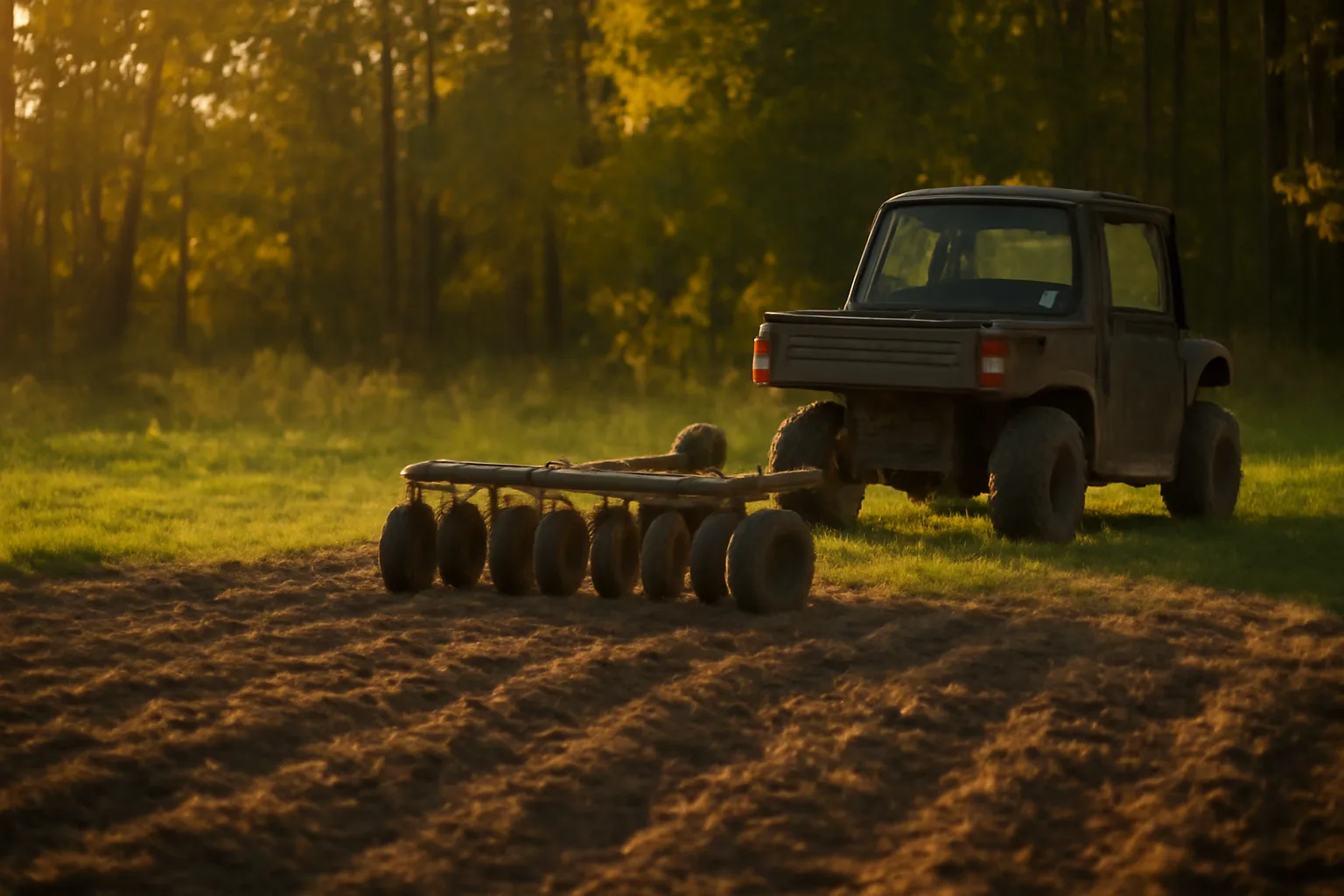
A UTV food plot planter is any seeding implement built light enough to pull behind an ATV or side-by-side instead of a tractor. That covers a lot of ground, from a $150 chain-link drag harrow to a $6,000-$8,000 all-in-one unit that disks, seeds, fertilizes, and cultipacks in a single pass. The common thread is weight and hitch design: these implements use a receiver-style or clevis hitch sized for a UTV's pulling capacity, usually somewhere between 1,000 and 2,500 pounds depending on the machine. Most hunters use the term loosely to mean "anything that lets me plant a plot without hauling in a tractor." That includes standalone disks, drag harrows, cultipackers, broadcast spreaders mounted on the UTV itself, and combo units that handle seedbed prep and seeding in one trip. Brands like Firminator, Woods, and Ranew's Outdoor Equipment all build UTV-scaled versions of their tractor implements. The appeal is simple. A tractor with a disk, drag, and cultipacker attachment costs more, needs a trailer to move between properties, and often can't fit through the same gates and trails a UTV can. For small food plots (a half acre to two or three acres) tucked into timber openings or clearcuts, a UTV rig gets the job done with less hassle and a smaller upfront bill. If you're mapping out what to plant before you buy equipment, a food plot whitetail overview or a deer food plot seed guide is worth reading first. Equipment choice should follow the seed choice, not the other way around.
How much does a UTV food plot planter cost
| Drag harrow / chain harrow | $150-$800 | Breaks light ground, covers seed | |
|---|---|---|---|
| Disk only (tow-behind) | $500-$2,000 | Breaks sod, works up seedbed | |
| Cultipacker | $400-$1,500 | Firms soil after seeding | |
| Broadcast spreader (UTV-mount) | $100-$400 | Spreads seed or fertilizer | |
| All-in-one combo unit | $1,500-$8,000+ | Disk, seed box, cultipacker in one pass | There's no independent third-party price survey for this category, so these ranges come from current retail listings and dealer pricing as of 2025, not a government or academic source. Expect regional variation and financing markups at farm stores. For a one to two acre plot, most hunters land in the $1,500 to $3,000 range for something that actually works the ground and seeds it in the same trip. That's a real cost difference against a $500 tractor implement rental or a neighbor's disk, so weigh how many plots you're planting and how often before buying. |
Prices split into three rough tiers. Basic drag harrows and disk-only units run $150 to $800. Mid-range combo implements (disk plus seeder plus cultipacker in one frame) run $1,500 to $4,000. Full-featured units with metering seed boxes, adjustable disk gangs, and a rear cultipacker roller run $4,000 to $8,000 or more. A broadcast spreader alone (mounted on the UTV's bed or a tow-behind cart) is the cheapest entry point at $100 to $400, but it does nothing for seedbed prep. You'd still need something to break ground and something to firm the seed in afterward. | Implement type | Typical price range | What it does |
Do I actually need a UTV planter, or will hand tools work
For plots under a half acre, hand tools and a UTV-mounted spreader often beat buying a disk. A hand-crank or ATV-mount broadcast spreader, a rake, and a lawn roller (or driving over the seed with UTV tires) can seed a small plot for under $200 total. Once you're planting more than a half acre, or you're dealing with sod and compacted ground instead of loose dirt, a disk becomes worth it. Hand tools can't break sod. You either need herbicide burndown and no-till drilling, or mechanical disking, and a UTV disk is the cheaper of those two paths for most small landowners. The honest break-even point: if you're planting one plot a year under an acre, skip the disk and rent or borrow one for the one day you need it. If you're maintaining three or more plots, or you plant twice a year (spring and fall), owning a UTV combo unit pays for itself in saved rental fees and saved weekends within two to three seasons.
When to plant food plots for deer
Timing splits into two windows: spring plots (May through June in most of the whitetail range) and fall plots (July through September, moving later as you go south). The exact date depends on your first and last frost dates, which your state's land-grant extension service publishes by county. Spring/summer plantings (soybeans, cowpeas, clover, chicory) go in after your last frost date, generally April in the Deep South up to early June in the northern tier and Canada. Fall plantings (brassicas, cereal grains, clover) need enough time before your first killing frost to establish roots and, for brassicas, build sugar reserves that make them attractive after frost. A widely cited rule from extension and wildlife agency guidance is to plant fall brassica and cereal grain plots 60 to 90 days before the average first frost date in your area. That gives brassicas time to bulb and cereal grains time to tiller before winter dormancy. Check your local frost dates through NOAA's climate normals or your state extension office rather than guessing by calendar date alone, since a "September planting" in Georgia and a "September planting" in Minnesota are entirely different windows [1].
When to plant oats for deer
Oats go in the ground in late summer to early fall, typically 6 to 8 weeks before your first expected frost, so they've got time to establish 4 to 6 inches of leaf growth before cold weather slows them down. In much of the whitetail range that lands in mid-August through mid-September. Oats are a cool-season annual grain and one of the most attractive fall food plot options for whitetails, especially in October and November before snow cover. They germinate fast, often within 7 to 10 days in warm, moist soil, which makes them a good option if you're planting late or want quick green-up. Oats do winterkill in most of the northern half of the country once temperatures drop into the low teens or single digits, so they're a fall-and-early-winter food source rather than a year-round planting. Pairing oats with a winter-hardy cereal like winter wheat or cereal rye extends attraction later into the season if that matters for your hunting calendar.
When to plant turnips for deer
Turnips go in 70 to 90 days before your first fall frost, which for most of the Midwest and mid-South lands in late July through mid-August. Turnips need that lead time to bulb out and build the sugar content that makes them palatable after a couple of frosts convert starches to sugars. Deer often ignore turnip bulbs and leaves early in the season and hit them hard after the first hard frosts, sometimes not until November or December. That's a normal pattern, not a sign of a failed plot. Extension guidance on brassica forage crops notes that a hard freeze improves palatability by increasing sugar content in the leaves and roots [2]. Plant turnips too late (inside 60 days of frost) and you'll get small, underdeveloped bulbs that don't hold much food value through winter. Plant them too early in warm soil and flea beetles can shred young seedlings before they establish, so timing within that 70-90 day window matters more with brassicas than with most other food plot species.
Do deer eat sorghum
Yes, deer eat grain sorghum, both the standing seed heads and the foliage, though it's generally considered a secondary food plot species rather than a primary draw. Sorghum is more commonly planted as a screening or bedding cover crop, or as a component in a fall blend, than as a standalone attractant. Grain sorghum is drought-tolerant and grows well in poor soils where corn struggles, which is part of why it shows up in food plot mixes across the southern and central states. Deer will browse young sorghum shoots and later feed on the mature grain heads, and turkey and other wildlife use it too. If your goal is maximum deer attraction, sorghum usually ranks behind soybeans, clover, and brassicas in preference studies and practical field observation. It works best as part of a multi-species blend or as standing cover next to a more attractive food source, not as the main course.
Do deer eat clover, and do deer like clover
Yes, deer eat clover readily, and it's one of the most consistently preferred food plot forages across the whitetail's range. Clover (both white clover varieties like Ladino and red clover) offers 20-25% crude protein in vegetative growth stages, which matters most in spring and summer when does are lactating and bucks are growing antlers [3]. Clover's advantage over annuals is that it's a perennial. A properly limed and fertilized clover plot can produce for 3 to 5 years before needing to be reseeded, versus replanting brassicas or grains every single year. That lower long-term cost is a big reason clover shows up in nearly every food plot rotation plan. Deer preference for clover holds up across regions and soil types, though clover struggles in acidic soil below pH 6.0 and in heavy shade, so a soil test matters more for clover than for almost any other plot species. Your soil test lab's lime and fertilizer recommendation is the final word here, not a generic online chart. If you want a starting point on species selection before you test soil, deer food plots and deer food plot seed cover the basics.
What is a food plot
A food plot is a planted area of forage crops, grasses, or grains established specifically to provide supplemental nutrition and attraction for deer and other wildlife on hunting land. Food plots range from quarter-acre kill plots tucked into timber to multi-acre agricultural-style fields planted in soybeans or corn. Food plots serve two overlapping purposes: nutrition (helping deer through stress periods like late summer antler growth or winter) and hunting access (concentrating deer movement in a spot with good wind and stand placement). Most serious food plot programs run a rotation across the year, spring plots for nutrition during antler growth and fawn-rearing, fall plots for hunting season attraction and winter carbohydrate reserves. State wildlife agencies generally regulate food plots differently from bait piles, since a growing crop isn't considered "placed feed" in most states, but rules vary widely and some states restrict hunting over food plots within certain distances of property lines or require the crop be planted using normal agricultural practice, more than dumped seed. Check your state wildlife agency's regulations before hunting over any plot, since baiting and feeding definitions differ state to state. For a broader overview of plot types and layout strategy, see food plot whitetail and domain food plot seed.
What are deer's favorite foods
Deer preference isn't uniform across the country, but several species show up consistently at the top of preference studies and food plot performance data: soybeans, clover, chicory, and brassicas (especially after frost) rank among the most preferred planted forages, while natural browse like acorns, honeysuckle, and greenbrier often outcompetes plots when mast crops are heavy. A University of Tennessee and Mississippi State body of food plot research consistently ranks perennial clover and soybeans among the highest-preference planted forages for whitetails in the Southeast, with brassicas gaining preference sharply after frost [2] [3]. That said, local mast conditions swing everything. In a heavy acorn year, deer will walk past a lush clover plot to hit a white oak flat, and no food plot planting schedule changes that. The honest answer for "favorite food" is that it depends on season, region, and what's naturally available that year. Soybeans and standing corn dominate in late summer and fall where legal and available. Clover holds appeal spring through fall. Brassicas and cereal grains take over once frost hits and temperatures push deer toward higher-carbohydrate, higher-sugar foods.
Do deer like honey
There's no real evidence deer seek out honey in the wild or that it functions as a meaningful food plot or attractant strategy. Deer are herbivores built around a rumen designed to digest plant fiber, not the simple sugars in honey, and no state wildlife agency or extension publication lists honey as a food plot input or established attractant. Some hunters use honey-based or honey-scented commercial deer attractant sprays, but that's a manufactured mineral or scent lure product, not a food source, and its effectiveness is not something extension research has evaluated in any way comparable to food plot species trials. If you're looking at attractant sprays or mineral products, check your state's baiting regulations first since many states classify any placed food or scent-based feed additive under the same baiting restrictions as corn piles.
How do I match a UTV planter to plot size and soil type
Plot size and existing ground cover (sod versus bare dirt versus old crop stubble) decide what implement you actually need, more than budget alone. Under a half acre, a spreader and drag harrow handle most jobs. A half acre to two acres in established sod needs a real disk to break ground before seeding. Two acres and up starts pushing UTV pulling capacity limits, and that's often where a small tractor becomes the better long-term investment. Heavy clay soils need more disk passes and more horsepower than sandy loam, so a UTV rated at the low end of its towing capacity (say, 1,000 pounds) may struggle in wet clay even with a light disk. Check your UTV's actual towing rating, more than engine size, before buying an implement that outweighs what the machine can safely pull. A soil test is step one regardless of equipment. Your soil test lab's lime and fertilizer recommendation is specific to your dirt and should drive what you plant and how much amendment you spread, not a generic chart. Once you know your soil pH and nutrient levels, the equipment question gets a lot simpler because you're not guessing at what the plot needs to support. If you want a plan built around your specific soil test results, plot size, and region, that's exactly the gap a $99 Custom Food Plot Plan is built to fill: species selection, seeding rates, and a planting calendar matched to what your dirt and your equipment can actually do.
What features actually matter on a UTV food plot planter
Disk gang adjustability matters more than disk count. Being able to angle the gangs steeper for aggressive ground-breaking in sod, then flatten them for light seedbed finishing, means one implement covers both initial plot establishment and yearly maintenance disking. A metering seed box beats broadcasting for row crops like corn or soybeans, and it's not needed for broadcast species like clover, brassicas, or cereal grains, which get spread evenly on top of prepared soil and cultipacked in. If your plot rotation is mostly broadcast species, don't pay extra for a precision seed box you won't use. A rear cultipacker roller (the ribbed roller that firms soil after seeding) genuinely improves germination rates by ensuring good seed-to-soil contact, especially for small-seeded species like clover that fail badly if planted too deep or left exposed on the surface. If your combo unit doesn't include one, budget for a separate tow-behind cultipacker or expect to drive over the seed with UTV tires as a rough substitute. Hitch weight rating and ground clearance matter for getting the implement to remote plots through rough trails. A wider implement (6 feet or more) covers ground faster but may not fit through tight logging trails or gates that a narrower 4-foot unit clears easily.
Frequently asked questions
Do deer eat sorghum?
Yes, deer eat both sorghum foliage and mature grain heads, but it's usually planted as a secondary species or screening cover rather than a primary attractant. Soybeans, clover, and brassicas typically outrank sorghum in deer preference, so sorghum works best mixed into a fall blend or used as standing cover.
Do deer eat clover?
Yes, clover is one of the most reliably preferred food plot forages for whitetails across most of the country. It offers 20-25% crude protein during active growth and, as a perennial, can produce for 3 to 5 years once established, provided soil pH stays above roughly 6.0 for good growth.
When should I plant food plots for deer?
Spring/summer plantings (soybeans, clover, cowpeas) go in after your last frost date, generally April to early June depending on latitude. Fall plantings (brassicas, cereal grains) go in 60 to 90 days before your first fall frost. Check your county's frost dates through NOAA climate normals or your state extension office rather than a fixed calendar date.
Do deer like clover better than other food plot crops?
Clover ranks among the top preferred forages in extension food plot research, especially in spring and summer, though preference shifts seasonally. Brassicas and cereal grains often out-draw clover after frost, and deer will favor heavy mast (acorns) over any planted forage in a good mast year.
When should I plant oats for deer?
Plant oats 6 to 8 weeks before your first expected frost, typically mid-August through mid-September across most of the whitetail range. Oats germinate quickly (7 to 10 days in warm soil) but winterkill once temperatures drop into the low teens, so they're a fall and early-winter food source, not a year-round planting.
When should I plant turnips for deer?
Plant turnips 70 to 90 days before your first fall frost, generally late July through mid-August in most of the Midwest and mid-South. That window gives bulbs time to develop before a hard frost converts starches to sugars, which is when deer typically start hitting turnips hard, often not until November or December.
What is a food plot?
A food plot is a planted area of forage, grain, or browse crops established on hunting land specifically to supplement deer nutrition and concentrate movement for hunting purposes. Plots range from quarter-acre timber openings to multi-acre agricultural fields, and most programs rotate spring plantings for nutrition with fall plantings for hunting season attraction.
What are deer's favorite foods?
Soybeans, clover, chicory, and frost-sweetened brassicas rank consistently high in food plot preference studies, but natural mast like acorns often outcompetes any planted crop in a heavy mast year. Preference shifts by season: clover in spring and summer, standing beans and corn in fall, brassicas and grains after frost.
Do deer like honey?
There's no credible evidence deer seek out honey as a food source; their digestive system is built around fibrous plant material, not simple sugars. Honey-scented commercial attractant products exist, but they're scent lures, not nutrition, and their effectiveness hasn't been evaluated the way food plot species have in extension trials.
How big should a food plot be for a UTV planter to handle it efficiently?
UTV-scaled implements work best on plots from a quarter acre up to about 2 to 3 acres, based on typical UTV towing capacities of 1,000 to 2,500 pounds. Beyond 3 acres, a small tractor generally becomes more time-efficient and less strain on the UTV's drivetrain and hitch.
Is a UTV food plot planter worth the cost compared to renting a tractor?
If you're maintaining one small plot a year, renting or borrowing a disk is usually cheaper than buying. If you maintain three or more plots, or plant spring and fall every year, a $1,500 to $4,000 UTV combo unit typically pays for itself within two to three seasons in saved rental costs and time.
Can I use a UTV planter without a soil test first?
You can, but you're guessing at lime and fertilizer needs, which wastes money and often produces a weak stand regardless of equipment quality. A soil test from your local extension office or a private ag lab tells you exact pH and nutrient levels; that lab's recommendation should drive your amendment rates, not a generic online chart.
Do I need a metering seed box on a UTV planter?
Only if you're planting row crops like corn or soybeans that benefit from precise seed spacing and depth. Broadcast species like clover, brassicas, and cereal grains get spread over prepared soil and cultipacked in, so a broadcast spreader attachment works fine and costs far less than a precision metering box.
Sources
- NOAA National Centers for Environmental Information, Climate Normals: County-level frost date and climate normal data used to time plantings
- University of Georgia Extension, Brassicas: A Winter Forage Alternative: Hard frost improves palatability of brassica forage by increasing sugar content in leaves and roots
- USDA NRCS Plant Guide, White Clover (Trifolium repens): White clover forage quality and its use as a high-protein perennial forage for wildlife
- Auburn University Extension, Wildlife Food Plots: Clover and soybeans rank among the highest-preference planted forages for whitetail deer, with brassica preference increasing after frost
- Michigan Compiled Laws, Natural Resources and Environmental Protection Act, Baiting and Feeding of Deer, MCL 324.40111a: State law defines and restricts baiting and feeding of deer separately from standing planted crops, and these definitions vary by state