Last updated 2026-07-26
TL;DR
The best ATV plow for food plots depends on your soil and ground cover. Disc harrows handle established sod and tilled soil, chisel plows break new ground, and box blades finish and level. Most hunters end up needing a disc plus a cultipacker or drag, not a single do-it-all tool. Budget $150 to $2,500 depending on size and features.
What is a food plot, and why does the plow you pick matter?
A food plot is a planted patch of ground, usually somewhere between a quarter acre and a few acres, seeded with forage or grain to feed and hold deer on land you own or lease. Extension publications describe food plots as a supplemental habitat tool, not a replacement for natural browse, cover, and water [1]. The plot itself is only as good as the seedbed underneath it, and that's where the plow comes in. Here's the thing nobody tells you at the farm store: there's no single "best" ATV plow. A disc harrow that works great breaking up thick fescue sod is overkill for touching up a plot you planted last fall. A chisel plow that rips through compacted clay does nothing useful in loose, sandy soil that's already broken. The right tool depends on what your ground looked like before you showed up with a four-wheeler. Most small-plot guys (under 3 acres, working with a 400cc to 700cc ATV or UTV) end up owning two or three implements over time, not one. That's normal. Don't expect to buy a single $300 plow and have it handle everything from breaking sod to finishing a seedbed. If you're still deciding what to plant before you worry about tillage, it helps to nail down your food plot seed choice first, since seed size and depth requirements change how fine you need your seedbed.
What's the difference between a disc, chisel plow, and box blade for ATV work?
| Chisel plow | Breaking compacted or new ground | $200 to $500 | No, needs disc/drag after |
|---|---|---|---|
| Disc harrow | General tillage, working in lime/fertilizer, finishing | $150 to $1,500 | Mostly, may need a drag |
| Box blade | Leveling, grading ruts | $150 to $400 | No, it's a finishing tool |
| Cultipacker/drag | Firming seedbed before/after seeding | $50 to $1,000+ | Yes, this is the final step |
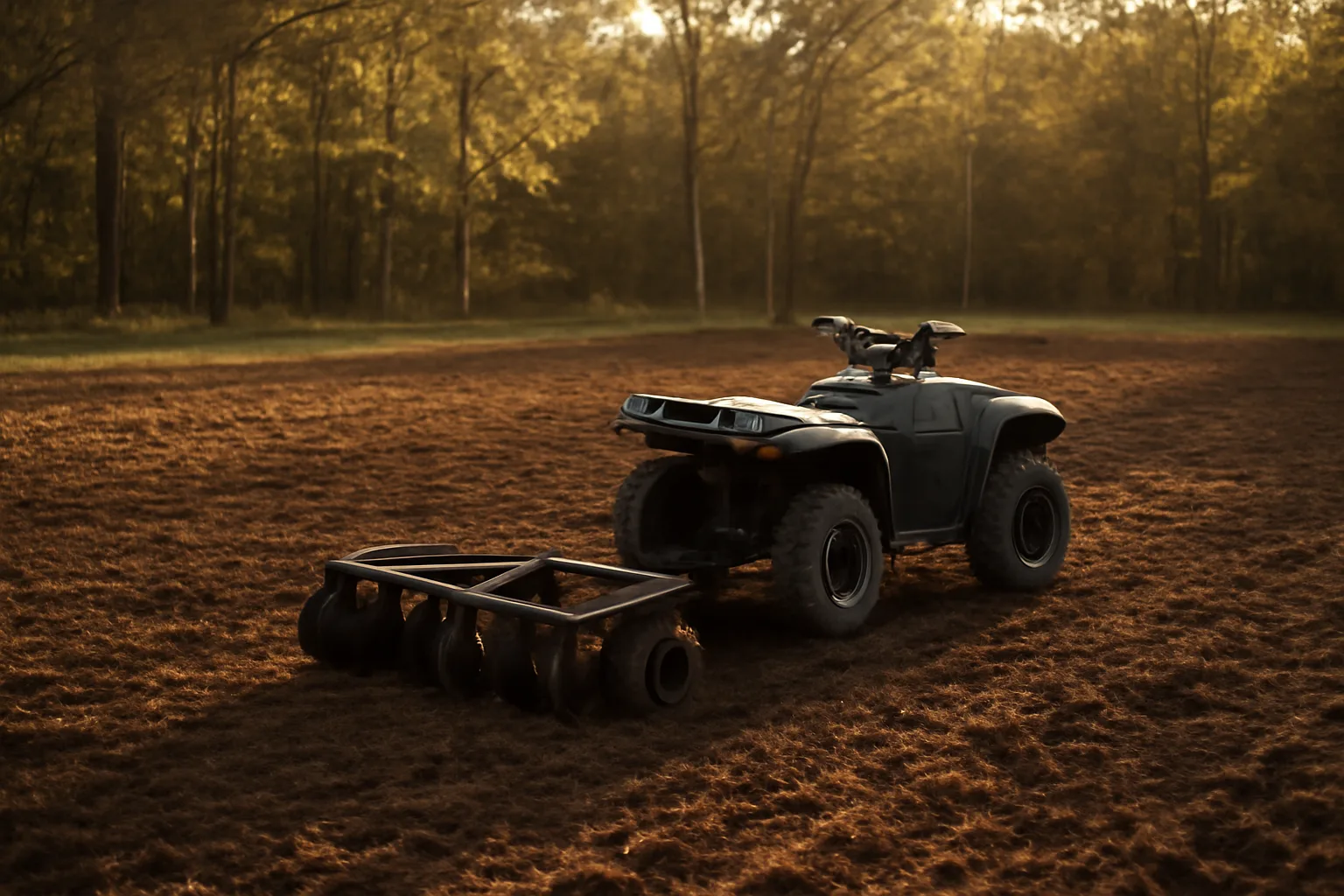
Each implement does one job well and struggles outside that job. Knowing the difference saves you from buying the wrong $400 tool. Disc harrows use angled concave discs to cut and turn soil. They're the most common ATV implement for food plots because they handle so many conditions well: breaking light sod, working in lime or fertilizer, and finishing a seedbed after a chisel plow has done the heavy lifting. A basic 4-foot pull-behind disc for ATVs runs $150 to $600 depending on disc size and gang spacing. Bigger discs (5 to 6 feet) built for UTVs or small tractors run $600 to $1,500. Chisel plows use shanks (rigid or spring-loaded) to rip through compacted or root-bound soil without fully inverting it. They're the right call for breaking new ground, old logging roads, or soil that's been compacted by equipment or years of no-till. A basic ATV chisel plow costs $200 to $500. They leave a rough surface, so you'll almost always need to follow with a disc or drag. Box blades are flat steel boxes with cutting edges and sometimes small rippers on the back. They're a leveling and grading tool, not a primary tillage tool. Use one to smooth ruts, fill low spots, or knock down clods after discing. A 4-foot ATV box blade costs $150 to $400. Cultipackers and drags aren't technically plows, but no seedbed conversation is complete without them. A cultipacker firms the soil after seeding, which matters enormously for small seeds like clover and brassicas that need good seed-to-soil contact. Cheap chain-link drags cost $50 to $150; a real cultipacker runs $400 to $1,000+. | Implement | Best for | Typical ATV price range | Leaves seedbed ready? |
What size ATV or UTV do you need to pull a food plot plow?
For a basic 4-foot disc or chisel plow on soft, already-worked ground, a 400cc ATV with a receiver hitch handles it fine. Once you're breaking new sod, working clay, or running a 5-foot-plus implement, you want something in the 500cc to 700cc range, or a UTV with a winch and lower gearing. Weight matters more than horsepower here. A lightweight ATV can spin its tires in wet clay before it ever moves a heavy disc. Adding wheel weights, water-filled tires, or just riding two-up (safely, on flat ground) can help traction on tough pulls. If you're regularly breaking new ground larger than an acre, a compact tractor with a 3-point disc starts making more economic sense than fighting an ATV all day, but for the 1/4 acre to 2 acre plots most lease hunters plant, ATV-scale implements are the right tool.
When should you plant food plots for deer?
Timing depends on what you're planting and where you hunt, but the two big windows are spring (May through June) for warm-season plots like soybeans and clover, and late summer (July through September) for fall annuals like brassicas, oats, and cereal grains. State wildlife agencies and extension services generally break plot planting into these two seasons because soil temperature and frost dates drive germination [2]. Spring plots: clover, chicory, and soybeans go in after your last frost date, once soil temps are consistently above 50°F. Check your local extension office's frost date charts, since "spring" in southern Georgia and "spring" in northern Wisconsin are two months apart. Fall plots: brassicas (turnips, radishes) and cereal grains (oats, wheat, rye) are typically planted 60 to 90 days before your first expected fall frost, which puts most of the country in a late July to early September window. Planting too early in hot, dry conditions risks poor germination; planting too late means plants don't have time to establish before deer start browsing them hard or before cold shuts down growth. Your state wildlife agency's food plot guidance and your county extension office are the best sources for exact local windows, since they're calibrated to your actual growing season, not a national average.
When should you plant oats for deer?
Oats for deer are almost always a fall planting, going in 6 to 10 weeks before your first killing frost so plants reach the 6 to 8 inch grazing stage right as hunting season opens. In most of the whitetail's range that means a window from mid-August in the north to late September in the mid-South. Oats are a cool-season annual grass. They germinate fast (5 to 10 days in warm soil), tolerate light frost, and are one of the most palatable fall forages available, often preferred over brassicas early in the season before a hard frost sweetens the turnips and radishes. Plant oats at roughly 100 to 130 lbs/acre if drilled, more if broadcast, into a firm, worked seedbed at about 1 inch depth. A light disc pass followed by a cultipacker gives you the seed-to-soil contact oats need; they don't do well broadcast onto rough, cloddy ground with no cultipacking at all. A spring oat planting works too, mainly as a nurse crop or quick cover ahead of a summer planting, but it won't hold up as forage through hot months the way it does as fall feed.
When should you plant turnips for deer?
Turnips for deer go in during late summer, typically 80 to 90 days before your average first fall frost, since they need that runway to bulb out and reach peak palatability after a hard frost converts starches to sugars. For most of the whitetail range that's a planting window from late July (far north) through early September (mid-South). Turnips are planted shallow, about 1/4 to 1/2 inch deep, at 4 to 6 lbs/acre if drilled alone, less if blended with other brassicas or grains. They need a fine, firm seedbed because the seed is tiny; a rough, cloddy field from a chisel plow pass with no follow-up disc and cultipack will give you spotty germination. This is exactly where the disc-then-cultipack sequence earns its keep. Deer often ignore turnip tops and bulbs early in fall, then hit them hard after the first frost or two, so don't panic if a turnip plot looks untouched in October. That's normal, not a sign you did something wrong.
Do deer eat sorghum, and is it worth planting?
Yes, deer eat sorghum, particularly the grain heads and young leaves, but it's more commonly planted as a screening or structural crop (tall cover, wind blocks, or a nurse crop for other species) than as a primary attractant. Grain sorghum and forage sorghum are both used in food plot mixes, often blended with soybeans or cowpeas. Deer will browse sorghum leaves when young and eat the mature grain heads, especially in fall and winter when other food sources decline, but it's rarely a deer's first choice when clover, soybeans, or brassicas are available nearby. Most experienced plotters treat sorghum as a secondary or structural planting rather than the centerpiece of a plot.
Do deer eat clover, and do they actually like it?
Yes, deer eat clover heavily, and it's one of the most consistently preferred food plot forages across the whitetail's range. Extension research on forage preference and food plot species repeatedly lists clover among the top choices for both nutritional value and deer use [1]. White clover (Dutch, ladino types) and red clover are both common in food plot blends. Clover offers 20 to 30% crude protein in good growing conditions, which matters most in spring and summer when does are lactating and bucks are growing antlers. It's also a perennial in most climates, meaning a well-maintained clover plot can produce for 3 to 5 years before it needs to be replanted, which makes it one of the better costs-per-year values in food plot seed. The catch: clover needs decent soil pH (extension guidance generally recommends 6.0 to 6.5) and needs mowing or spot-spraying to keep grass and weeds from choking it out over multiple seasons [3]. A soil test is the only way to know if your clover ground needs lime, and how much.
What are deer's favorite foods, really?
There's no single universal answer, because preference shifts by season, region, and what's available naturally, but research and extension data consistently point to a short list: clover, soybeans, acorns (white oak group especially), and agricultural crops like corn and alfalfa when available. Deer are also highly selective browsers of native forbs and woody browse outside of food plots, which is why food plots supplement rather than replace natural habitat [1]. Within food plot species specifically, soybeans and clover tend to top preference studies for palatability and use during the growing season, while brassicas and cereal grains take over as fall and winter staples once frost sweetens them and other green forage dies back. Corn is heavily used but mainly as an energy source in late fall and winter, not a preferred browse during the growing season. Bottom line: there's no magic seed that outperforms everything else everywhere. What deer prefer on your ground depends heavily on what's already growing around your plot. A clover plot surrounded by ag fields full of soybeans won't get hit nearly as hard as the same clover plot in the middle of hardwoods with little other green forage.
Do deer like honey, or is that a myth?
There's no real biological basis for deer preferring "honey" as bait or attractant in the way it's sometimes marketed, and most commercial "honey" or "honeysuckle"-labeled deer attractants rely on scent, sugar, or molasses-based additives rather than actual honey. Deer are drawn to sugar and salt more broadly, which is why molasses-based mineral licks and sweet feed products get attention, not because honey itself is a preferred food. More relevant for food plotters: japanese honeysuckle (a woody vine, not honey the substance) is a browse species deer do eat readily in the eastern U.S., and this is likely where some of the "deer like honey" confusion comes from. If you're seeing "honey" in a product name at the hunting store, read the actual ingredient list rather than assuming it means anything about deer nutrition. Also worth flagging here: many states restrict or ban baiting and supplemental feeding for deer, including sugar-based attractants, separate from food plot planting rules. Bait and feeding regulations vary a lot state to state and sometimes county to county, so check your state wildlife agency's current baiting and feeding regulations before using any attractant product, scent, or mineral supplement.
How do you match your plow choice to your soil test results?
Your soil test tells you pH and nutrient levels, not tillage needs, but the two are connected. Heavy clay soils that test low in organic matter often need more aggressive tillage (chisel plow first) to break compaction before lime and fertilizer can work into the root zone. Sandy or loamy soils that already have decent structure may only need a disc pass to incorporate amendments. Your state land-grant extension soil testing lab is the actual authority on how much lime and fertilizer your specific field needs. Recommendations vary by crop, current pH, and buffer index, and a general food plot article (this one included) can't replace a site-specific soil test result. Most state extension labs charge somewhere between $7 and $20 per sample and turn results around in 1 to 3 weeks [4]. Once you have your test back, the plow's job is simple: get lime and fertilizer mixed into the top 4 to 6 inches of soil where roots will actually use it. Surface-applied lime without incorporation can take years longer to move pH where you need it, according to extension soil fertility guidance [3]. That's the real argument for owning a disc even if you think your ground is already "good enough." If you want a plan built around your specific soil test numbers, target species, and region instead of general advice, that's exactly the gap our $99 one-time Custom Food Plot Plan is built to fill; you send us your soil test and goals, and it's built around your ground at /plot-plan-builder, not a national average.
What's a realistic ATV plow setup and budget for a first-time food plotter?
For someone planting their first 1 to 2 acre plot on a 500cc ATV, a realistic starter setup is a 4-foot disc harrow ($200 to $400), a basic drag or small cultipacker ($100 to $300), and a hand-crank or ATV-mount broadcast seeder ($40 to $150). That's roughly $350 to $850 total, and it covers 90% of what you'll need for maintaining an established plot or working ground that's already been broken once. If you're breaking brand new ground, sod, or old logging roads, add a chisel plow ($200 to $500) to that list, since a disc alone will bounce off hard-packed or heavily rooted soil rather than cutting into it. Skip the temptation to buy the biggest, heaviest implement your ATV can theoretically pull. A 6-foot disc on a 400cc ATV in wet clay just means a lot of spinning tires and a frustrating afternoon. Match implement size to your machine's actual weight and torque, not its top speed on the highway. For species and seeding rate decisions once your seedbed is ready, it's worth reading through deer food plot seed options and food plot whitetail planning basics so your tillage and your seed choice actually match up.
Frequently asked questions
What is a food plot for deer hunting?
A food plot is a planted area, usually a quarter acre to a few acres, seeded with forage crops like clover, brassicas, or cereal grains to supplement natural deer nutrition and hold deer on a property during hunting season. Extension guidance treats food plots as a supplemental habitat tool, not a substitute for natural browse, cover, and water sources.
What size disc do I need for a food plot ATV plow?
A 4-foot disc harrow works for most food plots under 2 acres pulled by a 400cc to 700cc ATV. Larger plots or heavier soils may need a 5 to 6 foot disc, but that usually calls for a UTV or compact tractor rather than a standard ATV, since traction and weight become the limiting factor, not horsepower.
Do I need both a chisel plow and a disc harrow?
Only if you're breaking new ground or heavily compacted soil. A chisel plow rips and loosens; a disc harrow cuts, mixes, and levels. For maintaining an already-established plot, a disc alone usually does the job. For brand new sod or old roads, run the chisel plow first, then follow with a disc.
Do deer eat sorghum in food plots?
Yes, deer eat sorghum grain and young leaves, especially in fall and winter, but it's typically planted as a screening or structural crop and blended with other species rather than used as a standalone attractant. Clover, soybeans, and brassicas are generally preferred when available nearby.
Do deer like clover, and how long does a clover plot last?
Yes, clover is one of the most consistently preferred food plot forages, offering 20 to 30% crude protein in good conditions. A well-maintained perennial clover plot with proper pH (6.0 to 6.5) and periodic mowing can produce for 3 to 5 years before needing replanting.
When should I plant food plots for deer?
Spring plantings (clover, soybeans, chicory) go in after your last frost date, once soil temps top 50°F. Fall plantings (brassicas, oats, cereal grains) go in 60 to 90 days before your first fall frost. Exact dates depend heavily on your region, so check your local extension office's frost date charts.
When should I plant oats for deer food plots?
Plant oats 6 to 10 weeks before your first fall frost, generally mid-August in northern states through late September in the mid-South. Oats germinate in 5 to 10 days and are one of the more palatable early-fall forages, especially before a hard frost sweetens brassicas.
When should I plant turnips for deer?
Plant turnips 80 to 90 days before your average first fall frost, typically late July through early September depending on region. They need a fine, firm seedbed because the seed is tiny, so disc and cultipack before broadcasting rather than planting into rough, cloddy ground.
What are deer's favorite foods overall?
There's no single universal favorite, but clover, soybeans, acorns from the white oak group, and agricultural crops like corn and alfalfa consistently rank high in preference research. Preference shifts seasonally: soybeans and clover dominate during growing season, while brassicas and grains take over after frost.
Do deer actually like honey?
There's no real evidence deer are drawn to honey the substance. Commercial 'honey' branded attractants typically use sugar or molasses additives, and deer respond to sugar and salt broadly, not honey specifically. The confusion may stem from japanese honeysuckle, a woody vine deer readily browse.
Can I use a box blade instead of a disc for food plot prep?
No, a box blade is a leveling and grading tool, not a primary tillage implement. It smooths ruts and knocks down clods after discing, but it doesn't cut or turn soil the way a disc or chisel plow does. Use it as a finishing step, not a replacement.
How much does a basic ATV food plot plow setup cost?
A starter setup with a 4-foot disc harrow, a drag or small cultipacker, and a broadcast seeder runs roughly $350 to $850 total. Add a chisel plow ($200 to $500) if you're breaking new ground or heavily compacted soil rather than maintaining an established plot.
Do I need to check state rules before planting a food plot?
Food plot planting itself is generally legal everywhere, but baiting and supplemental feeding rules vary significantly by state and sometimes by county, especially around minerals, sugar-based attractants, and hunting over bait. Check your state wildlife agency's current regulations before adding any attractant beyond the planted forage itself.
Sources
- Mississippi State University Extension, Publication 2751: "Establishing and Managing Wildlife Food Plots": Food plots are described as a supplemental habitat tool rather than a replacement for natural browse, cover, and water
- University of Georgia Extension, Circular 1055: "Food Plots for Wildlife": Food plot planting is generally split into spring (warm-season) and late summer/fall (cool-season) windows tied to frost dates
- University of Missouri Extension, Publication G9101: "Soil Sampling for Testing": Clover requires soil pH generally in the 6.0 to 6.5 range and surface-applied lime moves into the root zone slowly without incorporation
- Clemson University Cooperative Extension, Agricultural Service Laboratory Fee Schedule: Land-grant extension soil testing labs typically charge roughly $7 to $20 per sample with results in 1 to 3 weeks
- Michigan State University Extension: Turnips and other brassicas should be planted in late summer for optimal fall deer forage
- University of Georgia Extension: Grain sorghum can serve as a supplemental deer food plot crop but is less preferred than other forages