Last updated 2026-07-25
TL;DR
There's no single best food plot seeder for everyone. Small plots under an acre do fine with a $50-150 hand-crank or ATV broadcast spreader. Half-acre to five-acre plots benefit from a $300-1,500 ATV/UTV pull-behind unit with a seed and cultipacker option. Larger tracts justify a tractor-mounted drill or broadcaster, often $1,500-5,000+.
What is a food plot, and why does the seeder matter?
A food plot is a planted area on hunting land, usually a fraction of an acre up to several acres, seeded with forage or grain that attracts and holds deer through part or all of the year. It's more than corn tossed in a field. A good plot works with soil type, sunlight, moisture, and deer pressure to grow something deer will actually eat at the time you need them there. The seeder matters more than most people think. Broadcast too heavy and you waste $40-a-bag clover seed and get overcrowded, weak plants. Broadcast too light or unevenly and you get bare patches that turn into weed beds by August. The right tool gets seed-to-soil contact close to what the label recommends, which for most food plot seed means a shallow drop of 1/4 inch to 1/2 inch depending on species. Think of the seeder as the delivery mechanism for a plan you've already made on soil type and species. If you haven't nailed down what to plant based on your soil test, that decision comes first. A food plot seed choice built around your dirt, not around what's on sale, saves you money on seeder capacity too, since some seeds (like small brassica or clover) need a fraction of the rate corn or soybeans do.
What are the main types of food plot seeders?
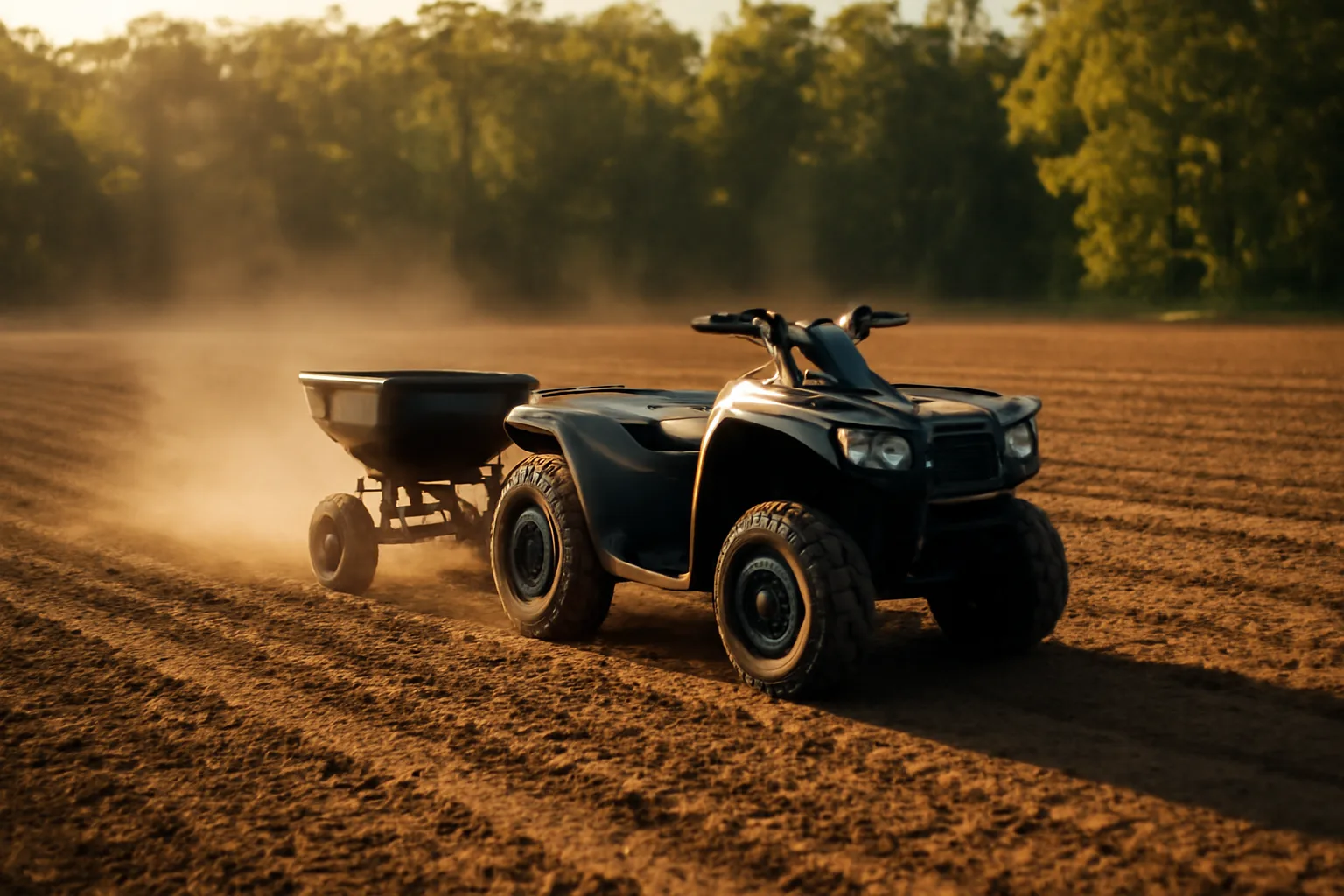
Food plot seeders break into four rough categories: hand-crank broadcasters, ATV/UTV tow-behind broadcasters, tractor-mounted broadcast spreaders, and drills (including no-till drills). Each fits a different plot size, budget, and soil prep level. Hand-crank or handheld broadcasters cost $20-80 and work fine for plots under a half acre, or for overseeding small brassica or clover patches. They're slow and inconsistent on windy days, but for a small kill plot tucked in timber, they're often all you need. ATV/UTV tow-behind broadcasters run $150-600 for basic models, up to $1,500-2,000 for units with built-in cultipackers or agitators for fluffy seed like clover. These are the workhorse choice for most food plotters managing 1-10 acres across a few fields, because they cover ground fast and handle a mix of seed sizes. Tractor-mounted broadcast spreaders (three-point hitch, PTO or ground-driven) run $500-3,000 and make sense once you're seeding 10+ acres or running a 35-plus horsepower tractor already for tillage. No-till drills are the priciest option, often $3,000-15,000+ used, but they place seed at a controlled depth without full tillage, which matters a lot for small-seeded species like clover and brassica that fail if buried too deep. Many state extension offices and soil and water conservation districts rent no-till drills to landowners at $10-25 per acre, which is often the smartest move if you only need one for a weekend.
How do I choose the right seeder for my plot size?
| Under 0.5 acre | Hand-crank or handheld broadcaster | $20-80 | |
|---|---|---|---|
| 0.5 to 3 acres | ATV/UTV tow-behind broadcaster | $150-800 | |
| 3 to 10 acres | ATV/UTV broadcaster with cultipacker, or small tractor spreader | $800-2,500 | |
| 10+ acres | Tractor-mounted broadcaster or drill | $1,500-15,000 | If your land has multiple small plots scattered across different stand sites, an ATV setup usually wins even at low total acreage, because you need the mobility to move between plots without hauling a tractor down a trail. If you're planting one big field, a tractor spreader or drill earns its cost back in time saved and seed placed correctly. A lot of readers ask us to help size this out as part of a broader planting plan. That's part of what we build into the $99 Custom Food Plot Plan, which factors in your acreage, soil test results, and species mix before recommending equipment scale, more than seed type. |
Match the seeder to your acreage, not your budget wish list. Buying a $2,000 tractor spreader for a 0.3-acre plot behind your stand is a waste of money; a $60 hand spreader does the same job in ten minutes. Here's a rough sizing guide based on total food plot acreage across your property: | Total plot acreage | Best-fit seeder type | Typical cost |
When to plant food plots for deer?
Timing depends on species and region, but most food plots go in during one of two windows: spring (April-June) for warm-season plots like soybeans, corn, and sorghum, or late summer to early fall (August-September) for cool-season plots like clover, brassica, and cereal grains such as oats and wheat. Cooperative extension guidance generally splits the country into planting zones tied to first and last frost dates. In the Midwest and Upper South, cool-season plots typically go in from mid-August through mid-September, giving brassica and cereal grains time to establish before frost slows growth [1]. In the Deep South and along the Gulf Coast, that window can push into October because of longer growing seasons and hotter late-summer soil temperatures. Spring plantings for warm-season annuals usually follow your local last-frost date, often late April in the Upper Midwest and Northeast, and March in the Deep South, per USDA's Plant Hardiness Zone data used by most extension programs to set planting windows. The short version: don't plant by the calendar alone. Check your local soil temperature and frost dates, and lean on your state extension's specific guidance, since "food plot season" varies by 6-8 weeks across a state like Georgia versus Michigan.
When to plant oats for deer?
Oats for deer food plots are almost always a fall planting, typically 6-8 weeks before your area's first hard frost. That puts most of the Midwest and Northeast planting oats from mid-August to mid-September, and the South from late September into October. Oats germinate fast, often within 5-10 days in warm, moist soil, and they're a favorite because deer hit them hard in early fall when the leaves are still tender. They winterkill in colder climates (generally below 20degF sustained), so in the northern tier oats work as an annual fall attractant rather than a plant that carries deer through February. If you want a plot that lasts longer into winter, many food plotters mix oats with wheat, rye, or a clover blend. The oats germinate and green up quickly to give early cover and attraction, while the wheat, rye, or clover carries into winter and spring after the oats die back.
When to plant turnips for deer?
Turnips, like other brassicas, go in during late summer, generally 90-100 days before your first expected hard frost, since they need that runway to bulb out and reach peak sugar content after a frost or two sweetens the leaves and roots. For most of the Midwest and Northeast, that means planting turnips between late July and mid-August. In the transition zone and Upper South, early to mid-August works. In the Deep South, you can push into September. The mistake a lot of first-timers make is planting turnips too late, treating them like oats or wheat. Turnips planted in September in Ohio, for example, often don't bulb out before hard frost, leaving you with thin leaves and no root mass, which is the part deer often prefer once cold weather hits and sugar concentrates in the bulb. Seeding rate matters here too: turnip seed is tiny, roughly 1/4 to 1/2 inch deep or even just pressed into the surface, and oversized seeders or heavy hand-broadcasting can bury it too deep to germinate.
Do deer eat sorghum?
Yes, deer eat sorghum, particularly grain sorghum heads in fall and winter, and they'll also browse the young leaves earlier in the season. Sorghum is a warm-season annual, planted in late spring after soil warms past roughly 60degF, and it's often used as a standing grain crop that holds through winter better than corn in some regions because of its drought tolerance. Sorghum isn't usually a first-choice food plot species on its own for most whitetail managers. It's more common as part of a mixed warm-season blend alongside soybeans, cowpeas, or corn, giving deer options and giving the plot some structure and cover value. Deer browse pressure on young sorghum can be heavy enough in some areas to stunt a small plot before it establishes, so larger plot acreage helps here.
Do deer eat clover, and do deer like clover?
Yes, deer eat clover, and it's one of the most consistently preferred food plot forages across the whitetail's range. Clover offers 20-30% crude protein in good growing conditions, which supports antler growth in bucks and lactation in does through spring and summer [2]. White clover (including ladino types) and red clover are the two most common food plot varieties. White clover tends to handle grazing pressure better because it grows low and spreads by stolons, while red clover grows taller and can get overgrazed into thin stands if deer density is high relative to plot size. Clover is also one of the better "low-maintenance" perennial plot choices; a well-established stand can produce for 3-5 years with proper mowing and fertility, versus replanting annuals every season. That said, clover needs a soil pH close to 6.0-6.5 to thrive, so a current soil test really is the starting point, not an afterthought [3].
What are deer's favorite foods, and do deer like honey?
Deer preference shifts by season and region, but extension research and browse studies consistently rank soybeans, clover, chestnuts, acorns (especially white oak family), and standing corn among the most preferred food sources for whitetails where available. In late summer and fall, agricultural crops like soybeans and standing corn draw heavy use; in winter, deer shift toward woody browse and mast (acorns) when plots and crops are gone or frozen off. As for honey: deer don't seek out honey in the wild, and there's no meaningful research or wildlife agency guidance recommending it as deer food. It's sometimes used anecdotally as a scent additive or in homemade mineral/attractant mixes, but it isn't a food plot species or forage, and in many states, using bait or scent-based attractants to draw deer for hunting purposes is regulated or outright banned. Some states classify any placed food, including liquid attractants, as "baiting" for legal purposes, so check your state wildlife agency's regulations before using anything outside a planted food plot.
What should I plant for a fall food plot versus a spring plot?
Fall plots typically use cool-season species: clover, brassica (turnips, radishes, rape), oats, wheat, and rye. These germinate in warm late-summer soil and grow through cooler fall temperatures, some persisting through winter or into the following spring if they're perennials like clover. Spring plots typically use warm-season species: soybeans, cowpeas, corn, sorghum, and some clover varieties planted for summer establishment. These need warmer soil (generally above 55-60degF) to germinate reliably and provide forage through the growing season into early fall. Many food plotters run both: a spring/summer plot for soybeans or cowpeas that feeds deer through late summer stress and antler growth, and a fall plot of brassica, clover, or cereal grain that peaks right as hunting season opens. If you're planning a full rotation across a season, our guide on deer food plots breaks down how spring and fall plantings work together on the same acreage.
How much seed do I need, and how does seeder settings affect that?
Seeding rates vary a lot by species. Clover typically goes down at 6-8 lbs per acre for a pure stand, brassica at 4-6 lbs per acre, oats at 100-120 lbs per acre (roughly 2-3 bushels), and soybeans at 50-60 lbs per acre for drilled rows, more for broadcast. Most broadcast seeders have adjustable gate or flow settings, often numbered 1-10 or by percentage open. The problem is these settings are calibrated by the manufacturer for a "typical" seed size, and clover seed (tiny, like ground pepper) flows very differently than soybean seed (large, round). If you don't recalibrate for each species, you'll either starve the plot or dump seed at 3-4x the recommended rate, wasting money and creating overcrowded, weak stands prone to disease. The fix is simple but often skipped: do a bag test. Fill the hopper, run the seeder over a tarp or driveway for a measured distance at your planned overlap width, weigh what came out, and adjust the gate until you're hitting the per-acre rate math for your actual plot dimensions. It takes 15 minutes and saves a season's worth of seed cost.
Do I need tillage before seeding, or can I just broadcast into standing residue?
It depends on your seeder and species. Broadcast seeders spread seed on the surface, so for good germination you generally need either bare, worked soil, or a no-till drill that cuts through residue and places seed at depth. Broadcasting small seed like clover or brassica onto bare, recently tilled or disked soil, then cultipacking or dragging to press seed into contact with dirt, works well and is the most common small-plot method. Broadcasting into thick sod or heavy weed residue without any soil disturbance usually gives poor results; germination rates drop because seed sits on top of thatch instead of touching soil. No-till drills solve this by cutting a slot through residue and dropping seed at a controlled depth, which is why extension offices and soil and water conservation districts often rent them out for exactly this use case, especially for converting a fallow field or CRP-type ground into a food plot without a full-tillage pass. If you're working reclaimed or overgrown ground, our piece on food plot whitetail covers site prep steps before seed ever goes down.
What does a food plot seeder actually cost to own versus rent or borrow?
For most landowners managing 5 acres or less of total plot ground, renting or borrowing a drill once or twice a year, at roughly $10-25 per acre through a local conservation district, costs less over a 5-year span than buying a $3,000+ drill outright. For ATV/UTV broadcast units, ownership makes more sense sooner because the equipment is cheaper ($150-800) and you'll use it multiple times a season, spring and fall, across multiple plots. Here's a rough breakeven look: a $500 ATV broadcaster used twice a year across 3 acres for 5 years costs about $33 per acre-year in equipment alone. Renting a drill at $20/acre twice a year for the same 3 acres over 5 years runs about $40 per acre-year, plus the hassle of scheduling around other renters. The math tips toward ownership as your acreage or plot count grows, and toward renting or borrowing for occasional, small plantings. Whatever you choose, get the species and soil work right first. A seeder just delivers what you've already decided to plant; it doesn't fix a wrong species pick for your dirt. That's the gap our $99 Custom Food Plot Plan is built to close, matching species and rates to your soil test and region before you ever touch the seeder settings.
Frequently asked questions
Do deer eat sorghum?
Yes. Deer browse young sorghum leaves and eat the grain heads in fall and winter. It's a warm-season annual usually planted in blends with soybeans or cowpeas rather than as a standalone plot, and it holds up well in drought compared to corn.
Do deer eat clover?
Yes, clover is one of the most reliably preferred food plot forages for whitetails. It offers 20-30% crude protein in good conditions, supports antler growth and lactation, and a well-managed stand can produce for 3-5 years before replanting is needed.
When to plant deer food plots?
Cool-season plots (clover, brassica, oats, wheat) typically go in mid-August to mid-September in the Midwest and Northeast, later in the South. Warm-season plots (soybeans, corn, sorghum) go in spring after your last frost date, often April in the Upper Midwest, March in the Deep South.
Do deer like clover?
Yes, deer strongly prefer clover, especially white clover and ladino varieties, which handle grazing pressure well because they spread by stolons and regrow quickly. Red clover grows taller but can thin out faster under heavy browse.
When to plant oats for deer?
Plant oats in late summer, roughly 6-8 weeks before your area's first hard frost. That's mid-August to mid-September in the Midwest and Northeast, and late September into October in the South. Oats germinate fast, often within 5-10 days.
When to plant food plots for deer, generally?
There are two main windows: spring (March-June depending on region) for warm-season crops like soybeans and corn, and late summer to early fall (August-September) for cool-season crops like clover, brassica, and cereal grains. Check your local extension office for exact frost-date guidance.
When to plant turnips for deer?
Plant turnips 90-100 days before your area's first hard frost, generally late July to mid-August in the Midwest and Northeast, and into September in the Deep South. Planting too late means the bulbs won't develop before frost, leaving thin leaves and no root mass.
What is a food plot?
A food plot is a planted area on hunting or managed land, seeded with forage or grain crops, designed to attract and nutritionally support deer during specific seasons. Plot sizes range from a tenth of an acre near a stand to multi-acre agricultural-style fields.
What are deer's favorite foods?
Soybeans, white oak acorns, chestnuts, clover, and standing corn rank among the most preferred whitetail foods where available, based on browse studies from wildlife agencies and universities. Preference shifts seasonally: crops and plots dominate in fall, woody browse and mast take over in winter.
Do deer like honey?
No, honey isn't a natural deer food and there's no research supporting it as an attractant. It's sometimes used in homemade mineral or scent mixes, but many states regulate or ban liquid attractants as a form of baiting, so check your state wildlife agency's rules first.
What's the best food plot seeder for a small 0.5-acre plot?
A hand-crank or handheld broadcaster, $20-80, is usually all you need for a plot under half an acre. It's slow but affordable, and pairs well with a hand rake or ATV drag to press small seed like clover or brassica into contact with the soil.
Should I buy a no-till drill for one or two food plots?
Probably not. Most soil and water conservation districts rent no-till drills for $10-25 per acre, which is cheaper than buying a $3,000-15,000 drill if you're only planting a few acres a year. Ownership starts making sense once you're seeding 10+ acres regularly.
Can I broadcast seed without tilling the soil first?
Broadcasting onto bare, worked soil and then cultipacking or dragging works well for small seed like clover and brassica. Broadcasting into thick sod or heavy weed residue without disturbance usually fails, because seed sits on thatch instead of touching soil. Use a no-till drill if you can't till.
Sources
- University of Tennessee Extension, Wildlife Food Plots: Cool-season food plot planting windows in the Upper South and Midwest
- Mississippi State University Extension, Nutrient Content of Food Plot Forages: Clover crude protein content range of 20-30 percent
- University of Georgia Extension, Soil Testing for Food Plots: Recommended soil pH range of 6.0-6.5 for clover establishment
- University of Georgia Extension: Recommended seeding rates and planting dates for oats and other cool-season forages in food plots
- University of Missouri Extension: Clover establishment and seeding rate guidance for wildlife food plots