Last updated 2026-07-25
TL;DR
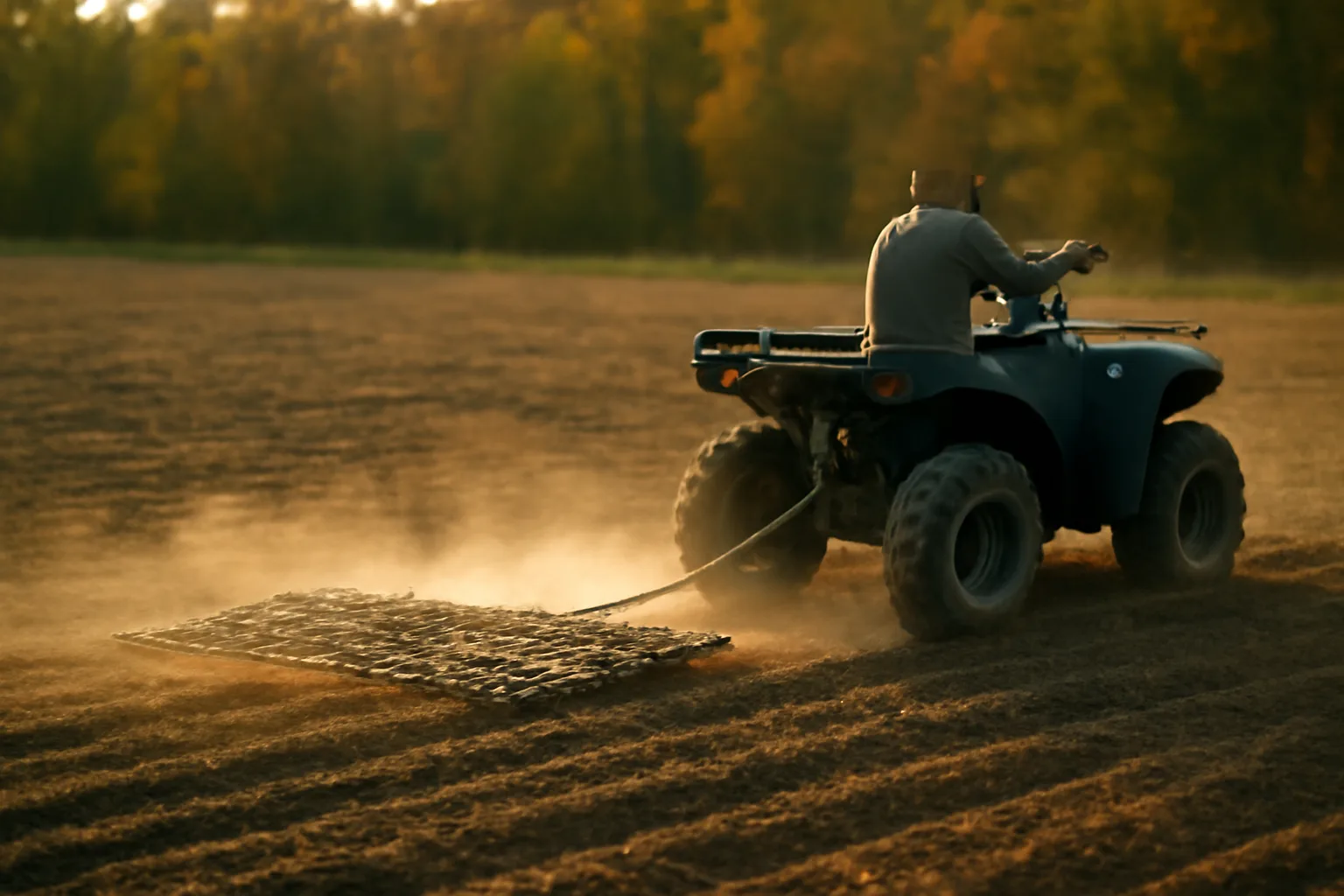
Dragging a food plot means pulling a chain, harrow, or drag mat over broadcast seed to press it into loose soil and lightly cover it. Small seeds like clover and brassicas need this contact; grain drills skip the step because they place seed at depth already. No drag on hand? A section of chain-link fence or box spring towed behind an ATV works fine.
what is a food plot drag and why do you need one
A drag is any implement you pull behind a tractor or ATV to smooth soil, press broadcast seed into contact with dirt, and knock down clods after tillage. In food plot work it usually means a chain-link section, a section harrow, a drag mat, or something homemade like a bed frame or piece of cyclone fencing weighted with cinder blocks. The job it does is simple but it's the difference between a plot that comes up thick and one that comes up patchy. Small seeds broadcast on top of loose soil dry out fast and half of them never germinate because they're sitting in open air instead of touching moisture-holding dirt. A drag firms the seedbed, closes the gap, and improves seed-to-soil contact, which is the single biggest lever you control after you've picked the right seed and gotten your pH right. Extension agronomists treat seeding depth and soil contact as the top mechanical variable behind uneven stands. Purdue University's forage extension program notes that seeds broadcast onto tilled ground should be "cultipacked or dragged to ensure good seed-to-soil contact," especially for small-seeded legumes and brassicas [1]. That's not marketing language, it's the same principle behind planting any cover crop or hayfield. If you already run a food plot seed program with a mix of clover, brassicas, and cereal grains, you'll be dragging most years regardless of what equipment you own, because at least part of that mix is going in via broadcast, not a drill.
do you really need a drag or can you skip it
You can skip dragging if you're using a grain drill or a no-till drill that places seed at a set depth and closes the furrow behind it. Drills are built to do the drag's job internally with press wheels. That's why guys running a Great Plains or Genesis drill over a soybean stubble field often get away without a separate pass. But most weekend food plotters broadcast seed by hand, ATV spreader, or tractor-mounted spinner, and broadcast seed sitting on the surface has a rough time. Clover, chicory, and brassica seed are tiny, some barely bigger than ground pepper, and they need to be pressed into the top quarter inch of soil, not buried. Oats, wheat, and other cereal grains are bigger and more forgiving, they'll germinate fine at a half inch to an inch and can be lightly disked or dragged in without much fuss. So the honest answer: if you're broadcasting, drag. If you're drilling, you probably don't need to. A cultipacker after dragging is even better for small seeds because it firms the soil further without burying seed too deep, but a chain drag alone gets you 80% of the benefit for a fraction of the cost.
what can you use as a drag if you don't own one
You don't need to buy a dedicated drag harrow to get this done. Plenty of good plots get planted with homemade equipment that costs less than a tank of gas. A section of chain-link fence, roughly 6 to 10 feet, towed flat behind an ATV or tractor works well and is probably the most common DIY option among small-acreage plotters. An old box spring mattress frame, dragged upside down so the springs face the ground, does something similar and a lot of guys already have one sitting in a barn. A section harrow (sometimes called a drag harrow or spike harrow) is the purpose-built version, with rows of tines that you can angle to be aggressive or gentle depending on soil condition. For light finishing work, even a few lengths of chain-link fence weighted with cinder blocks or a couple of railroad ties chained together will press seed in without burying it too deep. The goal isn't perfection, it's contact. If you're standing in the plot and seed is visibly sitting on top of bare dirt after your pass, go over it again or add weight.
when to plant food plots for deer
Planting windows depend entirely on what you're growing and where you hunt, because it's really two separate planting seasons: spring/summer plots for warm-season forage and late-summer/fall plots for cool-season annuals and perennials. Spring plantings (soybeans, cowpeas, corn, some clover establishments) generally go in after your last frost date, which ranges from early April in the Deep South to late May or early June in the northern tier. Fall plantings (brassicas, cereal grains, clover overseeds) are timed backward from your first fall frost, because most of these species need a certain number of weeks of growth before cold weather hits or before hunting season opens. A rough national rule extension programs use: plant fall brassicas and cereal grains 60 to 90 days before your average first frost date, which for a lot of the whitetail range falls between late July and early September [2]. Check your state's climate data or a regional frost date map, because a plot planted in coastal Alabama in early September will be way behind a plot planted the same week in northern Minnesota. If you're building a full-season plan across multiple plot types, our food plot whitetail guide breaks planting windows down by region in more detail.
when to plant oats for deer
Oats go in during your fall planting window, typically 6 to 10 weeks before your first expected frost, so deer have a tender, high-attraction food source right as hunting season opens. In much of the whitetail range that lands between mid-August and mid-September, though southern states can push into late September or October. Oats are one of the most forgiving cereal grains for food plotters because they germinate fast, often within 5 to 7 days in warm soil, and they tolerate a wide pH range better than clover does. They don't overwinter reliably in cold climates the way winter wheat or rye does, so in the North they're often treated as an annual that gets hammered hard through archery and firearms season and then dies back over winter. In the South, oats can persist and regrow into late winter if temperatures stay mild. Seeding rate for oats broadcast alone typically runs 2 to 3 bushels per acre (roughly 60 to 96 pounds), and depth should be a half inch to an inch and a half, covered with a light disk pass or drag [3]. Oats mixed with brassicas or clover usually get cut back to a lighter rate, often 50 to 60 pounds per acre, to leave room for the other species.
when to plant turnips for deer
Turnips go in with the rest of your fall brassica plot, generally 80 to 90 days before your first fall frost, because turnips need more time than oats to bulb out and reach peak palatability. Extension guidance commonly recommends late July through August seeding across the northern half of the whitetail range, with a few extra weeks of slack in southern states [2]. Deer often ignore turnip tops and bulbs early in the season and hit them hard after a couple of hard frosts convert starches to sugars, which is why turnip plots planted for late-season hunting shine most in December and January rather than October. Seeding rate for turnips alone runs about 4 to 6 pounds per acre, since the seed is tiny and a little goes a long way; oversowing wastes seed and gives you a jungle of tops competing with itself. Because turnip seed is so small, it's a textbook case for dragging. Turnip seed broadcast onto bare, tilled soil and left uncovered has poor germination in dry spells. A light drag or cultipacker pass after broadcasting is close to mandatory here, not optional.
do deer eat sorghum
Yes, deer eat grain sorghum (milo), both the standing grain heads and the foliage, though it's usually planted more as a wildlife food source, screening cover, and winter standing grain than as a primary attractant like clover or brassicas. Sorghum is drought-tolerant and holds grain well into winter, which makes it valuable in areas that get hot, dry summers where corn struggles. Deer will browse young sorghum shoots but tend to focus on the grain heads once they mature and dry down, especially after other food sources thin out in late fall and winter. It's commonly used as a component in wildlife food plot blends rather than planted in monoculture for deer specifically, and it does double duty as bedding/screening cover because of its height, often 4 to 7 feet. If your goal is pure attraction during archery season, sorghum isn't your best pick, clover and brassicas outperform it for early-season draw. If your goal is standing winter forage and cover in one planting, it's a reasonable option, particularly in the southern half of the whitetail range where sorghum handles heat and drought better than corn.
do deer eat clover and do deer like clover
Yes, deer eat clover readily and it's one of the most consistently preferred food plot forages across the whitetail's range. Clover, particularly white clover varieties like Durana and Ladino and red clover varieties, is high in protein (often 25 to 30% crude protein in vegetative growth) and stays palatable through spring, summer, and fall in a properly maintained stand [4]. Clover's biggest advantage over annuals is that a well-managed perennial stand can produce for 3 to 5 years or more before it needs to be reseeded, provided you maintain pH, fertility, and mow to control weed competition. The Noble Research Institute and multiple land-grant extension programs list clover as a top-tier food plot legume specifically because of its combination of high protein, wide adaptation, and deer preference across regions [4]. The catch is establishment. Clover seed is small and shallow-planted (a quarter inch or less), and it's slow to get going compared to cereal grains, so weed competition and poor seed-to-soil contact are the two most common reasons clover plots fail in year one. This is exactly the scenario where a drag or cultipacker pass after broadcasting makes or breaks the stand.
what is a food plot
A food plot is a planted area, typically ranging from a quarter acre to several acres, established specifically to provide supplemental forage for deer or other wildlife and, for hunters, to concentrate animal activity in a huntable location. Food plots range from small, secluded "kill plots" tucked into timber and planted mainly to draw deer within bow range, to larger destination or field plots meant to hold deer on a property through fall and winter. Most plots fall into a few basic categories: annual plots (brassicas, cereal grains, soybeans, corn) that get replanted every year, perennial plots (clover, alfalfa, chicory) that persist for multiple seasons, and mixed plots that combine both to spread out attraction through the season. The right choice depends on your soil, your equipment, your budget, and honestly how much time you want to spend on maintenance each year. State wildlife agencies generally regulate food plots differently from bait piles or supplemental feed, since a planted, standing crop is treated as normal agricultural activity rather than artificial feeding. But rules vary a lot by state, some states restrict feeding and baiting for disease control (particularly in areas managing chronic wasting disease) while still allowing food plots, and a few draw the line differently depending on distance from a stand or whether the crop is harvested and piled versus left standing. Check your state wildlife agency's regulations before you plant or hunt over anything you're not sure is legal, because "food plot" and "bait pile" aren't always defined the way you'd assume.
what are deer's favorite foods
Deer preference shifts by season and region, but across most of the whitetail's range, extension and wildlife agency research consistently ranks a handful of foods at the top: acorns (especially white oak acorns, which are lower in tannins and more palatable than red oak), soybeans, clover, and, seasonally, standing corn and brassicas after a frost. Acorns are often the single most preferred natural food where they're available, and deer will bypass planted forage entirely during a heavy acorn drop. That's a real management headache for food plotters, a plot that looked great in September can sit untouched in October if the oaks dump a big crop nearby. Soybeans rank high too, both as a summer browse and a fall/winter grain source if enough survives deer pressure to mature seed pods. Clover consistently ranks as a top preferred planted forage because of its protein content and long growing season, and it's a staple recommendation across university extension deer management guides [4]. Brassica tubers and tops become highly preferred after frost converts starches to sugar, which is why turnip and radish plots peak in attraction during late season rather than early bow season. If you're deciding what to actually plant, our deer food plot seed breakdown compares species by season and region.
do deer like honey (nonsense internet question, real answer)
Deer don't eat honey, and there's no wildlife agency or extension research treating honey as a deer food or attractant. Deer are herbivores, they browse plants, forbs, mast, and agricultural crops, not the products of a beehive. This question shows up in search because "honey" sometimes gets confused with sweet feeds, molasses-based mineral licks, or commercial attractant products that use sugar or molasses as a carrier for scent. Those products are a different category entirely and their legality as bait varies by state, some states classify any placed food, mineral, or scent attractant as bait subject to baiting regulations, especially in CWD management zones. If you're trying to draw deer with something sweet-smelling, that's a bait or attractant question, not a food plot question, and it's governed by different rules than planting a legal standing crop. Check your state wildlife agency's baiting and feeding regulations directly, because what's legal in one state (standing food plots, no restriction) can be a game violation two states over if it involves placed feed.
how does soil test guidance affect your drag and planting plan
Your soil test result determines lime and fertilizer rates, and it should come from your state or land-grant university soil testing lab, not a general internet chart, because recommendations are calibrated to your specific soil type and the crop you're planting. Most land-grant extension soil labs (Penn State, University of Kentucky, Mississippi State, and similar programs) return a report with pH, phosphorus, potassium, and lime recommendation specific to your sample. None of that changes whether you need to drag, but it does change your timing. If your soil test calls for lime, that lime needs weeks to months to fully react and adjust pH, ideally applied 3 to 6 months before planting when possible, so a fall food plot often needs its lime application decided back in spring or early summer. Fertilizer, by contrast, can go down right before or right after planting and gets worked in with the same disking or dragging pass that preps your seedbed. If you'd rather not piece together a plan from scattered advice, PlotSeason's $99 one-time Plot Plan Builder turns your soil test and property details into a straightforward planting plan, species picks, and timing calendar. It's general guidance built around your inputs, not a substitute for your soil lab's specific lime and fertilizer recommendation, which stays the final word on your ground.
step by step: dragging a broadcast food plot the right way
Here's the actual sequence that works for most broadcast plantings, whether you're doing clover, brassicas, or a cereal grain blend. First, till or disk the plot to break up sod and expose bare soil, then let it settle for a few days if you can, especially after rain, so you're not dragging mud. Second, broadcast your seed at the recommended rate for your species or blend, using a hand spreader, ATV spreader, or tractor-mounted spinner, and try to get an even pass rather than dumping seed in clumps. Third, drag the plot with your chain, harrow, or drag mat, going over it once or twice depending on how loose the soil is; you want seed pressed into the top quarter to half inch, not buried under an inch of dirt. Fourth, if you have a cultipacker, run it after the drag for small seeds like clover or brassicas, it firms the seedbed further and improves moisture retention without burying seed too deep. For bigger seed like oats, wheat, soybeans, or corn, a straightforward disk pass to work seed in a half inch to two inches deep does the job, and dragging afterward is optional rather than critical, since the seed is already covered enough on its own. The mistake most first-timers make is dragging too aggressively and burying small seed too deep, so err on the side of a lighter, faster pass rather than a slow, heavy one if your seed is fine and your soil is loose.
Frequently asked questions
Do deer eat sorghum?
Yes. Deer browse young sorghum foliage and eat the grain heads once mature, especially in late fall and winter. It's more often planted as a drought-tolerant grain and cover crop component than as a primary attractant, since clover and brassicas typically outperform it for early-season draw.
Do deer eat clover, and do deer like clover?
Yes, clover is one of the most preferred food plot forages across the whitetail range. It runs 25 to 30% crude protein in vegetative growth and stays palatable spring through fall, which is why land-grant extension programs consistently rank it as a top perennial forage choice.
When should I plant food plots for deer?
It depends on the species. Spring/summer plots (soybeans, corn) go in after your last frost date. Fall plots (brassicas, oats, clover overseeds) go in 60 to 90 days before your first fall frost, which lands between late July and mid-September across most of the whitetail range.
When should I plant oats for deer?
Plant oats 6 to 10 weeks before your first expected fall frost, typically mid-August through mid-September in much of the whitetail range, later in the South. Oats germinate fast, often in 5 to 7 days, and are commonly used as a fast-growing early-season attractant plot.
When should I plant turnips for deer?
Plant turnips 80 to 90 days before your first fall frost, generally late July through August across the northern whitetail range, with more flexibility farther south. Turnips need extra time to bulb out, and they're most attractive to deer after a few hard frosts sweeten the tops and bulbs.
What is a food plot?
A food plot is a planted patch, from a quarter acre kill plot to multi-acre field plots, established to feed deer or other wildlife and to concentrate their activity for hunting. Plots are typically annual (brassicas, grains), perennial (clover, chicory), or mixed to extend attraction through multiple seasons.
What are deer's favorite foods?
Across most of the whitetail range, acorns (especially white oak), soybeans, and clover rank consistently high, with brassica tubers and tops becoming highly preferred after frost. Preference shifts seasonally and by region, and a heavy acorn drop can pull deer off planted plots entirely.
Do deer like honey?
No. Deer are herbivores that browse plants, forbs, and crops, not honey. This question usually gets confused with sweet feeds, molasses-based mineral products, or scent attractants, which are a separate category governed by state baiting and feeding regulations, not food plot planting.
Do I need a drag if I use a grain drill?
Usually not. Drills place seed at a controlled depth and close the furrow with press wheels, doing the drag's job internally. Dragging matters most for broadcast seeding, where small seed sits exposed on the surface until you press it into contact with soil.
What can I use instead of a store-bought drag harrow?
A section of chain-link fence towed flat, an old box spring dragged upside down, or railroad ties chained together all work fine for small food plots. The goal is pressing broadcast seed into loose soil, not achieving a perfectly engineered implement.
How deep should I drag seed into the soil?
For small seed like clover or brassicas, aim for a quarter to half inch of coverage; going deeper often buries seed too far to germinate. For larger seed like oats or soybeans, a half inch to two inches is fine, and a disk pass alone often covers it adequately without a separate drag.
Is dragging the same as cultipacking?
No. Dragging presses seed into loose soil and knocks down clods using a chain, harrow, or mat. Cultipacking uses a heavier roller with ridged wheels to firm the seedbed further and improve moisture contact. Many plotters drag first, then cultipack for small-seeded species like clover.
Sources
- Purdue University Extension, Forage Establishment guidance: Broadcast forage seed should be cultipacked or dragged for good seed-to-soil contact
- University of Tennessee Extension, wildlife food plot planting date guidance: Fall brassica and cereal grain plots are typically planted 60-90 days before first fall frost
- Noble Research Institute, clover for wildlife food plots: Clover crude protein content and multi-year stand persistence for deer forage
- University of Georgia Extension: Soil testing guides lime and fertilizer application rates for wildlife food plots
- USDA Forest Service: Soil test results inform lime and fertilizer decisions before planting food plots