Last updated 2026-07-26
TL;DR
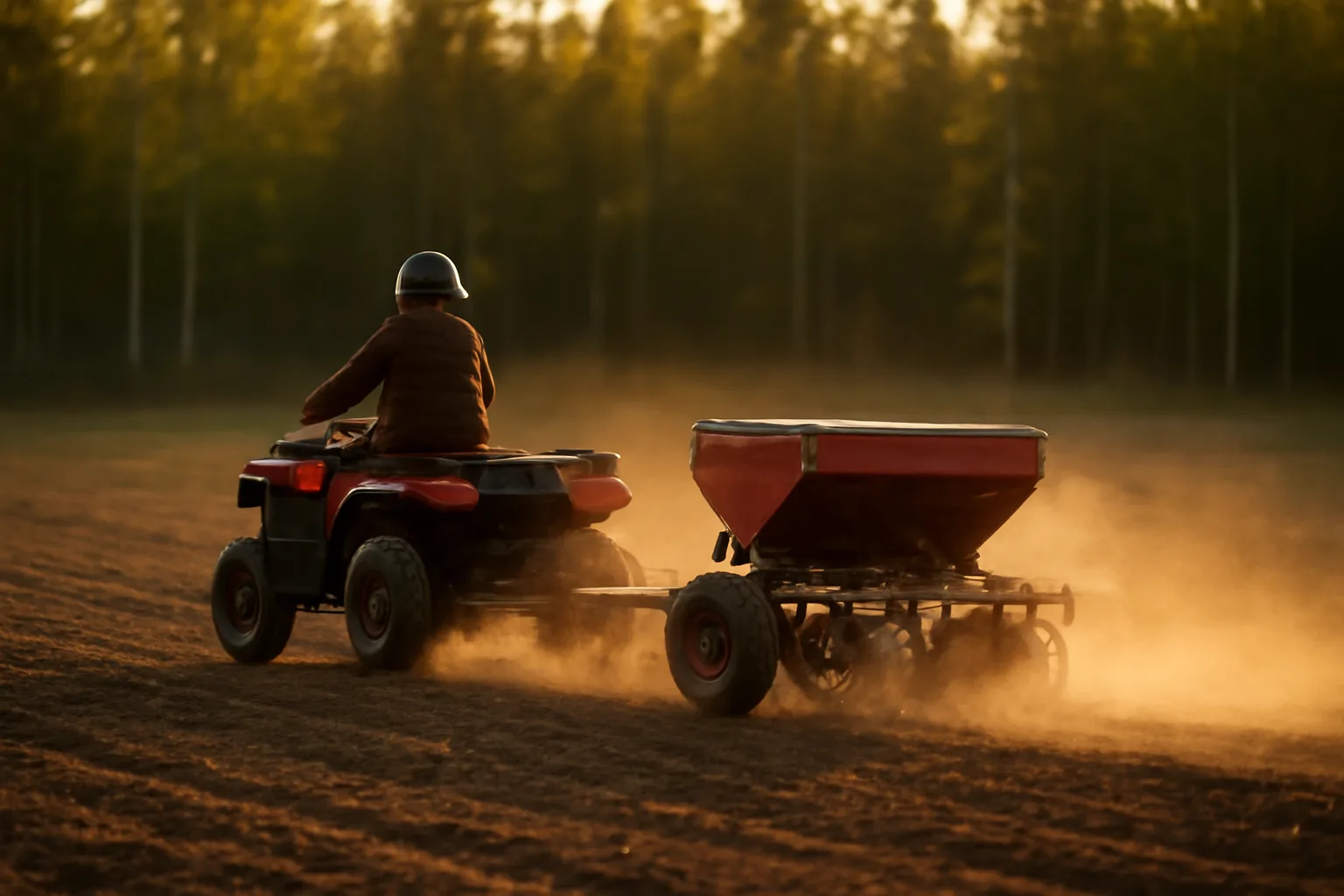
The Genesis food plot planter is a small, pull-behind, no-till drill made for ATVs and UTVs that scarifies soil, meters seed, and packs it in one pass. It works best for small food plots (under 5 acres) with clover, brassicas, and cereal grains. Planting dates depend on your zone, not the equipment.
what is a food plot, and where does a planter fit in?
A food plot is a planted patch of forage, usually somewhere between a quarter acre and several acres, put in to give deer and other wildlife a reliable food source and to give hunters a place to observe or hunt over. Plots range from small hidden "kill plots" tucked in timber to bigger "destination" fields planted in clover, brassicas, or grain. Neither term is regulated; it just means you're planting something deer will eat, on ground you own or lease. A planter is the tool that gets seed into the ground. On the small end, that's a hand-crank broadcaster and a rake. On the big end, it's a farm-grade no-till drill pulled behind a tractor costing tens of thousands of dollars. The Genesis planter sits in the middle: a compact, ATV/UTV-towed unit built specifically for food plot work, not row-crop farming. Where it fits: if you've got small, hard-to-reach plots, rough or rocky ground, or you're working solo without a tractor, a compact drill like this closes the gap between broadcast-and-pray and full-size farm equipment. It won't out-perform a good disc, cultipacker, and broadcaster combo on a big open field, but it saves steps and it works in tight spots a tractor can't reach.
how does the genesis food plot planter actually work?
It's a no-till, pull-behind unit that combines several jobs into one pass: a coulter or scarifier to break the soil surface, a seed metering system to drop seed at a set rate, and a drag or roller to press seed into contact with soil. The idea is to skip separate disking, broadcasting, and cultipacking trips, which matters a lot if you're doing this alone on a lunch break or a Saturday morning. Most small food plot drills, Genesis included, are designed to run behind an ATV or UTV rather than a tractor, which is the whole point: they're built for guys who don't own farm equipment and don't want to rent a disc harrow for one afternoon a year. Seed depth control is the detail that actually separates a good compact planter from a broadcaster with extra steps. Clover and brassica seed is tiny and wants to sit at or near the surface (roughly 1/4 inch or less), while cereal grains like oats and wheat want closer to 1 to 1.5 inches. A planter that can adjust for that difference is worth the money; one that can't is just an expensive rake. No-till equipment doesn't replace fertility work. Whatever you plant, whatever you plant it with, your soil test still calls the shots on lime and fertilizer. Cooperative extension services consistently note that soil pH below about 6.0 cuts nutrient availability for most food plot species, and no drill on earth fixes that. Your soil test lab is the authority on how much lime and fertilizer your specific field needs; treat any general planting guide, including this one, as a starting point, not a replacement for that report.
is a compact drill worth it, or should you just broadcast and cultipack?
| Broadcast + cultipacker | 2-3 (till, broadcast, pack) | Small-to-mid plots, flat ground | $200-$600 (used cultipacker) | |
|---|---|---|---|---|
| Compact no-till drill (Genesis-type) | 1 | Small plots, no-till, tight access, solo work | $1,500-$3,500 new | |
| Full-size tractor drill | 1 | Large acreage, farm operations | $10,000-$30,000+ | None of these numbers are locked in; used equipment prices swing hard by region and season. Check current listings before you budget. |
Depends on your ground and your patience. Broadcasting seed and dragging a cultipacker or drag harrow behind it is cheaper up front (a cultipacker alone can run several hundred dollars used, versus $1,500 to $3,000+ new for a compact no-till drill) and it works fine on small plots if you're willing to do it in stages: kill weeds, disk or till, broadcast, then pack. A compact drill earns its keep in a few specific situations: you're planting no-till into standing residue or a killed cover crop, your plot is small and irregular enough that a tractor and disc can't maneuver, or you're planting alone often enough that a one-pass tool saves real time over a season. If you've got one big flat field and you already own a tractor and disc, you probably don't need it. Here's the honest tradeoff table. | Method | Passes needed | Best for | Rough cost range |
when to plant food plots for deer, by season and zone
Timing depends far more on your frost dates and soil temperature than on the calendar month. Cooperative extension guidance for the Southeast, Midwest, and Northeast generally splits food plot planting into two windows: spring/summer plantings (warm-season annuals and some perennials) and late summer/fall plantings (cool-season annuals and perennials), timed around your area's average first and last frost dates. As a rough national guide: spring plantings usually go in from mid-April through May once soil has warmed past roughly 50-55°F, and fall plantings go in from late August through early October, timed so cool-season seed has 6 to 8 weeks of growth before the first hard frost. The University of Tennessee Extension and Mississippi State University Extension both frame fall plot timing around "4 to 8 weeks before the average first frost date" for the specific county, which is the safest rule of thumb if you don't want to memorize dozens of zone charts. Use your county extension office's frost date data, not a national chart, to nail down actual dates. A grower in Zone 7 (parts of Tennessee, North Carolina, Virginia) plants fall brassicas and cereal grains in early-to-mid September; a Zone 4 grower (northern Minnesota, Wisconsin, parts of Michigan) needs those seeds in the ground by mid-to-late August to get the same growth window before frost shuts things down.
when to plant oats for deer
Oats are almost always a fall planting, going in 6 to 8 weeks before your area's first hard frost so they can establish before cold slows growth. In much of the whitetail range that means late August through mid-September; in the Deep South it can stretch into early October. Oats germinate fast (often within a week in warm, moist soil) and deer will hit them hard as soon as they're a few inches tall, which is part of why oats show up in so many fall blend mixes alongside brassicas and clover. They don't handle deep cold as well as winter wheat or rye, so in far-northern zones oats often get treated as an early-fall attractant crop that dies back with hard frost, while winter-hardy cereals carry the plot into winter. Seeding depth for oats runs about 1 to 1.5 inches, drilled if possible; broadcast oats work but germination rates drop if seed sits on top of dry soil with no packing.
when to plant turnips for deer, and do they need special timing?
Turnips are a fall brassica, planted in mid-to-late summer so they have time to bulb up before frost, and they actually get better after a hard freeze because cold converts starches to sugars and makes the bulbs and tops sweeter to deer. Most extension guidance puts turnip planting 80 to 90 days before the first expected hard frost, which lands most of the country in a July-to-August window, a bit earlier than oats or clover. Deer often ignore turnip tops early in the season and hammer them after the first frost, so don't panic if a turnip plot looks untouched in September; that's normal, not a failure. Seeding depth is shallow, around 1/4 to 1/2 inch, and turnip seed is small enough that a precise metering system (whether that's a compact drill or a hand-crank broadcaster used carefully) matters more than with a big cereal grain seed. Mississippi State University Extension notes brassicas like turnips "are best planted from mid-July through August" in much of the mid-South, giving bulbs roughly 10 to 12 weeks to mature before the first freeze.
do deer eat clover, and do they actually like it?
Yes, and clover is one of the most consistently used food plot forages in the whitetail range. White clover and red clover both show up repeatedly in university deer research plots because they're high in crude protein (often 20-30% on a dry matter basis in good stands), regrow after grazing, and hold up as both a spring/summer perennial and part of fall/winter blends. Clover isn't a one-and-done planting either. A well-maintained perennial clover stand can last 3 to 5 years with proper mowing, weed control, and periodic fertilization, which makes it one of the better cost-per-year forages if you've got the ground for a dedicated perennial plot rather than rotating annuals every season. Deer food plot seed mixes commonly pair clover with chicory or cereal grains to extend the window deer will hit the plot. Seeding rate and depth matter here too: clover seed is tiny, wants roughly 1/4 inch depth or even just pressed into the surface, and a cultipacker pass after broadcasting (or a drill set correctly for small seed) makes a real difference in stand establishment.
do deer eat sorghum, and where does it fit in a plot plan?
Deer will eat grain sorghum, both the seed heads and, to a lesser extent, the foliage, but it's used more often as a screening/cover crop or a late-season grain source than as a primary attractant forage. Sorghum tolerates heat and drought better than corn, which is part of why it shows up in food plot mixes for the South and drier parts of the Midwest. Compared to standing corn, sorghum matures faster and needs less nitrogen, which makes it a reasonable lower-input alternative if you want a fall/winter grain plot without corn's fertility demands. It's a warm-season crop, planted after soil temperatures are reliably above 60°F, generally the same late-spring window as corn and soybeans. The honest caveat: sorghum isn't most deer's first choice when better food is available nearby. It's a solid late-season or drought-tolerant option, not a guaranteed magnet.
what are deer's favorite foods, really?
There's no single universal answer; deer preference shifts by season, region, and what else is available, but repeated browse studies and extension forage guides point to a consistent short list: acorns and other hard mast, soybeans and other legumes, clover, and, in season, agricultural crops like corn. Acorns in particular are heavily preferred in fall wherever oaks are present, often outcompeting planted food plots when there's a good mast year. Among planted forages, clover, soybeans, and brassicas (turnips, radishes, rape) consistently rank as high-preference food plot species across multiple state extension deer forage guides, largely because of protein content and palatability after frost (for brassicas specifically). Corn and grain sorghum matter more in late fall and winter as high-energy food when protein needs drop and deer are stockpiling fat and calories. Seasonal note worth remembering: what deer "like" in October isn't necessarily what they hit hardest in January. A frosted turnip plot that got ignored in early fall can become the most-hit food source on the property once natural browse thins out.
do deer like honey, or is that a myth?
This one's mostly folklore mixed with real biology. Deer aren't documented as seeking out honey itself in any wildlife research literature; they don't raid beehives for honey the way bears do. What deer do respond to is sugar and sweet scent in general, which is part of why some hunters use sweet feed, molasses-based products, or sweetened mineral supplements as attractants in areas where that's legal. Check your state wildlife agency's regulations before using any bait or attractant product, since rules on baiting and supplemental feeding vary a lot by state and even by county (some states ban baiting outright for disease-management reasons, especially in areas managing chronic wasting disease). What's legal in Texas may be a citable offense in Michigan. Bottom line: honey specifically isn't a documented deer attractant in any research we could find. Sugar and molasses-based products have more anecdotal use, but always check current state rules first.
how do you turn a soil test into an actual planting plan?
Start with the soil test, not the seed bag. A basic food plot soil test (available through most land-grant university extension soil labs for somewhere between $10 and $20 per sample) tells you pH, phosphorus, potassium, and organic matter, and gives you lime and fertilizer recommendations specific to what you're planting. Extension soil labs are the authority here; a bag of seed's fertilizer suggestion printed on the label is generic, your test results are not. Most food plot species want soil pH in the 6.0 to 7.0 range; clover and alfalfa lean toward the higher end of that, brassicas and cereal grains tolerate slightly more acidic soil. If your test comes back at 5.2, lime needs to go down weeks to months before planting (agricultural lime takes time to react with soil), not the same day. Once you know your pH and nutrient levels, the actual planting plan is really just matching species to your frost dates, soil drainage, and sunlight, then sequencing planting so something is always growing. This is the exact gap a lot of hunters hit: they've got the soil test and maybe even a drill or planter, but no clear sense of what to plant where and when. That's the specific problem PlotSeason's $99 one-time Custom Food Plot Plan is built to solve, turning your soil test and property details into a straightforward species and timing plan instead of a guess.
what equipment do you actually need beyond a planter?
A planter (whether that's a Genesis-style compact drill or a broadcaster) is one piece. Realistically, most food plot setups also need some way to kill existing vegetation (herbicide and a sprayer, or tillage), a way to smooth and firm the seedbed (a drag harrow or cultipacker), and a mower for maintaining perennial clover stands. If you're running an ATV or UTV instead of a tractor, look for implements specifically rated for that pull weight and hitch type; some compact drills and cultipackers are sized for ATV use and others genuinely need a tractor's weight and hydraulics to work the ground properly. Overloading an ATV-rated implement on rough or rocky ground is a common way people snap hitches or damage frames. Don't over-invest in equipment before you've nailed the plan. A $3,000 drill sitting on a $99 mistake (wrong species for your frost dates, wrong pH for the seed you bought) doesn't help anything grow.
Frequently asked questions
Do deer eat sorghum?
Yes, deer eat both the grain heads and some foliage of grain sorghum, though it's usually planted as a drought-tolerant late-season grain source or screening cover rather than a primary attractant. It's a warm-season crop planted in late spring once soil temperatures pass roughly 60°F.
Do deer eat clover?
Yes, clover is one of the most widely used and well-studied food plot forages, valued for high crude protein (often 20-30% dry matter) and its ability to regrow after grazing. Both white and red clover show up repeatedly in university deer forage research as high-preference species.
When should you plant deer food plots?
Timing depends on frost dates, not a fixed calendar date. Spring/warm-season plantings generally go in mid-April through May once soil warms past 50-55°F; fall/cool-season plantings go in 4 to 8 weeks before your area's average first frost, per extension guidance from universities like Tennessee and Mississippi State.
Do deer like clover more than other forages?
Clover ranks consistently high in extension deer forage preference guides alongside soybeans and brassicas, largely due to protein content and regrowth after grazing. Preference still shifts seasonally; deer often favor acorns and hard mast over clover in a strong mast year.
When should you plant oats for deer?
Oats go in as a fall planting, roughly 6 to 8 weeks before your area's first hard frost, which lands in late August through mid-September for most of the whitetail range. Plant at 1 to 1.5 inches deep, drilled if possible, for best germination.
When is the best time to plant food plots overall?
There are two main windows: spring (mid-April to May, warm-season annuals and perennials) and late summer to early fall (late August to early October, cool-season annuals). Exact dates depend on your county's average frost dates, which your local extension office can provide.
When should you plant turnips for deer?
Turnips are typically planted 80 to 90 days before the first expected hard frost, which lands in a July-to-August window for most of the country. They actually improve in palatability after a hard freeze converts starches to sugar in the bulbs and tops.
What is a food plot?
A food plot is a planted area, usually a quarter acre to several acres, seeded with forage crops to feed deer or other wildlife and to give hunters a place to observe or hunt. Common species include clover, brassicas, cereal grains, and soybeans, chosen based on soil, season, and region.
What are deer's favorite foods?
There's no single universal favorite; it shifts by season and region. Acorns and hard mast dominate deer preference in fall when available, and among planted forages, clover, soybeans, and brassicas consistently rank highest in extension forage preference studies.
Do deer like honey?
There's no research documenting deer actively seeking out honey the way bears do. Some hunters use sweet, molasses-based attractants where legal, based on deer's general response to sugar, but honey itself isn't a documented food source or attractant in wildlife literature.
What is a Genesis food plot planter used for?
It's a compact, no-till, ATV/UTV-towed drill built to scarify soil, meter seed, and pack it in one pass, aimed at small food plots and hunters without tractor equipment. It's best suited to plots under about 5 acres or ground a tractor and disc can't reach easily.
Is a compact no-till drill better than broadcasting seed?
It depends on your plot size and access. A drill saves passes and works well on small, tight, or no-till ground, but broadcasting plus a cultipacker is cheaper and works fine on flat, accessible plots where you're willing to till, broadcast, and pack in separate steps.
Do you still need a soil test if you use a no-till drill?
Yes. A drill controls seed placement and depth, not soil chemistry. Your soil test lab's lime and fertilizer recommendations still determine whether your planted seed actually has the pH and nutrients it needs to establish, regardless of what equipment put it in the ground.
Sources
- University of Tennessee Extension, Establishing Wildlife Food Plots: fall food plot planting timed 4-8 weeks before average first frost date, and general food plot species/timing guidance
- USDA Natural Resources Conservation Service, Plant Fact Sheet: White Clover: white clover crude protein content and regrowth characteristics as forage
- USDA NRCS Plant Guide, Grain Sorghum: grain sorghum drought tolerance and lower nitrogen requirement compared to corn
- University of Georgia Extension, Wildlife Food Plots: spring versus fall planting windows and soil temperature thresholds for warm-season plantings
- Michigan Department of Natural Resources, Baiting and Feeding Regulations: state-level baiting and supplemental feeding restrictions vary and some states restrict due to CWD management
- USDA NRCS Plant Guide, Oat: oat germination speed and seeding depth recommendations