Last updated 2026-07-25
TL;DR
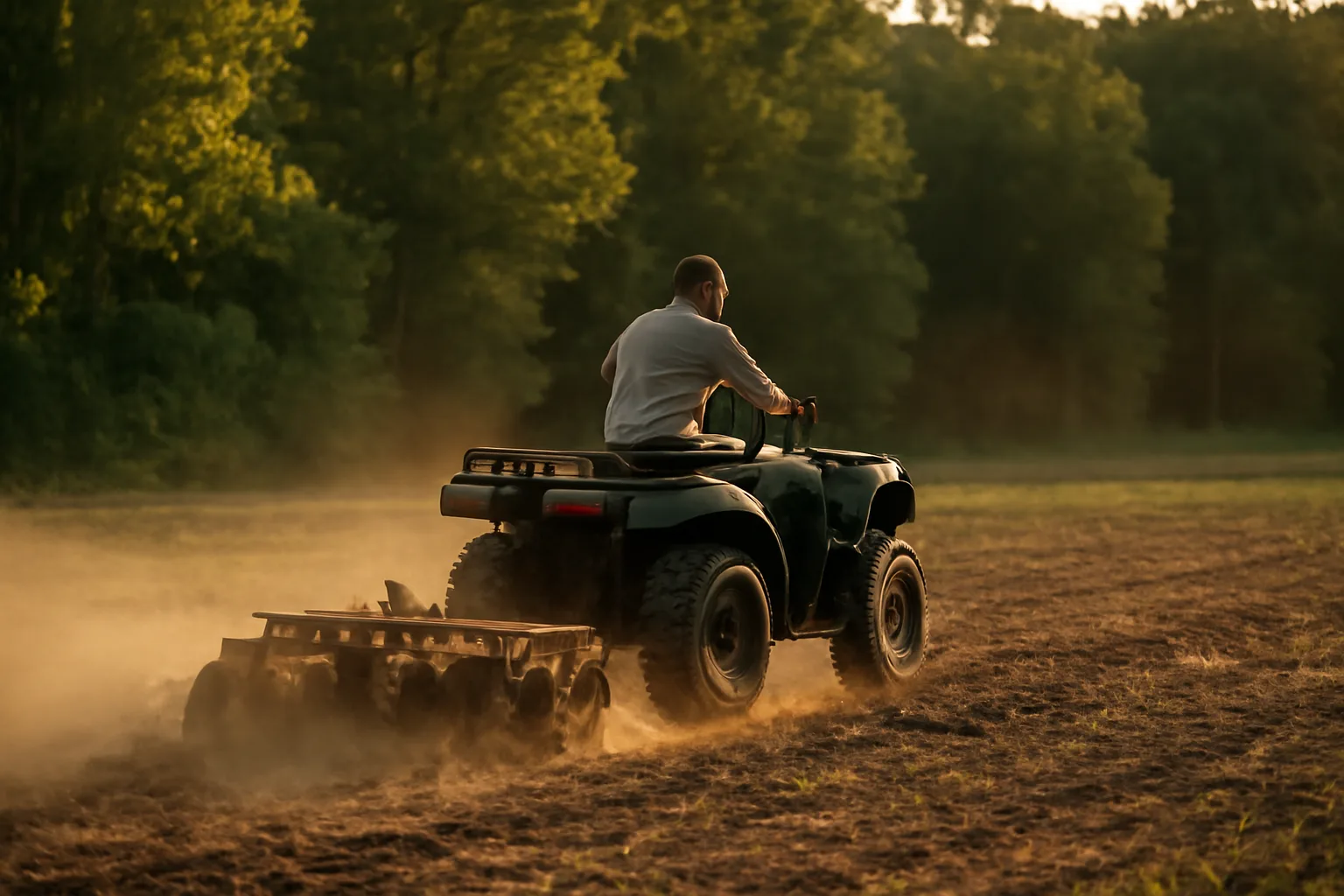
Yes, you can plant a full food plot with just an ATV or UTV. You need a sprayer for kill-down, a disk or drag harrow to work soil, a broadcast spreader for seed and fertilizer, and a cultipacker or drag to firm the seedbed. Most plots under 3 to 5 acres are very doable with a 400cc+ ATV and pull-behind implements costing $150 to $2,000 total.
what is a food plot, exactly
A food plot is a planted patch of forage, usually somewhere between a quarter acre and several acres, put in specifically to feed and hold deer or other wildlife on a property. It's not a garden and it's not a crop field meant for harvest. The goal is deer nutrition and hunting opportunity, not yield per acre for sale. Most plots fall into two buckets. Annual plots get replanted every year with things like brassicas, cereal grains, or soybeans. Perennial plots, mostly clover and alfalfa mixes, get established once and then mowed and fertilized for three to five years before you till them back up. Extension agronomists generally treat food plots as a wildlife management tool separate from row-crop agriculture, and state wildlife agencies frequently publish their own plot guides because the goals (attraction, nutrition, cover) differ from commercial farming [1]. An ATV changes what's practical here. You're not running a 60-horsepower tractor with a 10-foot disk. You're working in tight spaces, small clearings, and often steep or root-choked ground where a full-size tractor can't go or isn't worth trailering in. The tradeoff is scale: ATV plots tend to run under an acre to a few acres, and the tools are lighter, slower, and cheaper.
can you really plant a food plot with just an atv
Yes. Thousands of hunters plant every acre of their food plots with nothing bigger than a 400 to 700cc ATV or UTV. The limiting factor isn't horsepower, it's implement weight and ground condition. A quad in the 500cc-plus range with a locking rear differential can pull a disk harrow, drag, or small no-till drill through most soils that aren't heavy clay or full of roots. What you give up compared to a tractor is depth and speed. A tractor-mounted disk bites six to eight inches. An ATV-pulled disk might manage two to four inches in decent soil, less in compacted or rocky ground. That means more passes. Where a tractor might disk a plot twice, expect to run an ATV disk three or four times, sometimes crisscrossing at angles, to get a workable seedbed. Size matters too. Under an acre, an ATV setup is honestly just as fast as a tractor once you count loading and trailering time. Push past 3 to 5 acres and the extra passes start costing real hours. Above that, most hunters either upgrade to a compact tractor or accept that plot day becomes a full weekend.
when to plant food plots for deer
| Deep South (zones 8-9) | Mid-March to May | Mid-September to November | |
|---|---|---|---|
| Mid-South / Transition (zones 6-7) | April to early June | Late August to mid-October | |
| Upper Midwest / North (zones 3-5) | Mid-May to June | Late July to early September | If you're planting brassicas for late-season hunting, count backward from your first expected hard frost. Most brassica varieties need 80 to 100 days to reach full maturity and palatability, and a hard frost actually sweetens turnips and radishes by converting starches to sugars, which is part of why deer often ignore turnip plots in October and hammer them in December [2]. |
Timing depends entirely on what you're planting and your USDA plant hardiness zone, but the short answer is: cool-season plots (clover, brassicas, oats, wheat) go in from late summer into early fall, and warm-season plots (soybeans, cowpeas, sorghum) go in late spring after your last frost date. Cooperative extension services publish planting windows by region because a date that works in southern Georgia is six to eight weeks off from one in northern Michigan. As a rough national framework: warm-season annuals go in April through June depending on zone, and cool-season annuals and perennials go in August through October, aiming for 60 to 90 days of growth before your first hard frost so plants can establish before dormancy. USDA's Plant Hardiness Zone Map is the standard reference hunters use to pin down their zone and rough frost timing before checking local extension dates. Here's a simplified planting calendar by general region. Always check your local extension office for your specific zone, since frost dates can shift by two to three weeks even within a state. | Region (rough) | Spring planting window | Fall planting window |
when to plant oats for deer
Oats are a fall annual for most food plot purposes. Plant them 6 to 8 weeks before your first fall frost date so plants have time to establish a root system and put on leaf growth before cold shuts things down. In most of the whitetail range that lands somewhere between late August and mid-September. Oats germinate fast, often within 5 to 10 days in warm, moist soil, and they're one of the most attractive cool-season grains you can plant, especially in September and October before broadleaf plants like brassicas hit peak palatability. Oats don't tolerate hard freezes as well as winter wheat or rye though. In colder zones they'll often winterkill, which is fine if you wanted an early-fall attraction plot and don't need it to survive into deep winter. If you want oats to persist through hunting season into late winter, blend them with winter wheat or cereal rye, which are more cold-hardy and will keep green growth going even after oats have browned off.
when to plant turnips for deer
Turnips go in the ground in mid-summer to early fall, timed so they mature right as hunting season and cold weather arrive. Most extension guidance and seed producers recommend planting turnips 80 to 90 days before your first expected hard frost, which in much of the whitetail's range means late July through August. The reason timing matters so much with turnips: deer often walk right past a turnip plot in September and start hammering it in November or December. That's not a planting failure, it's plant biology. Frost converts starches in the bulb and leaves into simple sugars, making the plant noticeably sweeter and more palatable, which is why late-season turnip plots can look untouched for months and then get hit hard once temperatures drop [2]. Be careful with seeding rate. Turnip seed is tiny, roughly 150,000 seeds per pound, and it's easy to overseed with a hand spreader. Most guidance calls for 4 to 6 pounds per acre for pure turnip stands, mixed lower if you're blending with radish or rape.
do deer eat clover, and do they like it
Yes, deer eat clover heavily, and it's one of the most reliable food plot species for spring through fall. White clover and red clover both show up as staple food plot choices because they're perennial (lasting 3 to 5 years with good management), high in protein (often 25 to 30 percent crude protein in vegetative growth), and they regrow after grazing pressure instead of getting wiped out. Deer preference studies and forage quality analyses consistently rank clover among the top attractants for whitetail, particularly in spring when does need protein for lactation and bucks need it for antler growth. It's not a magic bullet though. Clover struggles in acidic soil below pH 6.0, it needs decent drainage, and it can get out-competed by weeds if you don't mow it two or three times a year. One real tradeoff: clover takes a full growing season to establish well, and it can't handle constant heavy browse pressure on small plots the way brassicas or grain can. On a half-acre plot with a dense deer herd, clover sometimes gets grazed down to nothing before it can recover. Bigger plots or multiple smaller plots spread the pressure out.
do deer eat sorghum
Deer eat sorghum, mostly the seed heads and to a lesser extent the leaves, but it's more of a fall and winter grain-food source than a preferred browse. Grain sorghum (milo) is planted as a warm-season annual, usually alongside corn and soybeans in a food plot blend, because it stands up to drought better than corn and the seed heads persist standing through winter, giving deer and turkey a late-season food source after other plots have been picked clean. Sorghum isn't usually a deer's first choice when soybeans, clover, or standing corn are nearby. It functions best as a secondary, cold-tolerant option, or as cover and screening since it grows 5 to 8 feet tall in good soil. Some hunters plant it specifically as a visual screen along field edges as much as for the food value.
what do deer prefer to eat most
There's no single universal favorite, deer preference shifts by season, region, and what's locally available, but soybeans, clover, and acorns consistently rank at the top across whitetail research and food plot trials. In spring and summer, soybeans and clover provide the protein deer need for antler growth and lactation. In fall, acorns (when available) often outcompete anything you plant, because they're calorie-dense and deer evolved around mast crops. State wildlife agency food habit studies generally find that deer diet composition shifts constantly through the year: forbs and browse in spring, agricultural crops and soft mast in summer, hard mast (acorns) in fall where oaks are present, and woody browse in winter when everything else is gone [3]. This is part of why a food plot works best as one piece of a broader habitat plan rather than the only food source on a property. As for honey: no, deer do not eat honey. That's not a real food plot question with a wildlife biology answer, deer are herbivores and honey isn't part of their diet or attractant use in any legitimate food plot or wildlife management practice. If you've seen this question floating around hunting forums, it's usually confused with using sweet liquid scents or molasses-based mineral licks, which is a different category of product entirely and subject to your state's baiting and supplemental feeding regulations.
what atv and implement setup do you actually need
For most food plots under 3 acres, here's the realistic gear list: a 400cc or bigger ATV or UTV with a locking differential (helps a lot in soft dirt), a tow-behind sprayer (15 to 25 gallon tank is plenty for spot spraying), a disk harrow or ATV disk (3 to 4 foot working width is common), a drag harrow or section of chain-link fence for smoothing, a broadcast spreader (either handheld or tow-behind), and something to firm the seedbed, which can be a cultipacker, a piece of plywood weighted with cinder blocks, or even just driving the ATV itself over the seed in a grid pattern. Most dedicated ATV disk harrows and plot systems run somewhere between $400 and $1,500 depending on width and build quality. Tow-behind sprayers with a boom run $150 to $600. A decent tow-behind broadcast spreader is $150 to $400. You can build a full ATV plot kit for under $1,500 if you shop used equipment or go with basic drag-and-disk setups instead of combination implements. One thing worth saying plainly: you don't need a fancy all-in-one plot disk to get a good stand. A box blade, a chain-link drag, and a hand spreader have put in productive plots for decades. The equipment helps with speed and consistency, not with whether the plot works at all.
step-by-step: how to plant a food plot with an atv
Start with a soil test. This isn't optional if you want the plot to actually perform, and it's cheap, usually $10 to $20 through your local extension office. Your soil test results are the real authority here, not a generic ratio off a bag; follow whatever lime and fertilizer rate the lab report calls for. Step one: kill existing vegetation. Spray glyphosate (or whatever herbicide fits your target weeds, always read the label) 2 to 3 weeks before you plan to plant, giving it time to fully kill the sod and root system. Skipping this step is the single most common reason ATV food plots fail, because the existing grass and weeds outcompete your new seed for water and light. Step two: work the ground. Once vegetation is dead and brown, run the disk harrow behind the ATV. Expect to make 2 to 4 passes, often at different angles, to break up the sod and create loose soil. Don't go so deep you're just flipping clay to the surface; 2 to 4 inches is usually the sweet spot. Step three: apply lime and fertilizer per your soil test, using the broadcast spreader, then work it into the top few inches with another light disking pass or a drag harrow. Step four: broadcast your seed at the recommended rate for your species (rates vary hugely, from 4 to 6 lbs/acre for turnips up to 50 to 60 lbs/acre for oats). Check the seed tag or your food plot seed source for exact numbers, since overseeding wastes money and underseeding leaves gaps weeds will fill. Step five: cultipack or drag the seed in. Most food plot seed needs good seed-to-soil contact but very shallow planting depth, often a quarter inch or less for clover and brassicas. Dragging a section of chain-link fence or a weighted pallet behind the ATV does this job fine if you don't own a cultipacker. Step six: walk away and let rain do the rest. Resist the urge to keep driving equipment over a freshly planted plot; you'll compact the seed too deep or expose it back to birds.
how do you handle tight, wooded, or small plots with an atv
This is actually where ATVs beat tractors outright. Small interior plots, kill-plots tucked into timber, or narrow field edges are often impossible to reach with a full-size tractor and disk. An ATV with a 3 to 4 foot implement can thread through gaps a tractor never could. For plots under a half acre, some hunters skip the disk entirely and go with a no-till approach: spray to kill existing growth, broadcast seed directly into the dead thatch, then drag or cultipack to press seed into the duff layer. This works especially well for small, hard-to-reach kill plots where hauling a disk in isn't worth the trouble. It's not as reliable as a proper tilled seedbed, germination rates run lower, but for a quarter-acre plot the labor savings are real. Roots and rocks are the other ATV-specific problem. A tractor disk with more weight and horsepower plows through root mats that will just bounce an ATV disk off the surface. If you're clearing new ground with heavy roots, you may need to hand-clear or use a York rake / box blade first before the disk can do anything useful.
what mistakes wreck atv food plots
Planting into live weeds without spraying first is the number one failure mode. Green competition beats new seedlings every time, no matter how good your seed is. Planting too deep is second. Small-seeded species like clover, brassicas, and chicory need to sit near the surface, a quarter inch or less. Drag them in too hard or disk them under and they'll never emerge. Skipping the soil test and guessing on lime is third. Most food plot forage species (especially clover and brassicas) want soil pH in the 6.0 to 7.0 range. Acidic soil below that locks up nutrients no matter how much fertilizer you dump on, and lime takes months to fully react in the soil, so testing early (ideally the season before planting) matters more than most people realize [4]. And overloading a small ATV disk by trying to work wet, heavy clay right after rain. Wet clay just clumps and smears instead of breaking apart. Wait for it to dry to a crumbly, workable moisture before running equipment over it.
do you need to worry about baiting and feeding rules
A planted, standing food plot is legal to hunt over in the overwhelming majority of states, since it's considered normal agricultural or wildlife habitat practice rather than bait. But rules genuinely vary, and some states draw lines around things like planting inside a certain distance of a stand, or treating cut/mowed plots differently from standing ones, or restricting plots on public land differently than private. Before you plant or hunt a plot, check your state wildlife agency's current baiting and feeding regulations directly, since these rules get updated and enforcement definitions differ meaningfully state to state. Don't rely on hunting forum consensus here, check the actual regulation page for your state.
getting a plan built for your specific ground
Everything above is general guidance that applies across most of the whitetail range, but your soil, shade, drainage, and local frost dates are specific to your property. A soil test tells you exactly what your dirt needs; a planting plan tells you what to put on top of it and when. If you'd rather skip the guesswork on species selection and timing for your exact zone, PlotSeason's Custom Food Plot Plan is a $99 one-time build that takes your soil test and property details and turns them into a specific seed and timing plan. It's general planning guidance built around your inputs, not a substitute for your soil lab's lime and fertilizer recommendations, which remain the final word on your ground's chemistry. For picking species and blends beyond what's covered here, food plot whitetail and deer food plots go deeper on strategy, and deer food plot seed covers specific seed options and blends by goal.
Frequently asked questions
Can a small ATV really pull a disk harrow through sod?
Yes, a 400cc-plus ATV with a locking differential can pull a 3 to 4 foot disk through most established sod, though it usually takes 2 to 4 passes versus 1 to 2 for a tractor. Wet clay and heavy root mats are the main things that stall out ATV-sized equipment.
Do deer eat sorghum?
Yes, deer eat grain sorghum (milo), mainly the seed heads in fall and winter, but it's usually a secondary food source behind soybeans, corn, and clover. Sorghum's real strength in a food plot is drought tolerance and standing winter cover as much as raw attraction.
Do deer eat clover and do they actually like it?
Yes, clover is one of the most consistently preferred food plot species for whitetail deer, offering 25 to 30 percent crude protein in vegetative growth. It's especially important in spring and summer for antler growth and lactation, though it needs pH 6.0 or higher and regular mowing to persist.
When should you plant food plots for deer?
Warm-season annuals like soybeans and sorghum go in after your last frost, typically April through June depending on zone. Cool-season plots like clover, oats, and brassicas go in 60 to 90 days before your first fall frost, generally August through October. Check your local extension office for exact frost dates.
When should you plant oats for deer?
Plant oats 6 to 8 weeks before your first fall frost, usually late August to mid-September in most whitetail range. Oats germinate fast, often within 5 to 10 days, but can winterkill in cold climates unless blended with more cold-hardy winter wheat or rye.
When should you plant turnips for deer?
Plant turnips 80 to 90 days before your first expected hard frost, generally late July through August. Turnips get sweeter after frost converts bulb starches to sugar, so plots often go untouched in early fall and get hammered once cold weather hits.
What exactly is a food plot?
A food plot is a planted area, usually a quarter acre to several acres, established specifically to feed and hold deer or other wildlife for hunting and habitat purposes, not for commercial harvest. Plots are either annual (replanted yearly) or perennial (clover, alfalfa, lasting 3 to 5 years).
What is a deer's favorite food overall?
There's no single universal favorite; preference shifts by season and region. Soybeans and clover top most rankings in spring and summer for protein, while acorns often outcompete any planted food source in fall when available, since they're calorie-dense mast deer evolved around.
Do deer like honey?
No. Deer are herbivores and honey has no role in their natural diet or in legitimate food plot practice. This question likely gets confused with molasses-based mineral licks or scent products, which fall under different rules and aren't a food plot topic.
What's the minimum ATV size for planting food plots?
Most hunters use a 400cc or larger ATV or UTV, ideally with a locking rear differential for traction in loose or wet dirt. Smaller ATVs can work tiny plots under a quarter acre with light implements, but struggle pulling a disk through established sod.
Do you need a cultipacker to plant a food plot with an ATV?
No. A cultipacker helps firm the seedbed and improve seed-to-soil contact, but a dragged section of chain-link fence, a weighted pallet, or even driving the ATV in a grid pattern over broadcast seed works as a low-cost substitute for small plots.
Is it legal to hunt over a planted food plot?
In most states yes, a standing planted food plot counts as normal habitat and agricultural practice, not bait. Rules vary by state though, especially around mowed or cut plots and public versus private land, so check your state wildlife agency's current baiting regulations before hunting one.
Sources
- Mississippi State University Extension, "Wildlife Food Plots" (Publication 2872): Food plots are a distinct wildlife management practice from commercial row-crop agriculture
- Iowa State University Extension and Outreach, "Brassicas for Deer Food Plots" (PM 3047): Frost converts brassica starches to sugars, increasing palatability of turnips in late season
- Pennsylvania Game Commission, Deer-Forest Study: Seasonal Food Habits Findings: Deer diet composition shifts seasonally between forbs, agricultural crops, mast, and woody browse
- University of Georgia Extension, Soil Testing for Wildlife Food Plots (Circular 1029): Most food plot forage species perform best in soil pH between 6.0 and 7.0, and liming reacts slowly in soil
- Clemson Cooperative Extension, "Establishing Wildlife Food Plots" (Land-Grant Press LGP 1034): Standard seeding rates and species selection guidance for annual and perennial food plots