Last updated 2026-07-24
TL;DR
A no till drill plants seed directly into existing sod, cover crop, or crop stubble without tilling the soil, cutting a slot, dropping seed, and closing it in one pass. It saves moisture, cuts erosion, and works in fields you can't easily till. Rental runs roughly $10 to $25 per acre through most conservation districts and co-ops.
What is a food plot no till drill
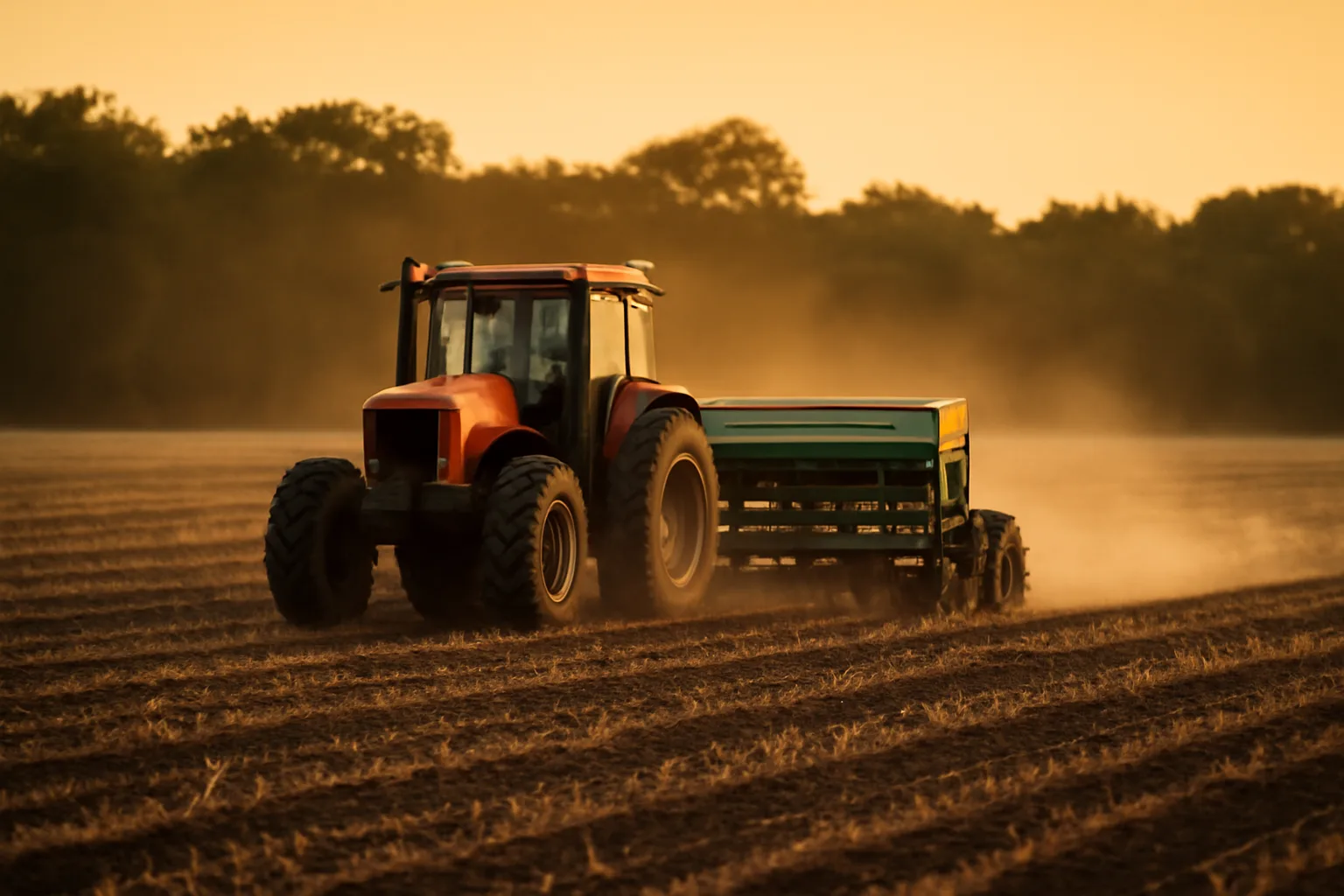
A no till drill is a planter built to cut through sod, crop residue, or a killed cover crop and place seed at a controlled depth without turning the soil first. Standard drills have coulters (sharp rotating discs) that slice a narrow furrow, a seed tube that drops seed into that slot, and press wheels that close it back up and firm the soil against the seed. Some models add a second box for small seeds like clover or brassicas so you can plant a mix in one pass at two different depths. The whole point is skipping the plow, disc, or tiller step. On a lot of hunting ground that matters more than it sounds, because a lot of leased and owned parcels have steep ground, thin topsoil, or fields you only visit a few times a year. Tilling exposes soil to erosion and burns through soil moisture fast, which is a real problem for late-summer plantings ahead of fall season. No till drilling leaves the soil structure and existing root channels intact, so rain infiltrates better and moisture holds longer between rain events [1]. For background on what a food plot actually is and why species selection matters before you ever touch equipment, see food plot whitetail.
How does a no till drill work compared to broadcasting seed
| No till drill | Excellent, controlled depth | High (own) or $10-25/acre (rent) | Clover, alfalfa, small grains, brassica mixes, sod conversions | |
|---|---|---|---|---|
| Disc + broadcast | Good if worked in | Moderate | Larger fields with tillable soil | |
| Broadcast + cultipack | Fair, depends on rain | Low | Small plots, tight budgets, soft seedbeds | |
| Broadcast only | Poor to fair | Lowest | Frost-seeding clover, overseeding into thin stands | Many county Soil and Water Conservation Districts and NRCS field offices rent no till drills to landowners for exactly this reason, small acreage users who'd otherwise never justify the purchase [2]. |
A no till drill places seed at a set depth in a slot and closes soil over it. Broadcasting throws seed on top of the ground, where it depends on rain, frost heave, or a cultipacker to get soil contact. Drilling gives you much more consistent seed-to-soil contact and depth control, which usually means better and more even germination, especially with small-seeded species like clover or brassicas that fail hard if buried too deep. The tradeoff is cost and access. A quality no till drill is a real piece of equipment, often $8,000 to $30,000+ new depending on size and brand, and most food plotters don't own one outright. Broadcasting is nearly free by comparison, just seed, a spreader, and some luck with weather. Here's a rough side by side for plot use: | Method | Seed-to-soil contact | Equipment cost | Best for |
When should you use a no till drill instead of tilling
Use a no till drill when you're planting into existing sod, a killed cover crop, or crop stubble and want to avoid disturbing the soil. It's also the right call on erodible ground, sloped fields, or anywhere soil moisture is tight, since tillage dries out the top few inches fast right when small seeds need consistent moisture to germinate. A few specific situations where a drill earns its keep: converting a fescue field to clover, planting into a terminated cereal rye cover crop, seeding a ridge or hillside plot where tillage would invite gully erosion, or getting a fall brassica planting in the ground during a dry August when tillage would cook what little moisture is left. Where tillage still makes sense: fields with heavy weed pressure that need burial or mechanical knockdown, compacted ground that needs breaking up, or when you're incorporating lime and fertilizer deep enough that surface application won't reach the root zone in time. Your soil test results should guide lime and fertilizer decisions either way. A soil test lab's recommendations are the actual authority on rates for your dirt, not a generic plan.
When to plant food plots for deer
Timing depends on region and species, but most food plot planting falls into two windows: spring plots (April through June depending on latitude) for warm-season forages like soybeans, cowpeas, and sorghum, and late summer to early fall plots (mid-July through September) for cool-season forages like clover, brassicas, and cereal grains. Southeastern and Gulf Coast states can plant cool-season plots into October. Northern states need brassicas and clover in the ground by early September so plants establish before hard frost. Land-grant extension services publish state-specific planting calendars because a date that works in Alabama is often a month too late in Wisconsin. Check your state's cooperative extension office for a zone-adjusted calendar before locking in dates. For a broader rundown of species options and how to sequence a spring and fall rotation, see deer food plots.
When to plant oats for deer
Oats are a cool-season annual, typically planted in late summer to early fall (mid-August through September in most whitetail range) for fall and winter grazing, or in early spring (March to April) where a spring cereal grain window fits the rotation. Oats germinate fast, often within 5 to 10 days in warm soil, and deer hit young oat shoots hard, which is part of why they're a food plot staple. Oats don't handle deep cold as well as winter wheat or rye, so in northern zones they'll often winterkill, which is fine if you're using them as a fall attractant rather than trying to carry a stand through to spring. Purdue Extension notes oats are among the least winter-hardy small grains commonly planted, losing stands at temperatures wheat and rye would survive [3].
When to plant turnips for deer
Turnips go in the ground roughly 90 to 120 days before your first hard frost, which in most of whitetail country lands in late July through August. Turnips need that runway to bulb out and build sugar content, since frost is actually what sweetens the bulbs and leaves and triggers heavier deer browsing in late fall and winter. Plant too late and you get leafy growth with no bulb development, plant too early in hot dry soil and germination suffers. A soil temperature in the 45 to 85 degree range at planting depth generally works, per University of Kentucky Extension guidance on brassica forage establishment [4]. Turnips are shallow-seeded, roughly a quarter inch, which is exactly the kind of seed a no till drill handles better than broadcasting, since depth control on tiny seed makes or breaks the stand.
What is a food plot, exactly
A food plot is a planted area, usually somewhere between a quarter acre and several acres, established specifically to grow forage that attracts and feeds deer or other wildlife. It's distinct from a farm field grown for harvest and sale. Food plots are managed for wildlife nutrition and hunting opportunity, not yield per bushel. Most hunters run some combination of a spring/summer plot (soybeans, cowpeas, sorghum, sunflowers) and a fall/winter plot (clover, brassicas, cereal grains) to cover deer nutritional needs and hunting windows across the year. State wildlife agencies frequently publish habitat management guides covering food plot design alongside natural browse management, since food plots work best as one piece of a broader habitat plan rather than a standalone fix [5]. If you're building your first plot and want a rundown of core species options, food plot seed and deer food plot seed both cover the basics.
Do deer eat sorghum
Yes, deer eat sorghum, both the grain heads and the young leafy growth, though it's more commonly used as a summer forage and cover crop than a primary attractant plot. Grain sorghum also draws turkey, dove, and other wildlife, which makes it a popular multi-species planting on larger acreage. Sorghum is drought-tolerant compared to corn, which matters in hot, dry summer stretches when a corn plot might stall out. It's typically planted in late spring once soil temps are reliably above 60 degrees, similar timing to corn. Deer browse pressure on young sorghum can actually be heavy enough to stunt a stand if plot size is small relative to deer density, so sorghum tends to work better in larger plantings of an acre or more.
Do deer eat clover, and do deer like clover
Yes, deer eat clover readily, and it's one of the most consistently preferred food plot forages across whitetail range. Clover offers high protein content, often 20 to 30 percent crude protein in vegetative growth, and it regrows after grazing, which is why a well-maintained clover plot can get hit hard all season and keep producing [6]. Clover also fixes nitrogen in the soil through its root nodules, which means it needs less nitrogen fertilizer than grasses or brassicas and can actually improve soil for whatever you plant next in rotation. Perennial white clovers like Ladino can hold a stand for 3 to 5 years with proper mowing and weed control, which makes clover one of the better cost-per-year forages once it's established. Because clover seed is small, a no till drill set to a shallow quarter-inch depth (or a cultipacker pass after broadcasting) gives much more reliable stands than a straight broadcast into rough ground.
What are deer's favorite foods, and do deer like honey
Deer preference shifts by season and by what's locally available, but across food plot forages, clover, soybeans, and acorns consistently rank at the top of preference studies and browse surveys. Corn and brassicas draw heavy use in late fall and winter when protein-rich options are scarce and deer shift toward carbohydrate and energy-dense foods to build fat reserves. As for honey, there's no research or established browse survey showing deer seek out honey as a food source, and it's not a recognized part of whitetail diet in any wildlife agency or extension publication. Deer are herbivores adapted to browse, forbs, mast, and agricultural forage; honey isn't part of that picture. If you've heard of hunters using honey or sugar-based products near feeders or plots, know that many states restrict baiting and supplemental feeding, sometimes banning it outright or limiting it to certain seasons and distances from stands, so check your state wildlife agency's regulations before adding any attractant, honey included .
How much does a no till drill cost to rent or buy
Renting a no till drill through a county conservation district, NRCS office, or farm co-op typically runs $10 to $25 per acre, sometimes with a flat daily rate of $150 to $400 depending on drill size and region. Many districts prioritize rentals for cover crop and conservation seeding, so food plot use may need to fit around ag season demand, book early. Buying new, a compact no till drill sized for food plot acreage (roughly 5 to 10 foot working width) runs $8,000 to $20,000+, while larger farm-scale units used for larger tracts can run well past $30,000. Used drills show up regularly at farm auctions and through ag equipment dealers for a fraction of new price, often $3,000 to $10,000 for a serviceable smaller unit, though wear on coulters, seed meters, and press wheels needs a real inspection before buying. For most hunters managing under 10 acres of plots, renting makes far more financial sense than buying. You'd need years of consistent no-till plantings across a lot of acreage to justify ownership over rental rates. Getting the species and rotation right up front is honestly more valuable than the equipment itself. This is where a $99 one-time Custom Food Plot Plan pays for itself fast, since a plan tailored to your soil test results and region tells you exactly what to plant and when, before you spend a rental fee planting the wrong thing at the wrong time. Build one at /plot-plan-builder.
What's the actual step-by-step for no till drilling a plot
Start by killing existing vegetation, usually with a glyphosate application 2 to 3 weeks before planting, giving the cover crop or sod time to fully die back so it doesn't compete with your new planting for moisture and nutrients. Skipping this step is the single most common no-till failure, drilling into live sod that regrows and chokes out the new seeding. Next, pull a soil test if you haven't in the last 2 to 3 years, and apply lime and fertilizer per your lab's recommendations. Lime especially needs lead time, often 3 to 6 months to fully adjust soil pH, so if your test shows you're low, get lime down as early as the calendar allows even if the drilling itself happens later. Set the drill's seed depth and rate for your specific species, small seeds like clover and brassica typically a quarter to half inch, larger seeds like beans, oats, and sorghum an inch to an inch and a half. Drive at a controlled speed, most drills work best in the 4 to 6 mph range, faster speeds risk poor depth control and seed bounce. After drilling, resist the urge to run a heavy roller over everything, most no till drills already have press wheels built in to firm the seed row properly.
What mistakes should you avoid with a no till drill
The biggest mistake is drilling into living vegetation instead of properly terminated cover. Green, growing sod or cover crop out-competes new seedlings for water and light, and you'll often end up with a thin, patchy stand no matter how well the drill performed mechanically. Second most common mistake: wrong seed depth. Every seed box on a drill needs separate calibration for the species going in it, and guessing at settings from the last crop you planted is a fast way to bury small seed too deep or leave large seed exposed on the surface where it dries out or gets picked off by birds. Third, ignoring soil compaction. A no till drill cuts through residue fine, but if the ground underneath is badly compacted from years of equipment traffic or heavy clay that's been worked wet, root penetration still suffers regardless of tillage method. A soil test and a simple compaction check (a screwdriver or soil probe pushed into moist ground) tells you fast whether you've got a structural problem no drill can fix on its own.
Frequently asked questions
Do deer eat sorghum in food plots?
Yes. Deer browse both grain sorghum heads and young leaf growth, and it also draws turkey and dove. It's mostly used as a summer forage or drought-tolerant alternative to corn, planted once soil temps hit roughly 60 degrees. On small plots, heavy deer browsing on young sorghum can stunt the stand, so it works better on larger acreage.
Do deer like clover, and is it worth planting?
Deer strongly prefer clover, and it's one of the most reliable food plot forages available. It offers 20 to 30 percent crude protein in vegetative growth, regrows after grazing, and fixes its own nitrogen. A well-managed perennial clover stand can produce for 3 to 5 years, making it one of the best cost-per-year plantings for whitetail plots.
When should you plant food plots for deer?
Spring plots (soybeans, cowpeas, sorghum) generally go in April through June depending on latitude. Fall plots (clover, brassicas, cereal grains) go in mid-July through September in most of whitetail range, earlier in northern states, later in the Southeast and Gulf Coast. Check your state's cooperative extension planting calendar for exact local windows.
When is the best time to plant oats for deer?
Plant oats in late summer to early fall, roughly mid-August through September, for a fall and winter attractant plot, or in early spring (March to April) for a spring cereal grain window. Oats germinate in 5 to 10 days in warm soil but winterkill more easily than wheat or rye, so don't count on them overwintering in northern climates.
When do you plant turnips for deer food plots?
Plant turnips 90 to 120 days before your area's first hard frost, typically late July through August across most whitetail range. That runway lets bulbs develop and sweeten after frost, which is what triggers heavier deer browsing in late fall and winter. Plant too late and you get leaves with no bulb; too early in hot dry soil and germination suffers.
What exactly is a food plot?
A food plot is a planted area, often a quarter acre to several acres, established specifically to feed and attract deer or other wildlife rather than for harvest and sale. Most hunters run a spring/summer plot and a fall/winter plot to cover deer nutrition and hunting season across the year, alongside natural browse and habitat management.
What are deer's favorite foods overall?
Preference shifts by season, but clover, soybeans, and acorns consistently top browse preference surveys. In late fall and winter, deer shift toward energy-dense foods like corn and brassicas to build fat reserves. Local availability matters a lot too; deer eat what's abundant and accessible in their specific range.
Do deer like honey or seek it out as food?
No. There's no wildlife agency or extension research showing deer seek out honey as a food source, and it's not part of documented whitetail diet. Deer are browsers adapted to forage, forbs, and mast. If you're considering any sweet attractant near a plot or feeder, check your state's baiting and feeding regulations first, since many restrict or ban it.
What does a no till drill actually do differently than tilling?
A no till drill cuts a narrow slot through sod or residue, drops seed at a controlled depth, and closes the slot with press wheels, all without turning over the soil. Tilling loosens and inverts soil before planting. No till preserves soil moisture and structure and cuts erosion risk, which matters most on sloped or drought-prone plot ground.
Is it cheaper to rent or buy a no till drill for food plots?
For most food plotters managing under 10 acres, renting is far cheaper. Rental through a conservation district or co-op typically runs $10 to $25 per acre or $150 to $400 per day. Buying new runs $8,000 to $20,000+ for a compact model, so you'd need many years of heavy use to justify ownership over renting.
Can you use a no till drill for small seeds like clover and turnips?
Yes, and it's actually the better method for small seed. Clover and turnip seed need shallow, consistent depth (about a quarter inch) to germinate well, and a drill's depth control beats broadcasting for even stands. Many drills have a separate small-seed box so you can plant a clover-brassica mix in one pass at two depths.
Do you still need to kill existing vegetation before no till drilling?
Yes. Drilling into live, growing sod or cover crop is the most common cause of failed no-till plantings, since the existing growth competes for water and light against new seedlings. Most plans call for a glyphosate application 2 to 3 weeks ahead of drilling to fully terminate cover before the drill ever touches the field.
Sources
- USDA NRCS, Soil Health and No-Till/Cover Crop guidance: No-till practices preserve soil structure, reduce erosion, and improve moisture infiltration and retention compared to tillage
- USDA NRCS, Equipment Rental / Conservation District Programs: NRCS field offices and conservation districts assist landowners with conservation planting equipment access
- Purdue University Extension, Forage Field Guide - Small Grains: Oats are among the least winter-hardy small grains and commonly winterkill compared to wheat or rye
- University of Kentucky Cooperative Extension, Brassicas for Forage: Brassica forage crops like turnips need adequate lead time before frost to bulb properly and establish in the recommended soil temperature range
- Pennsylvania Game Commission, Food Plot and Habitat Management Guidance: State wildlife agencies publish food plot and habitat management guidance as part of broader deer management
- Michigan Department of Natural Resources, Baiting and Feeding Regulations: States regulate or restrict baiting and supplemental feeding of deer, with rules varying significantly by state