Last updated 2026-07-25
TL;DR
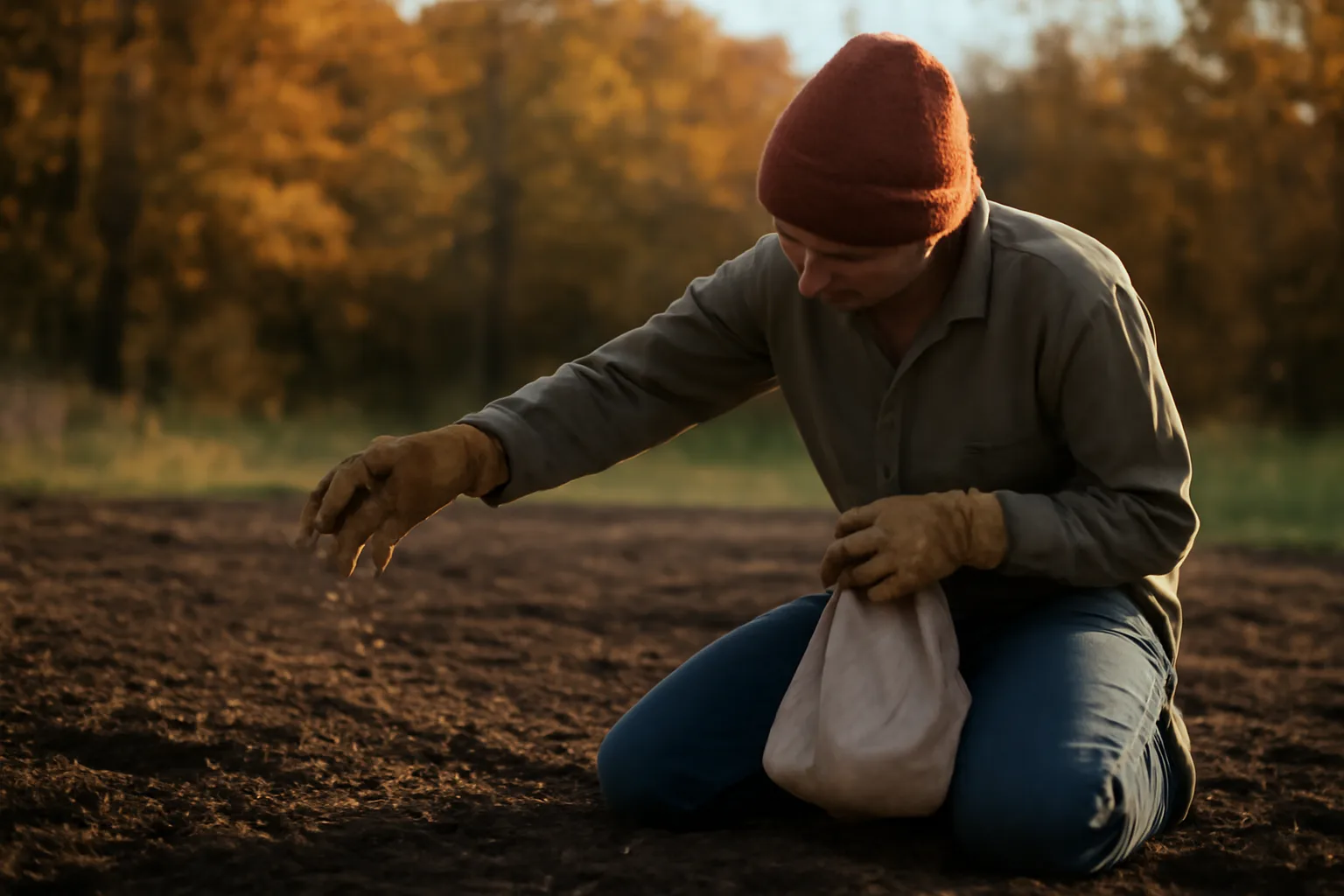
Planting a food plot by hand works fine on plots under an acre or two. Kill or clear existing vegetation, test and amend soil per your lab report, broadcast seed at the right rate and depth for your species, then cultipack or drag to get seed-to-soil contact. Timing depends on species: clover and oats go in late summer to early fall in most zones, turnips 60-90 days before first frost.
what is a food plot, exactly
A food plot is a small planted area, usually a fraction of an acre to a few acres, designed to give deer and other wildlife a concentrated food source and to give hunters a place to observe or hunt over. It's not a farm field. Most hunting-land food plots run from a quarter acre to two or three acres, and plenty of good ones are smaller. The USDA's NRCS treats food plots as a wildlife habitat practice, not agriculture, and many states offer cost-share or technical help through their wildlife agencies for exactly this reason. A food plot serves two jobs at once: it feeds deer through a nutritional gap (usually late summer stress or the cold months) and it gives hunters a predictable place to set up. You don't need a tractor to make one work. Hand-planting a plot under an acre is completely realistic with a hand seeder, a rake, and a few weekends. It's how a lot of small woodlot and hunting-lease plots get planted every year, and it's often the only option when the ground doesn't have road or trail access for equipment. For a broader look at how food plots fit into a whitetail management plan, see food plot whitetail.
what do you actually need to plant a food plot by hand
The gear list is short. You need a way to knock down existing vegetation (a brush cutter, string trimmer, or hand scythe for small plots, or a glyphosate application if you're going herbicide-first), a way to work the seedbed (a hard rake, a hand cultivator, or a garden tiller for tiny plots), a broadcast seed source (a hand-crank seeder, called a belly grinder, costs $25-50 and covers ground fast and evenly), and something to firm the seed in, which can be as simple as dragging a section of chain-link fence or a mattress spring behind you, or walking it in with boots if the plot is small enough. A soil test kit or a mail-in soil test from your state's land-grant university extension office is the other non-negotiable. Extension soil tests typically cost $7-20 and take one to two weeks to come back, and they tell you the actual lime and fertilizer numbers for your dirt, not a guess. Your test results are the final word on how much lime and what fertilizer blend to use, more specific than anything in this article. A lot of hand-plotters skip the tiller and go no-till instead: spray existing vegetation, wait 10-14 days for it to die, then broadcast seed directly into the dead thatch and drag it in. This saves a lot of labor and reduces erosion on sloped ground, which is common on hunting leases in hill country. If you want a rundown of specific seed blends that broadcast well by hand, deer food plot seed covers the common options.
when to plant food plots for deer
Timing depends on your species and your USDA plant hardiness zone, but there are two main windows almost everywhere: late summer to early fall for cool-season plots (clover, oats, brassicas, wheat), and spring for warm-season plots (soybeans, corn, sorghum, cowpeas). Cool-season fall plots generally go in 6-10 weeks before your area's average first frost date, which lets the plants establish before real cold hits. In the Midwest and Upper South that's typically late August through mid-September. In the Deep South, growers often wait until late September through October because summer heat lingers. In the Northeast and Upper Midwest, late July through August is common because the frost-free window closes earlier. Spring plots go in after your last frost date and once soil temps are consistently above 55-60°F, usually April through May in most whitetail range, later in the northern tier. Your own frost dates matter more than any generic calendar. NOAA's National Centers for Environmental Information keeps historical frost-date data by station, and your state extension office publishes zone-specific planting guides that are worth five minutes to look up before you buy seed [1].
when to plant clover for deer, and do deer like clover
Yes, clover is one of the most reliable draws in the food plot world, and deer readily browse it through spring, summer, and fall when it's actively growing. It's a perennial in most of whitetail range, meaning one planting can produce for 3-5 years with mowing and fertility maintenance. Plant clover in late summer to early fall (August-September in the Midwest and North, September-October in the South) or in early spring once soil temps hit the mid-50s. Fall plantings tend to establish better because there's less weed competition than in spring. Clover seed is tiny, so it needs a shallow planting depth, no more than 1/4 inch, and firm seed-to-soil contact. Broadcasting on a fine, firmed seedbed and then lightly dragging or rolling it in works better than trying to bury it. Many hand-planters mix clover seed with dry sand or pelletized lime before broadcasting just to spread it more evenly, since a little seed covers a lot of ground. Purdue Extension's forage guide notes that clovers fix their own nitrogen through rhizobium bacteria in the soil, so a proper inoculant on the seed (or pre-inoculated seed) matters more for clover than almost any other food plot species [2]. Skip the inoculant and you can end up with pale, stunted clover even on decent ground.
when to plant oats for deer
Oats go in during the same cool-season window as clover, roughly 6-8 weeks before first frost, which lands in late August through September for most of the whitetail range and into October in the Deep South. Oats are an annual, so they won't come back next year on their own, but they're fast, cheap, and deer hit them hard as soon as they green up. Planting depth for oats is 1-2 inches, deeper than clover because the seed is bigger and needs more soil contact to germinate reliably. A hand broadcast followed by a rake-in or light disking works fine. Oats also make a solid nurse crop, meaning you can plant them alongside clover or brassicas to get quick green-up while the slower species establish underneath. One real limitation: oats generally aren't as cold-hardy as winter wheat or rye, so in the northern part of whitetail range they can die back hard after the first few real freezes, right when deer need food most. If you're in a cold zone and want green forage into December and January, cereal rye is usually the better cool-season grain.
when to plant turnips for deer
Turnips and other brassicas go in 60-90 days before your area's first expected frost, which usually means late July through August in the North and August through early September in the mid-South. That window matters more for turnips than almost any other plot species because they need enough growing season to bulb up before deer start hitting them hard. Here's the pattern extension agronomists describe again and again: deer often ignore brassicas for the first several weeks, then hammer them hard once a hard frost hits. That's because frost converts starches in the leaves and bulbs to sugars, making the plant sweeter and more palatable. If you plant too late and that frost-sweetening never has time to happen before deer need groceries, you lose a lot of the plot's value. Seeding depth for turnips is shallow, about 1/4 to 1/2 inch, similar to clover. Seeding rate for a pure turnip plot is typically 4-6 lbs per acre broadcast, according to blends distributed through university and state agency wildlife programs [3]. Turnips are also commonly blended with radish and clover in a brassica mix, which is easy to broadcast by hand in one pass since seed sizes are all fairly small.
do deer eat sorghum, and does it work as a hand-planted plot
Deer do eat sorghum, both the standing grain and the foliage, and it's a legitimate warm-season option, but it's more of a secondary or cover-and-food combo crop than a primary attractant compared to soybeans, corn, or clover. Grain sorghum (milo) produces a seed head deer and turkey both use, and the standing stalks provide decent screening cover into winter. Sorghum goes in during the spring warm-season window, after soil temps are reliably above 65°F, which is typically May into June across most of the Midwest and mid-South. Planting depth runs 1-1.5 inches, and broadcast rates for food plot use are usually higher than row-crop rates since you're not thinning, often in the 10-12 lb per acre range for a solid stand, though check your specific seed tag since sorghum varieties differ. One real caution: sorghum and its relative sudangrass can develop toxic levels of prussic acid (cyanide compounds) in young, stressed, or frost-damaged plants, a documented risk in forage sorghum that university extension livestock and forage programs warn about repeatedly [4]. It's mostly a concern for grazing livestock in stressed regrowth, and wild deer browsing mature standing sorghum in a food plot context isn't the same risk profile, but it's worth knowing before you plant it as a primary or heavy monoculture.
do deer like clover, and what are deer's favorite foods overall
Deer definitely like clover, and it consistently ranks among the top food plot forages in university browse studies because it's high in protein (often 25-30% crude protein in good stands) and stays palatable through most of the growing season. But "favorite food" depends heavily on season, region, and what's naturally available. In spring and summer, deer favor high-protein forbs and legumes: clover, soybeans, cowpeas, and natural browse like greenbrier and honeysuckle where it grows. In fall, acorns often beat almost any planted food plot when there's a good mast crop, which is one reason plot performance varies so much year to year and has nothing to do with what you planted. In late fall and winter, brassicas (turnips, radish) and standing grain (corn, soybeans, sorghum) become more important as energy sources going into cold weather. Mississippi State University's Deer Lab, which runs some of the more detailed food plot and deer nutrition research in the country, has repeatedly found that natural forage availability and mast crops swing deer use of plots year to year more than plot species choice alone. In other words: a good plot in a bad acorn year gets hit hard, and a great plot in a bumper acorn year might sit quiet for weeks. Don't read too much into one slow season. For a species-by-species comparison of what tends to draw deer best in different regions, deer food plots is a useful next read.
do deer like honey, and is it worth using as an attractant
There's no real research showing deer seek out honey specifically, and it's not a standard food plot or attractant ingredient in any university extension guidance. Deer are drawn to sweetness in general, which is part of why frost-sweetened brassicas and sugar beets work so well, but pouring honey on the ground isn't a documented or common practice among wildlife biologists. More relevant: many states restrict or ban baiting and feeding deer entirely, and the legal line between a "food plot" (a planted, growing crop) and "baiting" (placing loose feed, minerals, or attractants on the ground) is a real distinction with real legal consequences. Michigan, for example, prohibits baiting and feeding deer in the Lower Peninsula with specific exceptions, and defines bait broadly enough to include things like scent-based products spread on the ground [5]. Other states allow baiting with limits on volume and distance from a stand. Check your state wildlife agency's regulations before using any additive, syrup, mineral, or scent product on or near a planted plot. A planted food plot is legal almost everywhere; what you add to it afterward is where the legal risk shows up.
step by step, how to plant a food plot by hand
Here's the actual sequence, in order, for a plot under two acres with no tractor. First, pull a soil test 60-90 days before your planting date and send it to your state extension lab. This is the step people skip and regret; without it you're guessing at lime and fertilizer, and lime especially takes months to fully adjust soil pH once applied. Second, clear the existing vegetation. For small plots, spraying glyphosate 10-14 days ahead of planting and letting it die down is the lowest-labor approach. For a truly hand-tool approach, a brush cutter or scythe followed by raking out the thatch works, though it's more work and leaves more competition behind. Third, work the seedbed lightly. You don't need to till deep or turn the soil over. A hard rake dragged across the surface to break up clumps and expose some bare dirt is usually enough, especially if you're going no-till into dead thatch. Fourth, apply lime and fertilizer per your soil test results, broadcasting by hand or with a bag spreader, and work it into the top few inches if you can. Fifth, broadcast the seed at the labeled rate. Walk in a grid pattern, north-south then east-west, to even out any unevenness in your throw. Halving your seed and doing two passes in opposite directions gives noticeably more even coverage than one heavy pass. Sixth, firm the seed in. This is the step that makes or breaks small-seeded species like clover and brassicas. Drag a chain-link section, a piece of cattle panel, or even a heavy tarp weighted down across the plot, or just walk the whole area in a grid pattern to press seed into contact with soil. Seventh, water if you can and if rain isn't in the forecast within a few days, though most hand-planted hunting plots rely on natural rainfall. A reader with a lab report in hand can build a plan around exact lime and fertilizer numbers instead of guessing; that's the whole idea behind a $99 one-time Custom Food Plot Plan, which turns your soil test into a specific species and seeding plan for your zone rather than a generic blend recommendation.
how big should a hand-planted food plot be
Most hand-planted plots run from a quarter acre to one acre, occasionally up to two acres if you've got help and a few weekends to spare. Beyond that, the labor math stops making sense, and it's worth renting a small tractor or ATV implement for a day instead. A quarter-acre plot (about 10,890 square feet, roughly the size of a football end zone plus some) is very doable solo in a weekend: clearing, prep, and seeding. A full acre with hand tools is a multi-day project, more realistic with two or three people working together. Size also depends on purpose. A tiny 1/10-acre "kill plot" tucked near a stand for close bow shots doesn't need to feed the whole property, it just needs to hold deer in range during shooting light. Bigger plots (half acre and up) work better as destination food sources meant to carry deer through a nutritional gap over weeks, more than draw them past a stand once.
hand-planting vs. equipment-based planting, what actually changes
| Practical plot size | Up to 1-2 acres | 1 acre and up, scales easily | |
|---|---|---|---|
| Time per acre | Half a day to a full day | 1-2 hours | |
| Seedbed prep quality | Good with effort, uneven on rocky/rooty ground | More consistent, deeper if needed | |
| Cost of entry | $50-150 in hand tools | $2,000+ for used ATV implements, more for tractor gear | |
| Best for | Remote plots, small kill plots, no trail access | Larger destination plots, annual rotations | The biggest practical difference is seed-to-soil contact on uneven ground. A cultipacker on a tractor firms seed in consistently across acres in minutes. By hand, you're relying on foot traffic or a dragged chain, which works but takes longer and is less uniform on rocky or root-heavy ground, common in wooded hunting leases. For more on choosing between broadcasting, drilling, and no-till methods generally, food plot seed breaks down seeding methods in more depth. |
The biology doesn't change. Seed depth, timing windows, and fertility needs are identical whether you use a tractor or a rake. What changes is speed, evenness, and how much ground you can realistically cover. | Factor | Hand-planting | Tractor/ATV implement |
Frequently asked questions
Do deer eat sorghum?
Yes, deer eat both the grain heads and foliage of sorghum, and it works as a secondary warm-season food plot crop with good cover value. It's generally less of a primary draw than soybeans, corn, or clover, but useful in a mixed planting or where deer pressure on preferred forages is heavy.
Do deer eat clover?
Yes, clover is one of the most consistently used food plot forages for deer, high in protein and palatable through most of the growing season. It ranks near the top in university browse studies and works as a perennial that can produce for 3-5 years with proper mowing and fertility.
When to plant deer food plots?
Cool-season plots (clover, oats, brassicas) go in 6-10 weeks before first frost, typically late July through October depending on your zone. Warm-season plots (soybeans, corn, sorghum) go in spring after last frost once soil temps hit the mid-50s to 60s. Check your state extension's zone-specific planting dates for exact windows.
Do deer like clover?
Yes, deer show strong preference for clover across most regions, and it's a staple recommendation from land-grant university forage programs. It's especially valuable in spring and summer when protein needs are highest for antler growth and lactation.
When to plant oats for deer?
Plant oats 6-8 weeks before your area's first expected frost, generally late August through September across most of whitetail range, later into October in the Deep South. Oats are an annual and won't survive hard winter cold in northern zones, so they're best as a fast fall green-up crop.
When to plant food plots for deer?
Timing splits into two windows: cool-season species in late summer to early fall (roughly 60-90 days before first frost), and warm-season species in spring after the last frost once soil has warmed. Exact dates shift by USDA hardiness zone, so check your state extension's planting calendar.
When to plant turnips for deer?
Plant turnips 60-90 days before your area's first frost, usually late July through August in northern zones and August into early September in mid-southern zones. This timing lets bulbs mature before the frost-sweetening that makes turnips more palatable to deer in late fall and winter.
What is a food plot?
A food plot is a planted area, usually a fraction of an acre to a few acres, established specifically to feed deer or other wildlife and give hunters a place to hunt over. It's treated as a wildlife habitat practice by USDA's NRCS, distinct from row-crop agriculture.
What are deer's favorite foods?
It varies by season: clover, soybeans, and cowpeas in spring and summer; acorns and other mast in fall when available; brassicas and standing grain in late fall and winter. Natural mast crops often outcompete planted food plots in a good acorn year, according to Mississippi State's Deer Lab research.
Do deer like honey?
There's no established research showing deer specifically seek out honey, and it's not used in standard university extension food plot or attractant guidance. Deer respond to sweetness generally, which is part of why frost-sweetened brassicas work, but honey itself isn't a documented attractant, and many states restrict baiting additives entirely.
Can you plant a food plot without a tractor?
Yes, plots up to about one or two acres are realistic to plant entirely by hand using a brush cutter or herbicide for clearing, a rake for seedbed prep, a hand-crank broadcast seeder, and a dragged chain or foot traffic to firm seed in. It takes more labor and time than equipment planting but works fine at smaller scale.
How deep should you plant food plot seed by hand?
It depends on seed size. Small seeds like clover and brassicas need only 1/4 to 1/2 inch of coverage. Larger seeds like oats, wheat, and sorghum need 1 to 2 inches. Planting too deep is the most common hand-broadcasting mistake, especially with small-seeded species.
Is baiting deer with food plots legal?
A planted, growing food plot is legal in nearly every state and is not the same thing as baiting. Baiting refers to placing loose feed, minerals, or attractants on the ground, which many states restrict or ban, like Michigan's baiting and feeding rules for the Lower Peninsula. Always check your specific state wildlife agency's current regulations before adding anything beyond planted seed.
Sources
- NOAA National Centers for Environmental Information, Freeze/Frost Data: historical frost date data used to time cool-season and warm-season food plot plantings
- Purdue University Extension, Forage Field Guide: clover fixes nitrogen through rhizobium bacteria and needs inoculation for proper establishment
- Mississippi State University Extension, Brassicas for Deer: turnip seeding rates and brassica planting depth for food plot use
- University of Nebraska-Lincoln Extension, Prussic Acid Poisoning: sorghum and sudangrass can develop toxic prussic acid levels in young or stressed regrowth
- Michigan Department of Natural Resources, Baiting and Feeding Regulations: Michigan prohibits baiting and feeding deer in the Lower Peninsula with specific exceptions
- USDA Natural Resources Conservation Service, Wildlife Habitat Practices: food plots are treated as a wildlife habitat practice eligible for technical and cost-share assistance