Last updated 2026-07-24
TL;DR
A food plot planter is any tool that gets seed into soil at the right depth, from broadcast spreaders to no-till drills. Choice depends on plot size, soil type, and whether you can till. Most hunters on under 3 acres do fine with a spreader and drag; larger acreage benefits from a disc harrow or no-till drill behind an ATV or tractor.
what is a food plot planter, exactly
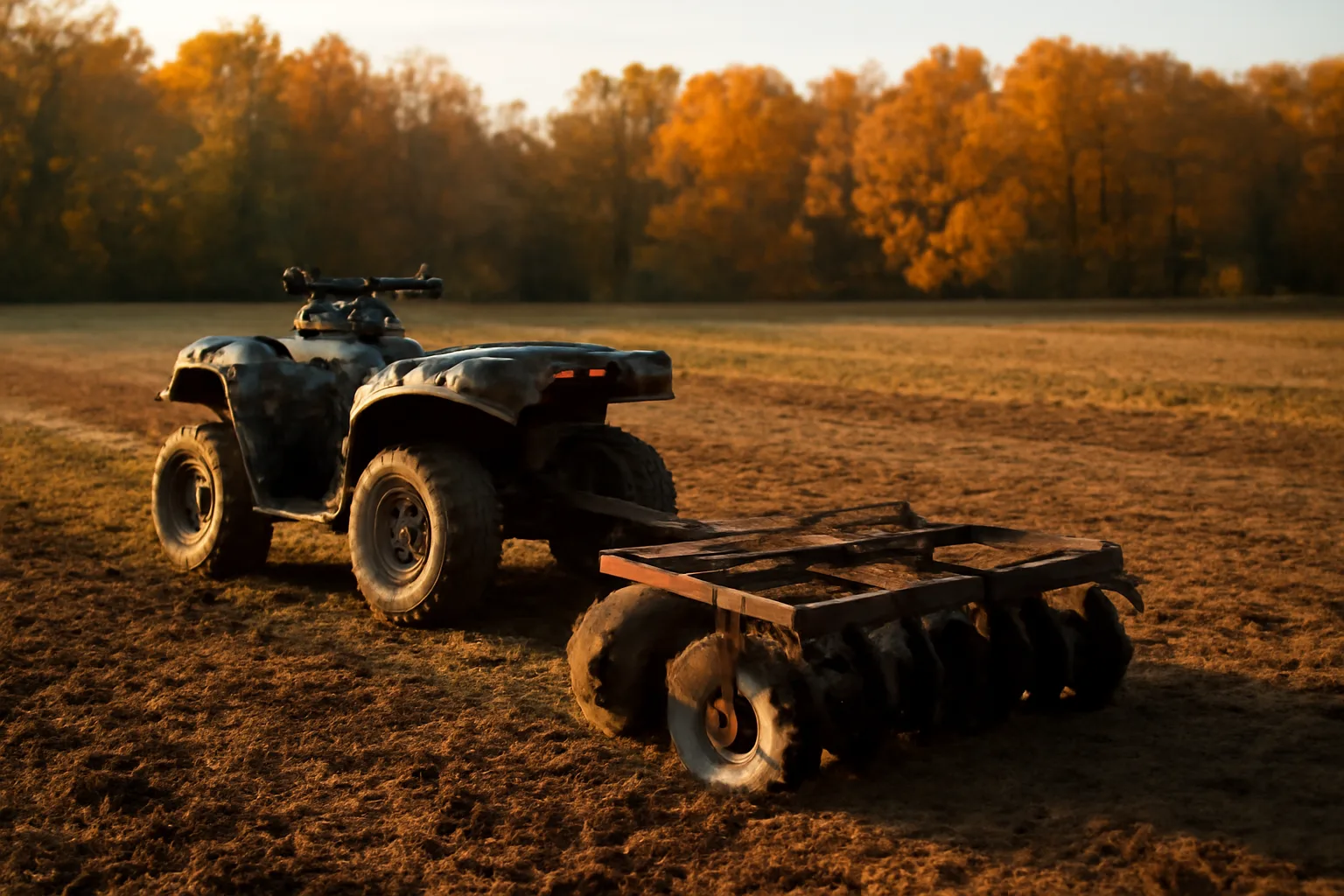
A food plot planter is any piece of equipment used to place seed into soil so it germinates and grows into a stand deer will eat. That definition covers a lot of ground. It includes a $40 handheld broadcast spreader you sling over your shoulder, a pull-behind disc that scratches seed into loose dirt, and a true no-till drill that cuts a slot, drops seed at a set depth, and closes the row behind it. The term gets used loosely in hunting media, so it helps to separate three categories. Broadcast spreaders throw seed on top of the ground and rely on rain, a drag, or foot traffic to work it in. Tillage-based planters (disc harrows, tillers, cultipackers) prepare a seedbed and press seed into contact with soil. No-till drills do both jobs in one pass, cutting through existing sod or residue without a full tillage pass first. Which one you need depends on your plot size, your soil, and your budget. A half-acre clover plot behind a house doesn't need a drill. Twenty acres of soybeans on a farm lease probably does, or at least benefits enormously from one. The University of Tennessee Extension notes that seedbed preparation and seed-to-soil contact are the two most common failure points in food plot establishment, more than seed choice itself [1]. For background on species that pair well with different planting methods, see food plot whitetail and deer food plot seed.
what planter should I actually buy for my plot size
| Hand broadcast spreader | Under 1 acre | $20-$150 | No, needs disturbed soil | |
|---|---|---|---|---|
| ATV pull-behind spreader | 1-5 acres | $150-$500 | No | |
| Small disc harrow | 1-10 acres | $400-$1,200 | No, this is the tillage | |
| Cultipacker/drag | Any size | $200-$800 | Used after broadcast, not standalone | |
| No-till drill (ATV/UTV) | 2-10 acres | $2,500-$6,000 | Yes | |
| No-till drill (tractor) | 5+ acres | $5,000-$15,000+ | Yes | For a deeper look at seed options once you've settled on equipment, deer food plots covers species selection by region. |
This is the question that matters most, and the honest answer is: match the tool to your acreage and your soil, not to what looks good in a hunting show. For plots under an acre, a hand-crank or backpack broadcast spreader ($30 to $150) paired with a hand tiller or a rake works fine. You till or disturb the top inch of soil, broadcast seed, then drag a section of chain-link fence or a mattress spring behind an ATV to work seed in. This is slow but costs almost nothing and works for small hidden plots you access on foot. For one to five acres, a pull-behind spreader (many mount to an ATV or UTV hitch, $150 to $500) speeds things up a lot. Pair it with a small disc harrow or a cultipacker. Disc harrows in the 4 to 5 foot range designed for ATVs run $400 to $1,200. This combo handles most food plot situations hunters actually have. For five acres and up, especially if you're running row crops like soybeans or corn, a tractor and an actual no-till drill starts making financial sense, either owned or rented. No-till drills designed for small acreage (Great Plains, Kasco, Firminator, and similar brands) run $3,000 to $12,000 new, though many co-ops and conservation districts rent them out by the day for $50 to $150, which is often the smarter move for a single food plot operation. Check with your local NRCS office or soil and water conservation district, many maintain a no-till drill for rent specifically because they want to encourage cover cropping [2]. Here's a comparison to make the decision easier: | Planter type | Best plot size | Typical cost | Works without tillage? |
do I need a no-till drill or can I get away with broadcasting
You can broadcast almost any food plot seed and get a stand. The question is whether you'll get a good stand or a thin, weedy one. Broadcasting works best for small-seeded species that don't need much soil coverage: clover, brassicas like turnips and radishes, and chicory all germinate fine when scattered on a prepared, loose seedbed and lightly dragged or cultipacked. These seeds need light to germinate in many cases, so burying them deep with a drill can actually hurt establishment. Clover in particular is often broadcast on top of a firmed seedbed rather than drilled. Larger seeds like soybeans, corn, and cereal grains (oats, wheat, rye) generally do better with actual planting depth control. Soybeans planted too shallow dry out and fail; planted right, drills place them at 1 to 1.5 inches consistently. Broadcasting soybeans and hoping a light disc pass covers them adequately is one of the most common reasons soybean food plots fail to establish, according to multi-state extension guidance on soybean planting depth [3]. The no-till advantage isn't just convenience. No-till planting reduces erosion, preserves soil moisture, and avoids waking up a dormant weed seed bank the way a full tillage pass does. USDA NRCS points out that reduced tillage systems can cut soil erosion substantially compared to conventional tillage, which matters on slopes and in areas with erodible soils common to a lot of leased hunting ground [4]. If you're renting a drill anyway, it's worth using it even on species you could broadcast.
when to plant food plots for deer
Timing depends entirely on whether you're planting a spring/summer plot or a fall plot, and both depend on your specific frost dates, which vary by hundreds of miles across whitetail range. Spring and summer plots (soybeans, corn, clover establishment, chicory) go in after your last frost date, typically anywhere from mid-April in the Deep South to early June in the northern Midwest and Canada border states. These plots are usually meant to provide summer nutrition through antler growth and lactation, and to still have standing forage into early fall. Fall plots (brassicas, oats, wheat, cereal rye, winter peas) go in 60 to 90 days before your average first frost, which lets them mature before the ground freezes and cold weather sweetens brassicas through starch-to-sugar conversion. In much of the whitetail's range this lands somewhere between mid-August and mid-September. Far south, you can push into October. The honest answer to "when to plant food plots" is: pull your county's average first and last frost dates from your state extension service or the NOAA National Weather Service climate normals, then count backward from there. Nobody can give you a single national date because a hunter in Alabama and a hunter in Minnesota are working with completely different calendars. For a fuller planting calendar broken out by USDA hardiness zone, see deer food plot seed.
when to plant oats for deer
Oats are typically planted as a fall food plot, 45 to 60 days before your first expected frost, so they have time to establish before growth slows in cold weather. In most of the whitetail's range this means late August through mid-September. Oats germinate fast, often in 5 to 7 days with adequate moisture, and deer will hit young oat shoots hard, sometimes hard enough to need to fence a small plot temporarily if deer density is high relative to plot size. Oats don't handle deep winter as well as wheat or cereal rye; a hard freeze below the mid-teens Fahrenheit can kill oat plants outright, while wheat and rye keep growing after a thaw. That makes oats a good early-fall to early-winter draw, but not a plot you should count on feeding deer in February in the northern half of the country. Some hunters plant a spring oat crop too, mainly as a nurse crop for establishing clover, since oats grow fast and give some weed suppression while slower clover gets rooted.
when to plant turnips for deer
Turnips go in 80 to 90 days before your first fall frost, which in most of the country lands between late July and mid-September. Turnips need that runway because you're growing both a bulb and leafy top growth, and both need to size up before frost sweetens them. Brassicas including turnips convert starches to sugars after a hard frost, which is why deer often ignore a turnip plot in October and then hammer it in December. This isn't superstition, it's a real plant physiology response to cold stress documented in forage brassica research from land-grant universities studying brassica quality for livestock and wildlife forage. One planting mistake worth flagging: turnip seed is tiny and needs to be planted shallow, no more than a quarter inch deep, and broadcast onto a firm, weed-free seedbed works better than drilling it deep. Extension guidance on brassica forage establishment recommends a firm seedbed and shallow seeding depth of 1/4 to 1/2 inch for brassica species [5].
do deer like clover, and do deer eat clover
Yes, deer eat clover readily and it's one of the most reliable food plot species in the country. Clover (white clover, red clover, and ladino varieties are the most common food plot types) is high in protein, often tests in the 20 to 25 percent crude protein range on quality stands, and it's a perennial, meaning a well-maintained clover plot can produce for three to five years before needing to be replanted. Deer favor clover especially in spring and early summer when does need protein for lactation and bucks need it for antler growth. It's also one of the few food plot species that holds up under fairly heavy browsing pressure without dying out, unlike annual grains that get grazed to nothing in high-deer-density areas. Clover does need lime and fertility management to persist. It's sensitive to soil pH, and most extension guidance recommends a pH of 6.0 to 6.5 for good clover establishment and nitrogen fixation. Your soil test is the actual authority here, not a blanket number from an article; lime and fertilizer recommendations should come from whoever ran your test, since regional soil chemistry varies enough that a generic answer can lead you to over-lime or under-lime a specific field.
do deer eat sorghum
Deer will eat sorghum, particularly the grain heads once they mature, but it's not a top-tier food plot species compared to soybeans, corn, or brassicas for pure deer attraction. Sorghum (including grain sorghum and forage sorghum types) is more commonly planted as a cover crop, a screening plant to block sightlines into a plot, or a drought-tolerant grain option in areas where corn struggles with moisture. Where sorghum earns its place in a food plot rotation is as a nurse crop or as standing cover that holds deer in an area through late season when the seed heads mature and dry down, similar to how standing corn works. It's also considerably more drought tolerant than corn, which matters in parts of the southern Plains and Southwest where summer moisture is unreliable. If your goal is maximum deer attraction and nutrition, sorghum isn't the first species most extension wildlife programs recommend; soybeans and cereal grains generally outperform it for food plot purposes according to wildlife forage comparisons from state extension wildlife programs [5].
do deer like honey (and does it actually attract deer)
There's no research support for honey as a deer attractant, and it's worth being direct about that instead of hedging. Deer are herbivores with a digestive system built around browse, forbs, and mast, not sugars from insect byproducts, and there's no published wildlife research showing honey draws deer the way mineral, salt, or actual forage does. What probably drives the "deer like honey" idea floating around hunting forums is confusion with commercial deer attractant products that use sweet, high-carbohydrate scents (some genuinely contain molasses, apple, or persimmon extracts) which deer will investigate because of sugar content in fall when they're keying on high-energy foods before winter. Actual raw honey left out isn't something you'll find in any state wildlife agency's food plot or attractant guidance. If you're looking for a legitimate high-carb late-season draw, standing corn, soybeans, and sugar beets are the tested, documented options. Also worth checking: many states regulate or ban baiting and supplemental feeding for deer hunting, including some attractant products, so check your state wildlife agency's regulations before using any scented product over a plot. Rules vary widely; some states ban all baiting, others allow it with restrictions on distance from a stand or timing.
what are deer's favorite foods overall
There's no single universal answer because deer preference shifts by season, region, and what's naturally available, but research and long-term food plot data point to a consistent short list: soybeans, clover, and acorns rank at or near the top almost everywhere whitetail live. Acorns deserve more credit than most food plot articles give them. In years with a good mast crop, deer will often bypass planted food plots entirely in favor of white oak acorns, which are lower in tannins and more palatable than red oak acorns. This is well documented in wildlife management literature; mast crop variability is one of the biggest year-to-year swing factors in deer movement and food plot use, more so than most equipment or seed choices [6]. Among planted options, soybeans consistently show up as a preferred summer forage in food plot trials, largely because of high protein content (often 30-40% crude protein in young leaf tissue) and because deer will hit soybean fields hard enough in some areas to require exclusion cages just to get a stand established. Clover and brassicas round out the list for spring/summer and fall/winter respectively. A useful mental model: deer preference is driven by protein and energy needs that shift seasonally, not by a fixed "favorite food" the way a person might have a favorite meal. What they want in June (protein for lactation and antler growth) is different from what they want in December (carbohydrates and fat reserves for winter).
how do I match my planter to my soil test results
Your soil test tells you pH, phosphorus, potassium, and often organic matter, and that data should drive both your seed choice and your tillage approach, more than your fertilizer bag. Heavy clay soils with low organic matter often need more aggressive tillage to break up compaction before a drill will work well, since a no-till drill still needs some soil structure to cut through cleanly. Sandy soils, on the other hand, often do better with minimal disturbance since they're already loose and prone to erosion. pH matters for equipment decisions too, indirectly. If your test comes back at 5.0 or lower, you likely need lime application before or during planting, and some drills have attachments for simultaneous fertilizer application while others require a separate broadcast pass. Either way, the lab that ran your soil test is the authority on how much lime and fertilizer your specific field needs; a generic article can tell you the target pH ranges most species want (roughly 6.0-6.5 for clover and brassicas, per land-grant extension guidance) but can't tell you how many tons per acre your particular field needs to get there. If you want a planting plan built around your specific soil test numbers, plot size, and region rather than generic ranges, PlotSeason's $99 one-time Custom Food Plot Plan (/plot-plan-builder) turns your soil test into a species and timing recommendation. It's guidance, not a substitute for your lab's specific lime and fertilizer recommendations, but it saves the guesswork of matching species to your actual dirt.
what mistakes do people make with food plot planters
The most common mistake isn't equipment, it's skipping seedbed prep because a drill or spreader is doing "the hard part." Even a no-till drill needs reasonably weed-free ground and decent soil moisture to work; running one into a foot of dead sod and weeds gets you a poor stand no matter how much the drill cost. Second most common: planting too deep. This is a broadcast spreader problem as much as a drill problem. Clover, brassicas, and chicory are small-seeded and want to sit at or near the surface, 1/4 inch or less. Bury them under an inch of soil with an aggressive disc pass and germination rates drop hard. Third: ignoring calibration on mechanical spreaders and drills. Every spreader and drill has a rate chart or calibration setting specific to seed size and desired pounds per acre. Running a soybean setting with clover seed, or guessing at a broadcast spreader's gate setting, routinely leads to plots that are either way too thick (fighting for light and nutrients) or way too thin (letting weeds win). It takes ten minutes to calibrate properly and it's the single highest-leverage step most people skip. For more on avoiding these mistakes across different seed types, food plot seed and domain food plot seed both go into species-specific planting depth and rate detail.
Frequently asked questions
Do deer eat sorghum?
Yes, deer eat sorghum grain and forage, but it's a secondary food plot choice compared to soybeans, corn, and brassicas. It's more often used as a drought-tolerant cover crop, a screening plant, or standing late-season cover than as a primary attraction species.
Do deer eat clover?
Yes, clover is one of the most reliable and heavily browsed food plot species available. It's high in protein (often 20-25% crude protein), perennial, and holds up under repeated grazing better than most annual food plot crops, making it a staple in spring and summer plots.
When should I plant food plots for deer?
Spring/summer plots (soybeans, corn, clover) go in after your last frost date, roughly mid-April to early June depending on region. Fall plots (brassicas, oats, wheat, rye) go in 60-90 days before your first fall frost, generally mid-August to mid-September in most whitetail range.
Do deer like clover more than other food plot species?
Deer strongly prefer clover, especially in spring and summer when protein demand peaks for lactation and antler growth. It ranks alongside soybeans as one of the most consistently browsed planted forages in food plot research and extension trials.
When should I plant oats for deer food plots?
Plant oats 45 to 60 days before your area's first expected frost, typically late August through mid-September in most whitetail range. Oats germinate fast (5-7 days) but don't survive deep winter cold as well as wheat or cereal rye.
When should I plant turnips for a deer food plot?
Plant turnips 80-90 days before your first fall frost, usually late July through mid-September depending on region. Turnips need that time to develop bulb and leaf growth before cold weather triggers the starch-to-sugar conversion that makes them palatable to deer.
What exactly is a food plot?
A food plot is a planted area of forage crops, grains, or legumes established specifically to provide supplemental nutrition and attraction for deer or other wildlife on hunting land. Plots range from quarter-acre hidden kill plots to multi-acre field-scale plantings.
What are deer's favorite foods?
Preference shifts by season, but soybeans, clover, and acorns consistently rank highest across whitetail range. In good mast years, deer often prefer white oak acorns over any planted food plot, since acorns are naturally lower in tannins and easier to digest than red oak acorns.
Do deer like honey?
No credible wildlife research supports honey as a deer attractant. Deer are herbivores keyed to browse, forbs, and mast, not sugars from insect byproducts. The idea likely comes from confusion with commercial sweet-scented attractant products, some of which use molasses or fruit extracts instead.
Do I need a no-till drill, or is a broadcast spreader enough?
For small-seeded species like clover and brassicas, broadcasting onto a firm, prepared seedbed works well and is often preferred since these seeds want to sit near the surface. For larger seeds like soybeans and corn, a drill's depth control usually produces a better, more even stand.
How much does a food plot planter cost?
Hand broadcast spreaders run $20-$150. ATV pull-behind spreaders run $150-$500. Small disc harrows run $400-$1,200. No-till drills sized for food plots run $2,500-$15,000 depending on size and whether it's ATV or tractor-pulled; many conservation districts rent them for $50-$150 a day.
Can I rent a no-till drill instead of buying one?
Yes, many county NRCS offices and soil and water conservation districts maintain no-till drills for rent, often at $50-$150 per day, since they're promoting reduced-tillage practices for erosion control. This is usually the smarter financial move for a single food plot operation under 10 acres.
Should I check hunting regulations before using a food plot attractant?
Yes. Many states regulate or ban baiting and supplemental feeding for deer hunting, and some rules cover scented attractant products in addition to piles of feed. Check your specific state wildlife agency's regulations before applying any attractant product near a stand.
Sources
- University of Tennessee Extension, Establishing Wildlife Food Plots: Seedbed preparation and seed-to-soil contact are among the most common failure points in food plot establishment
- USDA Natural Resources Conservation Service, Equipment Rental and Cost Share Programs: NRCS and conservation districts support reduced-tillage equipment access including drill rental programs
- Iowa State University Extension, Soybean Planting Date and Depth: Soybean planting depth of roughly 1 to 1.5 inches is recommended for reliable germination
- USDA NRCS, No-till and Soil Health: Reduced tillage systems cut soil erosion substantially compared to conventional tillage
- Mississippi State University Extension, Establishing Brassica Food Plots: Brassica seed should be planted shallow, roughly 1/4 to 1/2 inch deep, on a firm seedbed
- Auburn University School of Forestry and Wildlife Sciences, Deer and Mast Crops: Mast crop abundance strongly influences whether deer use planted food plots or shift to acorns