Last updated 2026-07-26
TL;DR
A food plot drill planter cuts a furrow, drops seed at a set depth, and closes the row in one pass, giving small seeds like clover and brassicas better soil contact than broadcasting. Compact no-till drills for ATVs run roughly $2,500 to $6,000; tractor-mounted units used by co-ops or rentals run higher. For many small plots, broadcast plus a cultipacker still works fine and costs far less.
what is a food plot drill planter
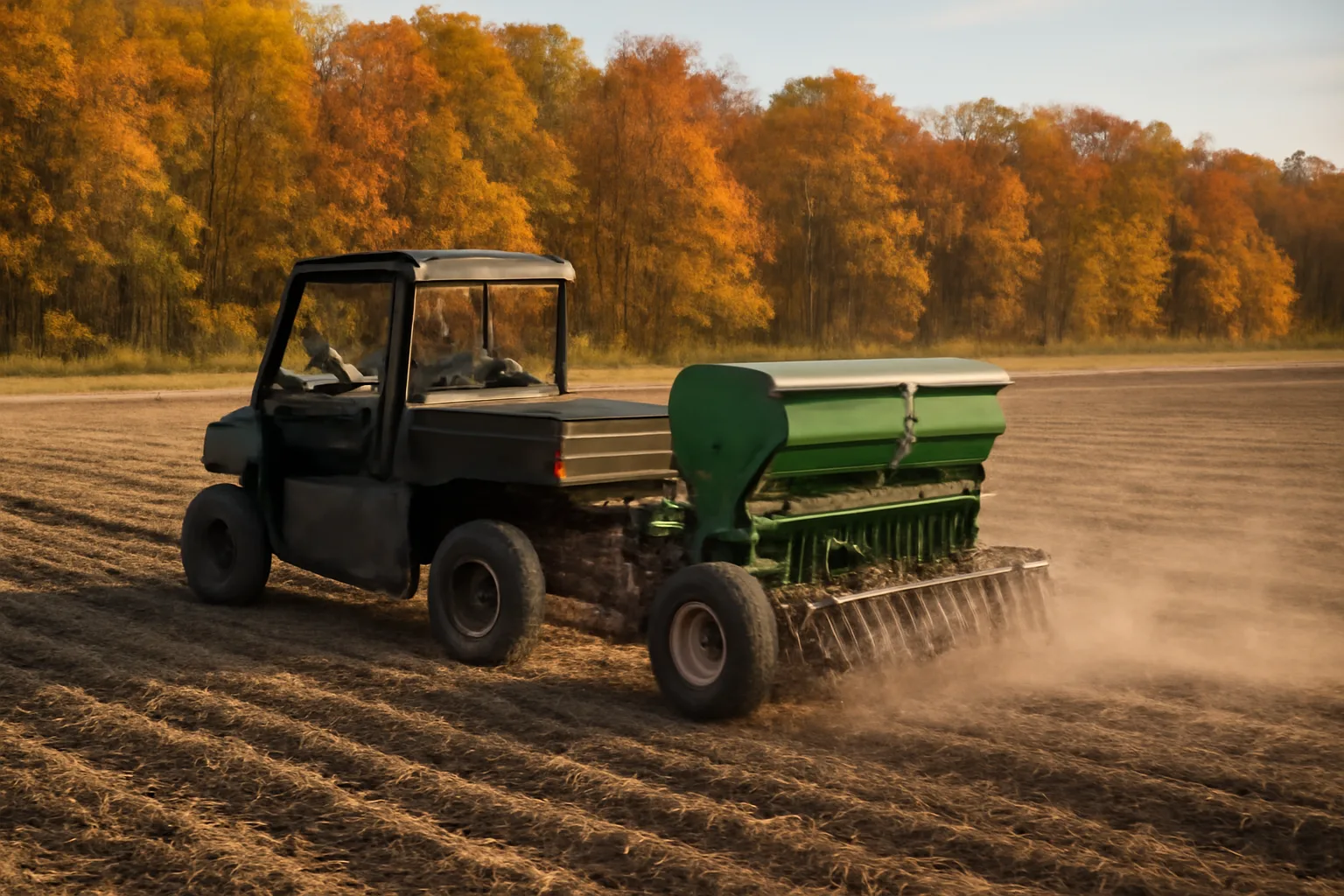
A food plot drill planter is a seeding implement that opens a narrow furrow in the soil, meters seed into that furrow at a set depth, and then closes and firms the soil over it, all in one pass across the field. That's different from a broadcast spreader, which just flings seed across the surface and leaves depth and soil contact to chance (or to a follow-up drag and roller). Most drills built for hunters and small landowners are no-till models designed to run behind a UTV or a compact tractor. They usually have disc openers up front to slice through thatch and old crop residue, a seed box with a metering wheel or roller, and packer wheels behind each row that press soil back around the seed. Some units combine a small-seed box (for clover, chicory, brassicas) with a large-seed box (for beans, corn, peas) so you can plant a mix in one trip without hand-calibrating a spreader twice. The basic idea is simple: put the seed at the right depth, in contact with soil, at a consistent rate. Extension agronomy guidance repeatedly points to planting depth and seed-to-soil contact as the two variables under a grower's direct control that most affect germination. A drill controls both. A broadcaster controls neither on its own. If you're planning a mix of species across a season, it helps to start with a food plot seed plan before you decide what equipment you actually need, because seed size and depth requirements drive the tool choice more than the other way around.
how does a no-till drill work for food plots
A no-till drill works by cutting through existing sod, stubble, or cover crop residue with a coulter or disc, dropping seed into that slot at a calibrated depth, then closing the slot with a press wheel, all without plowing or discing the ground first. The point is to disturb as little soil as possible while still getting seed buried correctly. Most compact no-till drills marketed to food plotters use double-disc openers (two angled blades that pinch open a V-shaped groove), a seed metering system driven off the wheel (so seeding rate stays consistent regardless of ground speed), and rubber or cast-iron packer wheels. Depth is usually set with a screw adjustment or a depth-gauge wheel riding beside each opener, and most units let you dial in anywhere from about a quarter inch up to 1.5 to 2 inches depending on the crop. Why no-till matters for food plots specifically: repeated tillage on the same small plot burns organic matter, increases erosion risk on sloped ground, and can bring up a fresh flush of weed seed every time you turn the soil. USDA's Natural Resources Conservation Service describes no-till as a practice that leaves crop residue on the soil surface to reduce erosion and protect soil structure compared to conventional tillage, under its Residue and Tillage Management, No-Till standard (NRCS Conservation Practice Standard 329) [1]. For a half-acre or one-acre plot carved out of timber, that matters more than most people think, because you don't have the luxury of rotating fields the way a row-crop farmer does. The tradeoff is that a no-till drill needs decent power to pull through sod, and the small compact units built for ATV/UTV use (drawbar pull in the 300 to 600 lb range) can struggle in heavy clay or thick perennial sod without a burndown herbicide pass first.
do you actually need a drill, or is broadcasting good enough
For small plots (under an acre) planted with forgiving species, broadcasting seed and then dragging or cultipacking it in works fine for most hunters; a drill earns its cost mainly on bigger acreage, tougher seedbeds, or seed that truly needs precise depth control. Here's the honest breakdown. Small-seeded legumes like clover need very shallow planting, often just a quarter inch, and land-grant extension guidance consistently says clover and similar small seeds should not be planted deeper than about a half inch because they lack the energy reserves to push through more soil than that [2]. A drill nails that depth every time. A broadcast-and-cultipack approach can get close, especially on a firm, well-prepped seedbed, but results are less consistent, particularly if you rush the cultipacking step or skip it. Bigger seed like soybeans, corn, and forage peas is more forgiving of broadcast planting because you can broadcast and then lightly disc or drag to bury it deeper, but germination rates and stand uniformity are still usually better with a planter or drill that places seed at a consistent 1 to 1.5 inch depth. So the real question isn't "drill vs. broadcast" in the abstract. It's: what species am I planting, how big is my plot, and how much am I willing to spend to get a more even stand. A guy with three quarter-acre plots in clover and cereal grain probably doesn't need a $4,000 drill. A guy managing 15 acres across four properties, planting brassicas, cereal grains, and soybeans on a rotation, probably does. If you haven't nailed down species yet, it's worth reading up on food plot whitetail strategy and matching your seed choice to your soil and shade conditions before buying equipment around it.
what does a food plot drill planter cost
| Broadcast spreader (ATV/handheld) + cultipacker | $150 to $800 | Small plots, forgiving seed, tight budgets | |
|---|---|---|---|
| Compact no-till drill (ATV/UTV pull-behind) | $2,500 to $6,000 | 1 to 10 acres, repeat plantings, mixed seed sizes | |
| Tractor-mounted no-till drill (3-point or pull-type) | $8,000 to $25,000+ | Larger acreage, multiple properties, co-op or club ownership | |
| Custom drilling service (hire a local farmer or co-op) | Often $15 to $30 per acre plus seed | One-time or occasional plots, no equipment storage | Many state Extension services and county Farm Service Agency offices maintain lists of local custom-hire operators, and some seed and equipment cooperatives will drill small acreages for a per-acre fee, which is often the cheapest way to get drill-quality results without buying a drill at all. A lot of hunting clubs split the cost of a compact drill three or four ways, since it pencils out fast once you're planting more than a few acres a year across multiple members' ground. |
Compact no-till drills built for ATV or UTV towing typically run $2,500 to $6,000 depending on width, seed box configuration, and brand, while tractor-mounted no-till drills used by farm co-ops or ag retailers for custom planting run well into five figures. Renting or hiring custom drilling is a common middle path. Here's a rough comparison of the common options: | Option | Typical cost | Best for |
when to plant food plots for deer
Timing for food plots for deer depends mostly on your USDA plant hardiness zone and whether you're planting a spring/summer annual (soybeans, cowpeas, sorghum) or a fall perennial or annual (clover, brassicas, cereal grains), and your state Extension office's planting date guide is the best single source for your specific county. As a general framework: spring and summer plots (soybeans, cowpeas, sunflowers, sorghum) go in after your last frost date, typically anywhere from late April in the South to early-to-mid June in the northern tier. Fall plots (brassicas, clover, cereal grains like oats, wheat, and rye) are timed so the plants establish before the first hard frost slows growth but also so brassicas have enough time to sweeten up after a frost. Most Midwest and Upper South Extension guidance points to a fall planting window roughly 60 to 90 days before your average first frost date for brassicas and 45 to 60 days before first frost for clover and cereal grains, though these windows shift meaningfully by zone [3]. If you're not sure of your first frost date, NOAA's climate normals and most state Extension frost-date tables list averages by county. Because frost dates and growing degree days vary so much state to state, this is one area where a generic national calendar does more harm than good. That's part of why a lot of hunters build a plan around their own zip code and soil test rather than a one-size list; the $99 Custom Food Plot Plan at plotseason.com/plot-plan-builder is built around that idea, matching species and planting windows to your zone instead of a national average, though your county Extension office's planting guide is a free and reliable starting point too.
when to plant oats for deer
Oats for deer food plots are typically planted in late summer to early fall, roughly 6 to 10 weeks before your area's first killing frost, so the plants can establish a leafy stand before growth slows in the cold. In much of the transition zone and Midwest that window lands between mid-August and mid-September; in the Deep South it can push into October. Oats are a cool-season annual grain and one of the most attractive early-fall forages for whitetails because the leaves stay tender and palatable through several frosts before eventually winter-killing in most zones colder than about zone 7. That winter-kill is actually useful information: in colder zones, oats function as an early-to-mid fall draw crop, not a stand that survives to spring, so pair them with a perennial or a cereal rye if you want green forage into late winter. A fall cereal grain mix (oats plus winter wheat or rye) is one of the more forgiving stands to establish because the seed is large enough that broadcast-and-drag or broadcast-and-cultipack works nearly as well as drilling, provided you get seed-to-soil contact and roughly a half-inch to one-inch planting depth.
when to plant turnips for deer
Turnips for deer food plots go in the ground in late summer, generally 80 to 100 days before your first expected hard frost, because the plant needs that much time to bulb up and because the sugars that make the bulb and foliage attractive to deer develop after a few frosts hit the plant. In practical terms that means a planting window of roughly mid-July through mid-August across most of the whitetail's range, shifting a couple weeks earlier in northern zones and later in the Deep South. Turnip seed is tiny (similar in size to clover) and should be planted no deeper than a quarter to a half inch; planting turnip seed too deep is one of the most common brassica-plot failures reported in extension trial write-ups, since the seed simply doesn't have the stored energy to emerge from more than a half inch of soil [2]. Because the seed is so small, a drill with a small-seed box set to a shallow depth is genuinely useful here, more useful than for a big-seeded crop like beans. If you're broadcasting turnips instead, mixing the tiny seed with dry sand or pelletized lime helps you spread it evenly, and a cultipacker pass afterward matters more than it does for larger seed.
do deer eat sorghum
Yes, deer eat grain sorghum, both the standing seed heads and the foliage, and it's commonly planted as a summer annual food plot crop and as a wildlife food source across the South and Midwest. It's also drought-tolerant, which makes it a common substitute for corn on sandier or drier ground. Grain sorghum (milo) is planted in late spring after soil temperatures warm past about 60°F, similar timing to corn, and it's typically drilled or planted with row equipment at roughly 1 to 1.5 inches deep. Deer will browse young sorghum foliage and later feed heavily on the mature seed heads, and it's a staple in wildlife food plot mixes recommended by several state wildlife agencies for turkey and deer alike because the standing grain persists into winter better than many alternatives. One caution worth knowing: sorghum, sudangrass, and related species can produce prussic acid (cyanogenic compounds) in young, frost-damaged, or drought-stressed growth. The Oklahoma State University Extension fact sheet on prussic acid poisoning notes that "young, rapidly growing plants, especially after a frost or during drought stress, can contain toxic levels of prussic acid" in sorghum-family forages, a documented livestock toxicity risk [4]. It's a livestock management concern more than a proven whitetail issue, but it's part of why sorghum is usually grown to maturity as a grain crop rather than grazed as young forage in food plot settings.
do deer eat clover, and do deer like clover
Yes, deer eat clover readily, and it's one of the most consistently preferred food plot forages across the whitetail's range because it's high in protein, stays palatable through most of the growing season, and regrows quickly after grazing pressure. White clover (including Ladino types) and red clover are the two most commonly planted varieties in food plots. Extension forage testing has repeatedly shown clover crude protein content in the 20 to 30 percent range during active growth, which is well above most native browse and most other food plot annuals during summer [5]. That protein density is a big part of why clover shows up on almost every food plot seed list as a foundational perennial, alongside its ability to persist for two to four years in a well-limed, well-fertilized stand before needing a reseed. Clover's biggest weakness is establishment: the seed is tiny, needs shallow planting (a quarter inch or less), and needs decent soil pH, generally 6.0 to 6.5 or higher, to really thrive, which is exactly why a soil test matters more for clover than for almost any other food plot species. If your soil test comes back at pH 5.2, no amount of good planting technique fixes that; you need lime, and your soil test lab's specific lime recommendation is the authority here, not a generic online rate. For picking clover varieties and understanding blend options, deer food plot seed breaks down the common cultivars in more detail.
what are deer's favorite foods, and do deer like honey
Deer's food preferences shift by season and region, but across most of the whitetail's range, acorns, soybeans, clover, and other legumes consistently rank as the most preferred and most heavily used food sources, with agricultural crops like corn and soybeans providing enormous seasonal volume where available. There's no single universal "favorite," because preference studies show it depends heavily on what's locally available and what stage of the growing season it is. Acorns in particular show up again and again in deer diet studies as a preferred fall food, largely because of their high fat content, which helps deer build fat reserves ahead of winter and the rut. Soybeans and other legumes are preferred through the growing season for their protein content, and browse (woody plant leaves and twigs) fills in heavily during winter when other options are scarce. As for honey: no, honey isn't a natural or meaningful part of a deer's diet, and there's no credible research or wildlife agency guidance suggesting deer seek out honey the way they do mast crops or legumes. Deer are herbivores built to digest fibrous plant material through a four-chambered rumen system, not concentrated sugars in that form. Where this question actually comes from is usually confusion with commercial deer attractant products that use sugar, molasses, or scent-based additives, some of which use "honey" in branding. Those products fall under state baiting and feeding regulations in most places, so check your state wildlife agency's rules before using any attractant, since baiting laws vary widely and some states prohibit it entirely during hunting season .
how do you calibrate a food plot drill correctly
Calibrating a food plot drill means confirming the actual seeding rate coming out of the machine matches your target rate for that specific seed, and doing it before you plant, not after, because seed size, seed coating, and even humidity change how a metering system doses seed. Most small drills use either a ground-driven roller or a rotor with interchangeable seed cups or gates sized for different seed classes (small seed like clover versus large seed like beans). Manufacturer manuals include a calibration chart or a simple bag-and-weigh test: run the drill a measured distance, catch the seed that would have gone into the ground, weigh it, and compare it to your target rate per acre for that species. Skipping calibration is the single most common reason people either waste seed (rate too high, more cost, more competition among seedlings) or get a thin stand (rate too low). Extension agronomy guidance consistently recommends recalibrating any drill or planter each time you switch seed lots, seed size, or seed coating, since a pelleted or inoculated seed can flow differently than raw seed even at the same nominal size. It's a 15-minute job. Skipping it because you're in a hurry is how people end up wondering why their "perfect" fall plot came in patchy despite a $4,000 drill doing the planting.
drill vs broadcast: quick decision guide
If you're still torn between buying or renting a drill versus just broadcasting, here's the practical shortcut most experienced plot managers use. Use a drill (or hire custom drilling) when: you're planting more than 2 to 3 acres regularly, your seedbed has heavy sod or crop residue you don't want to till, you're planting small seed like clover or brassicas where depth control matters most, or you're planting into a no-till situation on sloped ground where tillage risks erosion. Broadcast and cultipack instead when: your plot is under an acre, you've already got a clean, worked seedbed, you're planting larger seed like beans, peas, or cereal grains that tolerate depth variation better, or this is a one-time or occasional plot where drill ownership doesn't pencil out. A lot of successful plot programs actually use both: a small compact drill for the finicky perennial and brassica plots, and a simple broadcast spreader plus cultipacker for the bigger, more forgiving annual grain and bean fields. Neither tool is universally better; they solve different problems. For a broader look at how equipment choice fits into overall plot strategy across species, deer food plots covers the planning side, and domain food plot seed and deer for food are worth a look if you're still finalizing what to plant before you finalize how you'll plant it.
Frequently asked questions
What is a food plot drill planter used for?
A food plot drill planter cuts a furrow, drops seed at a controlled depth, and closes the row over it in one pass, giving small or precise seed better soil contact and more consistent germination than broadcasting seed on the surface and hoping for the best.
Do deer eat sorghum?
Yes. Deer browse young sorghum foliage and feed on mature grain heads, and sorghum (milo) is commonly planted as a drought-tolerant summer food plot crop across the South and Midwest, often as a corn substitute on sandier or drier ground.
Do deer eat clover, and do deer like clover?
Yes, clover is one of deer's most consistently preferred forages. It's high in crude protein, often 20 to 30 percent during active growth according to Extension forage testing, and it regrows fast after grazing, which is why it's a foundational species in most food plot programs.
When should you plant food plots for deer?
It depends on your USDA hardiness zone and the crop: spring/summer annuals go in after last frost, fall crops (brassicas, clover, cereal grains) go in 45 to 90 days before your first fall frost. Check your state Extension office's planting date guide for your specific county.
When should you plant oats for deer?
Plant oats roughly 6 to 10 weeks before your area's first killing frost, typically mid-August through mid-September in much of the Midwest and transition zone, later in the Deep South. Oats winter-kill in colder zones, so they're an early-to-mid fall draw crop, not a spring stand.
When should you plant turnips for deer?
Plant turnips 80 to 100 days before your first hard frost, generally mid-July through mid-August across most of the whitetail range. The bulb and foliage sweeten after a few frosts, and turnip seed needs shallow planting, no deeper than a quarter to a half inch.
What is a food plot, exactly?
A food plot is a planted area of forage or grain, usually a fraction of an acre to several acres, established on hunting land specifically to provide seasonal nutrition and to concentrate deer or other wildlife activity in a location a hunter can access and hunt effectively.
What are deer's favorite foods?
Preference shifts by season and region, but acorns, soybeans, and clover consistently rank among the most preferred foods across the whitetail's range. Acorns matter most in fall for fat content, legumes matter most through the growing season for protein, and browse fills in during winter.
Do deer like honey?
No, honey isn't part of a natural deer diet. Deer are herbivores adapted to digest fibrous plant material, not concentrated sugars. Confusion usually stems from branded attractant products; check your state wildlife agency's baiting and feeding regulations before using any attractant, since rules vary widely by state.
Is a food plot drill better than broadcasting seed?
Neither is universally better. A drill gives more consistent depth and germination, which matters most for small seed like clover and brassicas. Broadcasting plus a cultipacker works fine for larger, forgiving seed like beans and cereal grains, especially on small plots under an acre.
How much does a food plot drill cost?
Compact no-till drills built for ATV or UTV towing typically run $2,500 to $6,000. Tractor-mounted units run $8,000 and up. Hiring a local custom-hire operator or co-op to drill your plot often costs $15 to $30 per acre plus seed, which avoids equipment ownership entirely.
How deep should you plant food plot seed?
It depends on seed size. Small seed like clover and brassicas needs about a quarter to a half inch of soil. Larger seed like soybeans, corn, and peas typically goes 1 to 1.5 inches deep. Planting small seed too deep is one of the most common causes of a thin or failed stand.
Can you use a regular grain drill for food plots?
Yes, a standard farm grain drill works for food plots, especially for cereal grains and beans, as long as you can adjust it to shallow enough depth and a low enough rate for smaller seed like clover. Many hunters hire a local farmer's drill rather than buying their own for occasional plots.
Sources
- USDA Natural Resources Conservation Service, Conservation Practice Standard 329, Residue and Tillage Management, No-Till: No-till systems leave crop residue on the soil surface to reduce erosion and maintain soil structure compared to conventional tillage
- Oklahoma State University Extension, Establishing and Managing Wildlife Food Plots (PSS-2226): Small-seeded species like clover and brassicas should be planted at very shallow depths, generally under a half inch
- Oklahoma State University Extension, Prussic Acid Poisoning in Livestock (PSS-2904): Sorghum and sudangrass species can produce prussic acid in young, frost-damaged, or drought-stressed growth
- University of Kentucky Cooperative Extension, Red Clover (AGR-113): Clover crude protein content commonly falls in the 20 to 30 percent range during active growth
- Pennsylvania Game Commission, Feeding Wildlife and Baiting Regulations: States regulate baiting and feeding wildlife, and rules on attractant use vary by state