Last updated 2026-07-25
TL;DR
Yes, you can overseed an existing food plot, and it often works better than a full replant. Broadcasting seed like clover, oats, or brassicas into thinning stands (rather than tilling) saves time and protects soil, as long as you time it around rain and keep seed-to-soil contact good.
can you overseed a food plot?
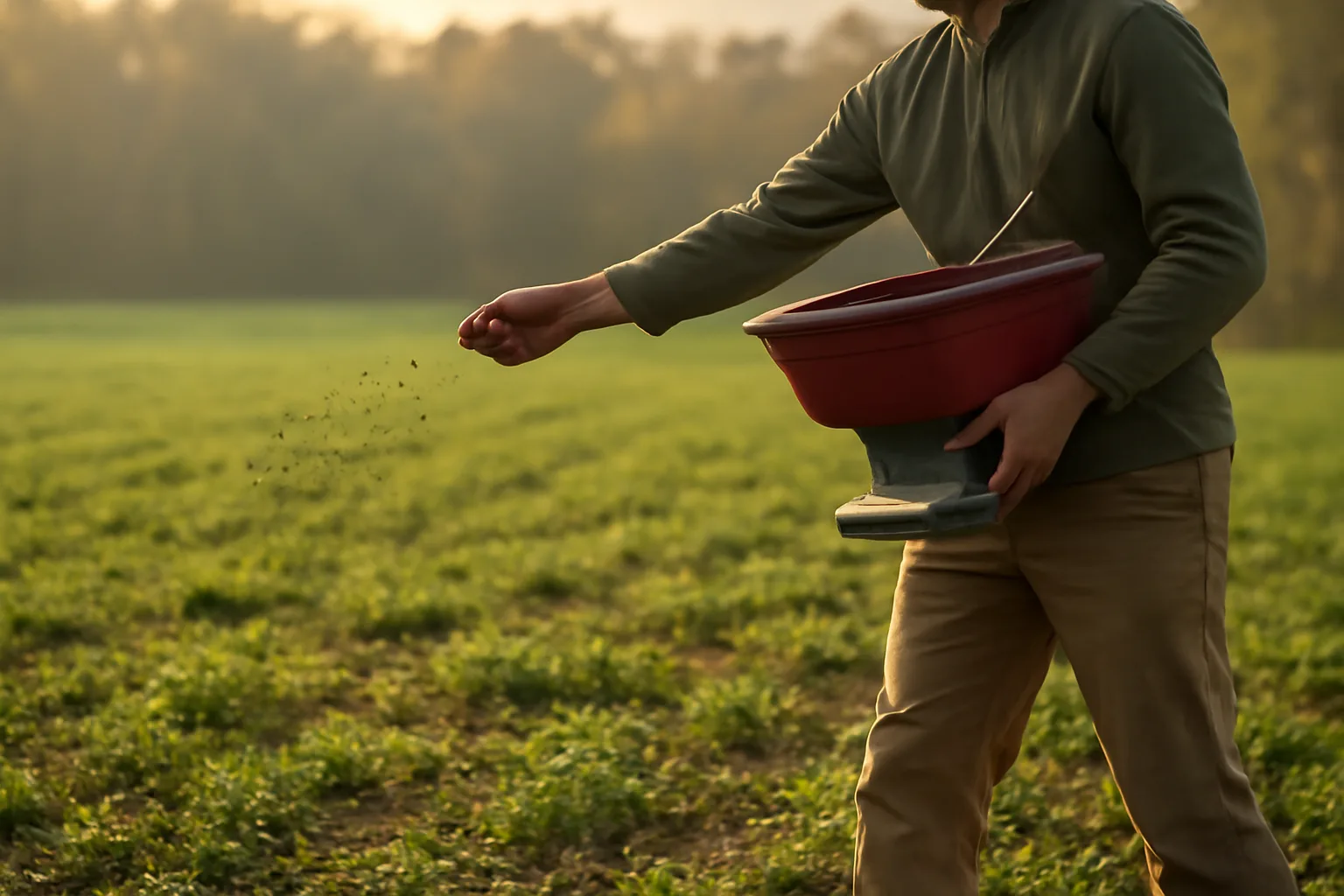
Yes. Overseeding, which means broadcasting new seed into an existing plot without full tillage, is a standard practice on both cropland and food plots. Extension agronomists recommend it specifically for thickening thin perennial stands like clover and for adding cool-season annuals into summer plots as they decline. The idea is simple. Instead of spraying everything out and starting from bare dirt, you drop new seed on top of what's already growing (or dying back) and let rain and frost work it into the soil. It works best with small-seeded species that don't need deep planting, and it works worst with big-seeded stuff like corn or soybeans that really need a planter or drill. Most food plotters overseed for one of three reasons: thickening a clover stand that's thinned from drought or heavy browsing, transitioning a warm-season plot to a fall annual before the growing season ends, or patching bare spots from erosion or over-grazing. All three are legitimate uses, and all three have a fairly narrow timing window that matters more than the method itself.
when does overseeding actually work versus fail?
Overseeding works when seed makes contact with soil, gets covered by at least light soil movement or rain-splash, and has 4 to 6 weeks of decent growing conditions before winter or before the summer heat hits hard. It fails when you throw seed onto thatch, hard-packed dirt, or a thick mat of existing vegetation with no way to get it down to soil. The University of Tennessee's food plot guidance notes that broadcast seeding into an existing stand works considerably better if you drag a chain harrow or run a light disc pass first to expose some soil, then broadcast, then cultipack or drag again. [1] Skipping that step and just flinging seed into standing grass from the truck window is the number one reason overseeding "doesn't work." The seed is sitting on top of thatch, a bird eats it, or it dries out and never germinates. Rain timing matters more than almost anything else. If you can get seed down 24 to 48 hours ahead of a rain event, germination rates jump. Broadcasting into a dry spell with no rain in the forecast is close to a wasted trip, especially for small seeds like clover that can't push through even an inch of dry crust.
when to plant food plots for deer?
| Zone 3-4 (Upper Midwest, Northeast) | Mid-May to mid-June | Late July to mid-August | April-May or Aug | |
|---|---|---|---|---|
| Zone 5-6 (Mid-Atlantic, Ohio Valley) | Late April to May | Mid-Aug to early Sept | April or Aug-Sept | |
| Zone 7-8 (Southeast, mid-South) | Late March to April | Sept to early Oct | March-April or Sept-Oct | These are general windows, not guarantees, and your local extension office's frost date tables are the more precise source than any national chart. For a full breakdown by species and region, see food plot whitetail planning guidance. |
Timing depends on your climate zone and what you're planting, not a single national date. Spring plots (soybeans, corn, warm-season annuals) generally go in after your last frost date, typically April through June depending on latitude. Fall plots (brassicas, cereal grains, clover) go in 60 to 90 days before your first fall frost so plants establish before growth slows. [2] The USDA plant hardiness zone map is the starting reference point most extension programs use to back into local planting windows. A hunter in zone 4 (parts of the upper Midwest and Northeast) is planting fall brassicas in late July to early August, while a zone 8 hunter in the Southeast can wait until September. Here's a rough framework by region: | Region (USDA zone) | Spring annuals | Fall annuals/brassicas | Perennial clover |
when to plant oats for deer?
Plant oats 6 to 8 weeks before your first killing frost, which lets them establish enough leaf growth to be attractive and winter-hardy before serious cold sets in. In most of the whitetail's range that lands somewhere between late August and late September. [3] Oats are one of the easier species to overseed into a thinning summer plot because the seed is cheap, the germination window is forgiving, and deer hit young oat shoots hard in early fall. Kansas State University's forage guidance lists oats as one of the fastest-establishing small grains, often showing visible growth within 5 to 7 days of a good rain. [3] One caution: oats aren't reliably winter-hardy north of about zone 6. In colder zones they'll green up fast, get hammered by deer, and then die back completely at the first hard freeze, which is fine if you wanted a short-term fall draw and not a season-long plot. If you want something that holds through winter, pair oats with winter rye or a brassica blend instead of planting oats alone.
when to plant turnips for deer?
Plant turnips 70 to 90 days before your first expected frost so the bulbs have time to size up before deer start eating them heavily, which usually doesn't happen until after a couple of hard frosts sweeten the plant's starches into sugars. [2] That planting window is typically late July through August in northern zones and August into early September farther south. Turnips are a classic overseed candidate into a fading summer annual plot. Broadcast at 4 to 6 lbs per acre, lightly incorporate with a drag or light disc, and expect germination in 4 to 7 days with adequate moisture. Deer often ignore turnip tops until frost, then hit both the greens and the bulbs hard through late fall and into winter, which is why turnips show up in almost every late-season brassica blend on the market. One mistake worth avoiding: don't broadcast turnip seed too deep. It's tiny (about 150,000 seeds per pound) and needs to sit close to the surface, no more than a quarter inch down. A heavy disc pass that buries it two inches deep will kill your germination rate.
do deer like clover, and do they eat it as much as people say?
Yes, deer like clover, and it's genuinely one of the most consistently used food plot forages across the whitetail's range. White clover and red clover both show up repeatedly in state and university deer forage studies as high-preference, high-protein forage, often tested above 20% crude protein in vegetative growth stages. [4] Clover is also one of the best species for overseeding because it's a perennial. You're not starting from scratch every year, you're thickening an existing stand. Mississippi State University Extension recommends overseeding thin clover plots in late winter or early spring by broadcasting 2 to 3 lbs per acre of additional clover seed directly onto existing growth, timed right before a freeze-thaw cycle that naturally works seed into the soil surface. [5] That freeze-thaw action does the job a disc would otherwise do. The catch with clover is it needs decent soil pH (extension programs generally recommend 6.0 to 6.5) and it can't handle standing water or heavy shade. [5] If your soil test comes back at pH 5.2, clover is going to struggle no matter how much you overseed it, and lime is the actual fix, not more seed. For species comparisons across your whole plot rotation, see deer food plot seed.
do deer eat sorghum?
Yes, deer eat sorghum, particularly grain sorghum heads in late fall and winter once other food sources thin out, but it's not typically a first-choice forage compared to soybeans, clover, or standing corn. Sorghum is more commonly planted for its cover value and drought tolerance than as a preferred deer attractant on its own. [6] Sorghum's real strength in a food plot rotation is structure. It grows tall, holds up in wind, and gives deer standing cover through the late season while also providing a grain source once the heads mature and dry down. Many food plot blends use sorghum as a component mixed with soybeans or cowpeas rather than as a standalone planting, specifically because deer will graze the beans down first and use the sorghum as screening cover. If your goal is pure attraction, sorghum isn't the top pick. If your goal is a late-season sanctuary planting that also feeds deer once grain matures, it's a reasonable choice, especially in dry or marginal soils where corn struggles.
do deer like honey, or is that a food plot thing at all?
No, honey isn't a food plot species or a natural deer food source, and it's not something you'd plant or use in a plot. This question usually comes up because of "honey hole" terminology (a hunter's best stand location) or because of scent and mineral attractant products that use molasses or sugar-based additives, which deer do respond to as a sweet, high-carbohydrate draw. Deer are drawn to sugar and carbohydrates generally, which is part of why molasses-based mineral licks and sweet feed products work as attractants in states where supplemental feeding and baiting are legal. Actual honey isn't practical or economical as a field additive, and there's no established agronomic or wildlife research showing deer seek it out in the wild the way they seek out acorns, clover, or corn. If you're asking because you saw a mineral or attractant product marketed with honey or molasses in the ingredient list, that's a manufactured supplement, not a food plot planting, and it's worth checking your state wildlife agency's baiting and feeding regulations before using any attractant product, since rules vary widely by state and by whether you're hunting over bait during archery or firearm season.
what is a food plot, exactly?
A food plot is a planted area, typically ranging from a quarter acre to several acres, established specifically to provide supplemental forage for deer and other wildlife, usually on hunting land. It's distinct from agricultural cropland in that the goal is attraction and nutrition for game animals, not commercial yield. Food plots generally fall into two categories: annual plots (replanted each year, examples include brassicas, cereal grains, soybeans) and perennial plots (established once and maintained for multiple years, examples include clover and alfalfa). Most serious plot programs run both types in rotation, using perennials as a stable base and annuals to target specific hunting seasons. State wildlife agencies generally treat food plots as legal wildlife management practice distinct from baiting, though the line can get blurry and rules differ by state. Some states classify a standing, unharvested crop as a food plot regardless of size, while others cap plot size or require it be planted using normal agricultural practice (more than piling seed on the ground) to avoid being classified as bait. Check your state agency's regulations before planting near a stand you intend to hunt over. For a full walkthrough of plot types and their use, see food plot whitetail and deer food plots.
what is a deer's favorite food, really?
There's no single universal favorite, deer preference shifts by season, region, and what's available, but acorns are consistently ranked among the highest-preference natural foods across whitetail research, often preferred over agricultural crops when available in good mast years. Among planted food plot species, soybeans and clover regularly top preference studies during the growing season. A widely cited Auburn University deer nutrition study found deer selectively sought out white oak acorns over red oak acorns and over standing soybeans when both were available in the same area, attributed to lower tannin content and higher palatability in white oak acorns. That's a good reminder that no food plot beats a good mast year, and plot planning should work around your property's natural food, not ignore it. Outside of mast years, or in areas without much oak cover, soybeans, clover, and standing corn are the most consistently preferred planted options, with brassicas and turnips becoming more attractive after the first frosts convert starches to sugars. Deer preference isn't fixed. It moves with the calendar, which is exactly why plot planning is a seasonal exercise and not a one-time decision. [species-and-strategy resources and comparisons on preference by species are worth reading if you're picking your first blend.]
how do you actually overseed a plot, step by step?
The process is the same whether you're thickening clover or adding fall brassicas into a tired summer plot, and it's simpler than a full replant. 1. Mow or graze down existing growth to 3 to 4 inches so new seed reaches soil, not shade. 2. Soil test if you haven't in the last 2 to 3 years, and apply lime or fertilizer per your lab's recommendation, not a generic chart. Your soil test lab is the authority here, not a blog post. 3. Lightly disturb the surface with a chain harrow, drag, or light disc pass. You want to see dirt, not till it deep. 4. Broadcast seed at label rate, slightly heavier than a fresh planting rate since germination in an existing stand runs a bit lower. 5. Drag or cultipack again to press seed into soil. 6. Time the whole thing 24 to 48 hours ahead of forecast rain if at all possible. That's it. No need for a drill or planter for small-seeded species like clover, brassicas, or cereal grains. If you're overseeding something like soybeans or corn into a thin stand, you're better off just replanting that section conventionally, since those seeds need actual depth control a broadcast pass won't give you. If you want a plan built around your specific soil test results and region instead of a generic checklist, that's exactly the kind of thing a Custom Food Plot Plan is for, a $99 one-time plan that maps species and timing to your actual dirt.
what seeding rates make sense for overseeding versus a fresh plant?
| White clover | 2-3 lbs/acre | 3-4 lbs/acre | |
|---|---|---|---|
| Oats | 2-3 bushels/acre | 2.5-3.5 bushels/acre | |
| Turnips (in a blend) | 4-6 lbs/acre | 5-8 lbs/acre | |
| Winter rye | 90-120 lbs/acre | 110-150 lbs/acre | These ranges come from general extension broadcast guidance rather than a single controlled study, so treat them as planning ranges and adjust based on how thick your existing stand is. [1] [5] A thin, patchy clover field needs closer to the high end of the overseed range. A field that's 60% bare dirt already might as well be treated as a fresh plant. |
Overseeding rates generally run 25 to 50% higher than fresh-planting rates, because germination and establishment in an existing stand is always less efficient than bare, prepared soil. Extension broadcast rate tables are built around clean seedbeds, so treat those numbers as a floor, not a ceiling, when overseeding. | Species | Fresh broadcast rate | Overseed rate (into existing stand) |
what mistakes ruin an overseed attempt?
The most common failure is broadcasting into thatch with zero soil contact and walking away. Seed sitting on dead grass or mulch doesn't germinate reliably, it either gets eaten by birds, dries out, or rots on the surface after a rain instead of rooting. Second most common mistake: ignoring pH. If your existing plot is failing because of a 5.4 pH soil, adding more seed on top doesn't fix that. Pull a fresh soil test, follow your lab's lime recommendation, and understand lime takes months to fully react in soil, so it's not an instant fix even once applied. Third: overseeding too late. Every species has a minimum number of growing days before frost or heat stress, and there's no rescuing a plot planted three weeks past that window. Oats need roughly 45 to 60 days to reach good grazing height, brassicas need 70 to 90 days to bulb properly, and clover seedlings need about 6 to 8 weeks of mild weather to root deep enough to survive their first hard freeze. [2] [3] Check your local extension office's frost date tables before you commit to a date, not a national calendar.
Frequently asked questions
Do deer eat sorghum?
Yes, deer eat grain sorghum, especially in late fall and winter once heads mature and other food thins out. It's used more for cover and drought tolerance than as a top attractant, and it's usually mixed with soybeans or cowpeas rather than planted alone as the main draw.
Do deer eat clover?
Yes, clover is one of the most consistently preferred food plot forages for whitetail deer, often tested above 20% crude protein during vegetative growth. Both white and red clover show up repeatedly in state extension forage recommendations as high-preference perennial plantings.
When to plant deer food plots?
Spring annuals go in after your last frost date, generally April through June. Fall annuals and perennials go in 60 to 90 days before your first fall frost, generally late July through September depending on your USDA hardiness zone. Local extension frost date tables are more precise than any national chart.
Do deer like clover more than other forages?
Deer show strong, consistent preference for clover in most extension studies and forage trials, often ranking it alongside soybeans as a top warm-season choice. Preference shifts seasonally though, and acorns during a good mast year can outcompete any planted forage, clover included.
When to plant oats for deer?
Plant oats 6 to 8 weeks before your first killing frost, typically late August through September depending on region. Oats establish fast, often visible growth within 5 to 7 days of good rain, but they aren't reliably winter-hardy north of about USDA zone 6.
When to plant food plots for deer overall?
It depends on species and your USDA hardiness zone. Spring plantings (soybeans, corn) go in after last frost; fall plantings (brassicas, cereal grains, clover) go in 60-90 days before first frost. There's no single national date, check your local extension office's frost tables.
When to plant turnips for deer?
Plant turnips 70 to 90 days before your first expected frost, typically late July through early September depending on region. Deer usually don't hit the tops or bulbs hard until after a couple of frosts sweeten the plant's starches into sugars.
What is a food plot?
A food plot is a planted area, often a quarter acre to several acres, established to provide supplemental forage and attraction for deer and other wildlife on hunting land. Plots are generally annual (replanted yearly) or perennial (maintained multiple years), and most programs run both in rotation.
What are deer's favorite foods?
There's no single universal favorite. Acorns, especially white oak, consistently rank among the most preferred natural foods when available. Among planted options, soybeans and clover are typically top choices during the growing season, with brassicas becoming more attractive after frost.
Do deer like honey?
No, honey isn't a natural or practical deer food and isn't used in food plots. Deer are drawn to sugar and carbohydrates generally, which is why molasses-based mineral products work as attractants, but actual honey has no established role in deer forage research.
Can you overseed clover without tilling?
Yes, and it's actually the preferred method for established clover stands. Broadcast seed in late winter right before a freeze-thaw cycle, which naturally works seed into the soil surface without any tillage, according to Mississippi State University Extension guidance.
How much seed do you need to overseed versus plant fresh?
Plan on roughly 25 to 50% more seed than a fresh-planting rate, since germination in an existing stand is less efficient than bare prepared soil. A thin, patchy plot needs the higher end of that range; a mostly-bare field should be treated as a fresh plant instead.
Can you overseed corn or soybeans into an existing plot?
Not really, and it's not recommended. Corn and soybeans need consistent planting depth that broadcast overseeding can't reliably provide. For those species, it's better to replant that section conventionally with a planter or drill rather than broadcast into an existing stand.
Sources
- University of Tennessee Extension, Establishing Wildlife Food Plots: Broadcast overseeding works better with light tillage before seeding and a cultipack pass after
- Kansas State University, Forage Facts: Oats: Oats establish quickly, with visible growth in 5-7 days, but require 45-60 days before reaching good grazing height
- USDA NRCS, Plant Guide: White Clover: White clover is a widely used, high-protein forage species in wildlife plantings
- USDA NRCS, Plant Guide: Grain Sorghum: Sorghum is valued for drought tolerance and cover, with grain used by wildlife once mature
- USDA NRCS, Wildlife Habitat Management: Food Plots: Food plots are planted areas established specifically for wildlife forage, distinct from commercial agricultural cropland
- Auburn University, School of Forestry and Wildlife Sciences, Deer Food Preference Research: White oak acorns are consistently preferred by deer over red oak acorns and over standing soybeans when both are available