Last updated 2026-07-25
TL;DR
Yes, you can broadcast soybeans for a food plot, but broadcasting alone isn't enough. Soybeans need seed-to-soil contact and about 1 to 1.5 inches of coverage, so you have to drag, disc, or cultipack after spreading. Broadcast-and-walk-away on bare dirt usually gives poor, patchy germination.
can you broadcast soybeans for a food plot instead of drilling?
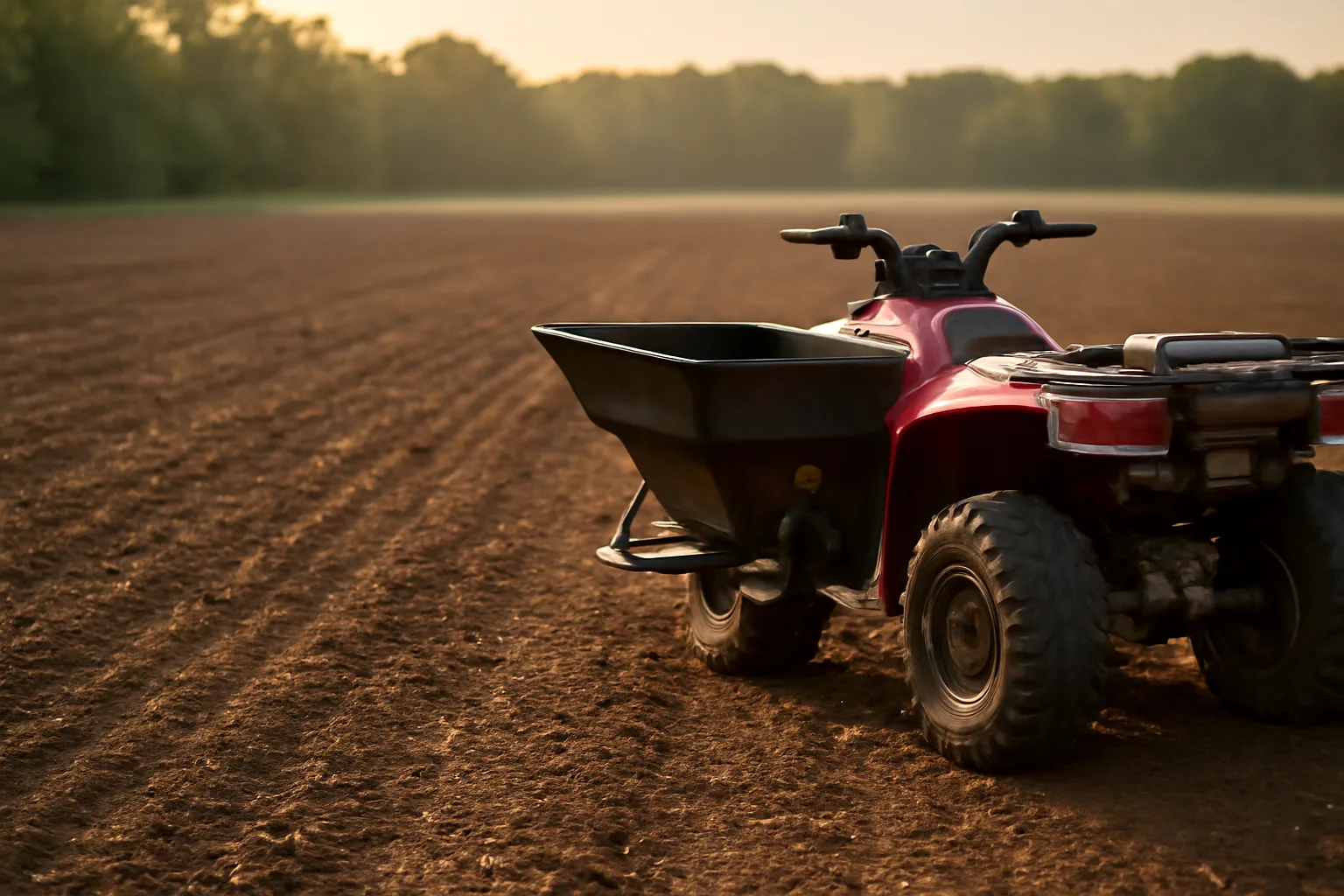
Yes. Broadcasting soybeans works fine as a planting method, and plenty of food plotters do it every spring with an ATV spreader or handheld crank spreader. The seed itself doesn't care whether it came out of a drill tube or off a spinner plate. What matters is what happens after the seed hits the ground. Soybeans are a big-seeded legume, and unlike clover or brassica seed, they need real depth to germinate well. Purdue University's soybean production guidance recommends a planting depth of 1 to 1.5 inches, sometimes up to 2 inches in dry soil [1]. A broadcast seed sitting on top of the dirt, exposed to sun, birds, and turkeys, is not going to hit that depth on its own. So the honest answer is: broadcasting is a legitimate application method, but it is only step one. You still need a way to incorporate the seed, whether that's a disc, a drag harrow, a culti-packer, or even dragging a section of chain-link fence behind a truck. Skip that step and you'll get spotty stands, heavy pigeon and turkey losses, and a plot that looks thin by July. If you're working ground that's already tilled or disced loose, broadcast the beans, then run a drag or cultipacker over the top to press seed into the loosened soil. If you're broadcasting onto a firm seedbed, disc lightly first, broadcast, then drag or pack again. Either order works as long as seed ends up covered.
what's the right way to broadcast soybeans step by step?
The reliable sequence is till or disc, broadcast, then cover and firm the seedbed. Skipping the cover step is the single biggest mistake first-time plotters make with broadcast beans. 1. Test and amend soil first. Soybeans do best in the 6.0 to 6.8 pH range, and a soil test tells you if you need lime months ahead of planting, since lime takes time to move pH [2]. Your soil test lab is the real authority here on how much lime or fertilizer your specific ground needs; a general planting guide can't see your dirt. 2. Work the seedbed. Disc or till to break up sod and knock down weed competition. You want loose soil, not clumps. 3. Broadcast at the right rate. For food plot soybeans, a common broadcast rate runs somewhat higher than drilled rates to compensate for uneven coverage. Most food plot seed labels for broadcast application suggest 60 to 100+ lbs per acre depending on the variety and whether it's a forage-type or standard bean; check your specific bag's rate, since this varies by product. 4. Cover the seed. Drag a section harrow, chain-link fence, or culti-packer over the plot immediately after broadcasting. You're aiming for 1 to 1.5 inches of soil coverage. 5. Firm the seedbed. A cultipacker after covering improves seed-to-soil contact and speeds germination, which matters a lot in dry springs. If you own or can rent a drill, drilling gives more consistent depth control and generally better stand establishment than broadcast-and-drag, especially in clay soils that clod up. But broadcasting with a diligent cover-and-pack routine gets you a usable plot without renting equipment.
when to plant food plots for deer, generally?
Timing depends on whether you're planting a spring/summer annual (soybeans, other legumes) or a fall annual (brassicas, cereal grains), and both depend heavily on your region's frost dates. There's no single national planting date; it's built around your local last and first frost. For soybeans specifically, plant after soil temperatures warm and the risk of frost has passed, generally the same window row-crop farmers use, which in much of the whitetail range runs from mid-May into June [1]. Soybeans are frost-sensitive as seedlings, so jumping the gun costs you a reseed. Fall food plots (brassicas, cereal grains, clover) go in on a different clock entirely, timed backward from your area's first fall frost so plants have 60 to 90 days of growth before deer season and cold weather hit. Extension services in Ohio and Georgia both frame fall plot timing around counting back from first frost date, not a calendar date [3] [4]. Broadly:
- Northern states (frost by late Sept/early Oct): fall plots late July through August, soybeans late May.
- Transition zone: fall plots mid-August through September, soybeans mid-May to early June.
- Southern states (frost late Oct/Nov or later): fall plots September into October, soybeans April through May. Check your state extension office's specific frost date maps rather than relying on a generic calendar. For a soil-informed starting point on species and timing for your own ground, PlotSeason's $99 Custom Food Plot Plan builds a species and calendar recommendation off your soil test and location, though your soil lab's specific lime and fertilizer numbers still take priority over any general plan.
when to plant oats for deer?
Plant oats as a fall food plot, typically 6 to 8 weeks before your area's first hard frost, so plants establish before frost kills top growth back. Oats are a cool-season annual grain that deer hit hard in early fall, then again after a frost sweetens the plant's sugars. In the Midwest and Upper South, that generally lands in the August to early September window. Oats germinate fast, often in 5 to 10 days with decent moisture, and produce quick tonnage, which is why so many plotters use them as a fast-growing draw crop alongside slower brassicas. Oats don't handle deep winter cold as well as winter wheat or cereal rye, so in far northern climates they often get browsed down and killed by hard freezes by December, while wheat and rye persist. If you want late-winter forage in a cold climate, blend oats with wheat or rye rather than planting oats alone.
when to plant turnips for deer?
Turnips go in as a fall brassica plot, planted 80 to 90 days before your area's first killing frost, since turnips need that full window to bulb out and reach peak tonnage. Plant too late and you get leafy top growth with no real bulb. For most of the whitetail range this means late July through August. Turnips are frost-tolerant and actually improve in palatability after a hard freeze, because cold converts starches to sugars, which is why deer often ignore a turnip plot in October and hammer it in December and January. A common mistake is treating turnips like a standalone plot when they work best blended with cereal grains (oats, wheat) or other brassicas like radish. A straight turnip monoculture can look untouched for months and then get demolished once frost hits, which spooks plotters who check too early and assume it failed. See deer food plot seed options for blend combinations that pair turnips with a faster-establishing grain.
do deer eat soybeans, and how do they use them?
Yes, deer eat soybeans heavily, both the leafy forage while the plant is growing and the beans themselves once pods mature and dry down in fall. Whole soybeans commonly run in the mid-to-high 30s percent crude protein on a dry matter basis, which puts them among the higher-protein food plot options available; agronomic guidance from Purdue Extension covers soybean forage and grain quality in its production materials [1]. The tradeoff is that soybeans are extremely attractive to deer as seedlings too, and a young bean plot on a property with a heavy deer herd can get browsed to nothing before it ever establishes. This is the number one reason broadcast soybean plots fail, not the broadcasting method itself. If your deer density is high relative to plot acreage, consider a larger acreage (2+ acres is a common recommendation to outpace browse pressure), a temporary electric exclusion fence for the first 4 to 6 weeks, or blending beans with a less palatable companion crop to spread out browse pressure. Once soybeans mature, standing beans left in the field through fall and winter give a high-energy food source that pulls deer through late season, similar to how standing corn functions.
do deer eat sorghum?
Yes, deer eat sorghum, both the leaves as forage and the grain heads once they mature, though sorghum generally ranks below corn and soybeans in deer preference in most food plot use. Grain sorghum (milo) is more common as a food plot component in the South and drought-prone regions where corn struggles, since sorghum tolerates heat and low rainfall better than corn. Sorghum's main food plot value is standing winter forage. The seed heads persist into late winter and give deer, turkey, and other wildlife a food source when other plots are picked clean. It's not typically a first-choice species if corn or soybeans grow well on your ground, but it's a solid option on sandy or drought-prone sites.
do deer eat clover, and do deer like clover?
Yes, deer eat clover readily, and it's widely considered one of the most consistently attractive food plot forages available, which is why it shows up in nearly every food plot mix on the market. Clover is a perennial legume, meaning a single planting can produce forage for several years with proper mowing and fertility maintenance. White clover (Ladino types) and red clover are the two most common food plot species. A University of Tennessee Extension publication on establishing clover for wildlife notes that well-managed clover stands can persist for multiple years and supply forage with crude protein commonly in the 25 to 30% range during active growth, competitive with alfalfa, and palatable through spring, summer, and fall in most regions, going somewhat dormant in deep winter or under snow cover [5]. The catch with clover is establishment patience and weed pressure. Clover seed is tiny and needs a firm, shallow seedbed (roughly a quarter inch of coverage), and it's slow to establish in year one, meaning it can lose a competition battle with weeds if you don't spray or mow to manage them early. See food plot whitetail for more on perennial plot planning.
what are deer's favorite food, and does that include honey?
There's no single scientifically ranked favorite food for deer nationwide, because preference shifts by region, season, and what's locally available, but food plot species that consistently show up as high preference in university browse studies include soybeans, clover, cowpeas, and, in fall, brassicas after a frost. Acorns, when available, often outcompete planted food plots entirely during a heavy mast year, which is a well-documented frustration for plot managers. Deer do not eat honey in any meaningful dietary sense. Deer are herbivores; their digestive system (a four-chambered rumen) is built to ferment plant fiber, not process animal-derived sugars like honey. There's no wildlife agency or extension source recommending honey as deer food, and using it as bait would fall under state baiting regulations anyway in states that restrict supplemental feeding, which is worth checking before using any non-plot attractant. Deer may occasionally investigate spilled sugary substances out of curiosity, but honey has zero standing as an actual forage or attractant in wildlife management literature.
what is a food plot, exactly?
A food plot is a planted area, usually somewhere between a quarter acre and several acres, established specifically to grow forage that attracts and supplements the diet of deer or other wildlife on a property. Food plots are distinct from farm fields grown for commercial harvest; the crop stays in the ground and gets consumed in place by wildlife rather than combined and sold. State wildlife agencies generally treat food plots as a land management and habitat tool, separate from bait piles or supplemental feed, though the line between a food plot and bait can get regulated depending on the state, particularly around minerals, corn piles, and timed feeders. Check your state wildlife agency's specific baiting and feeding regulations before combining any supplemental feed with your plot, since rules vary widely; some states restrict baiting for hunting purposes but permit food plots as agricultural plantings, others regulate both. Food plots generally fall into two categories: annuals (planted new each year or season, like soybeans, oats, or brassicas) and perennials (clover, chicory, alfalfa) that persist multiple years from one planting. See food plot seed for a broader rundown of species by category, and deer food plots for planning basics.
broadcasting vs. drilling soybeans: which actually works better?
| Drill | Most uniform, consistent depth | Grain drill or no-till drill | Larger acreage, clay/compact soils | |
|---|---|---|---|---|
| Broadcast + disc/drag + cultipack | Good if covered properly, patchier if not | ATV/handheld spreader, disc or drag, cultipacker | Small plots, loose or already-tilled soil | |
| Broadcast, no coverage | Poor, heavy bird/turkey loss | Spreader only | Not recommended for soybeans | The research-backed depth target (1 to 1.5 inches, per Purdue's soybean guidance [1]) doesn't change based on method. It's just harder to hit consistently with a spreader than with a drill's metering wheel. If you're planting under an acre, the labor of dragging and packing by hand or ATV is usually worth it rather than renting a drill for a small plot. Over 2 to 3 acres, a rented or borrowed drill often pays for itself in stand quality. |
Drilling gives more consistent depth and generally a better stand, but broadcasting-plus-cultipacking is a workable substitute if you don't own or can't rent a drill. The honest tradeoff is stand uniformity versus equipment cost and availability. | Method | Typical stand result | Equipment needed | Best for |
what soil and fertility do soybeans need for a food plot?
Soybeans need a soil pH around 6.0 to 6.8 and enough phosphorus and potassium to support pod fill, and as a legume they fix their own nitrogen through rhizobium bacteria on their roots, so heavy nitrogen fertilizer isn't necessary and can even reduce nodulation if overapplied [2]. A current soil test is the starting point, not a guess. Cooperative extension soil labs (through your state's land-grant university) will test pH, phosphorus, potassium, and organic matter, and return specific lime and fertilizer recommendations for your soil type and target crop. Your soil test lab's numbers are the authority on how much lime or fertilizer to apply; general planting guides, including this one, can only give ranges because soil chemistry varies plot to plot. If your test comes back low pH (below 6.0), get lime applied months before planting if possible, since agricultural lime takes time, often 6 months to a year, to fully react and raise pH, according to standard land-grant liming guidance [2]. Planting soybeans into acidic, unlimed soil is one of the most common reasons a broadcast bean plot underperforms even when the broadcasting itself was done correctly.
what mistakes cause a broadcast soybean plot to fail?
Most broadcast soybean failures trace back to one of four things: seed left uncovered, wrong planting date, poor soil fertility, or too much deer browse pressure on too little acreage. Uncovered seed is the most common and most fixable mistake. If you broadcast and walk away without dragging or packing, expect losses to birds, turkeys, and simple desiccation from sun exposure. Cover to 1 to 1.5 inches every time [1]. Planting too early into cold soil kills or stunts seedlings; wait until soil has warmed and frost risk has passed in your zone. Planting into unlimed, low-pH soil produces a weak, chlorotic stand even with perfect seeding depth, which is why the soil test has to come first [2]. And on smaller plots (under an acre) with a dense deer herd, seedling browse pressure alone can wipe out a stand before it gets established, regardless of how well you planted it. This isn't a planting-method problem; it's a scale problem. Bigger acreage, a temporary fence for the first month, or blending with a companion crop are the practical fixes. See deer for food for more on matching plot size to herd density.
Frequently asked questions
Can you broadcast soybeans without tilling first?
You can broadcast onto untilled ground, but germination will be poor unless you follow up with a disc, drag, or heavy harrow to work seed into the soil. Soybeans need 1 to 1.5 inches of coverage per Purdue Extension guidance [1]. Broadcasting onto bare, unworked sod with no follow-up tillage typically gives a thin, unreliable stand.
What rate should I broadcast soybeans at for a food plot?
Broadcast rates for food plot soybeans commonly run 60 to 100+ lbs per acre, higher than row-crop drilled rates, to offset uneven seed distribution and coverage. Check your specific seed bag, since rates vary by variety and whether it's a forage-type or standard soybean; food plot seed suppliers list broadcast-specific rates on the label.
Do deer eat sorghum in food plots?
Yes, deer browse sorghum leaves and eat mature grain heads, though sorghum generally ranks below corn and soybeans in deer preference. It's most useful in hot, drought-prone regions where corn struggles, and its main value is standing winter forage that persists after other plots are picked clean.
Do deer like clover, and how long does a clover plot last?
Yes, clover is one of the most consistently preferred food plot forages, with crude protein often in the 25 to 30% range during active growth. A properly maintained white or red clover perennial plot can produce forage for multiple years with routine mowing and fertility upkeep.
When should I plant oats for a deer food plot?
Plant oats 6 to 8 weeks before your area's first hard frost, typically August to early September in much of the Midwest and Upper South. Oats germinate in 5 to 10 days with good moisture but don't handle deep winter cold as well as wheat or rye, so blend with a hardier grain in cold climates.
When is the best time to plant food plots for deer overall?
It depends on species: spring/summer annuals like soybeans go in after your last frost and soil warms (often mid-May to June in much of whitetail range), while fall annuals like brassicas and cereal grains are planted 60 to 90 days before your area's first fall frost. Check your state extension's frost date data rather than a fixed calendar date.
When should turnips be planted for deer?
Plant turnips 80 to 90 days before your area's first killing frost, usually late July through August for most of the whitetail range. Turnips need that full window to bulb out, and their palatability actually improves after a hard freeze converts starches to sugars.
What exactly is a food plot?
A food plot is a planted area, typically a quarter acre to several acres, established to grow forage that deer or other wildlife consume in place, rather than a crop grown for commercial harvest. Food plots are generally treated as habitat management, distinct from bait piles, though state rules on that distinction vary.
What is a deer's favorite food?
There's no single ranked favorite nationwide since preference shifts by region and season, but soybeans, clover, cowpeas, and frost-sweetened brassicas consistently rank high in food plot use. Natural acorn mast, when abundant, often draws deer away from planted plots entirely during heavy mast years.
Do deer like honey?
No. Deer are herbivores with a rumen built to digest plant fiber, not animal-derived sugars like honey, and no extension or wildlife agency source lists honey as deer forage or an effective attractant. It has no real standing in food plot or attractant science.
Is broadcasting soybeans a waste compared to drilling?
Not a waste, but generally less consistent than drilling. Drilling controls seed depth precisely and usually produces a more uniform stand; broadcasting works fine as a lower-cost alternative if you follow it immediately with a disc, drag, or cultipacker to bury seed to 1 to 1.5 inches.
Why did my broadcast soybean plot fail to come up?
The most common causes are uncovered seed lost to birds and sun exposure, planting into cold soil before frost risk passed, low soil pH from skipping a soil test and lime application, or heavy deer browse wiping out young seedlings on too small a plot. Each is fixable except browse pressure, which needs more acreage or temporary fencing.
Can I mix soybeans with other seed in a broadcast food plot?
Yes, soybeans are commonly blended with cowpeas, sunflowers, or grain sorghum in warm-season broadcast mixes to spread out browse pressure and add tonnage. Just confirm all species in the blend share a similar planting depth and date window, since mismatched depths mean part of the mix won't establish well.
Sources
- Purdue University Extension, Corn & Soybean Field Guide: Recommended soybean planting depth of 1 to 1.5 inches, up to 2 inches in dry soil
- Purdue University Extension, Managing Soil pH and Liming: Soybean target soil pH range and liming lag time before pH changes take effect
- Ohio State University Extension, Wildlife Food Plots (fact sheet W-32): Fall food plot timing framed around counting back from first frost date
- University of Georgia Extension, Food Plots for Wildlife (Bulletin 1348): Fall plot planting windows tied to regional frost dates
- University of Tennessee Institute of Agriculture Extension, Establishing and Managing Clover and Other Legumes for Wildlife (PB 1782): Clover perennial stand persists multiple years with proper management; crude protein 25-30 percent during active growth