Last updated 2026-07-26
TL;DR
Plant sugar beets 12 to 16 weeks before your area's average first fall frost, so the bulb has time to size up before hard freezes hit. That puts most of the country in a mid-May to early July window. Soil needs to hit 50 degrees F, and pH matters more with beets than almost any other plot crop.
When should you plant sugar beets in a food plot?
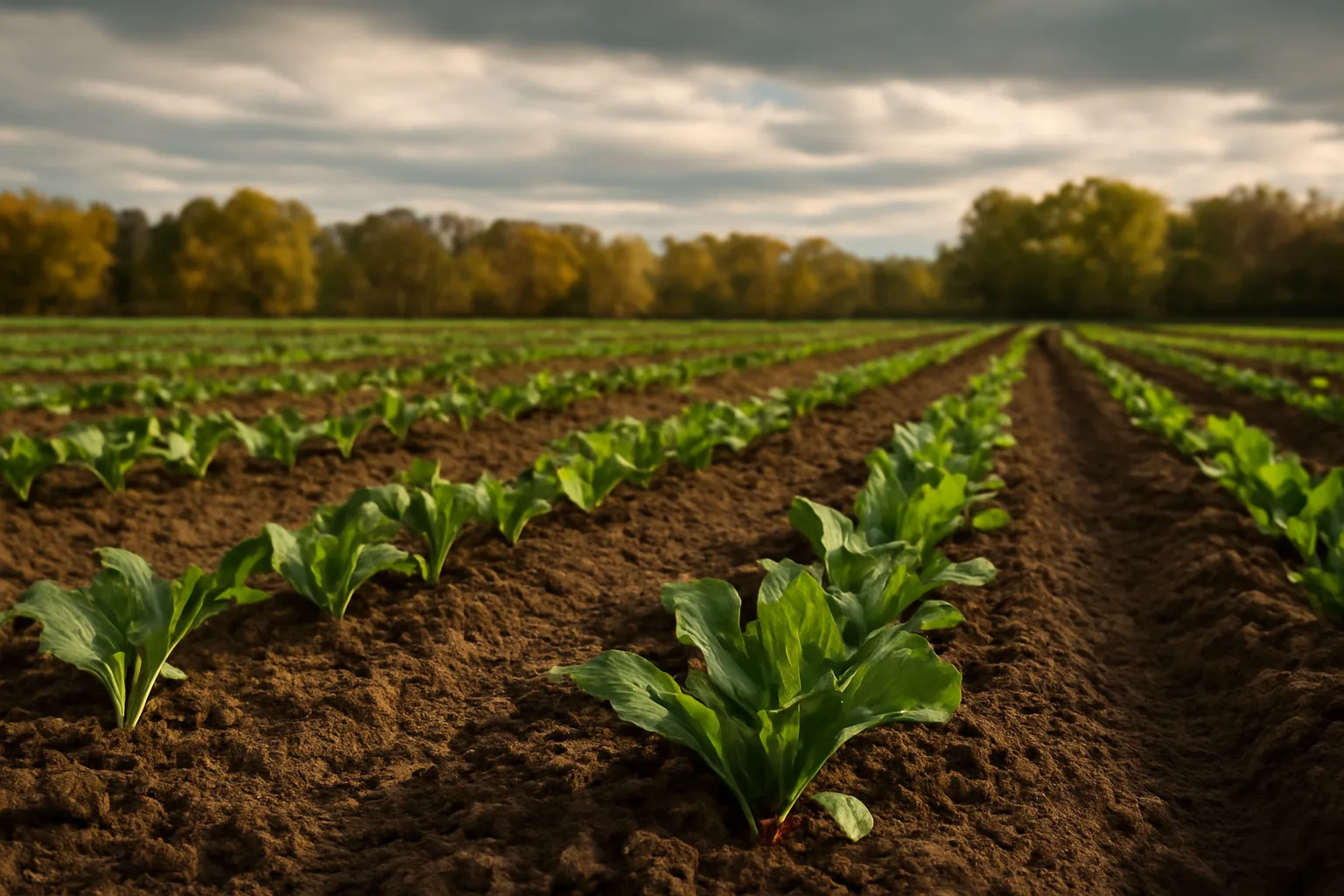
Sugar beets go in the ground roughly 90 to 120 days before your area's average first fall frost date. That's the simplest rule that actually works across regions, because beets need a long, slow season to build the big root reserves that deer key in on come late fall and winter. For most of the whitetail's range, that translates to a planting window of mid-May through early July. Northern states with early frosts (think International Falls, Minnesota or northern Wisconsin) need to get seed in by late May or very early June. Southern and mid-latitude states with frost dates in late October or November have more room, often into early or mid-July. The two things that actually gate the decision are soil temperature and days-to-maturity. Sugar beet varieties commonly used in food plots run 120 to 140 days to full maturity [1]. Work backward from your local frost date using your state extension's frost date tables, then plant no later than that maturity window allows. A lot of guys plant too late because they're thinking about deer season instead of the plant's biology. Sugar beets bulk up their root through summer and early fall. If you plant in August hoping for a quick fall food source, you'll get leafy tops and skinny little roots, not the softball-sized beets that make this crop worth the trouble.
What soil and site conditions do sugar beets actually need?
Sugar beets want soil temperatures at or above 50 degrees F at planting depth, well-drained ground, and a pH between 6.0 and 7.5, with most extension guidance targeting 6.5 to 7.0 [2]. This is not a crop that tolerates wet feet or sour soil. Get a soil test before you plant, not after. Your soil test lab is the real authority here, not a blog post or a bag of seed. Lime takes months to move pH, so if your test comes back at 5.5, you need to apply lime the fall or early spring before you plant, not the week you're trying to get seed in the ground. Beets are heavy feeders. University of Wisconsin-Madison Extension guidance on sugar beet production notes the crop responds strongly to nitrogen, phosphorus, and potassium, and yield drops off fast in compacted or poorly drained soils [1]. If you're planting on reclaimed ag ground or a tight clay pull-plot, expect to work harder on tillage and drainage than you would with turnips or brassicas. Seedbed prep matters more with beets than with almost anything else in the food plot world. You want a fine, firm seedbed, similar to what you'd prepare for alfalfa. Rough, cloddy ground gives you spotty germination and uneven stands.
What is a food plot, and where do sugar beets fit in?
A food plot is a planted area on hunting land, typically a fraction of an acre up to several acres, seeded with forage crops that attract and hold deer or other wildlife by providing food beyond what the natural landscape offers. Food plots range from small hidden kill plots tucked in timber to large destination fields planted for tonnage and late-season nutrition. Sugar beets belong in the late-season, high-energy category. They're planted alongside or in place of turnips, radishes, and other brassicas when the goal is a food source that survives hard frosts and stays available into December, January, or later depending on your zone. Compare that to clover or oats, which do more work in early fall or as a season-long protein source. If you're building a full-property plan with multiple plots doing different jobs, sugar beets are the piece that covers the coldest, hungriest stretch of the year. For a broader look at matching crop type to plot purpose, see food plot whitetail and deer food plots.
Do deer actually eat sugar beets, and how much do they like them?
Yes, deer eat both the foliage and the root of sugar beets, though preference shifts through the season. Early on, deer browse the leafy tops. Once cold hits and a few hard frosts sweeten the exposed roots by converting starches to sugars, deer will paw up and eat the bulbs themselves. This frost-triggered sugar conversion is the same reason brassicas and turnips get more attractive after several freezes. It's not folklore, it's basic plant physiology tied to cold stress response, and it's a major reason sugar beet plots peak in value during late muzzleloader and shotgun seasons rather than opening week of archery. Nobody has a clean, controlled feeding-preference study ranking sugar beets against corn or soybeans for whitetails specifically. Most of what we know comes from field observation and extension forage trial data rather than deer nutrition research, so treat preference claims as informed experience, not hard science. Deer's favorite foods, based on decades of forage studies and browse surveys, tend to be whatever's highest in protein or energy and easiest to access seasonally: acorns and other hard mast in fall, clover and alfalfa through the growing season, agricultural crops like corn and soybeans where available, and browse from woody plants when nothing else is on the menu [3]. Sugar beets slot into that pattern as a late-season energy source, filling the same caloric role acorns play earlier in fall.
Do deer eat clover, and do they like it?
Yes, deer eat clover readily, and it's one of the most consistently preferred food plot forages across the whitetail's range. Clover offers roughly 20 to 25 percent crude protein in good stands, which is a big part of why state agencies and extensions keep recommending it for spring and summer nutrition [4]. White clover varieties (ladino types especially) and red clover both get heavy use. Clover's advantage over sugar beets is longevity: a well-maintained clover stand can produce for 3 to 5 years, while beets are a one-season annual you replant every year. The tradeoff is timing. Clover peaks in spring through early fall and goes dormant or gets buried under snow in the harshest winter months in northern zones. That's exactly when sugar beets and brassicas take over. A lot of the better property plans run clover as the perennial backbone and beets or turnips as the late-season annual complement. If you want seed options built for that kind of layered plan, deer food plot seed and food plot seed cover the range of blends available.
Do deer eat sorghum?
Yes, deer eat sorghum, both the leaves and grain heads, though it's more commonly planted as a summer annual for browse and cover than as a primary attractant crop. Grain sorghum and forage sorghum both show up in food plot mixes, often blended with other summer annuals like cowpeas or soybeans. Sorghum tolerates heat and drought better than corn, which makes it a useful choice in the southern half of the whitetail's range or in drier soils where corn struggles. It's not typically the star of a plot the way beets or clover are. Think of it more as a supporting player: added tonnage, added cover, and a grain source that persists into fall when the heads dry down. Deer use of sorghum tends to increase once other food sources thin out, similar to the frost-triggered shift you see with beets and brassicas.
When should you plant food plots for deer overall?
| Sugar beets | Mid-May to early July (90-120 days before first frost) | 120-140 days | |
|---|---|---|---|
| Turnips/brassicas | Late July to early September (60-90 days before first frost) | 60-90 days | |
| Oats (fall) | Late August to mid-September | 45-60 days to grazable growth | |
| Clover | Spring (Mar-May) or late summer (Aug-Sep) frost seeding | Establishes over 60-90 days, perennial after | |
| Corn/soybeans | Late April to June, after last frost | 90-120 days | Your state's cooperative extension office publishes frost date maps and planting calendars specific to your county, and that's the single best free resource for dialing in exact dates [5]. State wildlife agencies also publish food plot guides tailored to in-state game seasons and regulations . |
Timing splits into two broad windows: spring/summer plantings for warm-season annuals and perennials, and late-summer plantings for fall and winter annuals. Spring plots (clover, alfalfa, soybeans, corn, sorghum) generally go in after your last frost date, typically April through June depending on latitude. Fall plots (brassicas, sugar beets, cereal grains, winter peas) go in during a specific late-summer to early-fall window, counted backward from first frost. Here's a rough breakdown by crop type: | Crop type | Typical planting window | Days to maturity/usefulness |
When should you plant turnips for deer?
Plant turnips 60 to 90 days before your area's average first fall frost, which puts most of the whitetail range in a late July through early September window. Turnips mature faster than sugar beets, so you've got more flexibility on the back end of summer. Like beets, turnips get sweeter and more palatable after a few hard frosts convert starches to sugars in the bulb. Deer often ignore turnip tops and bulbs early in fall, then hammer the whole plant once temperatures drop consistently below freezing. Soil prep is more forgiving than sugar beets. Turnips tolerate a slightly wider pH range and less-than-perfect seedbeds better than beets do, which is part of why they're the more commonly planted brassica for first-time plotters.
When should you plant oats for deer?
Plant oats for fall food plots in late August through mid-September in most of the whitetail range, aiming for 6 to 8 weeks of growth before killing frosts shut things down. Oats are a cool-season cereal grain that germinates fast and produces palatable, high-carbohydrate forage within 3 to 4 weeks of planting. Oats work well mixed with brassicas or winter peas because they establish quickly and give deer something to eat while slower-maturing crops like beets or turnips are still bulking up. Some plotters also plant oats in early spring as a quick, cheap cover crop or nurse crop for clover establishment, though fall plantings are far more common for direct deer attraction. Oats don't survive hard winters in northern climates the way winter wheat or winter rye do, so don't count on an oat plot to carry you through January in Zone 4 or colder.
Do deer like honey, and does it belong in a food plot?
Deer are not typically drawn to honey itself in any meaningful food plot context, and there's no forage crop or plot strategy built around it. This question usually comes up because people confuse honey with actual attractant products (sprays, minerals, or scent-based lures) that sometimes include honey or molasses as a carrier or flavoring agent. Those commercial attractants are a different category entirely from food plots, and their use is often restricted. Baiting and supplemental feeding rules vary significantly by state, and some states classify sugar-based attractants or mineral licks under baiting regulations with specific distance and timing restrictions, or ban them outright during hunting season . Check your state wildlife agency's current baiting and feeding regulations before using any attractant product, because rules change and enforcement varies by county and land type in some states. If you're after something deer will genuinely key in on for calories, sugar beets, standing corn, or a well-fertilized clover stand does far more real work than any bottled attractant.
How do you build a planting timeline for sugar beets on your own property?
Start with your county's average first fall frost date, which you can pull from your local NOAA or state extension climate data [5]. Count back 120 days for a safe maturity buffer, and that's your latest realistic planting date. Earlier is generally better than later, as long as soil temps are consistently above 50 degrees F. Next, pull a soil test 60 to 90 days ahead of planting if you haven't tested in the last 2 to 3 years. That gives you time to apply lime if pH needs correcting; lime reactions are slow, often taking 3 to 6 months to fully adjust soil pH depending on soil type and lime quality [2]. Fertilize according to your soil test's specific recommendations. Beets need solid nitrogen, phosphorus, and potassium, but the exact rates depend on your existing soil fertility, not a generic bag rate. This is the point where a lot of guys either guess or spend hours cross-referencing extension PDFs for their specific state and soil type. If you'd rather have a straight answer built around your zone, your frost dates, and your actual soil test numbers, PlotSeason's $99 one-time Custom Food Plot Plan does that work for you, matching species and timing to your specific property instead of a national average. It's general planning guidance built from your inputs, not site-specific agronomy, so your soil test lab still has final say on lime and fertilizer rates. Start at /plot-plan-builder. Finally, prep a fine, firm seedbed, plant at the recommended shallow depth for your seed type (check your specific seed tag, since rates and depths vary by variety), and plan to mow or spray for weed competition in the first 3 to 4 weeks while the beet canopy establishes.
What mistakes cost the most yield with a late-season beet plot?
Planting too late is the single biggest killer. Guys get busy in June, push planting into mid-July thinking they've still got time, and end up with beets the size of golf balls come November instead of fists. Skipping the soil test is the second biggest mistake. Sugar beets are more pH-sensitive than turnips, brassicas, or cereal grains, and a soil sitting at 5.5 will produce a fraction of the tonnage a corrected 6.5 to 7.0 soil will, even with identical fertilizer inputs [1]. Weed competition in the first month is the third. Beet seedlings are slow and small out of the gate compared to something like buckwheat or oats. If grass and broadleaf weeds get ahead of them in the first 3 to 4 weeks, the beet canopy never catches up and yield suffers hard. Last, don't plant sugar beets on ground with drainage problems. Standing water or heavy clay that stays saturated rots the developing root and wastes the whole planting. If your best plot ground is a low, wet spot, brassicas or a cereal grain blend will treat you better than beets will. For more on matching species to site conditions, deer for food and domain food plot seed walk through crop-by-crop site requirements.
Frequently asked questions
Do deer eat sorghum in food plots?
Yes, deer eat both the leaves and grain heads of sorghum, though it's more often used as a summer annual for tonnage and cover than as a primary attractant. It handles heat and drought better than corn, making it a common choice in the southern half of the whitetail's range.
Do deer eat clover?
Yes, clover is one of the most consistently preferred whitetail forages, offering roughly 20 to 25 percent crude protein in a good stand. It works best as a spring-through-fall perennial food source and is a staple in state wildlife agency food plot recommendations across the country.
When is the best time to plant deer food plots overall?
It depends on the crop. Spring annuals and perennials (clover, corn, soybeans) go in after your last spring frost, typically April through June. Fall annuals (brassicas, sugar beets, oats) get planted counting backward from your first fall frost date, usually late July through early September.
Do deer like clover more than other food plot crops?
Deer show strong, consistent preference for clover, especially in spring and summer when protein demands are highest for antler growth and lactation. It's not necessarily preferred over acorns or standing corn when those are available, but as a planted forage it's one of the most reliably used crops.
When should you plant oats for a deer food plot?
Plant oats in late August through mid-September across most of the whitetail range, giving them 6 to 8 weeks before hard frosts. Oats germinate fast and provide palatable forage within 3 to 4 weeks, making them a good companion crop with slower brassicas or beets.
When should you plant food plots for deer in general?
Count backward from your local frost dates. Fall food plot crops like sugar beets, turnips, and oats get planted 60 to 120 days before first frost depending on the species. Spring plots like clover, corn, and soybeans go in after your area's last spring frost.
When should you plant turnips for deer?
Plant turnips 60 to 90 days before your area's average first fall frost, generally late July through early September. Turnips mature faster than sugar beets and tolerate imperfect seedbeds and soil pH better, making them a more forgiving first brassica to try.
What exactly is a food plot?
A food plot is a planted area on hunting property, from a small hidden kill plot to a multi-acre destination field, seeded with forage crops to supplement natural food and attract or hold deer and other wildlife on that ground.
What are deer's favorite foods?
Based on browse surveys and forage research, deer favor acorns and hard mast in fall, clover and alfalfa through the growing season, agricultural crops like corn and soybeans where available, and frost-sweetened brassicas or sugar beets in late season. Preference shifts with season and what's locally available.
Do deer like honey?
Deer show no meaningful preference for honey itself, and it's not used as a food plot crop. The confusion usually comes from commercial attractant products that include honey or molasses as a flavoring, which are a separate category from planted food plots and often fall under state baiting regulations.
How late is too late to plant sugar beets for deer?
If you can't get seed in the ground at least 90 to 100 days before your area's average first fall frost, you're pushing your luck. Beets planted later than that typically produce small, underdeveloped roots that don't deliver the late-season tonnage the crop is planted for.
What soil pH do sugar beets need for a food plot?
Sugar beets do best in soil pH between 6.0 and 7.5, with most extension guidance targeting 6.5 to 7.0. A soil test is the only reliable way to know your starting point, and lime takes 3 to 6 months to fully adjust pH, so test well ahead of planting.
Can you plant sugar beets and turnips together?
Yes, mixing sugar beets with turnips or other brassicas is common and works well since both benefit from frost-sweetening and fill the same late-season niche. Just plant both within their respective windows (beets earlier, turnips can go a bit later) so neither crop gets shorted on maturity time.
Sources
- University of Wisconsin-Madison Extension, Integrated Pest and Crop Management, Sugarbeet Production: Sugar beet varieties commonly run 120-140 days to maturity
- Ohio State University Extension, Agronomic Crops Team, Soil pH and Liming: Target pH range for crop production and lime reaction time
- USDA Forest Service, Fire Effects Information System, Odocoileus virginianus: Deer food preferences shift seasonally toward mast, browse, and agricultural crops
- NOAA National Centers for Environmental Information, U.S. Climate Normals: Frost date data source for calculating planting windows
- Pennsylvania Game Commission, Habitat Management: State wildlife agencies publish food plot guidance tied to in-state regulations