Last updated 2026-07-25
TL;DR
Turnips make a solid cold-season deer food plot when planted 60 to 90 days before your first fall frost, roughly late July through early September in most of the whitetail range. Deer often ignore the leaves and bulbs until frost converts starches to sugars, so plant them alongside oats or clover, not as your only option.
What is a food plot, and where do turnips fit in?
A food plot is a planted patch of forage, usually somewhere between a quarter acre and several acres, put in the ground specifically to feed and hold deer or other wildlife on a property. Most hunters split plots into two rough categories: warm-season plots (soybeans, cowpeas, clover started in spring) and cool-season plots (brassicas, cereal grains, clover overseeded in fall). Turnips fall into the cool-season, brassica camp along with rape, kale, and radishes. They're planted in mid to late summer and hit peak attraction in the late fall and winter, which is exactly when a lot of native browse has dried up and acorns are gone. That timing is the whole reason hunters plant them: turnips are basically built to be a December and January food source, not an October opener plot. If you're new to plotting, it helps to think of turnips as one tool in a bigger toolbox alongside food plot whitetail strategy, not a stand-alone plan. A lot of successful plots blend turnips with cereal grains or clover so there's something green in the ground at every stage of the season.
Do deer actually eat turnips?
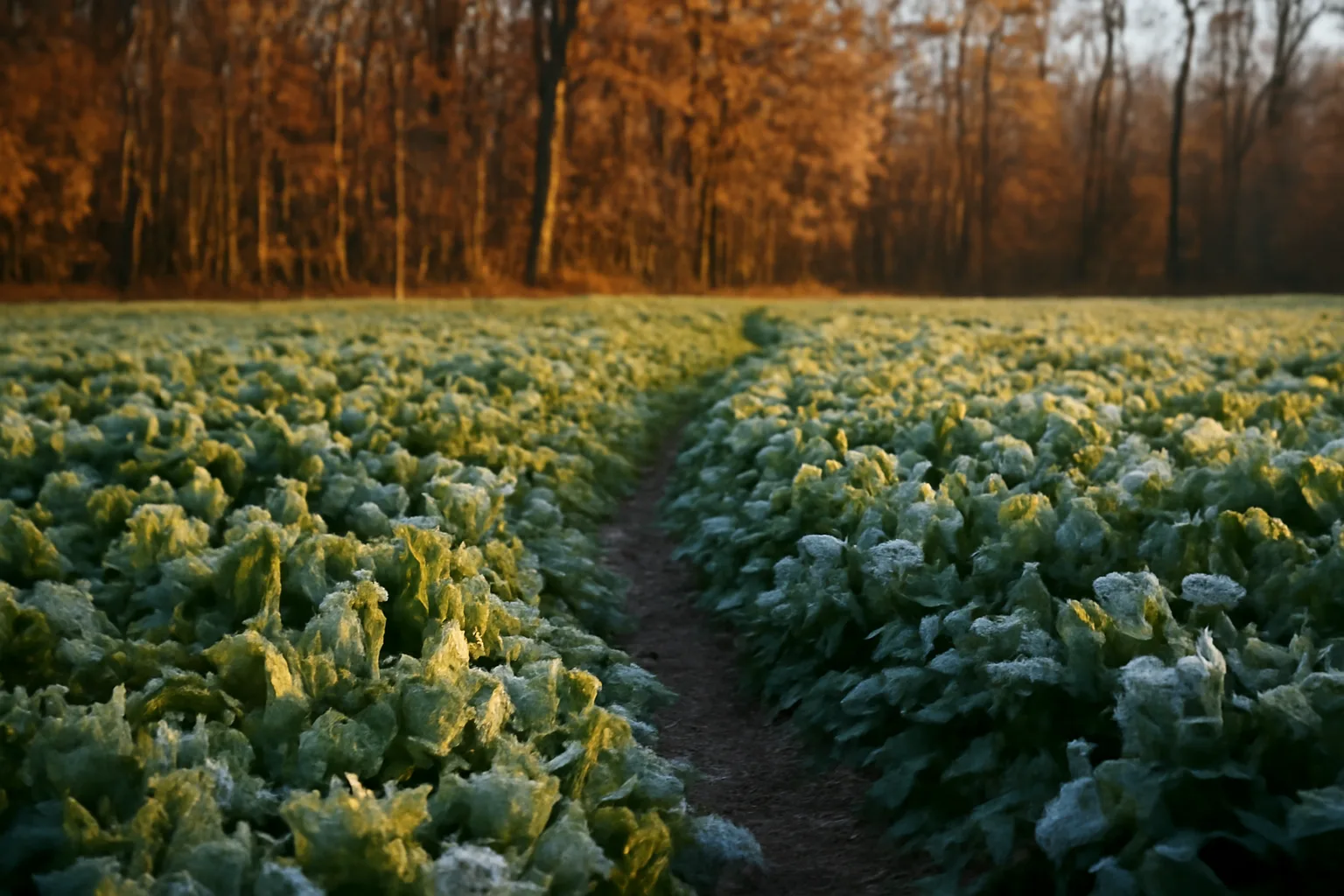
Yes, but not always right away, and that trips up a lot of first-time planters. Deer will browse turnip leaves some through fall, but the real draw is usually after one or two hard frosts, when cold temperatures convert starches in the bulb and leaves into simple sugars, making the plant noticeably sweeter [1]. Extension research from the University of Tennessee and other land-grant programs notes that brassica forages like turnips see a jump in palatability once freezing temperatures hit, which is why deer often walk right past a green turnip plot in October and hammer it in December [2]. Bulb size matters too. Deer will paw through snow to get at the bulb once tops are gone, and in northern climates a turnip plot can be one of the last green (or at least edible) food sources standing into January. In the South, where hard freezes are rare or late, turnips may never get sweet enough to pull deer in the way they do up north, so results vary a lot by latitude. One honest caveat: some properties see turnips sit almost untouched all season, especially in years with a heavy acorn drop or in areas where deer just haven't learned to use brassicas yet. It can take a season or two of exposure before deer key in on a new food source in a given area. That's a real phenomenon extension wildlife specialists have noted, more than plot bro folklore.
When to plant turnips for deer?
| Upper Midwest / Northern tier | Mid-July to mid-August | Mid-Sept to early Oct | |
|---|---|---|---|
| Mid-South / Transition zone | Late July to late August | Mid-Oct to early Nov | |
| Deep South | Mid-Aug to mid-Sept | Late Nov to Dec (if at all) | These are general guides, not guarantees. Always cross-check against your county's actual frost data rather than a regional average, because elevation and local microclimate shift things by two or three weeks in either direction. |
Plant turnips 60 to 90 days before your area's average first fall frost date. For most of the whitetail range that lands somewhere between mid-July and early September, with northern states planting earlier (mid-July to mid-August) and southern states planting later (late August to mid-September) [3]. Turnips need that window to bulb up properly. Plant too late and you get leafy growth with small or no bulbs; plant too early in hot, dry conditions and germination can be spotty. Check your local frost date through NOAA's climate normals or your state extension office, then count backward. Here's a rough planting window by region: | Region | Typical planting window | First frost (avg.) |
When to plant food plots for deer, in general?
Timing depends entirely on whether you're planting a warm-season or cool-season plot. Warm-season plots (soybeans, cowpeas, sunflowers, most clovers) go in after your last spring frost, typically April through June depending on latitude. Cool-season plots (brassicas, cereal grains, winter peas) go in during late summer, 60 to 90 days ahead of first frost, same logic as turnips above. A lot of hunters make the mistake of treating food plot planting like a garden calendar tied to the calendar date instead of frost dates. Frost date is the anchor. If you're planning a full-season rotation, USDA's Plant Hardiness Zone Map is a decent starting reference for what will survive winter in your area, though it's built around perennial hardiness rather than annual plot timing specifically. If you want a plan built around your specific property, soil test, and region rather than a generic regional window, that's the exact gap our $99 Custom Food Plot Plan is built to fill. It's general guidance based on your inputs, not site-specific agronomy, so your soil test lab still has the final word on lime and fertilizer rates.
How do you actually plant a turnip plot?
Turnip seed is tiny, roughly 150,000 seeds per pound, so planting depth and seedbed prep matter more than people expect. Plant no deeper than a quarter to half inch. Seed broadcast on a firm, well-packed seedbed and lightly cultipacked or dragged in works better than drilling too deep, where germination drops fast. Seeding rate for pure turnip stands typically runs 4 to 6 pounds per acre broadcast. Many hunters blend turnips with other brassicas (rape, radish) or a cereal grain like oats or winter wheat, which cuts the pure turnip rate down and gives you a plot that isn't 100% dependent on one species doing well. A basic sequence: 1. Soil test first. Turnips like a pH between 6.0 and 6.5; below that, lime becomes the priority before anything else [4]. 2. Kill existing vegetation with tillage or herbicide 2 to 3 weeks ahead of planting. 3. Broadcast seed onto a firm seedbed, or drill no deeper than half an inch. 4. Cultipack or drag lightly to ensure seed-to-soil contact. 5. Fertilize based on your soil test, typically split between a balanced starter and a nitrogen boost 3 to 4 weeks in. Don't skip step one. Brassicas are heavy nitrogen feeders and respond visibly to fertility, but throwing fertilizer at a plot with a pH of 5.2 is mostly wasted money. Your soil test lab's recommendation is the actual authority here, this article is a general framework, not a substitute for your specific results.
Do deer like clover, and how does it compare to turnips?
Yes, deer readily eat clover, and extension research consistently ranks white and red clover among the most preferred, most digestible forages available to whitetails, often outranking many other plot species in browse preference studies [5]. Clover's advantage over turnips is season length: a well-maintained clover stand can provide forage from spring green-up through fall, and perennial varieties like white clover can produce for 3 to 5 years with proper mowing and fertility management. Turnips can't do that. They're annuals, they die back or get consumed over winter, and the plot needs to be replanted each year. What turnips offer that clover doesn't is that late-season sugar spike after frost, plus a bulb that stays in the ground as a food reserve into deep winter when clover growth has stopped cold. A lot of experienced plotters run both: clover as the season-long anchor plot, turnips or a brassica blend as the late-season plot. If you're deciding between the two for a single plot, deer food plot seed selection really comes down to what part of the season you're trying to cover, early bow season versus late gun season versus a food source that carries deer through winter stress.
Do deer eat sorghum, and where does it fit next to turnips?
Deer will eat grain sorghum, both the standing seed heads and, to a lesser extent, the foliage, but it's used more commonly as a summer/fall grain and cover crop than as a preferred browse forage the way clover or brassicas are [6]. Sorghum is drought-tolerant and can add structure and screening cover to a plot, which matters for hunting access as much as for feeding value. It doesn't overlap much with turnips in a rotation because sorghum is a warm-season crop planted after last frost, while turnips are a cool-season crop planted ahead of first frost. Some hunters use sorghum as a nurse crop or screen bordering a turnip plot, planted earlier in the year, then let it stand through fall to break up sightlines into the brassica plot behind it. That's a legitimate use, but don't expect sorghum to be your primary deer draw the way a turnip plot is once frost hits.
When to plant oats for deer, and should you mix them with turnips?
Plant oats for deer in late summer to early fall, generally the same 60- to 90-day-before-frost window as turnips, though oats germinate and green up faster, often showing usable growth in 7 to 10 days versus 3 to 4 weeks for turnip bulbs to mature [7]. That speed makes oats a great companion crop: they give deer something to eat almost immediately while the turnips are still bulbing up underground. A common blend is 50 to 60 pounds of oats per acre with 3 to 4 pounds of turnip seed per acre, broadcast together. Oats provide early fall tonnage and some cold tolerance (though they'll winterkill in hard freezes further north), and turnips take over as the season's main draw once the oats get grazed down or die back. This blend approach also hedges against turnip failure. If deer are slow to key in on the brassica bulbs (common in year one on a new property), the oats still give you a functioning plot instead of an empty field.
What are deer's favorite foods overall?
There's no single universal answer because preference shifts by season, region, and what's locally available, but extension and wildlife agency research points to a fairly consistent short list: acorns (especially white oak group) rank at or near the top wherever they're available, along with soybeans, clover, and other legumes during the growing season, and brassicas, cereal grains, and browse (woody stems and buds) becoming more important in late fall and winter [8]. Acorns deserve special mention. White oak acorns are lower in tannins and generally preferred over red oak acorns, and in a heavy mast year deer will often bypass planted food plots entirely to hit an acorn drop, which is one of the most common reasons a turnip plot looks "ignored" in October and November of a big acorn year [9]. Bottom line: deer are opportunistic browsers, not menu specialists. Nutritional demands shift by season too, with does needing high protein through lactation in summer and both sexes needing energy-dense carbs heading into winter, which is exactly the niche turnips and other brassicas fill.
Do deer like honey, and does it belong anywhere near a food plot?
There's no real evidence deer seek out honey as a food source, and it's not a forage species or attractant with any wildlife research behind it as a deer food. Deer are herbivores built to digest plant fiber through a four-chamber rumen system, not concentrated sugars like honey. Some hunters have used sugar-based or molasses-based mineral and attractant products marketed for deer, but that's a different category entirely from a food plot planting, and the actual attraction claims on those products are largely unverified by any peer-reviewed wildlife research. More importantly, using bait, mineral, or scent attractants at all is regulated differently state by state, and in many states baiting or feeding deer is restricted or banned outright, sometimes tied to chronic wasting disease concerns. Always check your state wildlife agency's current baiting and feeding regulations before putting out anything beyond a planted crop, since rules vary widely and change periodically. If you're hunting near a food plot, the plot itself is generally treated differently under law than a bait pile, but the line varies by state, so don't assume.
How do soil pH and fertility affect a turnip plot?
Turnips grow best in soil with a pH between 6.0 and 6.5, and extension guidance is consistent that brassicas are moderate to heavy nitrogen users that respond strongly to added fertility once pH is corrected [4]. If your soil test comes back below pH 6.0, lime is the first move, not fertilizer. Lime takes months to fully react in the soil, so ideally it goes down the season before planting if you can swing it, though a fall application ahead of a fall plot still helps some. A typical fertility program for a turnip or brassica blend plot runs something like 300 to 400 pounds per acre of a balanced starter fertilizer (something like 19-19-19 or similar, depending on your soil test's phosphorus and potassium recommendations) at planting, with a supplemental nitrogen application (ammonium nitrate or urea, 40 to 60 pounds of actual nitrogen per acre) 3 to 4 weeks after emergence to push leaf and bulb growth. Those numbers are general ranges. Your actual soil test report from your lab is the real authority on exact rates for your dirt; a generic article can only give you the shape of a program, not the specific pounds per acre your field needs. If you want help translating a soil test into an actual seed and fertilizer plan for your property and region, that's the specific problem the Custom Food Plot Plan is built to solve for $99, but the lab's lime and fertilizer numbers always take precedence over any general recommendation.
What equipment do you need to plant a turnip plot?
You can plant turnips with surprisingly minimal equipment because the seed is small and broadcasting works fine. A basic setup includes a way to kill existing vegetation (tillage equipment or a sprayer with glyphosate), a broadcast spreader (even a hand-crank one for small plots), and something to firm the seedbed afterward, like a cultipacker, ATV drag, or even a piece of chain-link fence dragged behind a truck. For larger acreage, a no-till drill set very shallow can work, but a lot of experienced plotters actually prefer broadcasting turnip seed over drilling because it's easy to plant too deep with a drill calibrated for bigger seed like beans or corn. If you're renting or borrowing equipment, ask specifically for a drill that can be dialed down to a quarter-inch depth; not all can go that shallow. For more on matching gear to plot size and species, see general planning resources like deer food plots and food plot seed selection guidance, which cover broader equipment tradeoffs beyond just brassica planting.
Frequently asked questions
Do deer eat sorghum in food plots?
Yes, deer eat grain sorghum, mostly the seed heads, though it's used more as a drought-tolerant grain and screening crop than a top-preference forage like clover or brassicas. It's a warm-season crop, so it doesn't share a planting window with fall-planted turnips, but it can work as border cover for a plot.
Do deer eat clover, and is it better than turnips?
Yes, clover is one of the most preferred deer forages in extension research, and unlike annual turnips, perennial clover can produce forage for 3 to 5 years. Clover covers spring through fall; turnips cover late fall through winter after frost sweetens the bulbs. Most serious plotters run both rather than choosing one.
When should you plant food plots for deer?
Warm-season plots (soybeans, cowpeas, clover) go in after your last spring frost, typically April to June. Cool-season plots (turnips, brassicas, cereal grains) go in 60 to 90 days before your first fall frost, usually mid-July through mid-September depending on your region.
Do deer actually like clover more than other plot species?
Extension browse preference studies consistently rank clover, especially white and red clover, among the top forages deer select when given a choice. It's high in protein and digestibility, which is why it's a common base plot species alongside seasonal additions like turnips or oats.
When should you plant oats for deer?
Plant oats 60 to 90 days before your first fall frost, the same general window as turnips. Oats germinate in 7 to 10 days, much faster than turnips, so they're often mixed together, with oats providing quick early forage while turnip bulbs mature underground.
When is the best time to plant turnips for deer?
Plant turnips 60 to 90 days ahead of your area's average first fall frost date. In northern states that's mid-July to mid-August; in the mid-South, late July to late August; in the Deep South, mid-August to mid-September. Check your county's actual frost date rather than relying on a regional average.
What exactly is a food plot?
A food plot is a planted area, usually a quarter acre to several acres, seeded specifically to feed and hold deer or other wildlife on a property. Plots split into warm-season types (soybeans, clover, planted spring) and cool-season types (brassicas, cereal grains, planted late summer for fall and winter forage).
What are deer's favorite foods in general?
Acorns, especially white oak group, rank at or near the top wherever available. Soybeans, clover, and other legumes are preferred during the growing season. Brassicas, cereal grains, and woody browse become more important once fall and winter set in and other food sources dry up or drop.
Do deer like honey or sugar-based attractants?
There's no wildlife research supporting honey as a meaningful deer food or attractant. Deer are herbivores adapted to digest plant fiber, not concentrated sugars. Some mineral and molasses-based products are marketed as attractants, but claims are largely unverified, and baiting rules vary heavily by state, so check your state wildlife agency first.
Why won't deer touch my turnip plot until winter?
Turnips need a hard frost or two before starches convert to sugars, which is when palatability jumps. Before that, deer may ignore the plot almost entirely, especially in a heavy acorn year. This is normal behavior, not a sign the plot failed; patience through the first frost usually changes things.
Can you plant turnips alone, or do they need a companion crop?
Turnips can be planted alone, but blending with oats or another cereal grain is common because oats germinate faster and give deer something to eat while turnip bulbs are still maturing. It also hedges against a slow start if deer haven't keyed into brassicas on that property yet.
How deep should turnip seed be planted?
No deeper than a quarter to half inch. Turnip seed is tiny, roughly 150,000 seeds per pound, and planting too deep is the most common reason for poor germination. Broadcasting onto a firm seedbed and lightly cultipacking or dragging works better than drilling deep.
Sources
- University of Tennessee Extension, Brassicas for Deer Forage: Frost converts starches to sugars in brassica forages, increasing palatability for deer
- Mississippi State University Extension, Brassica Forages for Wildlife: Brassica forages like turnips see increased palatability after cold temperatures/frost
- NOAA National Centers for Environmental Information, Climate Normals: First fall frost dates vary by region and are the basis for planting window timing
- Clemson Cooperative Extension, Soil Fertility for Wildlife Food Plots: Turnips and brassicas grow best at soil pH 6.0-6.5 and respond strongly to nitrogen fertility
- Mississippi State University Extension, Wildlife Food Plot Establishment: Clover ranks among the most preferred and digestible deer forages in preference studies
- USDA NRCS Plant Guide, Grain Sorghum: Grain sorghum is used as a drought-tolerant grain crop with wildlife food value
- University of Georgia Extension, Warm and Cool Season Food Plots: Oats germinate quickly, typically within 7 to 10 days, faster than brassica bulb maturity
- USDA Forest Service / National Deer Association research summaries on whitetail diet: Acorns, legumes, and browse vary in seasonal importance to whitetail deer diet
- Mississippi State University Extension, Acorns and Deer: White oak acorns have lower tannin content and are generally preferred over red oak acorns by deer