Last updated 2026-07-25
TL;DR
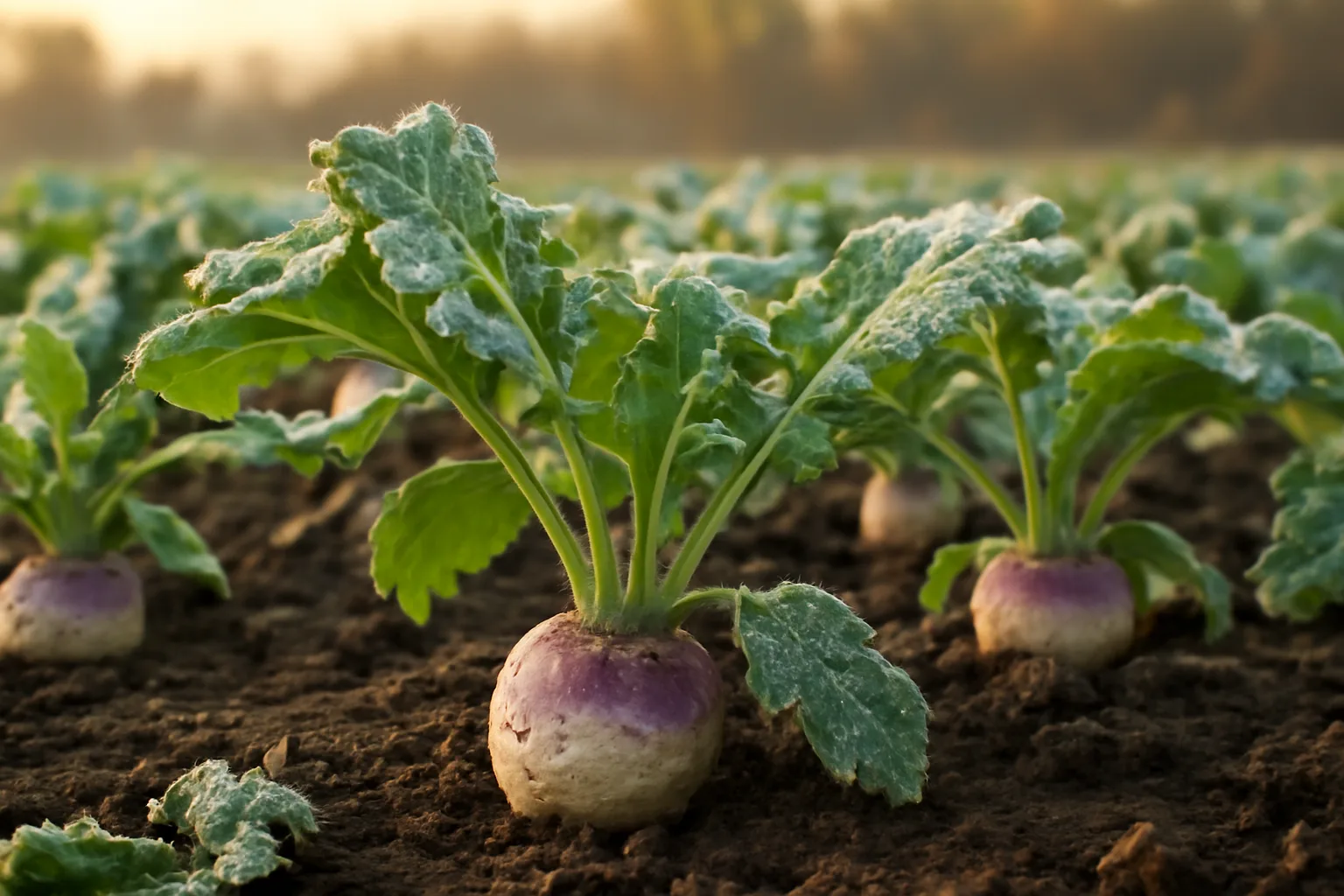
Plant turnip seeds for food plots 60 to 90 days before your first killing frost, roughly late July through early September depending on your zone. Drill or broadcast 1/4 inch deep at 4 to 6 lbs/acre alone, or 2 to 4 lbs/acre in a blend. Deer often ignore tops until frost sweetens the starch, then hammer both leaves and bulbs hard.
What is a food plot, and where do turnips fit in?
A food plot is a planted area on hunting land, usually 1/4 acre to a few acres, designed to feed deer and other wildlife while giving hunters a reason to see animals in daylight. Penn State Extension describes food plots as small plantings established on wildlife land specifically to supplement natural forage and improve nutrition and hunting opportunity, distinct from row-crop agriculture grown for sale. Turnips fall into the brassica family, along with radishes, rape, and kale. They're a fall/winter food source, not a season-long green plot like clover. The plant grows a leafy top through late summer, then bulks up a root (the bulb) as temperatures drop. That timing is the whole point: turnips are built to feed deer hard in November, December, and into January, right when natural browse is thinning out and hunting pressure is highest. Most turnip plots get planted as part of a blend with other brassicas, cereal grains like oats, or clover, not as a monoculture. A pure turnip plot can work, but blends spread out the food value and hedge against one crop failing. If you're weighing turnips against other plot types for your ground, it helps to look at the broader picture of food plot whitetail strategy before committing acreage to any single species.
When to plant turnips for deer?
| Upper Midwest / Northeast | Late July to mid-August | Late Sept to mid-Oct | |
|---|---|---|---|
| Mid-Atlantic / Ohio Valley | Mid-Aug to early Sept | Mid to late Oct | |
| Deep South / lower Southeast | Late Aug to mid-Sept | Nov to early Dec | Frost dates vary a lot even within a state, so check your county's average first frost date through NOAA's Climate Normals data rather than guessing off a regional map [2]. |
Plant turnips 60 to 90 days before your area's average first killing frost. That's the window Oklahoma State University Extension recommends for brassica forage crops to reach adequate bulb size and leaf tonnage before growth slows in the fall [1]. In practical terms: northern states (upper Midwest, Northeast, parts of the Rockies) usually plant late July through mid-August. Transition zones (Ohio Valley, mid-Atlantic, central Plains) plant mid-August through early September. Southern states (Deep South, lower Southeast, Texas) can wait until late August through mid-September and still hit the window, since frost comes later. Here's the trap a lot of first-time planters fall into: they plant too late because they're thinking about hunting season, not frost. Turnip tops need real time to build leaf mass and the bulb needs time to size up underground. Plant in September in Wisconsin and you'll get a thin, spindly plant with a bulb the size of a golf ball. Plant in July in the same spot and you'll get full-size bulbs and heavy leaf cover by October. Soil temperature matters too. Brassica seed germinates best when soil temps are in the 55 to 75 degree F range. If you're planting into baked, dry August ground, wait for a rain forecast if you can, or at least plant right before one. | Region | Typical planting window | First frost (avg) |
How deep and how thick should I plant turnip seed?
Turnip seed is tiny, similar to clover seed, so depth is the single most common mistake. Plant 1/4 to 1/2 inch deep, no deeper. Oklahoma State University Extension's brassica forage guidance recommends planting turnip and other brassica seed at 1/4 to 1/2 inch, noting that seed placed too deep struggles to emerge given how small and low-energy the seed is [1]. Seed buried an inch down often just never emerges. For a pure turnip plot, seeding rate runs 4 to 6 lbs per acre broadcast, or slightly less (3 to 4 lbs/acre) if drilled, since drilling gives better seed-to-soil contact and needs fewer seeds to get a stand. In a blend with oats, cereal rye, or clover, cut the turnip rate down to 2 to 4 lbs per acre so the turnip doesn't crowd out the other components. Broadcasting is the most common method for turnips because the seed is light enough to spread evenly with a hand spreader or ATV spreader, then cultipacked or lightly dragged to press it into the soil. A cultipacker (or even driving over the plot with an ATV) after broadcasting makes a real difference in germination rate, since good seed-to-soil contact matters more with small seed than with something like soybeans. If you're using a no-till drill, set it as shallow as it'll go, because most drills are calibrated for bigger seed and will bury brassica seed too deep by default.
When to plant food plots for deer overall?
Timing splits into two seasons: spring plots (clover, chicory, soybeans, cowpeas) go in after your last frost, generally April through June depending on latitude. Fall plots (turnips, brassicas, oats, wheat, cereal rye) go in 60 to 90 days before first frost, generally late July through September [1]. Many hunters run both. A perennial clover plot planted in spring gives food from May through the following winter for 3 to 5 years before it needs renovation. A fall annual plot like turnips gets replanted every single year and is timed specifically to peak during hunting season. Soil prep timing matters as much as planting date. If you're planning to lime, get it down at least 60 days before planting since lime takes months to fully react and adjust pH, per University of Missouri Extension liming guidance for forage establishment [3]. A soil test taken in early summer gives you time to lime before a fall brassica planting; a test taken the week you plant is too late to fix anything with lime. For a full walkthrough of picking the right species for your specific ground and goals, see deer food plot seed and deer food plots.
When to plant oats for deer?
Plant oats at the same time as turnips, generally 60 to 90 days before first frost, since oats are also a cool-season annual that thrives in fall planting windows. Oats germinate fast, often within 5 to 7 days in warm soil, and put on quick green growth that deer will hit immediately, which makes them a good nurse crop planted alongside slower-establishing brassicas or clover [1]. Oats winterkill in most northern climates once temps drop into the teens for sustained periods, so in the upper Midwest and Northeast they function as a fall-only food source. In the South, oats can survive winter and provide green forage into late winter and early spring. A common blend: oats plus turnips plus a little crimson clover. The oats give instant attraction and cover in September and October, the turnips take over as the main food source once frost hits, and the clover (if it survives) carries into spring.
Do deer eat turnips right after planting, or do they wait?
Deer usually ignore turnip tops for the first several weeks and don't touch the plot hard until after the first hard frost. This is the most common complaint from first-year turnip planters: the plot looks great in September, and deer walk right past it. The reason is starch conversion. Frost triggers the plant to convert starches into sugars as a natural antifreeze response, which makes the leaves and bulbs noticeably sweeter and more palatable. Oklahoma State University Extension's brassica forage guidance notes that brassica quality and palatability for livestock and wildlife improve after a killing frost as the plant's carbohydrates shift toward soluble sugars [1]. Before frost, turnip tops are still fairly bitter and high in glucosinolates, the same compounds that make raw turnip greens taste sharp to us. Once you get 2 or 3 frosts in the 25 to 32 degree F range, deer usage typically spikes hard. Leaves get eaten first, since they're easier to access; bulbs get dug up and eaten later in winter once other food is scarcer and deer have learned the plot is there. In snow country, deer will paw through several inches of snow to get at turnip bulbs in January, which is exactly why turnip plots are prized as a late-season draw. If you hunt a state with December or January seasons, this delayed-but-heavy pattern is turnip's biggest advantage over a plot that peaks too early and gets browsed out before the rut even starts.
Do deer like clover, and how does it compare to turnips?
| Plant type | Perennial | Annual |
|---|---|---|
| Stand life | 3-5 years | 1 season |
| Peak deer use | Spring-fall | Late fall-winter (post-frost) |
| Planting window | Spring or late summer | 60-90 days pre-frost |
| Cold tolerance | Good | Very good, tops improve after frost |
Yes, deer readily eat clover, and it's one of the most consistently preferred food plot forages across regions, particularly white clover and red clover varieties used in perennial plots. Clover gives season-long grazing pressure from spring through fall, plus decent late-season value where it doesn't get buried in snow. The real difference is timing and lifespan. Clover is a perennial that feeds deer for years off one planting (with annual maintenance like mowing and occasional overseeding), while turnips are annuals replanted every year that are specifically built for a fall-into-winter feeding peak. Clover also gets browsed immediately and continuously; turnips get largely ignored until frost, then eaten hard. A lot of experienced plotters run both: clover for spring and summer nutrition (especially useful for lactating does and antler growth), turnips or other brassicas for a late-season hunting draw. They're complementary, not competing, choices. | Trait | Clover | Turnips |
Do deer eat sorghum, and does it work in a food plot?
Deer do eat sorghum, especially grain sorghum heads and the leafy stalks, but it's used more often as a screening/cover crop or a late-season grain source than as a primary attractant crop. Grain sorghum reaches physiological maturity in roughly 90 to 120 days from planting depending on hybrid and region, per Kansas State University Research and Extension grain sorghum production guidance [4]. In food plot contexts, sorghum shows up in two roles: as a tall summer screen to block a plot from road view or hide access trails, and as a standing grain crop left through winter for late-season food, similar to how standing corn gets used. It's not a brassica and doesn't need frost to become palatable the way turnips do. Sorghum tolerates drought and poor soil better than corn, which is part of why it gets planted on marginal ground in the South and Plains where corn struggles.
Do deer like honey, and does that matter for food plots?
Deer don't seek out honey in the wild and it has no real role in food plot planning; deer are herbivores whose diet is built around forbs, browse, grasses, mast, and agricultural crops, not sugars like honey. This question sometimes comes up confused with mineral or attractant products, some of which use molasses or sugar-based additives as a scent draw, but that's a different thing from a planted food plot. If you're trying to figure out what actually pulls deer to a spot, focus on real forage species and mineral/supplement sites rather than sugar-based attractants, which have limited nutritional value and, depending on your state, may fall under baiting regulations.
What are deer's favorite foods, and where do turnips rank?
Deer preference shifts by season and region, but acorns, soybeans, clover, and agricultural crops like corn and alfalfa consistently rank as top-preferred foods where available, with browse species (woody plants, forbs) filling in the rest of the diet. Turnips aren't a top preference in September, but jump to a strongly preferred late-season food after frost sweetens the plant. Acorns deserve a special mention: in years with a strong mast crop, deer will often bypass food plots entirely in favor of white oak acorns, which are lower in tannins and more digestible than red oak acorns. This is a real frustration for plot owners in big mast years and isn't something any seed blend fixes. Soybeans and corn, where legal and practical to plant, tend to out-draw brassicas through late summer and early fall because of higher protein and energy density. Turnips fill the gap those crops leave once frost knocks down soybean leaves and deer have cleaned up standing corn.
How much does a turnip food plot cost to plant?
Turnip seed itself runs roughly $3 to $8 per pound depending on variety and whether it's sold alone or as part of a blend, and at a 4 to 6 lb/acre rate that's somewhere around $15 to $45 per acre in seed cost alone. Blended brassica/cereal mixes cost more per bag but need less turnip-specific seed, so per-acre cost is often comparable. The bigger cost driver is usually lime and fertilizer, not seed. A soil test typically costs $10 to $20 through a state or land-grant extension lab, and it's the only reliable way to know if you need lime and how much. University of Missouri Extension notes that most forage crops, including brassicas, perform best in soils with pH near 6.0 to 6.5, and that lime applications need time to react with soil before planting [3]. Guessing on lime is one of the most expensive mistakes in food plotting, since underliming can cut yield significantly even with good seed and timing. If you'd rather not build the whole plan yourself, species selection, seeding rate, and a fertility approach based on your soil test can get pulled together into a single reference through a $99 one-time Custom Food Plot Plan; it's general guidance built around your inputs, not a substitute for your soil-test lab's specific lime and fertilizer recommendations, which remain the final word on your ground.
What equipment do I actually need to plant turnips well?
For a small plot (under an acre), a hand-crank broadcast spreader, a rake or ATV drag harrow, and a way to mow or spray existing vegetation ahead of planting is genuinely enough. Turnip seed is small and light enough that even walking broadcast works fine on a half-acre plot. For larger plots, an ATV or UTV-mounted broadcast spreader speeds things up a lot, and a cultipacker (even a homemade one from a section of culvert pipe filled with concrete, a common DIY build) presses seed into the soil for better germination than a drag alone. A no-till drill is nice to have but not required for turnips specifically, since broadcast-and-cultipack works well for small seed. Where a drill earns its keep is in blends with bigger seed like oats or cereal rye, where depth control matters more. Herbicide (glyphosate, typically) to knock down existing weeds and grass before planting matters more for stand success than any piece of hardware. Turnip seedlings compete poorly against established weeds in the first few weeks. For a broader rundown of what to actually buy versus rent or borrow, food plot seed and domain food plot seed cover equipment tradeoffs by plot size.
What about baiting rules and turnip plots?
A properly planted, rooted food plot is legal to hunt over in essentially every state, but the rules change fast if you're talking about piled or scattered feed, mineral, or harvested crop left in an unnatural manner. Baiting definitions vary a lot by state, and some states restrict baiting and feeding more tightly than others, particularly in Chronic Wasting Disease surveillance zones. Wisconsin's DNR baiting and feeding regulations, for example, prohibit baiting and feeding of deer in counties with documented CWD detections or within a defined distance of a known positive, under authority tied to Wis. Stat. 29.885 [5]. A growing, standing turnip plot is a planting, not bait, in every state's regulatory framework, since the plant is grown in place rather than transported and placed. Where it gets murky is if you till up bulbs and leave them scattered on the surface, or haul in harvested turnips from somewhere else to supplement the plot; check your state wildlife agency's current baiting definition before doing anything beyond straight planting and letting it grow.
Frequently asked questions
Do deer eat sorghum in a food plot setting?
Yes, deer eat grain sorghum heads and leafy stalks, but it's more commonly planted as a screening crop or standing winter grain source than as a primary attractant. It matures in roughly 90 to 120 days and tolerates poor, dry soil better than corn, making it useful on marginal ground in the South and Plains.
Do deer eat clover, and is it better than turnips?
Deer readily eat clover, and white and red clover are among the most consistently preferred food plot forages. Clover feeds deer season-long as a perennial for 3 to 5 years per planting, while turnips are annuals that peak specifically after frost. Most plotters use both for different seasons rather than picking one over the other.
When should I plant food plots for deer in general?
Spring plots like clover, chicory, and soybeans go in after your last frost, roughly April through June. Fall plots like turnips, brassicas, and cereal grains go in 60 to 90 days before your area's average first killing frost, generally late July through September depending on your zone.
When to plant turnips for deer specifically?
Plant turnips 60 to 90 days before your first killing frost. That's late July to mid-August in northern states, mid-August to early September in transition zones, and late August to mid-September in the Deep South. Check your county's average first frost date rather than guessing off a regional map.
What exactly is a food plot?
A food plot is a planted area, typically a quarter acre to several acres, seeded with forage crops to supplement natural deer browse and create hunting opportunity. Penn State Extension describes food plots as small, managed plantings established on wildlife land to boost nutrition and hunting access, separate from commercial row-crop agriculture.
What are deer's favorite foods overall?
Acorns, soybeans, clover, corn, and alfalfa rank among the most consistently preferred foods where available, with woody browse and forbs filling out the rest of a deer's diet. Preference shifts by season; turnips aren't a top pick early but become a strongly preferred late-season food once frost sweetens the plant.
Do deer like honey?
No, deer don't seek out honey and it has no practical role in food plot planning. Deer are herbivores built around forbs, browse, mast, and crops. Some confusion comes from sugar or molasses-based mineral attractants, which are a different product category and may fall under state baiting rules.
When to plant oats for deer food plots?
Plant oats in the same 60 to 90 day pre-frost window as turnips, since both are cool-season annuals. Oats germinate fast, often in 5 to 7 days, and work well as a nurse crop planted alongside turnips or clover to give quick green growth while slower species establish.
How deep should turnip seed be planted?
Plant turnip seed 1/4 to 1/2 inch deep, no deeper. It's a tiny seed similar in size to clover seed, and burying it an inch or more down is the most common reason turnip plots fail to come up. Broadcast and lightly cultipack or drag for the best germination.
Why won't deer touch my turnip plot until winter?
Turnip tops are bitter before frost due to glucosinolate compounds, so deer often ignore them through September and October. A hard frost triggers the plant to convert starches to sugars, sweetening both leaves and bulbs. Usage typically spikes after 2 or 3 frosts in the 25 to 32 degree F range.
What seeding rate should I use for turnips?
For a pure turnip stand, use 4 to 6 lbs per acre broadcast, or 3 to 4 lbs per acre if drilling. In a blend with oats, cereal rye, or clover, drop the turnip rate to 2 to 4 lbs per acre so it doesn't crowd out the other species in the mix.
Is planting a turnip plot considered baiting in most states?
No. A standing, rooted planting is legal to hunt over in every state's regulatory framework since it's grown in place rather than transported and placed. Rules tighten around tilled-up, scattered bulbs or hauled-in harvested crop, so check your state wildlife agency's current baiting definition before doing anything beyond planting.
Sources
- Oklahoma State University Extension, Brassica Forage Crops: planting window, seeding depth, and frost-driven palatability guidance for fall brassica food plots
- NOAA National Centers for Environmental Information, U.S. Climate Normals: average first frost dates vary by county and should be checked locally
- University of Missouri Extension, Soil pH and Liming: lime application timing and target soil pH range for forage establishment
- Kansas State University Research and Extension, Grain Sorghum Production Handbook: grain sorghum maturity timeline
- Wisconsin Statute 29.885, Feeding of Wild Animals; Restrictions: state-level baiting and feeding restrictions in CWD-affected counties