Last updated 2026-07-24
TL;DR
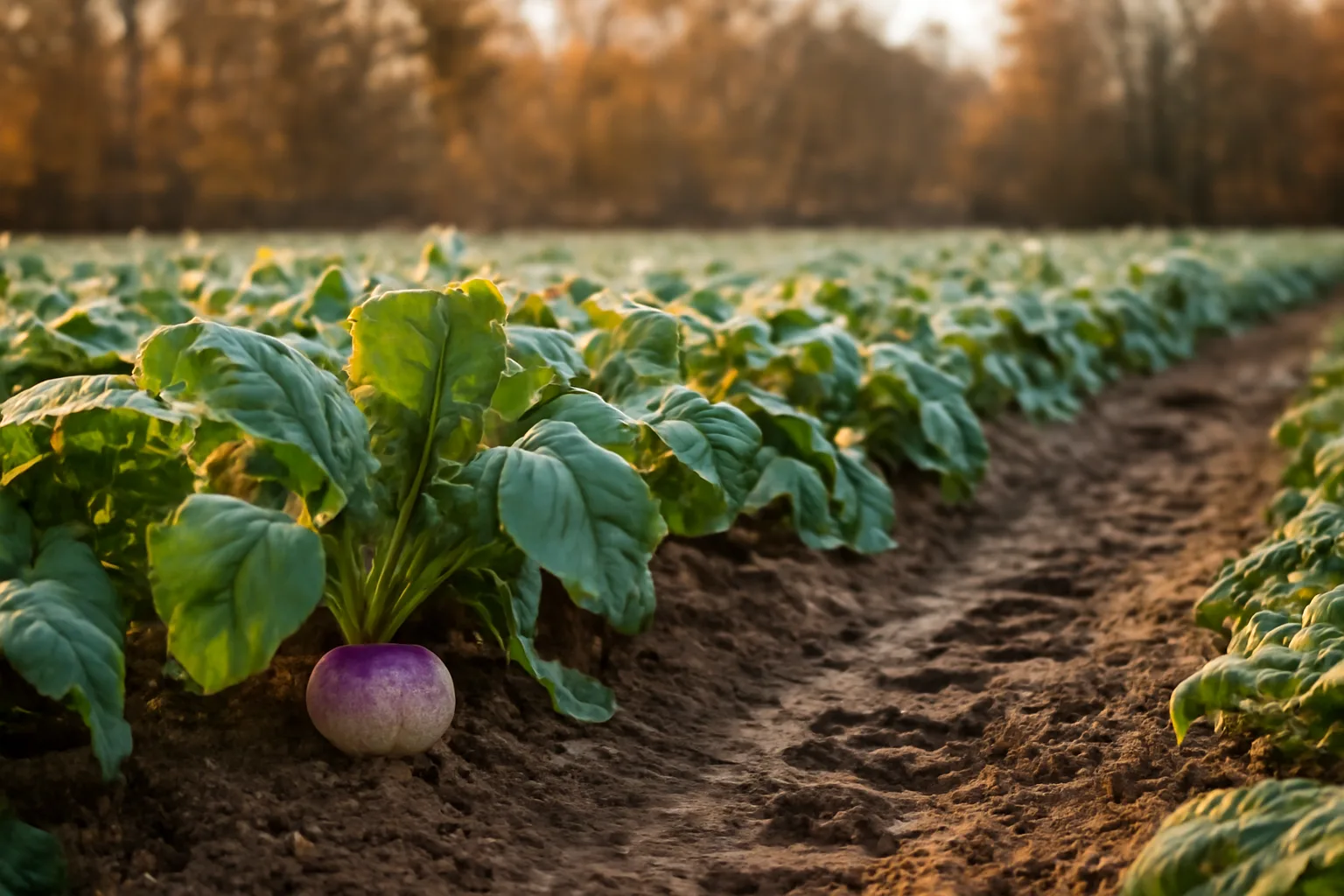
Turnips are a cheap, high-tonnage brassica that deer often ignore until after a hard frost converts starches to sugars. Plant 60 to 90 days before your first killing frost, at 2 to 5 lbs per acre, into a firm seedbed with pH 6.0 to 6.5. They're best mixed with clover or cereal grain, not planted alone.
what is a food plot, and where do turnips fit in?
A food plot is a planted patch of forage on land you own or lease, put there specifically to feed and hold deer (and other wildlife) rather than to sell as a farm crop. Plots run from a quarter-acre kill plot tucked in timber to multi-acre destination fields planted in rotation across a property. Turnips fit into the "brassica" category of plot seed, alongside forage rape, kale, radishes (tillage/daikon type), and swedes. USDA's plant guide classifies turnip (Brassica rapa) as a cool-season biennial grown for both the root and the leafy top growth, and that dual-use trait is exactly why hunters like it [1]. Deer can eat the leaves in early fall and then move to the roots later once the tops get thin or buried under snow. Compared to a straight clover or alfalfa plot, turnips are cheap per acre, grow fast, and produce a lot of raw tonnage. The tradeoff: they're often the last thing deer touch on a property with other options, and in a mild fall with soft frosts, some plots barely get browsed until December or January, if at all. That's a real risk you should plan for. Nobody can promise deer will hit a specific plot on a specific date.
when to plant turnips for deer?
| Upper Midwest / Northern tier | late July to mid-August | |
|---|---|---|
| Mid-South / Transition zone | early to late August | |
| Deep South | mid-August to mid-September | Check your local frost date against your state Extension's planting guide before locking in a date. Regional Extension offices publish specific brassica planting windows by county and elevation, and those numbers beat a national rule of thumb every time. |
Plant turnips 80 to 90 days before your area's average first hard frost, which for most whitetail range lands somewhere between late July and early September. Kentucky and Tennessee are on the earlier end of that window; the Upper Midwest and Northeast usually plant in early to mid-August; the Deep South can wait until late August or even September. The reason for the long runway is that turnip bulbs and tops need real time to bulk up before growth slows in the cold. Plant too late and you get spindly, low-tonnage plants that never fill out. Plant too early in hot, dry August soil in the South and you risk poor germination or flea beetle damage before the plant establishes. A rough planting-date table by zone: | Region | Typical planting window |
when to plant food plots for deer in general?
Cool-season plots (turnips, clover, oats, wheat, rye) go in from late summer into early fall, generally 60 to 90 days ahead of your first killing frost. Warm-season plots (soybeans, cowpeas, sorghum, corn) go in during spring after soil temps warm past roughly 55 to 60 degrees F, similar to row-crop planting dates in your area. So the calendar really splits into two seasons of work. Spring plots feed deer through summer stress (antler growth, lactation) and often get hammered hard before they ever reach maturity. Fall plots are timed to still be green and attractive during hunting season and into winter, which is why turnips, brassicas, and cereal grains dominate fall plantings. If you're planning a whole property, more than one field, stagger plot types so you've got early-season attraction (clover, beans left standing) and late-season carbs (brassicas, cereal grains) both represented. For a broader framework on staging plots across a property, see food plot whitetail and deer food plots.
when to plant oats for deer, and how does that compare to turnip timing?
Oats go in on roughly the same late-summer schedule as turnips, generally 6 to 8 weeks before first frost, which usually lands in late August through mid-September across most whitetail range. Oats germinate fast, often within a week in warm soil, so they can be planted a bit later than turnips and still produce usable forage before frost. Oats also winterkill in the Upper Midwest and northern tier once temps drop into the low teens or single digits, so in those zones oats are strictly a fall-only annual, not something that carries into spring. In the South and mid-South, oats often survive winter and keep growing into late winter and early spring. A lot of hunters plant oats and turnips in the same field, either mixed or in strips, because the combination gives you fast green groceries (oats) plus a slower-building, frost-sweetened tuber crop (turnips) in the same acre. That's a smarter play than a straight turnip monoculture for most properties.
do deer eat turnips right after planting, or only later?
Mostly later, and that catches a lot of first-time planters off guard. Deer will nibble turnip leaves some in early fall, but the heaviest use typically comes after one or more hard frosts, when cold temperatures convert starches in the plant to sugars and make both the tops and the roots noticeably sweeter and more palatable. This is a documented physiological response in brassicas generally, more than marketing language. It means a turnip plot planted in August might look almost untouched through October and then get hammered hard in December and January once other food sources thin out and a couple of freezes have hit it. That timing lines up nicely with late-season hunts, which is exactly why turnips got popular as a late-muzzleloader and late-bow strategy plant. On the flip side, if your fall stays warm and frost comes very late, or if deer have easier food sources nearby (standing corn, acorns, ag beans), a turnip plot can sit mostly ignored all season. There's no guarantee about timing here; soil, weather, deer density, and competing food all move that needle.
what soil and fertility does turnip food plot seed need?
Turnips want a pH between 6.0 and 6.5 and a firm, well-drained seedbed. Below pH 5.5, nutrient uptake drops sharply regardless of how much fertilizer you put down, which is the single most common reason a brassica plot underperforms. A soil test is the only way to know your actual number; don't guess. Lime corrects pH deficits, but it takes months to fully react in the soil, so it needs to go down well ahead of planting, not the same week. Fertilizer rates should follow soil test results rather than a flat rate off a bag label. As a rough starting point before you have a test back, many brassica guides land around 300 to 400 lbs/acre of a balanced blend like 19-19-19, or an equivalent split of nitrogen, phosphorus, and potassium, plus lime to hit that 6.0 to 6.5 target. Your soil test lab is the real authority here, not a bag label or a blog post. Lime and fertilizer recommendations are site-specific: two fields ten miles apart can need very different amounts depending on existing pH, organic matter, and past cropping history. Pull a test every plot, every season if you can swing it, and follow what comes back.
how do you plant turnip food plot seed (rate, depth, method)?
Turnip seed is tiny, roughly 150,000 to 220,000 seeds per pound depending on variety, so seeding rate and depth control matter more than with a big-seeded crop like corn or beans. Standard seeding rate for turnips alone runs 2 to 5 lbs/acre; in a brassica blend with radish or rape, turnip is often only 1 to 3 lbs/acre of the total mix. Plant no deeper than 1/4 to 1/2 inch. Broadcasting onto a firm, well-worked seedbed and then rolling or lightly dragging works fine; drilling is fine too if your drill can meter that small a seed accurately, but many drills can't go light enough without mixing the turnip seed with something bulkier (like cracked corn or pelletized lime) as a carrier to spread it evenly. A firm seedbed is worth repeating: turnip seed needs good seed-to-soil contact but can't be buried deep, so a loose, fluffy seedbed set up for corn or beans will bury the seed too deep and tank your stand. Cultipack or drive over it with a light roller after broadcasting if you can. For equipment options across broadcast spreaders, drills, and cultipackers, see food plot seed and deer food plot seed for gear-specific breakdowns.
what should you mix with turnips in a food plot?
Straight turnips are cheap and simple, but a blend almost always outperforms a monoculture for both tonnage and the length of the attraction window. Common, well-tested combos: Turnips plus cereal grain (oats, wheat, or winter rye): the grain greens up fast and gets hit early, the turnips build tonnage and get hit late. This is probably the single most common brassica blend on whitetail ground. Turnips plus clover: clover carries the plot into spring and summer after the turnips die back or get eaten out, giving you a perennial base with an annual boost layered in. Turnips plus other brassicas (radish, rape): radish roots break up compacted soil more aggressively than turnip roots, and rape tends to be leafier and more cold-hardy, so a three-way brassica blend spreads out both the plant structure and the frost tolerance. Whatever you mix, keep the turnip fraction modest (1 to 3 lbs/acre of the total blend rate) since the seed count per pound is so high that it's easy to overplant and end up with a crowded, stunted stand.
do deer eat sorghum, and how does it fit alongside turnips?
Yes. Deer browse grain sorghum (milo) leaves and will eat the grain heads, and standing sorghum also has real cover value, holding its structure through winter better than corn does in some regions. USDA's plant profile lists sorghum bicolor as used for forage, grain, and wildlife food plantings across much of the U.S. [2] Sorghum is a warm-season crop, though, planted in late spring like corn, not alongside fall turnip plantings. So the two rarely compete for the same planting window; sorghum is a summer plant, turnips are a fall plant. Where they can complement each other is in a whole-property plan: sorghum (or corn) gives you standing cover and carbs into early winter, turnips give you a late-season sugar spike after frost, and together they cover more of the calendar than either alone. Sorghum isn't a top-tier deer food compared to soybeans or corn in most preference studies; deer often use it more for cover and secondary browse than as a primary food source. If tonnage and pure preference are your goals, soybeans or corn usually win a head-to-head against sorghum on ag-capable ground.
do deer eat clover, and do they actually like it?
Yes, and by most field observation and several state Extension forage guides, clover ranks among the most consistently preferred plantable forages for whitetails, especially white clover and red clover blends. It's also one of the most forgiving perennial options: established clover stands can produce quality forage for 3 to 5 years with proper mowing and fertility upkeep, versus replanting an annual brassica or grain every single year. Clover's protein content (often 20 to 25% crude protein in good stands) makes it valuable spring through fall for antler growth and lactating does, which is a different job than what turnips do. Turnips are a late-season carbohydrate and sugar source; clover is a season-long protein source. Most well-planned properties run both, in different fields or in rotation, rather than picking one over the other. The honest caveat: clover needs decent drainage and won't tolerate standing water, and it's slower to establish than turnips or oats, often needing a full season before it's fully productive. If you want fast tonnage in year one, an annual like turnips or oats beats clover; if you want a low-maintenance perennial base, clover wins long-term.
what are deer's favorite foods, and where do turnips rank?
There's no single scientifically ranked "favorite food" list for whitetails; preference shifts by region, season, and what else is available. That said, native browse (acorns especially), soybeans, and clover consistently show up as heavily preferred, high-use foods in state wildlife agency and university forage studies, with brassicas like turnips typically ranking as a secondary, late-season preference rather than a top choice early in the season. Acorns in particular are often the single most preferred fall food where oaks are present; deer will bypass planted plots to hit a good acorn drop most years. That's not a knock on food plots, it's just reality. It's part of why plot planners recommend mapping your property's natural food (oaks, browse) before deciding what and where to plant. Turnips earn their spot not because deer prefer them over acorns or beans in October, but because they hold quality forage later into winter than almost anything else you can plant, after frost sweetens them and other food sources are gone. That's a timing advantage, not a raw preference advantage.
do deer like honey, or is that a myth?
There's no credible wildlife research showing deer seek out honey as a food source, and it's not something state agencies or Extension services list among deer forages. Deer are herbivores built around browse, forbs, mast, and grass; honey isn't part of their natural diet and isn't a food plot input. This question shows up online mostly through confusion with mineral or attractant products that sometimes use "honey" scented additives, or through mixing up deer with bears, which genuinely do raid hives for honey and brood. If you're building a plot plan, you can skip honey entirely; it has no place in the seed bag or the fertility discussion. Worth noting: many states restrict or ban baiting and supplemental feeding for deer, including sugary attractants, separate from food plot planting itself. Check your state wildlife agency's baiting and feeding regulations before adding any attractant product to a hunting setup, since rules vary widely and change year to year.
how do turnips compare to other common food plot options?
| Turnip | Annual brassica | 2-5 lbs/acre alone | Late summer/fall | Late-season carbs/sugar after frost | |
|---|---|---|---|---|---|
| Oats | Annual cereal grain | 60-100 lbs/acre | Late summer/fall | Fast early-fall green forage | |
| Clover | Perennial legume | 6-10 lbs/acre | Spring or late summer | Season-long protein, multi-year stand | |
| Soybeans | Annual legume | 45-60 lbs/acre (drilled) | Late spring | Summer forage, standing beans into fall/winter | |
| Sorghum | Annual grain | varies by variety | Late spring | Cover plus secondary grain/browse | No single plant does everything, which is the actual argument for diversifying a property's plots rather than betting on one seed type. Turnips are one tool, and a good one for the last six weeks of the season, but they shouldn't be the only tool in the shed. If you're trying to figure out which mix fits your specific soil, region, and hunting timeline, a soil test in hand is the best starting point; a $99 Custom Food Plot Plan can turn that test and your property details into a specific seed and fertility plan at /plot-plan-builder, though your soil lab's own lime and fertilizer numbers should always be the final word on what actually goes down. |
Here's a quick side-by-side on cost, timing, and role, using typical ranges rather than any one brand's pricing since seed costs shift year to year. | Plant | Type | Typical seeding rate | Planting season | Main role |
what mistakes cause turnip plots to fail?
The most common failure is planting too deep. Turnip seed is tiny, and a half inch is already pushing it; an inch or more and germination drops hard. Use a light touch and firm the seedbed rather than burying it deep. Second most common: skipping the soil test and guessing on lime. If pH sits below 5.5, brassicas struggle no matter how much fertilizer goes down, and lime correction ahead of planting matters more than any single fertilizer decision. Third: planting too late for the frost window, or too early into hot, dry August soil where flea beetles and drought stress take out young seedlings before they establish. Match your date to your region's actual Extension planting window, not a generic bag-label date meant for the whole country. Fourth: expecting deer to hit the plot immediately. If your plot sits quiet in October and November, that's often normal turnip behavior, not a failed plot. Give it through a couple hard frosts before judging it.
Frequently asked questions
When should I plant turnips for a deer food plot?
Plant turnips 80 to 90 days before your area's average first hard frost, generally late July through early September depending on region. Northern tier states plant earlier, the Deep South later. Check your state Extension's specific planting calendar since frost dates vary a lot by latitude and elevation.
How much turnip seed do I need per acre?
Plant 2 to 5 lbs/acre if turnips are the only plant in the mix. In a blend with radish, rape, or cereal grain, cut turnip down to 1 to 3 lbs/acre of the total seeding rate, since turnip seed count per pound is very high and overplanting crowds the stand.
Do deer eat turnip greens or just the roots?
Both, but usually at different times. Deer often browse the leafy tops some in early fall, then shift to hitting both tops and roots hard after a few hard frosts convert plant starches to sugars, which is why turnip plots are known as a late-season play.
Do deer eat sorghum?
Yes, deer browse sorghum leaves and eat the grain heads, and USDA lists sorghum among plants used for wildlife plantings. It's a warm-season crop planted in spring, not a fall brassica-timing plant, and it's generally viewed as secondary browse compared to soybeans or corn.
Do deer like clover, and is it better than turnips?
Deer consistently favor clover as a season-long protein source, and it's not really a competition with turnips since they do different jobs. Clover feeds deer spring through fall for years once established; turnips are an annual, late-season sugar and carb source after frost. Most solid plans include both.
When should I plant oats for deer?
Plant oats 6 to 8 weeks before first frost, generally late summer into early fall, similar to the turnip window but with a bit more flexibility since oats germinate faster. In the Upper Midwest and northern tier, oats winterkill; further south they often survive into late winter.
When is the best overall time to plant deer food plots?
Cool-season plots (turnips, clover, oats, wheat) go in late summer to early fall, 60 to 90 days before first frost. Warm-season plots (beans, corn, sorghum) go in spring after soil warms. Most properties run both seasons of plots to cover the full year.
What exactly is a food plot?
A food plot is a planted patch of forage, usually a half-acre to several acres, established specifically to feed and attract deer or other wildlife on hunting land, distinct from a commercial farm crop grown to sell. Plots range from small hidden kill plots to large destination fields.
What is a deer's favorite food?
There's no single ranked favorite; it shifts by region and season. Acorns are often the most preferred fall food where oaks are present, with soybeans and clover also ranking as heavily used, high-preference plantable forages. Brassicas like turnips tend to rank lower in preference but higher in late-season timing value.
Do deer like honey?
No credible wildlife research shows deer seek out honey; it isn't part of their natural browse-and-forb diet and isn't used in food plot planning. The idea likely gets confused with scented attractant products or with bears, which do actually raid hives for honey.
What soil pH do turnips need for a food plot?
Aim for pH 6.0 to 6.5. Below pH 5.5, nutrient uptake drops sharply even with heavy fertilizer use, so lime correction based on an actual soil test is the first and most important step, well before planting day since lime takes months to fully react.
Can I plant turnips alone, or should I mix them with something?
You can plant them alone, but a mix with oats, wheat, or clover usually performs better across the season. Straight turnips leave a long quiet stretch before frost hits; blending in a cereal grain gives you fast early green-up while the turnips build tonnage for later.
Why isn't anything eating my turnip plot?
This is normal turnip behavior more often than it's a failed plot. Deer often ignore turnips until after one or more hard frosts sweeten the leaves and roots. If your fall stays warm or deer have easier food nearby, expect little activity until real cold sets in, sometimes not until December or January.
Sources
- USDA NRCS Plant Guide, Turnip (Brassica rapa): Turnip is a cool-season biennial brassica grown for both root and leafy top growth
- USDA NRCS Plant Fact Sheet, Sorghum bicolor: Sorghum is used for forage, grain, and wildlife food plantings across much of the U.S.
- Oklahoma State University Extension, Soil pH and Liming for Agronomic Crops (PSS-2229): Lime applications correct soil pH deficits and should be made well ahead of planting since lime reacts slowly in soil
- University of Georgia Extension, Deer Food Plots (Circular 1030): Regional brassica and cereal grain planting windows and seeding rate guidance for wildlife food plots
- National Agricultural Law Center, State Hunting Baiting and Feeding Regulations summary: States vary widely in restrictions on baiting and supplemental feeding of deer, separate from food plot planting