Last updated 2026-07-25
TL;DR
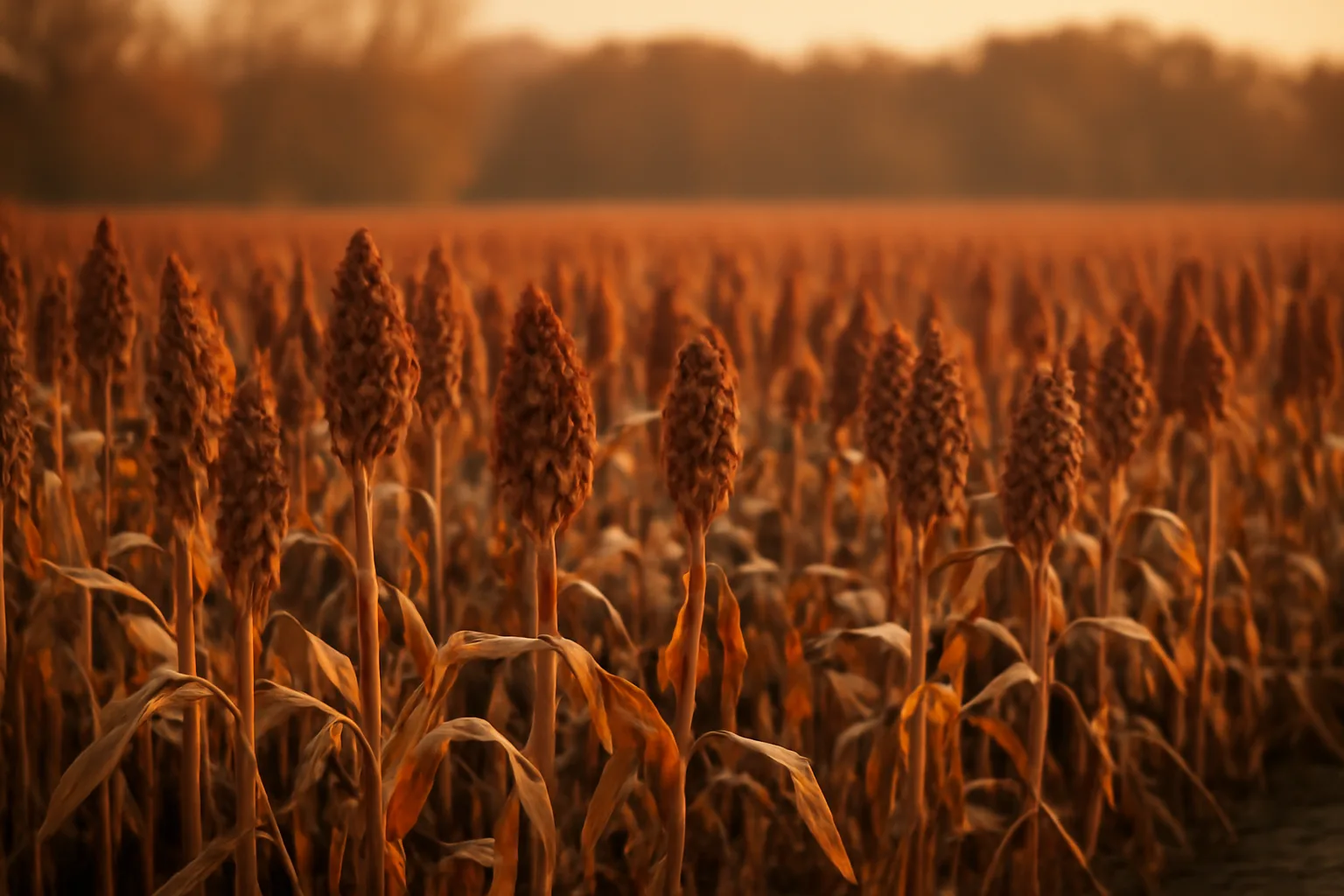
Sorghum (grain sorghum, also called milo) is a warm-season food plot crop planted after soil hits 60-65°F, usually late May through June depending on zone. Deer eat the standing grain heads through fall and winter, and it holds up better than corn on drought-prone or lower-fertility ground. It works best as part of a mix, not a standalone plot.
do deer eat sorghum?
Yes. Deer eat sorghum grain heads readily, especially from late fall through winter once other food sources thin out. Whitetail research and extension wildlife programs list grain sorghum (milo) as a standard fall/winter food plot option because the standing seed heads stay available above snow and provide a dense carbohydrate source similar to corn [1]. Deer don't usually hit sorghum hard in August and September the way they do soybeans or clover. The real draw starts once the grain matures and dries down, generally October into winter. Turkey, quail, and dove also use sorghum heavily, so a sorghum plot rarely serves whitetail alone. That's fine. A multi-species plot pulls its weight all winter. One practical note: sorghum contains compounds (dhurrin) that can produce cyanide-related toxins under stress conditions like frost or drought, mostly a concern for cattle grazing fresh sorghum forage, not for deer eating mature dry grain. Extension guidance on sorghum-sudangrass hybrids for livestock forage flags this risk specifically for green, stressed forage, not dried grain heads [2]. If you're growing grain sorghum for a fall food plot, this isn't the main worry, but it's worth knowing if you're mixing sorghum-sudangrass into a summer forage blend.
what is a food plot?
A food plot is a planted area, usually somewhere between a quarter acre and a few acres, seeded specifically to attract and feed deer or other wildlife on hunting land. It's not a farm field in the traditional sense. The goal is nutrition and attraction, not yield per acre for sale. State wildlife agencies generally treat food plots as a land management tool distinct from baiting, since the crop is planted and grown in place rather than distributed loose on the ground. That distinction matters legally. Many states regulate or ban baiting (placing feed, grain piles, or minerals to attract deer) but allow food plots as normal agricultural practice. Michigan, for example, defines and restricts baiting and feeding of deer under its Wildlife Conservation Order, separate from planted crop practices [3]. Rules vary by state, so check your state wildlife agency's specific baiting and feeding regulations before assuming a food plot practice is legal everywhere. Most hunters build food plots around a rotation: a warm-season plot (soybeans, sorghum, cowpeas) for spring/summer nutrition, and a cool-season plot (brassicas, cereal grains, clover) for fall/winter. Sorghum fits the warm-season, standing-grain-through-winter role. For a broader primer on plot types and how they fit together, see food plot whitetail and deer food plots.
when to plant food plots for deer?
| Deep South (Zone 8-9) | mid-April to early June | |
|---|---|---|
| Mid-South / transition (Zone 7) | late April to mid-June | |
| Midwest / Upper South (Zone 5-6) | mid-May to late June | |
| Northern tier (Zone 3-4) | late May to mid-June | Soil temperature matters more than the calendar date. Grain sorghum germinates poorly below 60°F and can rot in cold, wet soil. Land-grant extension guidance for grain sorghum production recommends waiting until soil temperature reaches at least 60°F at planting depth before drilling seed [4]. A $10 soil thermometer beats guessing off a calendar. |
Planting windows split into two seasons: warm-season plots go in after your last frost date once soil temps hit roughly 60-65°F, and cool-season plots go in 60 to 90 days before your first fall frost. Sorghum falls in the warm-season camp. There's no single national planting date because the U.S. spans multiple USDA Plant Hardiness Zones, from Zone 3 in northern Minnesota to Zone 9 in the Deep South. A hunter in southern Georgia can plant warm-season sorghum in April. A hunter in northern Wisconsin waits until early June. General windows, by region: | Region | Sorghum planting window |
when to plant oats for deer?
Oats are a cool-season cereal grain, planted 6 to 8 weeks before your first fall frost so they establish before the ground cools down hard. In most of the whitetail's range that lands somewhere between late August and mid-September, with southern states able to push into October. Oats germinate fast, often within 5 to 7 days in warm soil, and deer hit young oat shoots hard in September and October. They're not usually winter-hardy the way winter wheat or cereal rye is, so in cold zones oats die back after a hard freeze. That's actually useful: dying oats stay palatable and often sweeter as starches convert to sugar under cold stress, similar to what happens with brassicas. Oats pair well in a mix with brassicas and clover for a fall plot, and pair well behind a summer sorghum or soybean plot in rotation. If you want oats to survive into a true winter food source, blend in winter rye or wheat, both of which tolerate hard freezes far better.
when to plant turnips for deer?
Turnips go in 60 to 90 days before your average first fall frost, which lands most of the whitetail range somewhere between late July and early September. Plant too early and heat stress or weed pressure hurts stands. Plant too late and bulbs don't size up before cold shuts down growth. Turnips need that long runway because deer often ignore the leafy tops until a hard frost or two sweetens the plant by converting starches to sugars, a well-documented response in brassica crops. Many food plot managers see little grazing pressure on turnip tops in September, then heavy use in November and December once frost hits repeatedly. Seeding rate for turnips alone runs 4 to 6 lbs per acre, broadcast into a well-prepared, weed-free seedbed no deeper than a half inch, since turnip seed is tiny and doesn't tolerate deep planting. Turnips are commonly blended with radish, rape, and cereal grains for a fall brassica mix rather than planted as a monocrop.
do deer eat clover?
Yes, and it's usually rated among the top preferred food plot forages available. Clover (both white clover varieties like Ladino and red clover) gets used heavily spring through fall wherever it's planted, and its high crude protein content, often in the 20-30% range depending on variety and maturity, makes it valuable during antler growth and lactation [5]. Clover's biggest advantage is duration. A well-maintained perennial clover stand can produce for 3 to 5 years off one planting, versus an annual replant every year for sorghum, oats, or brassicas. The tradeoff is clover needs decent soil fertility and pH (most extension guidance recommends a soil pH of 6.0 to 6.5 for clover establishment) and it doesn't hold up in deep shade or waterlogged ground. Clover doesn't compete well with grain crops for winter tonnage though. A dormant clover stand under snow doesn't offer much compared to a standing sorghum or corn field. That's the case for running clover as your spring/summer perennial anchor and sorghum, corn, or brassicas as the fall/winter carbohydrate plot.
do deer like clover more than sorghum?
It depends entirely on the season you're asking about. Clover wins spring through early fall as a preferred, high-protein forage. Sorghum wins late fall through winter as a standing energy source once clover growth slows and grain heads mature. Think of it less as competition and more as a relay. Deer key in on tender, high-protein browse in spring and summer when they need it most for growth and lactation. By late fall, energy (carbohydrates and fat reserves for winter) becomes the priority, and standing grain crops like sorghum, corn, and soybeans deliver that far better than a dormant clover stand. A property with only clover leaves a winter gap. A property with only sorghum leaves a spring/summer gap. Most solid plot plans run both, in separate fields or in a rotation, which is the whole idea behind pairing a perennial clover plot with an annual grain plot elsewhere on the property. For seed selection across both categories, see deer food plot seed and food plot seed.
what are deer's favorite foods?
There's no single universal answer because deer preference shifts by season, region, and what's locally available, but research and extension data point to a consistent short list: acorns, soybeans, clover, and other legumes rank at or near the top almost everywhere whitetail are studied. Acorns are often the single most preferred natural food where oaks are present, since they deliver high fat content deer need heading into winter; white oak acorns in particular are lower in tannins and more palatable than red oak acorns [6]. Among planted crops, soybeans and clover consistently show up as top-preference forages in browse studies, largely because of protein content during the growing season. Corn and grain sorghum rank high for energy value in fall and winter but lower on a pure preference scale during the growing season since deer don't browse the leaves much. Brassicas (turnips, radish, rape) rank low in late summer and jump sharply in preference after frost. Preference is really a moving target tied to nutritional need at that point in the year, not a fixed hierarchy.
do deer like honey?
There's no wildlife research or extension data showing deer specifically seek out honey, and it's not a recognized food plot or attractant strategy in any state wildlife agency guidance. Deer are herbivores and don't forage for honey the way bears do. Some commercial deer attractant products use sweeteners, molasses, or sugar-based scents marketed as appealing to deer, and there's anecdotal hunter reporting of deer licking sap or sugary substances. But that's a different thing from a documented dietary preference for honey specifically. If you're looking to add sweetness that actually shows up in deer diet studies, frost-sweetened brassicas and high-sugar forage varieties have real data behind them; honey doesn't.
how do you plant a sorghum food plot? soil, seed rate, and equipment
Grain sorghum wants a firm, well-drained seedbed, a soil pH around 6.0 to 6.5, and planting depth of 1 to 1.5 inches, deeper in sandy or dry soil, shallower in heavier clay [4]. Get a soil test before you plant, not after. Sorghum responds to nitrogen, and without a test you're guessing at rates that could be wasted money or wasted growth. Seeding rates for food plot grain sorghum typically run 6 to 10 lbs per acre when drilled, or up to 12 lbs per acre broadcast, since broadcast seeding has lower emergence than a drill. Row spacing on drilled sorghum commonly runs 15 to 30 inches depending on your equipment; food plot growers without row equipment often broadcast and cultipack instead, which works fine for smaller plots. A basic sorghum plot setup: 1. Soil test 60-90 days ahead, apply lime if pH is low (lime needs months to adjust soil chemistry). 2. Disk or till to a clean, firm seedbed once soil temp hits 60°F. 3. Broadcast or drill seed at 6-10 lbs/acre, 1-1.5 inch depth. 4. Cultipack or drag to ensure seed-to-soil contact. 5. Apply fertilizer per your soil test recommendations; your soil test lab is the authority on exact lime and fertilizer rates for your specific field, not a generic blog number. Sorghum tolerates drought and poor soil better than corn, which is the real reason food plotters reach for it on rougher ground. It won't out-yield corn on good dirt with full inputs, but on a sandy ridge or a low-fertility field where corn struggles, sorghum often still stands and produces grain.
sorghum vs corn vs soybeans: which food plot crop fits your ground?
| Crop | Best season of use | Drought tolerance | Soil fertility need | Deer preference timing | |
|---|---|---|---|---|---|
| Grain sorghum | Fall/winter (standing grain) | High | Moderate | Low in summer, high in winter | |
| Corn | Fall/winter (standing grain) | Low-moderate | High | Low in summer, high in winter | |
| Soybeans | Spring/summer (forage + fall bean) | Moderate | Moderate-high | High spring-fall | |
| Clover | Spring-fall (perennial forage) | Moderate | Moderate | High spring-fall | Corn generally out-yields sorghum on fertile ground with adequate rain or irrigation, but it costs more in fertilizer and struggles on poor or droughty soils. Sorghum is the fallback crop for exactly those tougher sites, plus it tends to have fewer disease and pest issues than corn in a lot of regions. Soybeans and clover cover the growing-season nutrition gap that sorghum and corn don't fill well. If you've only got room for one plot, most experienced plot managers would rather run soybeans or clover first, since spring and summer nutrition drives antler growth and fawn health, and add a grain plot (corn or sorghum) as a second field once resources allow. For a full seed and species comparison across the board, domain food plot seed and deer for food cover other crop options worth stacking against sorghum on your specific property. |
how much does a sorghum food plot cost to plant?
Rough per-acre costs run something like this for a basic sorghum plot: seed at 6-10 lbs/acre generally costs $1-3/lb for treated grain sorghum seed depending on variety and source, putting seed cost around $10-30/acre. Add lime if your soil test calls for it (lime often runs $30-50/ton delivered and spread, with typical recommendations of 1-2 tons/acre on acidic ground), fertilizer per soil test (commonly another $30-80/acre depending on N-P-K needs), and fuel/equipment time. All-in, a modest food plot sorghum planting often lands somewhere in the $75-150/acre range once lime, fertilizer, and seed are accounted for, though this swings widely based on how far off your soil pH and fertility already are. A field that already sits at the right pH and fertility level costs a lot less than one needing a full lime and fertilizer correction. This is where a soil test earns its keep. Guessing at fertilizer without a test risks either underfeeding the crop (poor yield) or overspending on nutrients the soil doesn't need. If you want a structured starting point that turns your soil test and acreage into an actual planting plan rather than a guess, the $99 one-time Custom Food Plot Plan builds out species, rates, and timing for your specific property; it's general guidance built from your inputs, not a substitute for your soil test lab's site-specific lime and fertilizer recommendations.
common mistakes with sorghum food plots
Planting too early is the number one mistake. Cold, wet soil below 60°F causes poor germination and seedling rot in grain sorghum, and a lot of hunters plant on a fixed calendar date instead of checking actual soil temperature [4]. Skipping the soil test is the second most common mistake. Sorghum will grow in mediocre soil, which is part of its appeal, but it still responds to correct pH and nitrogen. A soil test costs $10-20 through most state extension labs and tells you exactly what your specific field needs, which beats blanket fertilizer guessing every time. Planting sorghum alone and expecting it to carry the whole property is the third mistake. Sorghum shines in fall and winter. It does very little for spring and summer nutrition. Pairing it with a clover or soybean plot elsewhere, or in the same field as a mix, covers the calendar gap sorghum alone leaves open.
Frequently asked questions
do deer eat sorghum?
Yes. Deer eat sorghum grain heads, especially in late fall and winter once the grain matures and dries down. Turkey, quail, and dove also use sorghum plots heavily. Deer don't browse sorghum much in summer since the plant offers little until the grain heads form.
do deer like clover?
Yes, clover is one of the most preferred food plot forages available, largely due to its high crude protein content (often 20-30%) during spring, summer, and fall growth. It's less useful in deep winter once growth goes dormant, which is why it's usually paired with a fall grain or brassica plot.
when should I plant food plots for deer?
Warm-season plots (sorghum, soybeans) go in after your last frost once soil hits 60-65°F, often April to June depending on your USDA hardiness zone. Cool-season plots (clover, brassicas, oats) go in 60-90 days before your first fall frost, typically late July through September.
when do you plant oats for deer food plots?
Plant oats 6-8 weeks before your area's first fall frost, generally late August through mid-September in most whitetail range, later in the Deep South. Oats germinate quickly and deer graze young shoots hard in fall, though oats usually winterkill in cold climates unless blended with winter rye or wheat.
when should turnips be planted for deer?
Plant turnips 60-90 days before your first expected fall frost, typically late July to early September. Deer often ignore turnip tops until a hard frost sweetens the plant, so the long runway lets bulbs size up before that frost-driven feeding window opens in November and December.
what exactly is a food plot?
A food plot is a planted area, usually a quarter acre to several acres, seeded specifically to feed and attract deer or other wildlife on hunting land. It's treated as standard agriculture by most state wildlife agencies and is legally distinct from baiting, though baiting and feeding rules vary significantly by state.
what do deer prefer to eat most?
Acorns (especially white oak) rank among the top preferred natural foods for fat content. Among planted crops, soybeans and clover consistently rank highest in preference studies due to protein content. Corn and sorghum rank lower on pure preference but high on winter energy value once other food thins out.
do deer eat honey?
There's no wildlife research or state agency guidance showing deer specifically seek out honey; it isn't a documented dietary preference. Deer are herbivores, unlike bears. Sugar-based commercial attractants exist, but honey specifically isn't backed by any deer diet study.
is sorghum better than corn for a food plot?
Neither is universally better. Corn out-yields sorghum on fertile, well-watered ground but needs more fertilizer and struggles in drought. Sorghum tolerates poor soil and dry conditions better, making it the stronger choice on sandy, low-fertility, or drought-prone fields where corn often underperforms.
what is the seeding rate for grain sorghum in a food plot?
Drilled grain sorghum runs 6-10 lbs per acre; broadcast seeding needs up to 12 lbs per acre since emergence rates are lower without a drill. Plant 1-1.5 inches deep into a firm, well-drained seedbed after soil temperature reaches 60°F.
can sorghum cause problems for deer to eat?
Sorghum can produce cyanide-related compounds (dhurrin) under stress like frost or drought, but this risk is documented mainly for fresh, green forage grazed by livestock, not for deer eating mature, dry grain heads from a standing food plot. Grain sorghum food plots are a standard, widely used practice.
how long does it take sorghum to mature for a fall food plot?
Most grain sorghum varieties reach maturity in roughly 90-120 days from planting depending on variety and heat units, per land-grant extension production guides. Planting in late May to June puts grain maturity right around September through October in most regions, timed well for fall and winter deer use.
should I plant sorghum alone or in a mix?
A mix is usually the better call. Sorghum alone provides almost nothing in spring and summer since deer don't browse the leaves much before grain forms. Pairing sorghum with soybeans, cowpeas, or a separate clover field covers the growing-season nutrition gap sorghum leaves open on its own.
Sources
- Mississippi State University Extension, Establishing and Maintaining Wildlife Food Plots (Publication 2111): Grain sorghum (milo) is a recognized standard fall/winter food plot crop for deer
- University of Wisconsin-Madison Extension, Prussic Acid Poisoning of Livestock (A3620): Sorghum-sudangrass hybrids carry prussic acid (cyanide) risk in fresh forage under stress conditions like frost or drought
- Michigan Department of Natural Resources, Wildlife Conservation Order, Chapter II (Deer Baiting and Feeding): State wildlife agencies regulate baiting and feeding separately from food plot planting, and rules vary by state
- Kansas State University Extension, Grain Sorghum Production Handbook (C-687): Grain sorghum should be planted once soil temperature reaches at least 60°F at planting depth
- University of Georgia Extension, Clover for Wildlife (Bulletin 1347): Clover forage commonly provides crude protein in the 20-30% range depending on variety and maturity
- USDA Forest Service, Fire Effects Information System, Quercus alba (white oak) species review: White oak acorns are lower in tannins and more palatable to deer than red oak acorns