Last updated 2026-07-25
TL;DR
Plant clover in a firm, weed-free seedbed with pH near 6.0-6.5, broadcast 6-9 lbs per acre of a ladino/red clover mix at 1/4 inch depth, and time it to spring (April-May) or late summer (August) depending on your zone. Deer favor clover over most other forages because it's high in protein and available almost all season long.
What is a food plot, exactly?
A food plot is a planted area, usually somewhere between a quarter acre and several acres, seeded with forage crops to attract and hold deer or improve their nutrition on a property. It's not a garden and it's not a lawn. Most plots use annual grains like oats or brassicas, perennials like clover and alfalfa, or a mix of both depending on the season and goal. Landowners plant food plots for a few different reasons: to supplement natural browse during stress periods (late summer, winter), to pull deer onto a property or into bow range, or to just grow healthier deer with better antler and body development. The USDA's NRCS lists food plots as a recognized wildlife habitat practice, Practice Standard 645, Upland Wildlife Habitat Management, and that standard can qualify for cost-share support in some states through NRCS conservation programs [1]. Clover plots specifically fall into the perennial category, meaning you plant once and get two to four years (sometimes five) of production if you maintain them. That's different from an oat or brassica plot, which you replant every year.
Do deer like clover, and do they actually eat it?
Yes. Clover is one of the most consistently preferred forages in whitetail diet studies and in practical food plot experience. It's soft, high in crude protein (often 25-30% in ladino clover under good management), and it regrows fast after grazing, which matters because deer hit it hard and repeatedly. Deer will graze clover from the moment it emerges in spring right through fall, and in mild-winter zones it can stay green into December or later. University extension forage programs across the whitetail's range list ladino and white clover among the top perennial food plot legumes precisely because of that long grazing window and consistent protein content [2]. The reason clover outperforms a lot of competitors isn't magic, it's biology. Legumes fix nitrogen and keep leaf tissue tender and digestible, unlike mature grasses or woody browse. Combine that with high tonnage per acre and you get a plot that gets hammered from spring green-up through the rut.
What are deer's favorite foods, and where does clover rank?
There's no single universal answer because preference shifts by season, region, and what's available naturally. That said, several long-running studies and extension surveys put clover, soybeans, and acorns near the top of preferred whitetail foods, with clover standing out because it's available for months rather than a few weeks like mast drops. Research summarized by the Noble Research Institute ranks legumes (clover, alfalfa, soybeans) and standing corn or soybeans as top picks, with brassicas and cereal grains rated lower in summer but higher after a hard frost when sugars in brassica leaves spike [3]. Acorns are a wildcard: deer will drop everything for a good white oak acorn crop, but that's not something you plant and control. So if you're asking what to plant if you can only plant one thing, clover is the safe, defensible answer for most of the U.S. It's not flashy, but it works nearly year-round and it's forgiving of a mediocre planting job.
When should you plant food plots for deer in general?
| Northern (zone 3-4, e.g. MN, WI, ME) | Late April - May | Mid-July - August | |
|---|---|---|---|
| Transition (zone 5-6, e.g. IA, PA, KY) | Late April - early June | Mid-August - early Sept | |
| Southern (zone 7-8, e.g. TX, GA, AL) | March - May | September - October | If you want plot-specific dates dialed to your exact county and soil test, that's the kind of thing a Custom Food Plot Plan is built for. It's a $99 one-time plan that gives you seed picks and a calendar for your ground instead of a generic national chart. |
Timing depends on whether you're planting a perennial (clover, alfalfa, chicory) or an annual (oats, brassicas, sorghum), and it depends on your zone. As a rule of thumb, perennials go in spring or late summer, and annuals go in either spring (for summer/fall forage) or late summer (for fall/winter forage, especially brassicas and cereal grains). Extension agronomy programs in the Southeast generally recommend cool-season legumes and grains from late August through October, and warm-season plots (soybeans, cowpeas, sorghum types) from April through June [4]. In northern states, that whole calendar shifts about a month earlier on both ends because of shorter growing seasons and earlier frost. Here's a rough national breakdown: | Region | Spring planting window | Fall planting window |
When is the best time to plant clover specifically?
Clover has two good windows: spring (as soon as soil temps hit the mid-50s and frost risk has passed) or late summer to early fall, roughly six to eight weeks before your first killing frost. Most extension agronomists lean toward the late-summer window because weed pressure is lower and clover seedlings don't have to compete with a flush of spring annual weeds. Cooperative extension forage guides commonly recommend planting ladino or white clover in early spring (March-April) or late summer (August-September) depending on region, with fall planting generally producing a cleaner stand with less crabgrass and foxtail competition. If you're frost-seeding (broadcasting clover seed onto frozen or freeze-thaw ground in late winter), that's a legitimate cheap-and-easy method too, and it works because freeze-thaw cycles pull the seed into the soil naturally. It's popular in the upper Midwest and Northeast where late winter thaws are reliable.
How do you actually plant clover step by step?
Start with a soil test. This isn't optional if you want a stand that lasts three or four years instead of dying out in one. Clover wants a pH between 6.0 and 6.5; below 5.5 and nitrogen-fixing nodulation on the roots basically shuts down, so your "free nitrogen" advantage disappears and the plant struggles. Step 1: Kill or till existing vegetation. A burndown herbicide (glyphosate) two to three weeks ahead of planting, or conventional tillage, gets you a clean seedbed. Clover seed is tiny and won't compete with existing sod or heavy weed cover. Step 2: Lime according to your soil test results, not a guess. Lime takes months to fully react in the soil, so if your test calls for 2 tons per acre, get it down as early as you can before planting, ideally the prior fall. Step 3: Broadcast seed at 6-9 lbs per acre for a ladino/white clover blend, or 8-12 lbs per acre for red clover, directly on a firm, fine seedbed. Depth matters more than people think: clover wants to sit at about 1/4 inch, no deeper. Too deep and it won't emerge at all. Step 4: Cultipack or drag lightly to press seed into good soil contact. A cultipacker (or even driving over it with an ATV and a section of chain-link fence dragged behind) works fine. Step 5: Fertilize per your soil test, typically light nitrogen at establishment (clover makes its own once nodulated) but real attention to phosphorus and potassium, which clover pulls hard from the soil. Step 6: Inoculate the seed if it isn't pre-inoculated. Clover needs the right rhizobium bacteria present to fix nitrogen, and if your field has never grown clover, uninoculated seed can genuinely fail to thrive even with everything else right. Your soil test lab is the real authority here on exact lime and fertilizer rates for your specific field. Treat any generic plan (including this one) as a starting point, not a substitute for what your test says.
What equipment do you actually need?
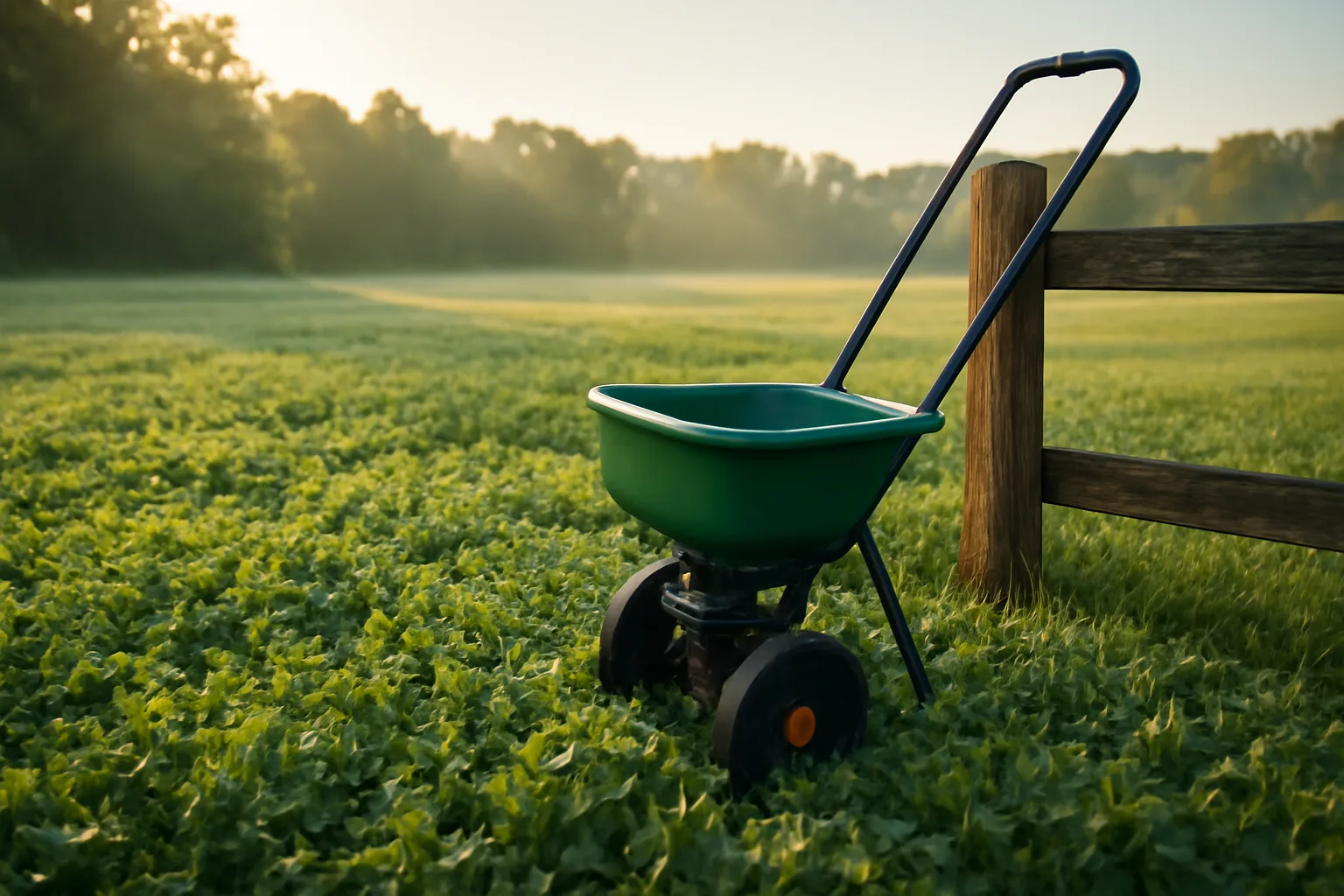
You don't need much. A hand-crank broadcast spreader (or ATV-mounted spreader) handles seeding on plots under 2-3 acres just fine. For seedbed prep, a disc harrow or tiller if you're starting from sod, and a cultipacker or drag for firming the seedbed after seeding. A lot of small-plot hunters skip the tractor entirely and use a UTV with a tow-behind plot disc and a broadcast spreader, which handles half-acre to two-acre plots without much trouble. If you're managing five-plus acres regularly, a compact tractor starts paying for itself in time saved. One mistake people make: covering clover seed too deep with a drill set for soybeans or corn. If you're using a seed drill, make sure it has a small-seed box or you dial the depth way back, because clover seed is roughly the size of a pinhead.
When should you plant oats for deer, and how do they fit with clover?
Oats go in during late summer to early fall for a fall/winter forage plot, typically August through mid-September depending on zone, so deer have fresh growth through the cooler months when clover growth slows. Oats are a classic clover companion or nurse crop because they germinate fast, giving early cover and grazing while the slower clover seedlings establish underneath. Extension forage programs commonly recommend oats planted alongside clover in fall blends specifically because oats provide quick tonnage in the first 60 days while clover takes hold. Some hunters plant a straight oat plot separate from clover, timed for archery season openers, since oats stay palatable and sweet (deer favor them especially after a light frost converts starches to sugars) right through early winter in most zones. If you want oats as a nurse crop with clover, cut the oat seeding rate to about half of a straight oat planting (roughly 1-1.5 bushels per acre instead of 2-3) so they don't shade out the clover seedlings.
When should you plant turnips for deer, and are they worth it?
Turnips go in mid-to-late summer, generally 90 to 100 days before your average first frost, since they need that window to bulb up and reach peak tonnage before deer start hitting them hard post-frost. In most of the Midwest and mid-South that lands somewhere between late July and mid-August. Brassicas including turnips get more attractive after frost because cold triggers the plant to convert starches to sugars, a documented physiological response in brassica species tied to freezing stress and cold acclimation [5]. That's why turnip plots often look ignored in September and get hammered in November and December. Turnips work well in rotation with clover rather than mixed into the same planting, since turnips are annuals that need full tillage and different fertility (they're heavier nitrogen feeders) than an established perennial clover stand. A common strategy is a dedicated turnip/brassica plot for late season, with clover in a separate perennial plot for spring and summer.
Do deer eat sorghum, and does it belong in a clover rotation?
Yes, deer will eat sorghum, particularly grain sorghum heads and the tender regrowth after grazing, though it's generally used more as a summer annual for tonnage, cover, and as a component of warm-season blends than as a primary deer attractant on its own. It's more heat and drought tolerant than corn, which makes it a reasonable warm-season option in the southern half of the country. Sorghum isn't typically planted alongside clover in the same plot; it's a separate warm-season annual choice, usually planted April through June once soil temps are reliably above 65 degrees F. Some food plotters use it in a summer blend with cowpeas or soybeans for tonnage and screening cover, then follow it in fall with a cool-season clover or brassica planting on the same ground. If your main goal is late-season browse and consistent spring/summer forage, clover beats sorghum as your anchor species. Sorghum has its place as a summer filler or a screening/cover crop, not as your primary food plot investment.
Do deer like honey, and does that matter for food plots?
This one gets searched a lot, and the honest answer is no, in the sense that matters for food plots. Deer aren't eating jars of honey in the woods, and there's no legitimate food plot or attractant use for honey as a planted forage since it's not a crop, it's a bee product. Deer are herbivores; they browse plants, not honey. Some commercial deer attractant sprays include sweet or sugary scent components (molasses-based products are common), and hunters sometimes ask about honey in that same context, wondering if a home-mixed sweet scent works as a lure. There's no research backing honey specifically as a deer attractant. Many states restrict baiting and supplemental feeding for deer hunting, so check your state wildlife agency's regulations before using any scent, mineral, or feed-based attractant near a stand. Rules vary widely: some states allow baiting on private land with limits, others ban it outright statewide. For actual nutrition and attraction that holds up, clover, brassicas, and cereal grains have real research behind them. Honey doesn't.
How do you maintain a clover plot after planting?
Mow it two to three times during the growing season, keeping clover at 6-8 inches before you cut it back to about 3-4 inches. This knocks back weeds that outgrow clover and keeps the clover in vegetative (leafy, high-protein) growth instead of flowering out and getting stemmy. Spray a grass-selective herbicide (like clethodim) if grasses start creeping in, since clover tolerates grass herbicides that would kill a corn or oat plot. Broadleaf weeds are trickier since most broadleaf herbicides will also kill your clover; 2,4-DB is one of the few options labeled for use in established clover that controls broadleaf weeds without wiping out the legume, per cooperative extension weed control guidance. Re-test soil every two to three years and top-dress potassium and phosphorus as needed, since clover is a heavy K feeder and depleted soil will thin your stand out fast, usually showing up as yellowing and reduced vigor in year two or three. A well-maintained clover stand can produce for four to five years before you need to till it up and start over; a neglected one often fails by year two.
What's a realistic clover plot budget and timeline?
For a half-acre plot, budget roughly $150-300 all-in for lime, fertilizer, seed, and herbicide, assuming you already have or can borrow the equipment (spreader, sprayer, some kind of tillage or drag). Seed alone for a quality ladino clover blend runs somewhere around $4-8 per pound, and at 6-9 lbs per acre that's $25-70 per acre just in seed cost, depending on brand and whether it's a blend with chicory or other companion species. Lime is often the biggest single cost if your soil test calls for a full 2 tons per acre, since bulk ag lime commonly runs $30-50 per ton delivered and spread in many regions, though this varies a lot by location and hauling distance. Timeline-wise: plan on 60-90 days from planting to a plot that's really pulling weight, though deer will nibble emerging clover almost immediately. Full establishment (a thick, weed-suppressing stand) usually takes a full growing season.
Where clover fits in a bigger food plot strategy
Clover is rarely the whole plan; it's the backbone. Most experienced food plotters run clover as their perennial anchor plot (maybe 30-50% of total plot acreage) and rotate annuals like oats, brassicas, and soybeans through the rest to cover spring green-up, summer growth, and post-frost late season nutrition. If you're picking your very first food plot species and can only manage one plot this year, clover is the lowest-risk, highest-payoff choice for most of the country. It's forgiving, it feeds deer nearly year-round, and it improves your soil for whatever you plant next if you ever till it under. For readers building out a full plot system rather than a single field, it's worth looking at how clover pairs with other food plot seed options, how a dedicated deer food plot seed blend differs from straight clover, and how plot design changes across a property in a broader deer food plots layout. If you want the whole thing mapped to your soil test and your zone instead of piecing it together from general articles, that's exactly what the $99 Custom Food Plot Plan is for.
Frequently asked questions
Do deer eat sorghum in food plots?
Yes, deer eat sorghum, both the grain heads and tender regrowth after grazing. It's mostly used as a warm-season tonnage and cover crop rather than a top attractant on its own, and it's more drought-tolerant than corn, which makes it useful in hot, dry regions as part of a summer blend.
Do deer eat clover?
Yes, clover is one of the most consistently preferred whitetail forages, offering 25-30% crude protein in good stands and staying palatable from spring green-up through fall, and into winter in milder climates. It regrows quickly after grazing, which is part of why deer return to clover plots repeatedly through the season.
When should I plant deer food plots?
It depends on the species: perennials like clover go in spring (April-May) or late summer (August-September), while annuals split into spring plantings (oats, soybeans, sorghum, April-June) and late-summer plantings for fall/winter forage (brassicas, cereal grains, August-October). Your exact window shifts earlier the farther north you are.
Do deer like clover more than other food plot crops?
In most preference studies and practical field experience, clover ranks at or near the top alongside soybeans and standing corn, mainly because it's available for months rather than weeks. Brassicas and cereal grains often rank higher only in late season after a frost sweetens the leaves.
When should I plant oats for deer?
Plant oats in late summer to early fall, typically August through mid-September depending on your zone, for a fall and early-winter forage plot. Oats germinate fast and are often used as a nurse crop planted alongside clover, giving quick cover while the slower-establishing clover seedlings take hold underneath.
When should I plant turnips for deer?
Plant turnips 90 to 100 days before your area's average first frost, generally late July through mid-August in most of the Midwest and mid-South. Turnips need that window to bulb up, and they get noticeably more attractive to deer after frost converts starches in the leaves to sugar.
What is a food plot exactly?
A food plot is a planted patch, typically a quarter acre to several acres, seeded with forage crops like clover, brassicas, or grains to supplement deer nutrition or draw deer to a specific part of a property. The USDA NRCS recognizes food plots under its Upland Wildlife Habitat Management practice standard, number 645.
What are deer's favorite foods overall?
Preferences shift by season and region, but clover, soybeans, and acorns consistently rank near the top in whitetail food preference research. Acorns can outcompete anything you plant in a good mast year, but they're not something you control, which is why clover and soybeans stay the more reliable planted choices.
Do deer like honey?
No, not in any way relevant to food plots. Deer are herbivores that browse plants, and honey isn't a crop you plant or a proven attractant. Some commercial scent products use sweet, molasses-based ingredients, but there's no research supporting honey itself as a deer lure, and baiting rules vary by state.
How much clover seed do I need per acre?
For a ladino or white clover blend, plan on 6-9 lbs of seed per acre. Red clover blends run a bit heavier, typically 8-12 lbs per acre. Always check the specific product's label since blends with chicory or other companion species can shift the recommended rate.
What pH does clover need to grow well?
Clover wants soil pH between 6.0 and 6.5. Below about 5.5, the rhizobium bacteria that let clover fix its own nitrogen struggle to function, which stunts growth and shortens the life of the stand even if every other input is right. A soil test is the only reliable way to know your starting point.
Can I plant clover and oats together?
Yes, this is a common and effective combination. Oats act as a fast-germinating nurse crop that provides early cover and grazing while clover seedlings establish more slowly underneath. Cut the oat seeding rate to roughly half of a straight oat planting so the oats don't shade out the young clover.
How long does a clover food plot last before I need to replant?
A well-maintained clover stand, mowed regularly and re-fertilized based on soil tests every two to three years, can produce for four to five years. Neglected stands, especially ones that get overrun by grass or run low on potassium, often thin out and fail by year two.
Sources
- USDA Natural Resources Conservation Service, Conservation Practice Standard, Upland Wildlife Habitat Management (Code 645), effective sheet: Food plots are recognized under NRCS Practice Standard 645 for upland wildlife habitat management
- University of Missouri Extension, Growing Clovers for Wildlife (G9018): Ladino and white clover provide high protein forage across a long grazing window and rank among top perennial food plot legumes
- Noble Research Institute, "Food Plots for Deer": Legumes and soybeans rank among top preferred whitetail forages, with brassica preference rising after frost
- University of Georgia Extension, Circular 1240, "A Guide to Successful Wildlife Food Plots": Cool-season plantings generally run late August-October and warm-season plantings April-June in the Southeast
- Thomashow, M.F., "Plant Cold Acclimation: Freezing Tolerance Genes and Regulatory Mechanisms," Annual Review of Plant Physiology and Plant Molecular Biology, 1999, PMID 15012239: Cold acclimation triggers accumulation of soluble sugars in plant tissue, the mechanism behind brassica leaves sweetening after frost