Last updated 2026-07-25
TL;DR
Yes, deer eat sorghum, both the grain heads and young forage growth, and it holds up to drought and poor soil better than corn. Plant grain sorghum after soil hits 60-65°F, typically late May through June depending on zone, at 6-10 lbs/acre drilled or broadcast into a firm, fertile seedbed.
Do deer eat sorghum?
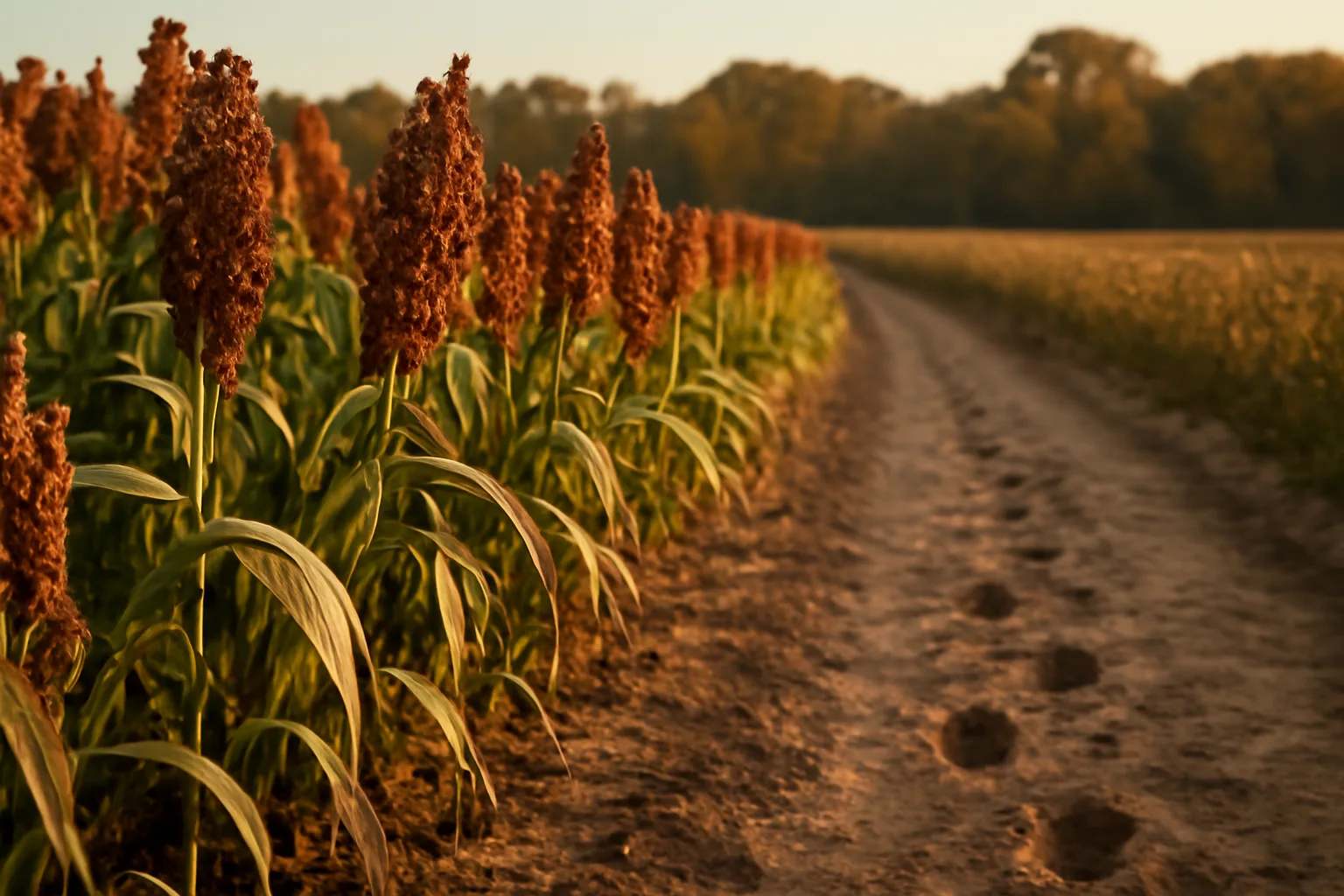
Yes. Deer browse young sorghum forage in summer and hit the grain heads hard once they mature and dry down in fall, especially after a frost softens the outer hull. Sorghum (Sorghum bicolor) is a warm-season annual grass grown for grain, forage, or both, and it shows up in wildlife plantings mostly as a drought-tolerant substitute or companion for corn. It's not usually a deer's first choice while better food is standing nearby. Research on whitetail food habits consistently ranks browse, forbs, and acorns above grain crops in preference during most of the year, with grain sorghum and corn functioning more as high-energy fall and winter fuel once natural forage drops off [1]. That's the honest framing: sorghum is a solid energy source for late season, not a magnet crop that pulls deer off adjacent bean fields in October. Turkey, quail, dove, and other wildlife eat sorghum heads too, which is part of why it shows up so often in wildlife seed mixes sold at farm stores. If your goal is strictly a fall attractant plot, sorghum works best mixed with something deer prefer more, like brassicas or a cereal grain, rather than planted alone.
What is a food plot, and where does sorghum fit in one?
A food plot is a planted area on hunting ground, usually somewhere between a quarter acre and several acres, seeded with forage or grain crops to feed deer and other wildlife and to concentrate animal activity in a spot you can hunt. Plots range from small hidden "kill plots" tucked in timber to large field-scale plantings meant to hold deer through winter. Sorghum fits the grain/energy category alongside corn, milo (a grain sorghum type), and soybeans. Extension guidance on wildlife plantings groups sorghum with these as fall and winter standing grain, valuable for calories when deer need to build fat reserves and when snow or drought has knocked back green forage [2]. It's rarely the whole plot. Most experienced planters use sorghum as 20-40% of a blend, or as a standalone block bordering a clover or brassica field, so deer have both a green forage source and a grain source in the same area. If you're building out a full plot plan and want help deciding where grain crops like sorghum should sit relative to your forage plots, that's exactly the kind of layout question a food plot whitetail plan should answer before you buy seed.
When to plant food plots for deer, in general?
| Deep South (Zone 8-9) | Late April - May | 65°F+ | |
|---|---|---|---|
| Mid-South / Transition (Zone 7) | Early May - early June | 60-65°F | |
| Lower Midwest (Zone 6) | Mid-May - mid-June | 60-65°F | |
| Upper Midwest / Northeast (Zone 4-5) | Late May - late June | 60°F+ | These are general starting points, not guarantees, since a cold snap or wet spring can push things back two or three weeks in any zone. |
Timing splits into two windows almost everywhere deer are hunted: spring/summer planting for warm-season annuals and perennials (clover, chicory, beans, sorghum, corn), and late summer/early fall planting for cool-season annuals (brassicas, cereal grains, winter peas). Get the window wrong and you either lose the crop to frost or to drought stress. Soil temperature drives warm-season planting more than the calendar date. Sorghum, corn, and soybeans want soil consistently above 60°F at planting depth, which in practice means late April in the Deep South, mid-to-late May in the mid-South and lower Midwest, and late May into June across the northern tier and Canada border states [3]. Cool-season plots (brassicas, wheat, oats, clover overseeds) go in 6-8 weeks before your area's average first frost, which lets them establish before growth slows. A rough zone breakdown for warm-season grain crops like sorghum: | Region | Typical planting window | Soil temp target |
When should you plant sorghum specifically?
Plant grain sorghum once soil temperature at a 2-inch depth holds steady at 60-65°F, which usually lines up with your local corn planting date, sometimes a week or two later. University agronomy guidance for grain sorghum production recommends waiting until soil reaches 60°F minimum, because cold, wet soil causes poor emergence and seedling disease [4]. Sorghum is more forgiving of a late, hot planting than corn is, so if you missed your corn window, sorghum is a reasonable backup crop for the same field. Seeding rate for wildlife plots runs 6-10 lbs/acre if drilled in rows, planted 1-1.5 inches deep. Broadcast plantings need a higher rate, often 10-12 lbs/acre, because seed-to-soil contact is less reliable without a drill. Row spacing of 20-30 inches with a plot drill mimics ag-scale sorghum production and makes cultivation or spraying easier if weeds get ahead of you. Sorghum takes 90-120 days to reach grain maturity depending on variety, so back-planning from your hunting season matters. If you want heads dry and standing by opening day of gun season in early November, you need seed in the ground by late June to early July in most of the whitetail's range, not later.
How does sorghum compare to corn, milo, and other grain plots?
| Drought tolerance | High | Moderate | |
|---|---|---|---|
| Nitrogen need | Lower | Higher | |
| Deer preference (standing grain) | Good, especially post-frost | Very good | |
| Deer/bird competition before season | Lower (bitter tannins in some varieties until frost) | Higher | |
| Typical seeding rate | 6-10 lbs/acre | 15,000-30,000 seeds/acre (roughly 8-10 lbs) | |
| Days to maturity | 90-120 | 100-120 | One underappreciated sorghum trait: some varieties carry tannins that make the grain less palatable to birds and deer until a hard frost breaks down the compounds, which naturally times the food source to open right as late season hunting pressure builds [5]. That's not universal across all sorghum varieties, so check with your seed dealer if that timing matters to your plan. If you're comparing grain options for a specific field, our deer food plot seed guide breaks down seed blends by goal, and domain food plot seed covers sourcing considerations. |
Sorghum's biggest edge over corn is drought tolerance and lower input cost. It has a deeper, more efficient root system and needs less nitrogen and less irrigation to produce a grain crop, which is why it's a common corn substitute on droughty, sandy, or clay-heavy ground that struggles to hold moisture [5]. Corn generally out-yields sorghum on good ground and deer often show a stronger initial pull to standing corn, partly because it's more common and partly because the ears are easier to access. But corn is expensive to plant (seed, fertilizer, sometimes irrigation) and it's more vulnerable to drought stress during pollination. Milo is simply a common name for grain sorghum, so "milo" and "sorghum" plots are usually the same thing at the seed store. | Factor | Grain sorghum | Corn |
Do deer like clover, and how does it compare to sorghum?
Deer like clover a lot, generally more consistently than sorghum, because clover is a preferred forage through spring, summer, and fall rather than a fall-only grain source. Extension forage trial data and deer nutrition research repeatedly place clover among the most heavily used food plot forages, particularly white clover and red clover blends, because of high protein content (often 20-25% crude protein in vegetative growth) and long grazing windows [6]. Clover is a perennial or short-lived perennial that you plant once and maintain for two to four years with mowing and fertility upkeep, versus sorghum, which is an annual you replant every year. That makes clover cheaper per year of coverage but sorghum better suited to fields you want in a corn/soybean/grain rotation. The two aren't competitors so much as different tools. A property with a clover perennial plot for spring/summer nutrition and a grain block of sorghum or corn for fall energy covers both nutritional needs across the year. That combination shows up constantly in state wildlife agency planting guides as a baseline strategy for properties big enough to run more than one plot [2].
When to plant oats for deer?
Plant oats 6-8 weeks before your area's average first fall frost, which puts most of the whitetail's range somewhere between late August and mid-September. Oats are a cool-season annual cereal grain, and they're one of the fastest-growing, most reliably attractive fall food plot options available, often showing green growth in 7-10 days after planting. Oats don't survive hard winters in northern climates the way winter wheat or rye does, so in Zone 5 and colder they function as a fall-only attractant that dies back with the first real hard freeze. Farther south (Zone 7 and warmer), oats can persist into winter and even regrow some in spring if temperatures stay mild. Seeding rate for oats runs 2-3 bushels per acre (roughly 64-96 lbs) broadcast, or on the lower end if drilled. They pair well in a blend with brassicas and clover, since oats germinate fast and give deer something to eat while slower-growing turnips and clover establish underneath.
When to plant turnips for deer?
Plant turnips 60-90 days before your first killing frost, which for most of the whitetail's range lands between late July and mid-August. Turnips are a brassica, and they need that runway to bulb out before cold weather, plus a hard frost or two actually improves palatability by converting starches to sugars in the leaves and roots. That late-fall sweetening effect is why turnip plots often get ignored by deer in September and then get hammered in December. It's one of the most common frustrations plot planters run into: they check trail cameras in October, see nothing touching the turnips, and assume the plot failed, when actually the plot is just not ready yet on the deer's schedule. Seeding rate for turnips alone runs 4-6 lbs/acre, broadcast shallow (turnip seed is tiny and shouldn't be buried deeper than a quarter inch). They're commonly blended with radish, rape, and a cereal grain like oats or wheat for a fall brassica mix that gives both early green forage and a late-season bulb crop.
What is a deer's favorite food?
There's no single favorite food for whitetail deer; preference shifts by season, region, and what's available, and it's driven mostly by nutritional need and digestibility rather than taste in the way we'd think about it. Deer nutrition studies consistently show acorns and other hard mast as a top preference in fall when available, because of high fat content that supports winter fat reserves, with agricultural crops like soybeans and clover ranking high through the growing season [1]. Soybeans get eaten hard both as a growing forage in summer and as a standing grain crop in fall, and they're often cited in food plot studies and extension literature as one of the most consistently preferred plantings across regions [2]. Clover is the perennial forage most often ranked at or near the top for season-long use. Brassicas (turnips, radish, rape) become strong preferences specifically in late fall and winter once frost sweetens them. Geography matters more than most plot marketing admits. A soybean field surrounded by corn and beans in Iowa isn't going to pull deer the way the same field would in a Georgia pine plantation with little other ag around it. Deer eat what's scarce and nutritious relative to their local landscape, which is part of why a Custom Food Plot Plan built around your specific property and region matters more than chasing whatever seed blend claims to be a deer magnet nationwide.
Do deer like honey, and does it belong in a food plot?
Deer don't eat honey in any meaningful way as part of natural foraging, and honey has no real place in a food plot. It shows up in this conversation mostly because commercial deer attractant sprays and mineral licks sometimes include sugar, molasses, or honey-scented additives marketed as irresistible lures. There's no wildlife agency or extension research supporting honey as a deer attractant crop or additive with measurable effect on deer behavior; it's a product marketing claim, not an agronomic one. If you're using scent-based attractants at all, check your state's baiting and feeding regulations first, because many states classify any placed food, mineral, or scent product used to lure game as bait, and rules vary widely by state on whether that's legal during hunting season, on public versus private land, or at all . A planted food plot is legal to hunt over in most states even where baiting is banned, because it's a standing agricultural crop rather than placed feed, but the legal line between the two is state-specific and worth confirming with your wildlife agency before you plant or spray anything.
How do you prep soil and fertilize a sorghum plot?
Start with a soil test, not a guess. Sorghum tolerates a wider pH range than most food plot crops (it'll grow acceptably from pH 5.5 to 7.5) but yields best in the 6.0-6.8 range, and your soil test report is the only reliable source for how much lime and fertilizer your specific field needs [4]. General extension nutrient guidance for grain sorghum suggests nitrogen rates around 1.0 to 1.2 lbs of actual N per bushel of expected yield, split between a modest amount at planting and a sidedress application when plants are 12-18 inches tall, plus phosphorus and potassium based on soil test levels [4]. That's a starting reference, not a substitute for your lab's specific recommendation; soil types, prior cropping history, and organic matter all shift the right rate for your field, and your soil test lab is the authority on your exact numbers. Bed prep matters more for sorghum than people expect since it's a small seed planted shallow. Work ground to a fine, firm seedbed, broadcast or drill seed no deeper than 1-1.5 inches, and roll or cultipack after planting if you broadcast, to improve seed-to-soil contact. Weeds are sorghum's biggest early threat; a clean seedbed and, where legal and appropriate for your equipment, a pre-emergent herbicide labeled for sorghum will save the stand more reliably than trying to spray your way out of a weedy mess later.
What equipment do you actually need for a sorghum plot?
A no-till or conventional drill is the best option for sorghum since it controls seed depth precisely, which matters more with sorghum's small seed size than with something forgiving like oats. A basic ATV or UTV-mounted broadcast spreader works too, but plan on a higher seeding rate (10-12 lbs/acre vs 6-10 drilled) and a cultipacker pass afterward to press seed into contact with soil. You don't need full-size farm equipment. Plenty of successful sorghum plots get planted with a disc, a hand-crank or ATV broadcast spreader, and a drag harrow or cultipacker, especially on plots under 2-3 acres. Where sorghum gets harder without equipment is weed control mid-season; a boom sprayer sized to your ATV or tractor makes labeled herbicide application realistic, while hand-spraying a half-acre or more of grass weeds in July is miserable work most people give up on. If you're deciding what to buy first for a new plot program, our equipment and methods resources and the general food plot seed guide cover the gear-versus-seed budget tradeoff in more depth.
Common mistakes people make planting sorghum food plots
Planting too early is the number one mistake. Cold, wet soil below 60°F causes poor germination and opens the door to seedling blight, and a lot of planters get impatient and go a few weeks before soil is actually ready [4]. Wait for the soil temperature, not the calendar. Skipping the soil test is the second most common error. Sorghum is forgiving of marginal pH, which leads people to assume it needs nothing, then they get a disappointing, short crop because nitrogen or potassium was actually the limiting factor the whole time. A $15-20 soil test avoids guessing. Planting sorghum alone as the entire plot, expecting it to be a magnet crop all season, is the third. It's a fall/winter grain source, not a summer attractant, and it competes with corn, soybeans, and acorns for deer attention wherever those are available. Pairing it with a clover or brassica plot nearby, or blending it into a diverse plot, covers more of the calendar than a monoculture ever will.
Frequently asked questions
Do deer eat sorghum heads or just the plant?
Both. Deer browse young sorghum forage in summer and eat the mature grain heads in fall and winter, especially after frost breaks down bitter tannins in some varieties. Turkey, dove, and quail eat the grain too, which is why sorghum shows up often in mixed wildlife seed blends rather than deer-only plots.
Do deer like clover better than sorghum?
Generally yes. Clover is a preferred forage across spring, summer, and fall with high crude protein (often 20-25%), while sorghum is mainly a fall/winter grain source. Most experienced planters use clover as a season-long perennial plot and sorghum as a separate fall grain block rather than choosing one over the other.
When is the best time to plant food plots for deer overall?
Warm-season plots (sorghum, corn, beans, clover) go in once soil hits 60°F or higher, typically late April in the Deep South through late June near the Canadian border. Cool-season plots (brassicas, oats, wheat) go in 6-8 weeks before your area's average first frost, usually August into September depending on zone.
When should I plant oats for a fall deer plot?
Plant oats 6-8 weeks before your area's average first frost, roughly late August to mid-September across most of the whitetail's range. Oats germinate fast, often showing growth in 7-10 days, and work well blended with brassicas or clover in a fall plot mix.
When do you plant turnips for deer?
Plant turnips 60-90 days before your first expected killing frost, usually late July through mid-August. Turnips need that time to bulb out, and a hard frost afterward sweetens the leaves and roots by converting starches to sugar, which is why deer often ignore turnip plots in early fall and hit them hard in December.
What exactly is a food plot?
A food plot is a planted area, from a quarter acre to several acres, seeded with forage or grain crops specifically to feed deer and other wildlife and concentrate their activity somewhere huntable. Plots range from small hidden kill plots in timber to larger field plantings meant to carry deer through winter.
What is a deer's favorite food overall?
There's no single favorite; preference shifts by season and region. Acorns and other hard mast rank high in fall for their fat content, soybeans and clover rank high through the growing season, and brassicas become preferred once frost sweetens them in late fall. Local food availability matters more than any universal ranking.
Do deer like honey or honey-based attractants?
No, deer don't naturally eat honey, and it has no agronomic place in a food plot. Honey shows up mainly as an ingredient in commercial attractant sprays with marketing claims, not research support. Check your state's baiting rules before using any scent or feed-based attractant, since regulations vary widely.
How does sorghum compare to corn for a deer food plot?
Sorghum tolerates drought and poor soil better and needs less nitrogen, while corn generally yields more on good ground and often gets an earlier, stronger pull from deer once it's standing. Sorghum is a solid, cheaper substitute or companion on marginal ground; corn wins where soil and rainfall support it.
What seeding rate should I use for a sorghum deer plot?
Drill grain sorghum at 6-10 lbs per acre, 1 to 1.5 inches deep. If broadcasting instead of drilling, bump the rate to 10-12 lbs per acre and cultipack afterward, since broadcast seed gets less reliable soil contact than drilled seed.
How long does sorghum take to mature for a fall food plot?
Grain sorghum takes roughly 90 to 120 days to reach maturity depending on variety. To have dry, standing grain by early November, most of the whitetail's range needs seed in the ground by late June to early July.
Is grain sorghum the same thing as milo?
Yes. Milo is simply a common name for grain sorghum varieties, so a bag labeled milo and a bag labeled grain sorghum are usually the same crop, sometimes just different varieties bred more for grain yield versus forage.
Can sorghum handle a drought better than other food plot grains?
Yes, sorghum has a deep, efficient root system and generally outperforms corn under drought stress, which is why it's a common corn substitute on sandy or clay-heavy ground that dries out fast or in regions with unreliable summer rainfall.
Sources
- USDA Forest Service, Southern Research Station - White-tailed Deer Food Habits: browse, forbs, and mast rank above agricultural grain crops in whitetail deer food preference for much of the year
- USDA NRCS Plant Guide - Grain Sorghum: grain sorghum planting timing and regional adaptation as a warm-season annual crop
- Kansas State University Extension - Grain Sorghum Production Handbook: sorghum should be planted once soil temperature reaches 60°F, along with nitrogen rate guidance of roughly 1.0-1.2 lbs N per bushel of expected yield
- Purdue University Extension - Grain Sorghum Production: grain sorghum's drought tolerance and lower nitrogen requirement compared to corn, and tannin content in some varieties affecting palatability
- Noble Research Institute - Clover for Wildlife and Livestock Forage: clover forage protein content and its ranking as a preferred, high-use deer food plot forage
- Pennsylvania Game Commission - Baiting and Feeding Regulations: state wildlife agencies regulate baiting and feeding of deer separately from standing planted food plots, and rules vary by state