Last updated 2026-07-25
TL;DR
Test your soil first ($10 to $20 through your county extension office), then apply lime to hit pH 6.0 to 6.8 and fertilizer based on what the test recommends for your specific crop. Most new plots need 1 to 3 tons of lime per acre and 200 to 400 pounds of a blended fertilizer like 19-19-19 or crop-specific blends. Skipping the soil test is the single most expensive mistake plotters make.
What is a food plot and why does fertilizing it matter?
A food plot is a planted area, usually somewhere between a quarter acre and several acres, put in specifically to attract and feed deer or other wildlife. It's not a farm field in the commercial sense, but it follows the same agronomic rules. Soil doesn't know the difference between a soybean field feeding a family and a clover plot feeding a deer herd. Fertilizing matters because most hunting ground was never farmed well, or hasn't been farmed in decades. Old pastures, cutover timber ground, and reclaimed logging roads tend to run acidic and low in phosphorus and potassium. Plant clover or brassicas into that dirt without amending it and you'll get thin, stressed plants that deer walk past for a real ag field down the road. The USDA's soil survey data and most land-grant extension programs agree on one point: soil fertility, not seed selection, is usually the limiting factor in plot performance. You can spend $60 a bag on the best clover blend on the market and still get a lousy stand if your pH sits at 5.0 and your phosphorus is depleted. If you want a structured starting point before you even touch fertilizer, a food plot whitetail plan built around your specific soil test saves you from guessing.
How do I know how much fertilizer and lime my food plot needs?
You test the soil. There's no shortcut that beats a real lab test, and at $10 to $20 through most university extension labs, it's the cheapest insurance you'll buy all season [1]. Pull 8 to 12 soil cores from across the plot, each about 4 to 6 inches deep for annual plots (go slightly shallower, 3 to 4 inches, for no-till or perennial clover ground where you're not disturbing the profile). Mix the cores in a clean bucket, pull about a pint of the composite sample, and send it in. Your county cooperative extension office almost always has submission forms and mailing instructions, and many state land-grant labs (Penn State, Mississippi State, Auburn, and others) turn results around in a week to ten days [2]. The report gives you a pH reading, phosphorus and potassium levels usually in pounds per acre, and a lime and fertilizer recommendation matched to the crop you tell them you're planting. This is the part people skip: you have to tell the lab what you're growing, because a soybean recommendation and a brassica recommendation are not the same numbers. Your soil test is the actual authority here, not a blog article. Treat the lab's specific pounds-per-acre numbers as the real answer for your dirt; everything below is the general range you should expect to see.
What soil pH do food plots need, and how much lime does that take?
Most food plot crops want a pH between 6.0 and 6.8. Clover in particular is picky. Below pH 6.0, clover struggles to fix nitrogen efficiently because the rhizobium bacteria that live on its roots lose efficiency in acidic soil, and yields drop hard below pH 5.5 [3]. Brassicas (turnips, radishes, rape) tolerate a slightly wider range, generally 5.5 to 6.8, but they still perform better closer to neutral. Cereal grains like oats and wheat are the most forgiving, tolerating pH down into the 5.5 range without major yield loss. Here's the number that surprises people: raising pH one full point on clay soil can take 1 to 2 tons of ag lime per acre. Sandy soils need less lime to move the same amount because they have lower buffering capacity, but they also don't hold that pH change as long. Your soil test report will state a specific tons-per-acre lime recommendation based on your soil's buffer pH, which is a different, more precise measurement than the basic pH reading. Lime is slow. Ag lime takes 3 to 6 months to fully react with soil, and sometimes up to a year for the full effect to show in a test. If you can get lime down the fall before planting, or even a full season ahead, you'll see a real difference. Pelletized lime reacts faster than ground ag lime because it disperses more evenly, but it costs more per effective ton and most university trials show ag lime is the better dollar for pH change if you have the lead time.
What fertilizer numbers (N-P-K) should I use for a food plot?
| Clover / legumes (establishing) | 0-20-20 or 6-24-24 | 300-400 lbs | Legumes fix their own N once nodulated; too much N at planting can hurt nodulation | |
|---|---|---|---|---|
| Clover (maintenance, yr 2+) | 0-20-20 or potash-heavy blend | 200-300 lbs | Top-dress P and K annually, skip N | |
| Brassicas (turnips, radish) | 19-19-19 or 13-13-13 | 300-400 lbs, plus 40-50 lbs N side-dress | Brassicas are nitrogen hungry, especially for bulb/leaf growth | |
| Cereal grains (oats, wheat) | 19-19-19 | 200-300 lbs | Split N application if soil is very sandy or plot gets heavy rain | |
| Corn/sorghum plots | 10-10-10 pre-plant, N side-dress | 300+ lbs pre-plant | Sorghum and corn are heavy N feeders through vegetative growth | The legume rule trips up a lot of first-time plotters: dumping high nitrogen on new clover actually discourages the plant from forming the root nodules it needs to fix its own nitrogen later. Give clover phosphorus and potassium at planting, inoculate the seed if it isn't pre-inoculated, and let it do its own nitrogen work once established. If you want a plan built around your exact soil numbers and the species you've already decided on, that's the whole point of the $99 Custom Food Plot Plan. It turns your lab results into an actual rate sheet instead of a range. |
Fertilizer is labeled by three numbers representing percent nitrogen (N), phosphorus as P2O5 (P), and potassium as K2O (K). A bag of 19-19-19 is 19% each. A bag of 34-0-0 (ammonium nitrate or urea-based) is straight nitrogen. Here's the general split by crop type, understanding your soil test overrides all of this: | Crop type | Typical blend | Approx rate per acre | Nitrogen timing note |
When should I fertilize and lime a food plot?
Lime whenever you can get it on the ground, ideally 3 to 6 months before planting, because it needs time to react. Fall liming for a spring plot, or spring liming for a fall plot, both work. Fertilizer timing follows planting timing. Broadcast or incorporate your P and K (and starter N for brassicas or grains) at or just before planting. For plots that will carry through a full growing season, like clover, a second application of P and K the following spring keeps the stand productive into year two and three. Don't fertilize right before a heavy rain if you can help it. Surface-applied nitrogen especially can wash or volatilize away within 24 to 48 hours in warm, wet conditions, which wastes money and can contribute to nutrient runoff into nearby water. Try to work fertilizer into the top few inches of soil with a disk or cultipacker when possible.
When should I plant food plots for deer?
Planting windows depend on your zone and your target season, spring/summer plots versus fall plots. Broadly, spring and summer plots (soybeans, cowpeas, clover establishment) go in after your last frost date, typically April through June depending on latitude. Fall plots (brassicas, cereal grains, clover) go in 60 to 90 days before your first fall frost so plants have time to establish before deer season and before hard frost. Your state extension service and USDA Plant Hardiness Zone Map are the best references for frost dates specific to your county. A grower in zone 8 (much of the mid-South) might plant fall brassicas in early September, while a grower in zone 4 (northern Midwest, upper New England) needs seed in the ground by mid-August to get the same maturity before frost. For a fuller breakdown by region and month, the deer food plots guide walks through zone-specific calendars in more detail than we can cover here.
When should I plant clover for deer, and do deer actually like it?
Yes, deer like clover, and it's one of the most consistently preferred food plot forages across studies and field observation. Clover is high in protein, typically 20 to 25% crude protein in a well-managed stand, and stays palatable through most of the growing season when other browse gets tough and fibrous [4]. Plant clover in early spring (March through May depending on zone) or late summer/early fall (August through September). Frost-seeding, broadcasting clover seed onto frozen or freeze-thaw ground in late winter, is a proven low-cost method many state wildlife agencies and extension programs recommend for establishing clover with minimal equipment. Once established, clover is a perennial that can produce for 3 to 5 years with proper mowing, weed control, and annual P/K maintenance fertilization. It's genuinely one of the better dollar-per-acre-per-year investments in food plotting, assuming your pH is right. Clover in acidic soil is a slow, frustrating disappointment; clover at pH 6.5 with decent P and K is a workhorse. For seed options and blend comparisons, see deer food plot seed and food plot seed.
When should I plant turnips for deer?
Plant turnips 80 to 100 days before your first expected fall frost, which puts most of the country somewhere between late July and early September. Turnips are a fall/winter food source, both the leafy tops (which deer hit hard early) and the bulbs (which deer often ignore until after a hard frost sweetens the starches into sugars). Turnips need a nitrogen-heavier fertilizer program than clover. A common approach is 300 to 400 pounds per acre of a balanced blend like 19-19-19 at planting, with an additional 40 to 50 pounds of actual nitrogen side-dressed or top-dressed 3 to 4 weeks into growth to push bulb size and leaf mass. Deer often won't touch turnip bulbs until after a few hard frosts convert starches to sugars, so don't panic if a turnip plot looks untouched in October. That's normal. The plot's real value often shows up in December and January when little else is green.
When should I plant oats for deer, and do deer eat sorghum?
Plant oats in early fall, generally 6 to 10 weeks before your first frost, so the same window as brassicas, often overlapping in a mixed plot. Oats germinate fast, tolerate cooler soil than corn or sorghum, and provide quick green attraction in September and October when deer are keying in on easy carbohydrates before harder winter browse. Oats can also be planted in early spring in northern climates as a quick cover crop or nurse crop for clover establishment, though fall is the more common food-plot use. As for sorghum: yes, deer eat sorghum, both the standing grain heads and the foliage, and it's commonly planted as a summer annual in warmer zones (roughly zone 6 and south) where corn struggles with drought. Grain sorghum also holds up well as standing winter forage after other summer annuals have been grazed out or died back, similar to how standing corn works in northern plots. It's not usually anyone's first-choice deer food, soybeans and corn generally rank higher in preference studies, but in drought-prone or sandy ground where corn underperforms, sorghum is a legitimate substitute [5].
What are deer's favorite foods, and do deer like honey?
Deer preference studies and decades of field observation from state wildlife agencies point to a consistent short list: soybeans, clover, and acorns rank at or near the top almost everywhere deer are studied, with corn, brassicas, and cereal grains filling seasonal roles [5]. Preference also shifts by season and by what's regionally available. A deer herd with unlimited soybeans nearby may barely touch a clover plot; the same herd in a soybean-scarce area will hammer clover hard. Acorns deserve a specific mention because they're often the single most preferred natural food when they're dropping, particularly white oak acorns, which are lower in tannins and more palatable than red oak acorns. No planted food plot crop reliably out-competes a good acorn drop in a mast year. As for honey: deer don't seek out honey in any meaningful, documented way as a food source, and it isn't a food plot input or attractant with any real research behind it. This one seems to come up because of confusion with mineral or sugar-based attractant products, some of which include molasses or sugar as a carrier, not because deer forage on honey or honeycomb in the wild. There's no wildlife agency guidance recommending it, and it's not something we'd spend money on.
Do I need different fertilizer for perennial plots versus annual plots?
Yes, and the difference matters more than most people think. Annual plots (brassicas, cereal grains, soybeans) get their full fertility investment once, at planting, because the crop lives one season and you're starting over next year regardless. Perennial plots (clover, chicory, alfalfa) need an annual maintenance application even in years you're not replanting. A 2-year-old clover stand that never gets refertilized will thin out, get weedy, and eventually needs to be torn up and replanted years before it should, wasting the whole point of planting a perennial in the first place. The general maintenance move for established clover is an annual application of 200 to 300 pounds per acre of a phosphorus/potassium blend (something like 0-20-20), applied in early spring as growth resumes. Skip nitrogen on established clover; a healthy, nodulated stand is fixing its own. If your clover looks pale and stunted despite decent moisture and you've ruled out pH problems, that's often a sign the rhizobium inoculation failed or the stand has some other issue, not a nitrogen deficiency to fix by dumping urea on it.
What equipment do I actually need to fertilize a food plot correctly?
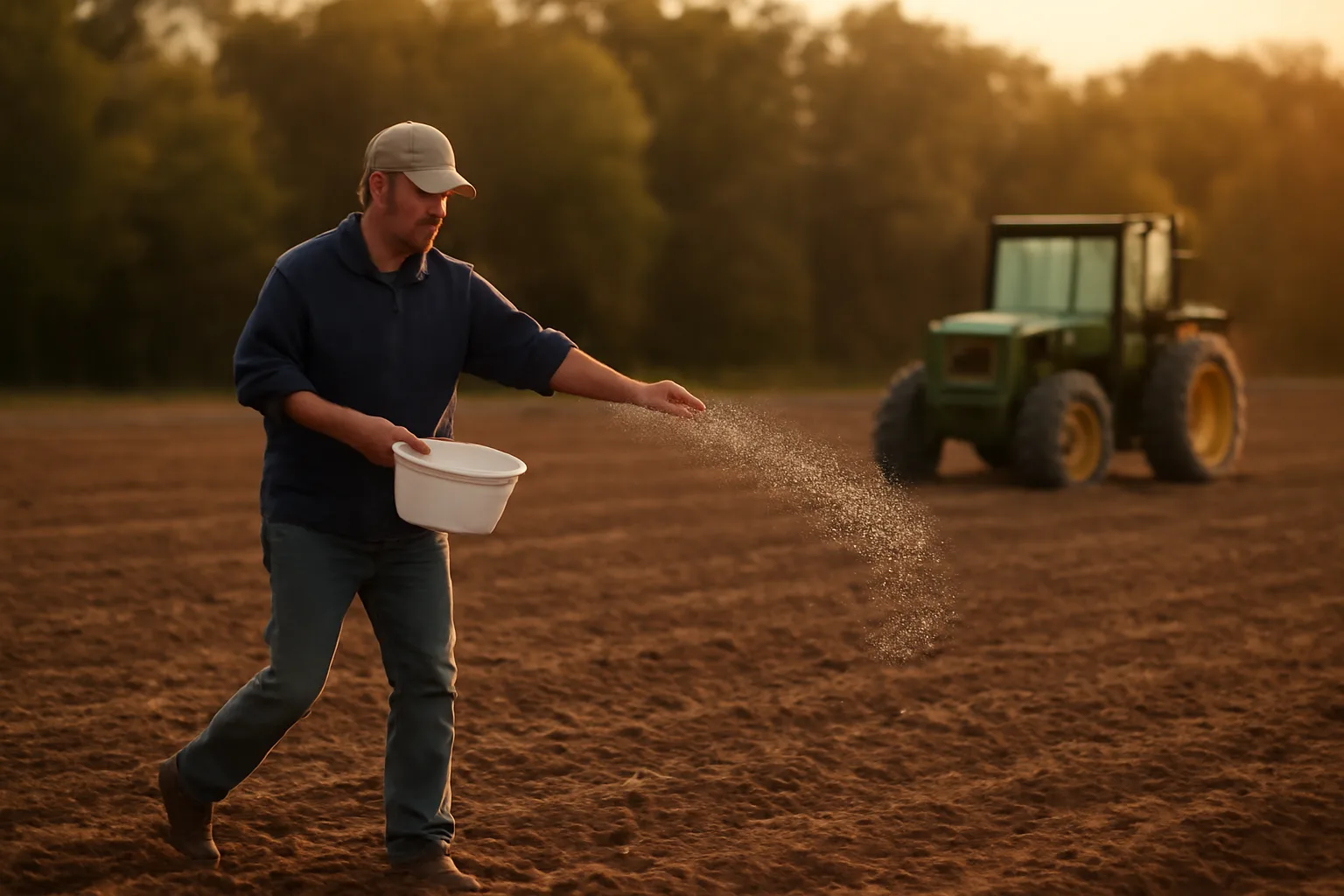
For small plots (under 2 acres), a tow-behind or ATV-mounted broadcast spreader handles lime and fertilizer fine, and a hand-crank spreader works for anything under half an acre if you're patient. Calibration matters more than horsepower: an uncalibrated spreader can put down double or half the intended rate depending on ground speed and gate setting, which defeats the whole purpose of a soil test. For plots over 2 to 3 acres, or if you're liming heavy clay ground that needs 2+ tons per acre, a tractor-mounted spreader or hiring a local ag co-op to spread lime with their equipment is usually more practical (and often cheaper per ton) than doing it yourself with small equipment. After spreading, incorporating fertilizer and lime into the top few inches of soil with a disk, tiller, or cultipacker improves availability versus leaving it sitting on the surface, especially on no-till or minimum-till ground where you're not otherwise disturbing the soil profile.
Do I need to worry about baiting or feeding laws when I fertilize a food plot?
Fertilizing and planting an actual food plot is legal everywhere in the U.S.; it's an agricultural practice, not baiting. The distinction states draw is between a planted, growing crop (a food plot) and placed feed, minerals, or attractants that aren't grown in place (bait). That said, rules on supplemental feeding, mineral use, and what counts as baiting near a food plot vary a lot by state, and some states restrict things like mineral licks or timed feeders even though standing food plots are fine. Michigan, for example, has specific baiting and feeding restrictions tied to chronic wasting disease management in certain counties . Always check your specific state wildlife agency's current regulations before adding mineral supplements, attractant products, or feeders near or in a plot, since a legal food plot can sit right next to an illegal bait pile if you're not careful about what else you're putting out there.
Frequently asked questions
Do deer eat sorghum?
Yes. Deer eat both the grain heads and foliage of sorghum, and it's a common summer annual in warmer, drought-prone zones where corn struggles. It's not usually a top preference compared to soybeans or corn, but it works well as a substitute on sandy or dry ground, and standing sorghum holds through winter similar to standing corn.
Do deer like clover?
Yes, clover is one of the most consistently preferred food plot forages. It runs 20 to 25% crude protein in a well-managed stand and stays palatable through most of the growing season, which is why it's a staple in spring and summer plot programs across most of the whitetail's range.
When should I plant food plots for deer?
Spring/summer plots (soybeans, clover establishment) go in after your last frost date, generally April through June. Fall plots (brassicas, cereal grains, clover) go in 60 to 90 days before your first fall frost. Exact dates depend heavily on your zone; check your county extension office or the USDA frost date data for your area.
When should I plant turnips for deer?
Plant turnips 80 to 100 days before your first fall frost, usually late July through early September depending on latitude. Deer often ignore the bulbs until after a hard frost converts starches to sugars, so a turnip plot that looks untouched in October is normal; its real value often shows up in December and January.
When should I plant oats for deer?
Plant oats in early fall, roughly 6 to 10 weeks before first frost, the same general window as brassicas. Oats germinate quickly and tolerate cool soil, providing fast green attraction in September and October. Oats can also go in as a spring nurse crop for clover establishment in northern climates.
What is a food plot?
A food plot is a planted area, typically a quarter acre to several acres, established specifically to feed and attract deer or other wildlife. It follows the same soil, fertility, and planting rules as any other planted crop; the difference is the intended consumer, not the agronomy.
What are deer's favorite foods?
Preference studies and field observation consistently put soybeans, clover, and acorns (especially white oak acorns) near the top, with corn, brassicas, and cereal grains filling seasonal roles. Preference shifts with season and regional food availability; a herd with abundant soybeans nearby may barely touch a clover plot.
Do deer like honey?
No, there's no real evidence deer seek out honey as a food source, and it isn't a legitimate food plot input. Confusion likely comes from sugar or molasses-based attractant products. No wildlife agency recommends honey as deer attractant, and it's not worth spending money on.
How much lime does a food plot need?
It depends entirely on your soil test, but raising pH one full point on clay soil often takes 1 to 2 tons of ag lime per acre; sandy soils typically need less. Lime takes 3 to 6 months to fully react, so apply it as far ahead of planting as you can, ideally the prior season.
What NPK fertilizer should I use for a food plot?
It varies by crop: legumes like clover want phosphorus and potassium (0-20-20 or similar) with little added nitrogen at establishment, while brassicas and grains want a balanced blend like 19-19-19 plus a nitrogen side-dress. Your soil test report will give exact pounds-per-acre numbers for your crop and soil.
How much does a soil test cost for a food plot?
Most university extension soil labs charge $10 to $20 per sample for a basic test that includes pH, phosphorus, potassium, and lime/fertilizer recommendations. Turnaround is usually about a week to ten days. Contact your county cooperative extension office for submission forms and mailing instructions.
Can I fertilize a food plot without a soil test?
You can, but you're guessing, and it often costs more in wasted fertilizer than the $10 to $20 test would have cost. Blind fertilizer application risks the wrong pH, wrong nutrient ratio, or over-application, all of which can stunt or kill a stand that a soil test would have prevented.
Does turnip need different fertilizer than clover?
Yes. Turnips are nitrogen-hungry annuals and typically need 300 to 400 pounds per acre of a balanced blend plus a nitrogen side-dress, while established clover is a nitrogen-fixing perennial that needs mainly phosphorus and potassium maintenance and little to no added nitrogen once nodulated.
Sources
- Penn State Extension, Agricultural Analytical Services Lab: Cost and process of standard soil fertility testing through a university lab
- University of Wisconsin-Madison Extension, Nutrient and Pest Management Program: Clover requires soil pH near neutral and rhizobium nitrogen fixation efficiency drops in acidic soil
- USDA Natural Resources Conservation Service, Plant Guide: White Clover: Clover forage quality and crude protein content supporting its use as deer forage
- Mississippi State University Extension, Deer Food Plot Planning: Sorghum and corn preference and use as summer annual food plot crops
- Michigan Department of Natural Resources, Baiting and Feeding Regulations: State-specific baiting and feeding restrictions tied to disease management near food plots