Last updated 2026-07-25
TL;DR
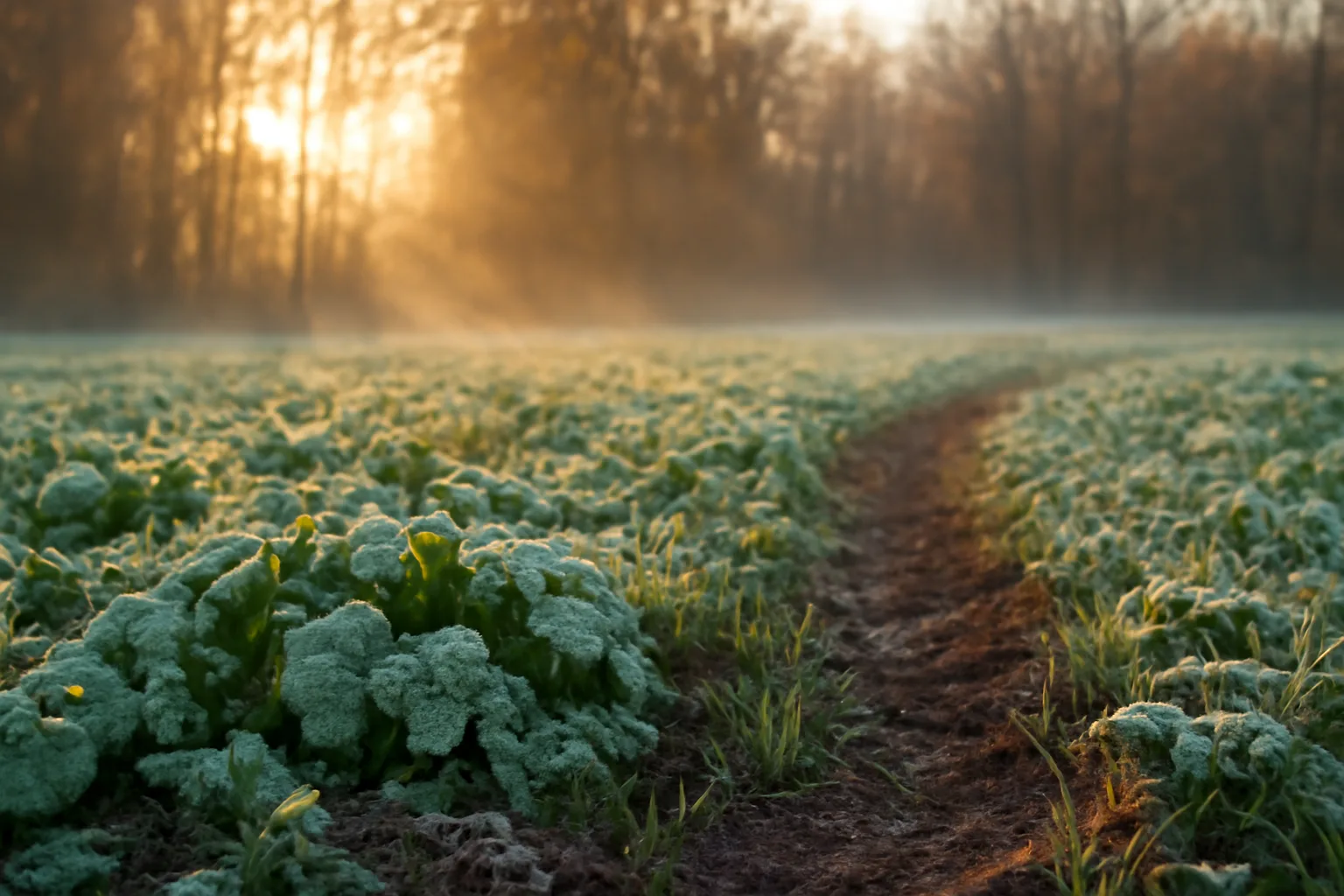
The best fall food plot mix combines a brassica (turnips or radish), a cereal grain (oats or winter wheat), and a legume like clover. This gives deer fast-growing forage in September, a frost-sweetened brassica bulb in November, and a perennial base that comes back next spring. Plant 60 to 90 days before your first hard frost.
What is a food plot, exactly?
A food plot is a planted patch of forage, usually somewhere between a quarter acre and several acres, put in specifically to feed and hold deer or other wildlife on a property. It's not the same as agriculture in the commodity-crop sense, though the equipment and seed sources often overlap. Most hunters plant food plots for two different jobs: a spring/summer plot to grow deer through antler development and lactation, and a fall plot timed to be most attractive during hunting season. State wildlife agencies generally treat food plots as a legal habitat practice, distinct from baiting, as long as the crop is planted and grown in place rather than piled or spread loose. Rules vary a lot by state though. Some states restrict hunting over food plots during specific seasons or require a minimum distance from a stand, and a handful have gotten stricter about supplemental feeding versus planted plots. Check your state wildlife agency's regulations before you plant if you're unsure where the line falls, because "food plot" and "bait pile" are legally different things in most places, but not all. A good fall plot isn't trying to replace the woods. It's filling a nutrition and attraction gap during the exact weeks you plan to hunt.
What's the best food plot mix for fall?
| Oats | 60-70 | Early fall, before hard frost | Moderate, dies back in hard freeze | |
|---|---|---|---|---|
| Winter wheat | 70-90 | Fall through winter | High | |
| Turnips/brassica | 80-90 | After first hard frost | Very high | |
| Clover (perennial) | 60-90 to establish | Spring through fall, multi-year | High once established | If you only have one field and one planting window, this three-way mix hedges your bets against weather and timing better than a single species ever will. For a soil-specific breakdown of what your dirt can support, a food plot whitetail planning guide is a good next stop. |
For most of the whitetail range, the best fall mix is a brassica plus a cereal grain plus a clover, planted together or in adjacent strips. This isn't one magic bag of seed, it's a strategy: stack a fast-germinating cover crop with a frost-activated brassica and a perennial legume so you get attraction from early bow season all the way through late muzzleloader or gun season. A practical fall blend looks like this: 60 to 70 percent cereal grain (oats or winter wheat), 20 to 30 percent brassica (turnip, radish, or a mix), and a smaller clover component seeded in the same ground or in an adjacent perennial plot. Oats and wheat germinate in 5 to 10 days and green up fast, giving deer something to eat within two weeks of planting. Brassicas take longer to become attractive. They need a hard frost to convert starches to sugars, which is why they often get ignored in September and hammered in November. Here's a rough comparison of the core fall species: | Species | Days to maturity | Peak attraction window | Frost tolerant |
Do deer eat sorghum?
Yes, deer will eat grain sorghum, especially the seed heads once they mature and dry down in fall, but it's not a top-tier food plot choice for most hunters. Sorghum (milo) is more commonly planted as a screening or bedding cover crop, or as a supplemental grain crop for upland birds and turkey, than as deer forage. Deer will browse young sorghum shoots some, and they'll hit the grain heads in late fall once they harden off, but intake is nowhere near what you get from a brassica or clover plot pound for pound. If you're looking for tall standing cover to break up a field edge or create a walking lane to a stand, sorghum has real value. If you're trying to maximize deer nutrition or hunting attraction, it's a secondary player, not your main plot.
Do deer eat clover, and do deer actually like it?
Yes, deer eat clover readily, and it's one of the most consistently preferred food plot forages across whitetail range. Clover is a legume, meaning it fixes nitrogen in the soil and produces forage that typically runs 25 to 30 percent crude protein when managed well, which lines up closely with what deer need for antler growth and lactation. Mississippi State University Extension identifies white clover as a top-performing, highly palatable forage and one of the most widely planted food plot species in the Southeast [1]. Clover's real strength is duration. A well-limed, well-maintained clover stand can produce for 3 to 5 years, giving you spring, summer, and fall forage from one planting instead of replanting annually. The catch with clover in a pure fall context is that it's already established forage, it doesn't have a dramatic fall attraction spike the way a frost-sweetened brassica does. Deer use it steadily rather than switching onto it hard in November. That's exactly why pairing clover (as your perennial base plot) with an annual brassica or grain plot (as your fall attraction plot) covers both jobs. For seed selection specific to clover blends, see deer food plot seed.
When to plant food plots for deer (by region)
| Deep South / Gulf Coast | Late September through October | |
|---|---|---|
| Mid-South / Transition zone | Early September through mid-September | |
| Midwest / Upper Midwest | Mid-August through early September | |
| Northeast | Early August through early September | |
| Northern tier / Canada border states | Late July through mid-August | These windows shift year to year with rainfall and heat, so use your own soil temperature and moisture as the final call, more than the calendar date. Cooperative extension guidance across the Northeast and Midwest generally recommends planting brassica-based fall plots 6 to 10 weeks before the first killing frost, to allow full bulb and leaf development [2]. If you're planting perennial clover instead of an annual fall mix, spring planting (April through May in most of the whitetail range) is usually the better call, since clover struggles to establish well going into cold weather. A soil test result in hand changes this timeline more than most people realize, because lime takes months to adjust pH and you want that reaction happening before your seed goes in, not after. |
Timing is the single biggest variable that separates a plot deer hammer from one they walk past. As a rule of thumb, fall annuals (oats, wheat, brassicas) go in 60 to 90 days before your area's average first hard frost, so the crop has time to establish before growth slows and so brassicas hit their sugar-conversion window right as hunting season opens. Regionally, that generally breaks down like this: | Region | Typical fall planting window |
When to plant oats for deer
Plant oats for deer 6 to 10 weeks before your area's first hard frost, which in most of the whitetail range lands somewhere between mid-August and mid-September. Oats germinate fast, often within a week in warm, moist soil, and can be grazed by deer within 3 to 4 weeks of planting. Oats are one of the least frost-tolerant of the common fall grains. A hard freeze in the low 20s (Fahrenheit) will usually kill oats outright, while winter wheat and rye keep growing through much colder temperatures. That makes oats a great early-to-mid fall attraction crop, but not a great choice if you're hunting a late December or January season and need standing green forage. In that case, winter wheat, rye, or a brassica bulb crop will outlast oats by weeks or months. Seeding rate for oats in a food plot context typically runs 100 to 130 pounds per acre when drilled, per extension recommendations for forage oat plantings. Broadcast rates run higher, often 150 pounds per acre or more, to compensate for uneven seed-to-soil contact.
When to plant turnips for deer
Plant turnips for deer roughly 80 to 90 days before your area's first expected hard frost, which puts most of the whitetail range somewhere in the July 15 to September 1 window depending on latitude. Turnips need that lead time to build both leaf mass and a bulb, and they need a hard frost afterward to actually become attractive. This is the part that trips up first-time planters: deer often ignore turnip plots in September and October, then hammer them hard in November and December. That's not a failed plot, that's the plant doing exactly what it's supposed to do. Frost converts starches in the turnip's leaves and bulb into simple sugars, which is why attraction spikes right after the first hard freeze rather than at planting. Oklahoma State University Extension recommends planting brassicas like turnips "6 to 10 weeks prior to the average first frost date" for the fall/winter forage window [3]. Seeding rate for turnips alone typically runs 4 to 6 pounds per acre broadcast, much lighter than a grain, since the seed is tiny and a heavy rate just wastes seed and crowds the stand.
When to plant food plots for deer, generally
Beyond the specific oats and turnip windows above, the general rule for any fall food plot is to work backward from your first hard frost date and count back 60 to 90 days depending on species. Cereal grains and brassicas both want that same rough window, which is exactly why they mix so well together in one planting. For spring/summer plots (soybeans, cowpeas, chicory, clover establishment) the target is after your last frost date in spring, typically April through May across most of the whitetail range, once soil temperatures reliably sit above 55 to 60 degrees Fahrenheit. Soil moisture matters as much as the calendar date. A perfectly timed planting into bone-dry August dirt will sit ungerminated for weeks waiting on rain, while a slightly late planting timed to a rain event will often outperform it. Watch your local forecast and your soil test's recommendation together rather than treating the calendar date as gospel. If you want a plan built around your actual zip code, frost dates, and soil test numbers rather than a regional generalization, that's the exact gap the Custom Food Plot Plan at PlotSeason is built to fill. It's a $99 one-time plan, and your soil test lab remains the final word on lime and fertilizer amounts, the plan gives you species selection and timing built around your specific conditions.
What are deer's favorite foods?
Deer are opportunistic browsers, and their "favorite" food shifts by season, region, and what's locally available, but a few categories consistently top preference studies and food plot performance data. Acorns are often the single most preferred natural fall food where oaks are present, deer will bypass planted plots for a good acorn drop in years when mast is heavy. Among planted forages, clover, soybeans, and cowpeas consistently rank at the top of preference trials for crude protein content and palatability, while brassicas and cereal grains rank high specifically in the fall and winter window once frost sweetens them. Mississippi State University Extension lists clovers and soybeans among the most consistently used planted forages across seasons [1]. Outside of plots, natural browse like honeysuckle, greenbrier, blackberry, and forbs make up a large share of a deer's actual year-round diet, food plots supplement that base rather than replace it. This is worth remembering when a plot seems underused: a great acorn year or a lush natural browse season can pull deer off even a well-timed plot, and that's not a sign your plot failed.
Do deer like honey?
There's no real evidence deer specifically favor honey as a food source, and it's not a practical food plot or attractant material. Deer are herbivorous browsers built around a rumen digestive system suited to plant fiber, not the concentrated sugars in honey. Some hunters have tried honey-based scent or mineral products as attractants, but that's a scent-and-taste attractant question, not a food plot species question, and there's no cooperative extension or wildlife agency guidance recommending honey as deer forage. If what you're really after is something with a strong sugar draw for fall attraction, a frost-sweetened brassica does that job legitimately, through a real biological process (starch-to-sugar conversion after frost) documented by extension research [3], rather than through an additive poured on the ground.
How do I build my own fall food plot mix?
Start with your soil test, then pick species that fit your region's frost timing, then decide whether you want an annual attraction plot, a perennial base plot, or both. A soil test is the one step most new food plotters skip and shouldn't. Land-grant extension soil testing labs consistently describe a lab soil test as the most reliable basis for lime and fertilizer recommendations on a field, and food plot seed, especially clover and brassicas, is genuinely sensitive to low pH [4]. Below 6.0, clover and brassica yields drop hard regardless of how much fertilizer you add, because the plant can't access the nutrients that are already in the soil. A reasonable build-your-own approach for a half-acre to two-acre fall plot: 1. Pull a soil test 2 to 3 months before planting so lime has time to work if you need it. 2. Pick a cereal grain (oats for early attraction, wheat or rye if you need late-season standing forage). 3. Add a brassica (turnip, radish, or a blend) at 20 to 30 percent of your total seed mix by weight. 4. If you have separate acreage, put in a perennial clover plot as your spring/summer base. It pays off in year two and beyond. 5. Fertilize and lime to your soil test's specific recommendation, not a generic bag rate. For seed sourcing and blend options once you know your mix, deer food plot seed and food plot seed both cover specific product categories worth comparing.
Fall plot mix mistakes worth avoiding
The most common mistake is planting brassicas too early and expecting fall attraction in September. They need the frost. Give it time. The second most common mistake is skipping lime because the plot "looks fine." A pH of 5.2 can grow a decent-looking stand of oats while quietly starving your clover and brassica of the nutrients they need, and you won't see the difference until you compare it to a properly limed plot side by side. Third, overseeding brassicas wastes money and thins your stand unnecessarily, since the seed is tiny and a light rate goes a long way; 4 to 6 pounds per acre broadcast is typically plenty [3]. And fourth, ignoring your state's baiting and feeding regulations before hunting over a plot can turn a perfectly legal food plot into a legal problem, since some states draw a hard line around minimum plot size, distance from a stand, or growing method. Check your state wildlife agency's current regulations directly rather than relying on general internet advice. Rules change and vary state to state.
Frequently asked questions
Do deer eat sorghum?
Yes, deer browse young sorghum shoots and eat the mature grain heads in late fall, but it's not a top food plot choice. Sorghum is more commonly planted for screening cover or as a supplemental grain for upland birds and turkey than as a primary deer forage species.
Do deer eat clover?
Yes, clover is one of the most consistently preferred planted forages for whitetail deer, running roughly 25 to 30 percent crude protein when well managed, according to Mississippi State University Extension. It's palatable across spring, summer, and fall, and a good stand can last 3 to 5 years.
When should I plant food plots for deer?
Plant fall annuals 60 to 90 days before your area's average first hard frost. That window runs late July through mid-August in the northern tier and late September through October in the Deep South. Spring/summer plots and clover establishment go in after your last spring frost, typically April through May.
Do deer like clover better than other food plot species?
Clover ranks among the top preferred planted forages in extension research, alongside soybeans and cowpeas, largely due to its high protein content and season-long availability. It doesn't have the dramatic fall attraction spike a frost-sweetened brassica has, which is why many hunters pair clover as a base plot with an annual fall mix.
When should I plant oats for deer?
Plant oats 6 to 10 weeks before your first hard frost, generally mid-August through mid-September across most of the whitetail range. Oats germinate within about a week and can be grazed within 3 to 4 weeks, but a hard freeze in the low 20s Fahrenheit will usually kill the stand.
When should I plant turnips for deer?
Plant turnips 80 to 90 days, or roughly 6 to 10 weeks, before your average first frost date, per Oklahoma State University Extension guidance. That's typically mid-July through early September depending on latitude. Turnips need a hard frost afterward to convert starches to sugars and become attractive to deer.
What is a food plot?
A food plot is a planted area of forage crops, from a quarter acre up to several acres, established specifically to feed and attract deer or other wildlife. It's a tool to supplement native food sources when natural forage is limited, and it's legally distinct from baiting in most state regulations.
What are deer's favorite foods?
Acorns often top the list where oaks are present, deer will choose a good mast drop over a planted plot most years. Among planted forages, clover, soybeans, and cowpeas rank highest in preference and protein content, while brassicas and cereal grains peak specifically after fall frost.
Do deer like honey?
There's no solid evidence deer specifically favor honey, and it's not a practical food plot material. Deer are herbivorous browsers built for plant fiber, not concentrated sugars. If you want a real sugar-driven fall attractant, a frost-sweetened brassica works through documented starch-to-sugar conversion, not an additive.
What's the best food plot mix for fall specifically?
A cereal grain (oats or winter wheat) at 60 to 70 percent, a brassica (turnip or radish) at 20 to 30 percent, plus a perennial clover plot nearby, covers early fall attraction, post-frost sweetness, and multi-year forage in one strategy rather than one bag of seed.
Can I plant a fall food plot mix without a soil test?
You can, but you're guessing at lime and fertilizer needs, and low pH (below 6.0) will suppress clover and brassica yield regardless of fertilizer applied. Extension soil testing labs treat a lab soil test as the most reliable way to determine a field's lime and fertilizer needs, so it's worth the two or three week wait for results.
Is it legal to hunt over a food plot?
In most states, a planted, growing food plot is legally distinct from a bait pile and is generally legal to hunt over, but rules on plot size, distance from a stand, and what counts as "growing in place" vary by state. Check your state wildlife agency's current regulations before hunting a new plot.
How much brassica seed should I use per acre?
Turnip or brassica blends are typically seeded at 4 to 6 pounds per acre when broadcast alone, since the seed is small. In a mixed fall blend with oats or wheat, the brassica portion usually makes up 20 to 30 percent of the total seed mix by weight.
Sources
- University of Tennessee Institute of Agriculture, Extension publication SP731-J, "Establishing and Managing Wildlife Food Plots": food plots provide supplemental, high-quality forage during periods when native food sources are limited
- Mississippi State University Extension Publication 2111, "Guide to Establishing Food Plots for White-tailed Deer": white clover is highly palatable and nutritious for deer and among the most planted food plot forages
- Penn State Extension, "Food Plots for White-tailed Deer": brassica-based fall plots should be planted 6 to 10 weeks before the first killing frost in the Northeast
- Oklahoma State University Extension Fact Sheet NREM-9019, "Brassicas for Deer and Other Wildlife Food Plots": brassicas should be planted 6 to 10 weeks prior to the average first frost date; seeding rate guidance for turnips
- University of Missouri Extension, "Soil Testing for Lawns, Gardens, and Landscape Plants," G9112: a laboratory soil test is the most reliable method for determining a field's lime and fertilizer needs