Last updated 2026-07-25
TL;DR
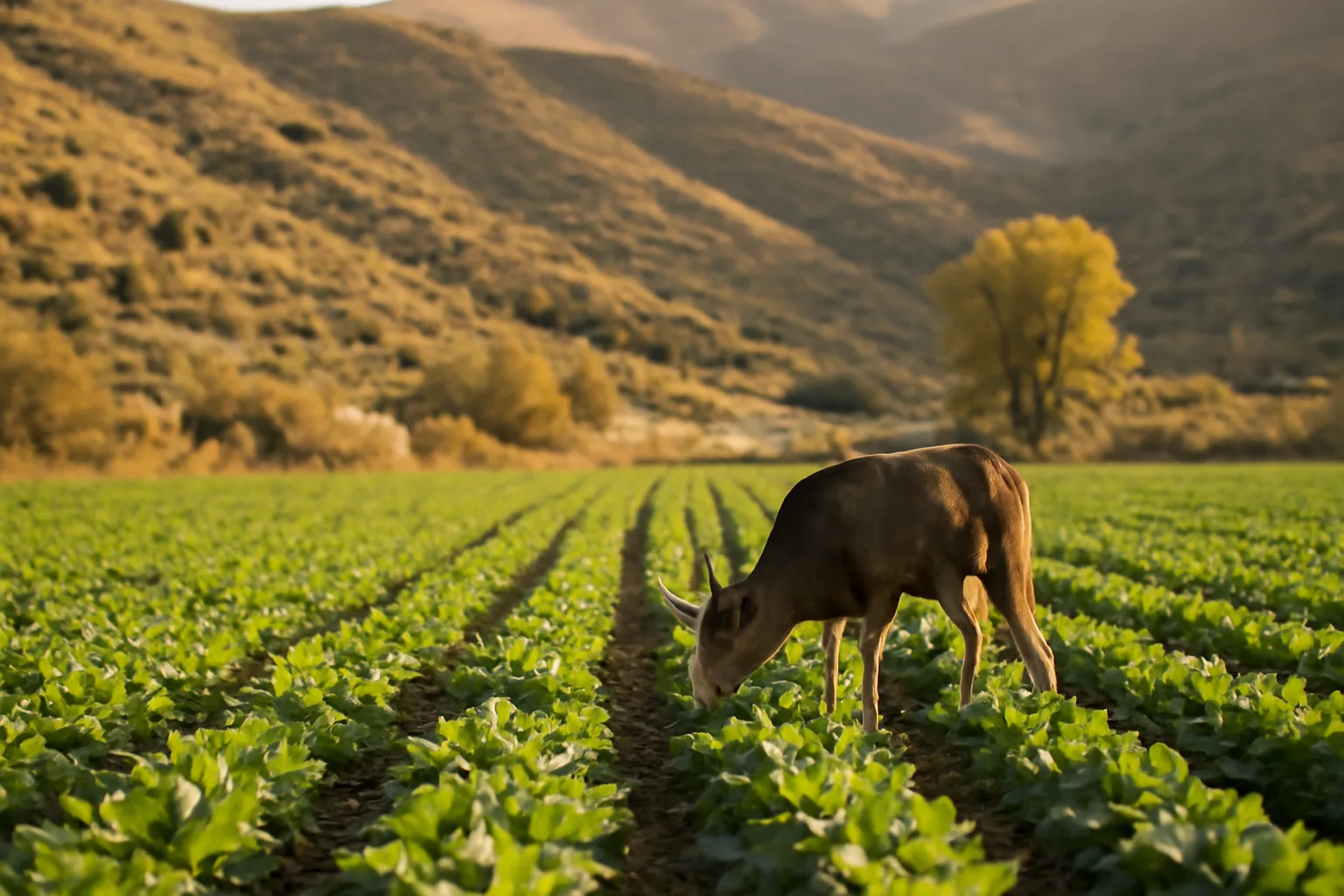
A mule deer food plot works best with brassicas (turnips, radish), oats, and clover planted from mid-July through early September in most western and mountain states, timed 60 to 90 days before the first hard frost. Mule deer favor high-protein forbs and browse over pure grass plots, and a soil test should drive your lime and fertilizer decisions before you plant anything.
What is a food plot, exactly?
A food plot is a planted patch of forage, usually somewhere between a quarter acre and several acres, established on land you own or lease specifically to feed deer and hold them nearby during hunting season or through winter stress periods. It is not the same as baiting. Baiting means putting out piles of corn, minerals, or feed in a spot. A food plot is a growing crop in the ground, planted with seed, fertilized, and managed like a small farm field. Most plots fall into one of two categories: annual plots (planted fresh each year, usually brassicas, cereal grains, or peas) and perennial plots (clover or alfalfa stands that come back for three to five years with mowing and maintenance). For mule deer country, where growing seasons are shorter and soils are often thinner than in whitetail country back east, annual brassica and cereal grain blends tend to outperform perennial clover in raw tonnage produced per acre, though clover still has a real place in irrigated or higher-rainfall pockets. State wildlife agencies generally treat food plots as a habitat practice distinct from bait piles, but the line can get blurry depending on how a plot is planted and hunted. Colorado's state regulations define baiting for big game as placing "salt, minerals, grain, pellets, hay or other food" to attract animals for the purpose of taking them, under 2 Colorado Code of Regulations 406-0, and that definition does not typically capture a standing planted crop [1]. Always check your state's specific regulation before you hunt over or near a plot, because rules on baiting and even on food plots near public land boundaries vary state to state and can carry real penalties. If you want a plan built around your specific coordinates, soil test, and equipment, that is exactly what a Custom Food Plot Plan does for $99, one time. But you can absolutely build a solid plot without it using the steps below.
What are mule deer's favorite foods?
Mule deer are browsers first and grazers second. That single fact drives almost every species decision you'll make for a western plot. Research summarized by Utah State University Extension shows mule deer diets shift heavily toward forbs (broad-leaved flowering plants) and shrubs like sagebrush, bitterbrush, and mountain mahogany, especially in fall and winter when they need calorie-dense, easily digestible browse [2]. This is a real difference from whitetail, which handle a grass-heavy or grain-heavy diet more easily. In a planted food plot context, that translates to a strong preference for: - Brassicas (turnips, radishes, rape) once cold weather sweetens the leaves and bulbs
- Clover, alfalfa, and other legumes when actively growing
- Cereal grains like oats and winter wheat in early growth stages
- Peas, both field peas and Austrian winter peas, which mule deer hit hard when tender Mule deer will also browse standing corn and sorghum stalks and heads once other food is scarce, but neither is a first-choice forage the way brassicas or legumes are. If you are picking a headline species for a mule deer plot, brassicas or a clover/alfalfa mix are the safer bet based on documented diet studies, not sorghum or straight corn. For a broader look at species selection across deer types, the deer food plot seed guide breaks down blends by region and goal.
Do deer eat clover, and do mule deer like clover specifically?
Yes. Deer of all species eat clover readily, and mule deer are no exception. Clover is a legume, meaning it fixes nitrogen from the air into the soil through a relationship with rhizobium bacteria, which is part of why it is a longtime plot staple: it feeds the soil while feeding the deer. Purdue University Extension guidance on forage legumes puts crude protein in actively growing clover in the range of roughly 20 to 30 percent, well above what most native browse offers in summer [3]. For mule deer specifically, clover shines most in irrigated plots or naturally higher-rainfall zones (think foothill benches, river bottoms, mountain parks above 6,000 feet with decent snowpack). In drier high desert country, straight clover can struggle without supplemental water, and a lot of western plot builders lean harder on drought-tolerant alfalfa or brassica blends instead. Clover is a perennial investment: expect three to five years of production from a well-maintained stand versus replanting an annual plot every single year. The tradeoff is establishment. Clover seed is small and needs good seed-to-soil contact and a firm seedbed, and it is slower to bulk up in year one than oats or brassicas. If you are working thin, rocky mountain soil, test a small block first before committing your whole plot budget to clover.
When to plant food plots for deer (general timing)
Timing splits into two windows almost everywhere in the country: a spring/summer window for warm-season plots and clover establishment, and a late-summer window for fall annual plots meant to be at peak palatability during hunting season. For mule deer country specifically, the fall window matters more, because that is when hunting pressure and the pre-winter feeding push both peak. As a rule of thumb, cool-season fall plots (brassicas, oats, wheat, peas) should go in the ground 60 to 90 days before your area's average first hard frost. That gives brassicas time to bulb up and gives cereal grains time to establish a few inches of growth before cold weather locks things down. Because elevation swings so much across mule deer range, from high desert basins to alpine parks, your actual calendar date will vary by a month or more between a low-elevation Wyoming plot and a high-elevation Colorado one. Check your local NOAA climate normals or your county extension office for average first-frost dates before locking in a planting date. Spring perennial establishment (clover, alfalfa) generally goes in as soon as soil temperatures hit the mid-50s Fahrenheit and the frost risk has passed, which in most of mule deer country lands somewhere between late April and early June depending on elevation.
When to plant oats for deer
Oats should go in the ground in late summer, generally 6 to 10 weeks before your first expected frost, so the plants can reach a leafy, several-inch-tall growth stage right as hunting season opens. Oats are one of the most forgiving and fastest-establishing cereal grains for a fall plot, often showing visible green-up in 5 to 7 days under decent soil moisture. For most of mule deer range, that means a planting window somewhere between late July and early September, earlier at higher elevations, later at lower ones. Oats also work well in spring as a nurse crop mixed with clover, where the oats grow fast and give young clover seedlings some shade and structure while they establish, though the oats will get grazed off or mowed once the clover takes hold. One real limitation: oats are not very cold-hardy compared to winter wheat or rye. A hard freeze in the teens will often kill oats outright, while wheat and rye keep growing through much colder temperatures. If your plot needs to produce food deep into December or January, blend oats with winter wheat or cereal rye so you have a fallback once the oats die back.
When to plant turnips for deer
Turnips go in the ground in mid-to-late summer, typically 80 to 90 days before your first hard frost, because they need that full runway to grow both leaf mass and a usable bulb before cold weather sweetens them up through starch-to-sugar conversion. Plant too late and you get leaves but no real bulb development. Plant too early in still-hot summer soil and germination can be spotty. Turnips are a classic brassica choice because deer, including mule deer, generally ignore the leaves in early fall when they are bitter with glucosinolates, then hit both the leaves and bulbs hard once a few frosts sweeten the plant. This late-season surge in palatability is well documented in extension brassica trial work and is the main reason brassica plots often look completely untouched in October and then get hammered to the dirt by late November. Seeding rate for turnips alone typically runs 2 to 4 pounds per acre if drilled, or up to 5 pounds per acre broadcast, since broadcast seeding always needs a bit more seed to compensate for uneven coverage and depth. Blending turnips with radish, rape, and a cereal grain like oats or wheat is generally smarter than a monoculture, since it spreads your risk across species with different drought tolerance and different palatability timelines.
Do deer eat sorghum?
Deer will eat sorghum, particularly the grain heads once they mature and dry down, and it can work as a standing cover crop or a component in a wildlife blend, but it is not a top preference food the way brassicas, clover, or oats are for mule deer. Sorghum is more commonly planted for its drought tolerance, its value as screening cover, and its usefulness for other wildlife like turkey and quail, than as a primary deer attractant. Grain sorghum requires warm soil to germinate, generally above 60 degrees Fahrenheit, which means it is a spring/summer planting, not a fall one, and it needs a full frost-free growing season of around 100 to 120 days to mature grain heads. In much of the higher, colder mule deer range, that growing season window can be tight or nonexistent, which is one practical reason sorghum sees far less use in western mule deer plots than in southern whitetail country. If you already have sorghum in a field edge or as part of a multi-species summer blend, mule deer will browse it opportunistically, especially the young shoots and later the mature grain. But if you are choosing a single species to build a mule deer fall plot around, sorghum is not the efficient choice. Brassicas and cereal grains will get you more deer use per acre in cold-climate conditions.
Do deer like honey (and does it belong in a food plot)?
There is no real evidence that deer are drawn to honey specifically, and honey has no practical place in a food plot. This question shows up online mostly because of confusion with 'deer attractant' products that use sugar, molasses, or apple scent, which are marketed for mineral sites or bait piles, not planted forage. Deer do have a documented sweet tooth in the sense that sugar content drives palatability in browse and forage, which is exactly why brassica bulbs and leaves become so attractive after a frost converts starches to sugars. But that is a plant biology response, not deer seeking out honey or sugar directly. If you are trying to boost attraction to a plot, put your money into soil fertility and the right species mix, not into pouring sweeteners on the ground, which in many states would also cross the legal line into baiting. Check your state wildlife agency's specific definition of bait before adding any scent, sugar, or mineral product near a plot you plan to hunt. Colorado's regulation, for instance, prohibits placing food as an attractant for taking big game statewide [1], and several other western states have similar language.
How do you test and prep soil for a mule deer plot?
Start with a soil test, full stop. A basic soil test measures pH, phosphorus, potassium, and often organic matter, and it typically costs somewhere in the range of $10 to $20 through a university extension lab. That's cheap insurance against wasting a whole season of seed and fertilizer on ground that cannot support it. Land-grant university extension soil labs across the country, including programs in mountain and western states, generally turn results around in one to two weeks once a sample arrives. Mule deer country soils vary enormously, from decent loam in mountain parks to thin, alkaline, rocky ground in high desert basins. A lot of high desert soil runs alkaline (pH above 7.5), which is the opposite problem of the acidic soils common in the eastern whitetail belt, and it changes your amendment strategy. Where eastern growers add lime to raise pH, western plot builders on alkaline ground sometimes need sulfur or acidifying fertilizer to bring pH down into the 6.0 to 7.0 range most food plot species prefer. Your soil test report is the actual authority here, not a general article. It will tell you the specific lime or sulfur rate and the specific nitrogen, phosphorus, and potassium rate for your exact field, based on your exact test results. Follow what your test says over any generic recommendation, because two fields ten miles apart can need completely different fertilizer rates. If digging into that report feels like more than you want to handle alone, a Custom Food Plot Plan takes your soil test numbers, your coordinates, and your equipment list and turns it into a straightforward planting plan for $99, one time. It does not replace your soil lab's specific lime and fertilizer recommendations. Think of it as the planning layer built on top of what your lab already told you.
What equipment do you actually need for a mule deer plot?
At minimum: a way to kill existing vegetation (herbicide and a sprayer, or a disc/tiller), a way to work the seedbed (disc, harrow, or tiller), a way to spread seed (broadcast spreader or a drill), and a way to pack the seed in (cultipacker, or just driving over it with a light ATV/UTV tire). A drill is the single biggest upgrade if you can rent or borrow one, since it puts seed at a consistent depth and dramatically improves germination compared to broadcasting and hoping for rain. Small plots (under 2 acres) are very doable with ATV or UTV-mounted implements: a pull-behind disc, a broadcast spreader, and a drag harrow made from a chain-link section or a section of cyclone fence. Larger plots, especially in remote mule deer country where trucking a tractor in is a real logistics problem, sometimes make more sense worked with a compact tractor rented for a weekend, or by hiring a local farmer with equipment already in the area. Remote access is the real wildcard for mule deer plots that whitetail plotters do not deal with as much. If your plot is a mile up a two-track at 8,000 feet, plan your equipment and your planting window around when that road is actually passable, more than around the ideal calendar date.
How big should a mule deer food plot be, and where should you put it?
Plot size depends entirely on your goal and your acreage, but a workable range for most hunting-focused plots is a quarter acre to 3 acres, with clusters of smaller plots often outperforming one big plot for both deer use and hunting setup. Small plots (under an acre) tucked into timber or brush get more nocturnal or pressured-deer use during daylight, while larger open plots capture more total tonnage but see more night use once deer get pressured. Mule deer, more than whitetail, often move across huge elevational ranges seasonally, migrating from high summer range down to lower winter range. A food plot's real value to a migratory mule deer herd is highest if it sits along a natural transition corridor or on winter range where deer are already concentrating from mid-fall through winter, not off in isolated summer range they will vacate before your plot even matures. Aspect and water matter more in the West than in most whitetail country. A plot on a south-facing slope in high desert country will bake out fast without irrigation. A north-facing bench or a spot near a seasonal drainage holds moisture longer and gives your plants a better shot at surviving a dry August. For more on matching plot type to your property, food plot whitetail and deer food plots both cover broader plot design principles that apply across species, and food plot seed breaks down blend options in more depth.
Mule deer vs. whitetail food plots: what actually changes?
| Top species | Soybeans, corn, clover | Brassicas, oats, alfalfa | |
|---|---|---|---|
| Typical rainfall need | Higher, often 30+ inches annual | Lower, drought-tolerant picks favored | |
| Common soil issue | Acidic, needs lime | Often alkaline, may need sulfur | |
| Migration pattern | Mostly resident, small range | Often long seasonal migration | |
| Plot placement priority | Bedding-to-feeding travel corridors | Winter range and migration corridors | If your property sits in a transition zone, say western Nebraska or eastern Montana where both species overlap, a mixed blend of brassicas, cereal grain, and clover generally covers both audiences reasonably well. For a more general breakdown of species choices by region, deer for food and domain food plot seed both dig into blend selection further. |
The species list overlaps a lot, but the priorities shift. Whitetail plots lean harder on high-tonnage annuals like soybeans and corn plus perennial clover, because whitetail country generally has better rainfall and deeper soil to support that tonnage. Mule deer plots lean harder on brassicas, cereal grains, and drought-tolerant legumes like alfalfa, because mule deer diets skew toward forbs and browse, and western soils and rainfall often cannot support corn or soybean tonnage without irrigation. | Factor | Whitetail plots | Mule deer plots |
Frequently asked questions
Do deer eat sorghum?
Yes, deer including mule deer will eat sorghum grain and young shoots, but it is not a top-preference food compared to brassicas, clover, or oats. Sorghum is more valuable as drought-tolerant cover and for other wildlife like quail and turkey than as a primary deer attractant in a mule deer plot.
Do deer like clover?
Yes, all deer species, including mule deer, readily eat clover. It runs roughly 20 to 30 percent crude protein during active growth according to Purdue Extension forage guidance, making it one of the highest-protein plot options available, though it performs best with reliable rainfall or irrigation rather than in dry high desert ground.
When should you plant food plots for deer?
Fall annual plots (brassicas, oats, wheat) go in 60 to 90 days before your area's average first hard frost. Perennial plots like clover go in spring once soil temps hit the mid-50s Fahrenheit and frost risk has passed, generally late April through early June depending on elevation.
When should you plant oats for deer?
Plant oats 6 to 10 weeks before your expected first frost, generally late July through early September across most mule deer range. Oats establish fast, often showing green-up in 5 to 7 days, but they are not very cold-hardy, so blend with winter wheat or rye if you need late-winter forage.
When should you plant turnips for deer?
Plant turnips 80 to 90 days before your first hard frost, typically mid-to-late summer. That window lets the plant build both leaf mass and bulb size before cold weather sweetens the plant through starch-to-sugar conversion, which is when deer use spikes.
What is a food plot?
A food plot is a planted patch of forage, usually a quarter acre to several acres, established to feed deer and hold them near a property during hunting season or winter. It differs from baiting because it is a growing crop in the ground rather than a pile of feed or grain.
What are deer's favorite foods?
For mule deer specifically, top choices are brassicas (turnips, radish, rape), clover and alfalfa, cereal grains like oats and wheat, and field peas. Mule deer lean more heavily on forbs and shrub browse than whitetail do, so pure grass or grain plots tend to see less use.
Do deer like honey?
There is no real evidence deer specifically seek out honey. Sugar content does affect palatability of forage, which explains why frost-sweetened brassica bulbs get hit hard in late fall, but that is a plant chemistry response, not deer honey preference. Sugar-based attractants near a huntable plot can also cross into illegal baiting in some states.
What is the best food plot for mule deer specifically?
A brassica and cereal grain blend (turnips, radish, oats, winter wheat) generally outperforms other options in mule deer country because it matches their forb-heavy diet, handles drier and thinner soils better than corn or soybeans, and produces a strong late-season palatability spike after frost.
How much does it cost to test soil for a food plot?
A standard soil test through a university extension lab typically runs $10 to $20 and covers pH, phosphorus, potassium, and organic matter. Turnaround is usually one to two weeks. It is one of the cheapest steps in the whole process and the one most likely to save you money on wasted fertilizer.
Can you hunt over a food plot legally?
In most states, a standing planted food plot is legally distinct from a bait pile, but rules vary and some states restrict hunting method or distance near planted plots on certain land types. Always check your specific state wildlife agency's current baiting and food plot regulations before hunting a plot.
How is a mule deer food plot different from a whitetail food plot?
Mule deer plots lean more on brassicas, oats, and drought-tolerant alfalfa because mule deer eat more forbs and browse and western soils and rainfall often will not support corn or soybean tonnage without irrigation. Placement also matters more around migration corridors and winter range rather than small home-range travel routes.
Sources
- Colorado Code of Regulations, 2 CCR 406-0, Big Game Baiting Restriction: Colorado's definition of baiting for big game hunting
- Utah State University Extension, Mule Deer Nutrition and Habitat: Mule deer diet shift toward forbs and shrubs like sagebrush and bitterbrush
- Purdue University Extension, Forage Legumes: Clover crude protein levels of 20 to 30 percent during active growth
- University of Kentucky Cooperative Extension, Establishing Wildlife Food Plots: 60 to 90 day pre-frost planting window for brassica and cereal grain fall plots
- Utah State University Extension: Growing and planting timing information for turnips as a forage crop for deer
- Oklahoma State University Extension: Growing characteristics of sorghum as a forage crop and its suitability for deer food plots