Last updated 2026-07-25
TL;DR
Deer will nibble millet, especially browntop or Japanese millet, but it's a low-preference forage compared to clover, brassicas or beans. Most plot managers plant millet as a dove field, a nurse crop, or a warm-season filler, not as the main deer attractant. Pair it with clover or chicory if whitetail is the real target.
Is millet actually good for deer, or is it more of a dove and turkey plant?
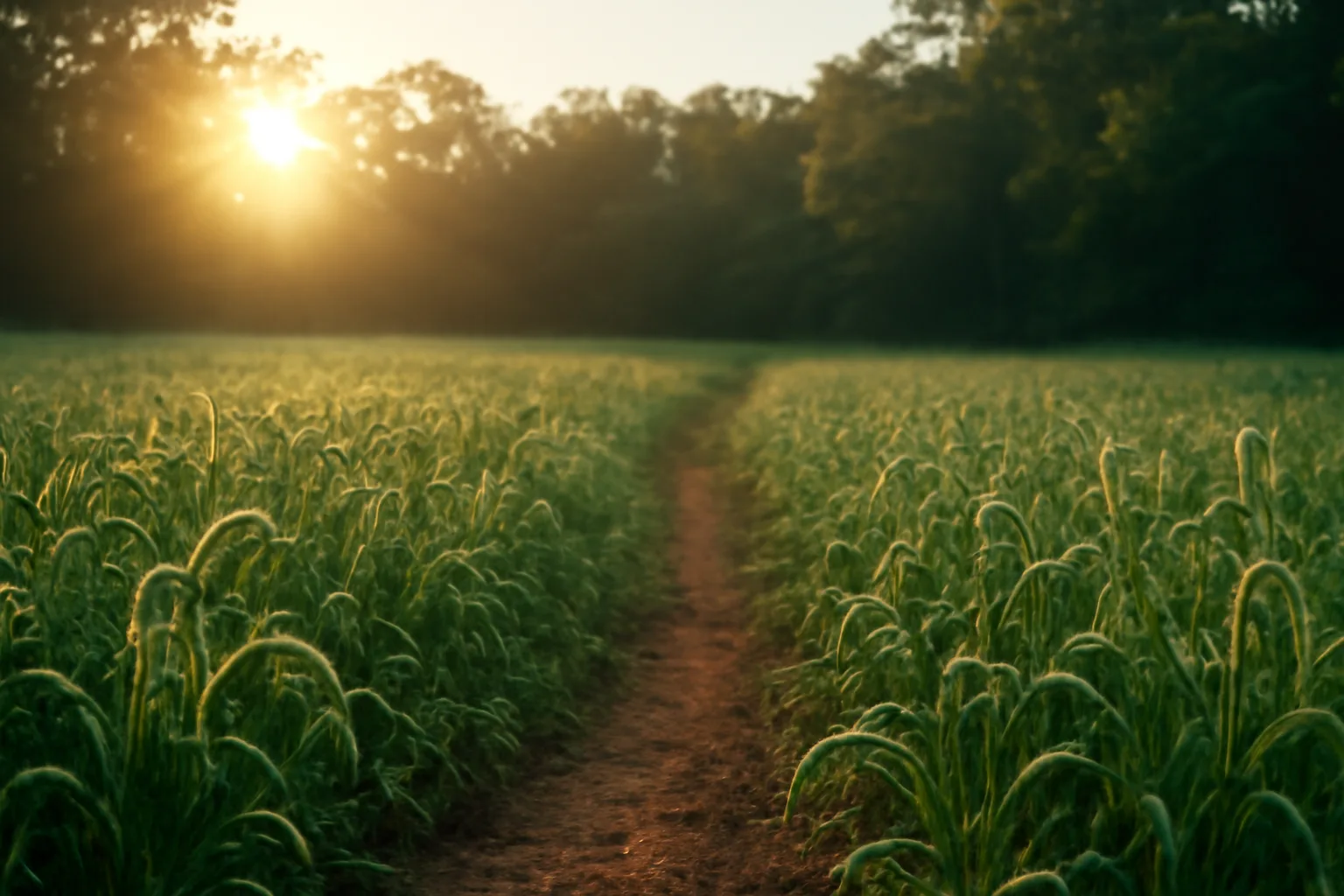
Millet is mostly a bird plant that deer will use on the side. Browntop millet and Japanese millet produce seed heads that turkey, dove, quail and waterfowl key in on, and that's why you see millet blends marketed heavily to upland bird and dove hunters. Deer will browse the young leaves and stems in summer, and they'll pick at fallen seed once it matures, but it's not a preferred forage the way clover, soybeans, or brassica tops are. Cooperative extension forage work backs this up. Land-grant forage guides describe browntop millet as a fast-growing warm-season annual grazed by livestock and planted for wildlife mainly for its seed value to birds, not as a top-tier deer forage [1]. If your goal is antler growth or drawing deer into bow range on a food source they prefer, millet alone isn't the tool. If your goal is a mixed-species field that also pulls in dove season traffic and gives deer some summer greenery, millet earns a spot. A lot of plot builders use millet as a nurse crop too. It germinates fast, holds soil in place, and gives a slower-establishing legume like clover or chicory some cover while it gets going. That's arguably millet's best real job on deer ground: not the entree, but the plate it's served on.
Do deer eat sorghum?
Yes, deer eat grain sorghum (milo), mostly the leaves and young shoots in summer and the grain heads once they mature and start to lean over or lodge. Sorghum shows up in a lot of dove field mixes for the same reason millet does: birds love the seed. Deer use is secondary and generally described as light to moderate browsing pressure in university forage guides, not a preferred food source [1]. Grain sorghum has a real advantage in drought-prone ground. It handles heat and dry spells better than corn and needs less nitrogen to produce a decent yield, which is why row-crop farmers in the southern Plains lean on it. For a food plot, that drought tolerance can matter if you're planting on thin, sandy soil with no irrigation. But if whitetail attraction is the only goal, soybeans or cowpeas will pull more deer per acre than sorghum will.
Do deer like clover, and how does it compare to millet?
Yes, and it's not close. Clover, especially white clover and red clover varieties bred for forage plots, is one of the most consistently preferred whitetail foods across the growing season. Forage quality research on clover, including work published through the Journal of Animal Science on legume nutritive value, points to crude protein commonly in the 20 to 25 percent range for actively growing clover, well above what a mature annual grass like millet offers, and clover holds that quality across a much longer grazing window [1]. The practical difference: millet is an annual grass that produces seed and dies. Clover, if it's a perennial variety like Durana or Ladino white clover, can produce grazable forage for three to five years off one planting if you maintain it with mowing and the right lime and fertility program. That's a fundamentally different investment. Millet costs you a planting every year. Clover costs more up front in seed and lime but spreads that cost over several seasons. If you're choosing between the two for a fall attraction plot, clover wins almost every time. Millet's case is narrower: as a warm-season component in a dove field, as erosion control on disturbed ground, or as a nurse crop for a slower legume establishing underneath it. For a deeper look at clover varieties and blends, see our guide on food plot seed selection.
When should you plant food plots for deer?
Timing splits into two windows: spring/summer plantings for warm-season annuals and perennials, and late summer/early fall plantings for cool-season annuals like brassicas, cereal grains, and clover establishment. Millet falls in the first window because it's a warm-season grass that needs soil temperatures above roughly 65°F to germinate well. Most of the whitetail range plants warm-season plots (soybeans, cowpeas, millet, sorghum) between mid-April and early June depending on latitude, and cool-season plots (clover, brassicas, cereal grains) between mid-August and early October. State extension planting calendars tie these windows to your average last spring frost date and first fall frost date, and NOAA's National Centers for Environmental Information maintains the historical frost/freeze data those local calendars are built from [2]. The honest answer for any specific date is: pull your local frost dates and count backward or forward from there, because a grower in south Georgia and a grower in northern Wisconsin are working with completely different calendars. If you want that mapped out for your actual coordinates and soil test results, that's the exact gap a Custom Food Plot Plan is built to close, a $99 one-time plan that turns your soil test and location into a specific seed list and planting window instead of a generic calendar.
When should you plant millet specifically?
Plant millet after your last spring frost, once soil temperatures are consistently above 65°F, and no later than about 90 days before your first fall frost so it has time to mature seed heads if that's your goal. For most of the whitetail range that puts planting anywhere from late April in the Deep South to early June in the upper Midwest and Northeast. Browntop millet is one of the fastest-maturing summer annuals available, producing a seed crop in as little as 60 to 70 days under good conditions, which is part of why it's a go-to for dove field managers working a tight summer window [1]. Japanese millet tolerates wetter, poorly-drained ground better than browntop and is a common choice for moist-soil waterfowl and wildlife management units. Seeding rate for browntop millet typically runs 25 to 30 pounds per acre broadcast, drilled rates a bit lower, around 15 to 20 pounds per acre, planted a half inch to an inch deep. Don't plant it deep. Millet seed is small and shallow planting depth matters more than people expect.
When should you plant oats for deer?
Plant oats in late summer to early fall, generally 4 to 8 weeks before your area's first killing frost, so they're a cool-season cereal grain, not a spring planting like millet. That timing puts most oat plantings anywhere from mid-August in northern states to late September or even October in the Deep South. Oats are one of the more reliably preferred cereal grains for deer in fall and early winter, and they're also one of the least cold-hardy, which is actually part of their appeal to hunters targeting early bow season. Oats green up fast, deer hit them hard while they're tender, and in colder climates the plant often winterkills, which some managers like because it doesn't compete with clover or brassicas the following spring. Extension cereal grain guides list oats among common cool-season components in wildlife food plot mixes, typically seeded at 2 to 3 bushels per acre (roughly 96 to 128 pounds, since a bushel of oats weighs 32 pounds) [1]. If you're in a region with harsh winters and want oats to survive into spring, look at winter-hardy varieties bred for that; standard spring oat varieties usually don't make it through a hard freeze.
When should you plant turnips for deer, and do deer actually eat them?
Plant turnips in late summer, roughly 60 to 90 days before your first fall frost, because they need that runway to bulb up and because deer preference for turnips typically increases after the first hard frost sweetens the leaves and roots through starch-to-sugar conversion. For most of the Midwest and mid-South that's a planting window from late July through late August; further south you can push into September. Deer absolutely eat turnips, though it's a two-stage relationship. Early in the season deer often ignore the bulbs and browse only the leaf tops. After a frost or two, sugar content rises and deer will start digging up and eating the bulbs themselves, sometimes cleaning a field down to bare dirt by late winter. This frost-triggered preference shift is well documented in university brassica variety trial work, including forage brassica research from North Carolina State University Extension on turnip, radish and rape performance and grazing timing in wildlife and livestock plots. Seeding rate for turnips is light, typically 4 to 6 pounds per acre if planted alone, less if blended with other brassicas like radish or rape. Turnip seed is tiny; broadcasting into a firm, prepared seedbed and rolling or cultipacking afterward gets you far better germination than deep drilling.
What is a food plot, exactly?
A food plot is a planted area of forage or grain established specifically to feed and attract wildlife, most commonly deer and turkey, on hunting land. It ranges from a quarter-acre kill plot tucked into timber to a multi-acre field planted like a small farm operation. Food plots serve a few overlapping purposes: supplemental nutrition (especially protein during antler growth and lactation), late-season food when natural browse is scarce, and hunting access, since a well-placed plot concentrates deer movement in a predictable spot at a predictable time of day. State wildlife agencies generally treat food plots as a habitat management practice, distinct from baiting, which is regulated separately and defined by placing loose grain or feed rather than growing a standing crop. Rules vary a lot by state, so check your state wildlife agency's baiting and feeding regulations before combining plots with any supplemental feed, since what counts as a legal food plot versus an illegal baited area differs from Michigan to Texas to Pennsylvania. For a broader rundown on plot types and how to pick one for your ground, see food plot whitetail and deer food plots.
What are deer's favorite foods, and where does millet rank?
| Soft mast / acorns | Very high | Fall | |
|---|---|---|---|
| Soybeans (forage type) | High | Summer-fall | |
| Clover (white/red) | High | Spring-fall | |
| Brassicas (turnip, radish) | High (post-frost) | Late fall-winter | |
| Cowpeas | High | Summer | |
| Oats | Moderate-high | Fall | |
| Chicory | Moderate-high | Spring-fall | |
| Millet (browntop/Japanese) | Low-moderate | Summer | |
| Grain sorghum | Low-moderate | Summer-fall | The practical takeaway: if you're planting one plot and want maximum deer draw, put your money in clover, brassicas, or a bean, not millet. Millet earns its keep in a mixed dove/deer field or as a nurse crop, not as a standalone attractant. |
Deer preference research consistently ranks certain acorns, soft mast, and high-protein legumes at the top, with millet ranked well below that tier. The Texas Parks and Wildlife Department's white-tailed deer food habits publication groups mast, forbs, and browse into preference tiers based on decades of rumen content and pen-trial studies, placing acorns, legumes like clover and native forbs high on the list and grasses (including millet) lower, used more opportunistically as filler forage [3]. Here's a rough ranking, acknowledging that regional forage availability shifts this constantly: | Forage type | Deer preference | Season |
Do deer like honey, or is that just a hunting myth?
No, deer don't seek out honey as a food source, and there's no research or extension guidance supporting honey as a deer attractant. Deer are herbivores built to digest cellulose and plant sugars through a four-chambered rumen; they're not drawn to concentrated sugars the way an omnivore or insect might be, and there's no documented natural behavior of deer raiding beehives or licking honey the way bears do. Where this myth probably comes from: commercial deer attractant sprays and mineral licks sometimes use sweet, sugary scents (molasses-based products are common and do have some track record) and hunters conflate that with honey specifically. Molasses-based mineral and attractant products are a different category with actual field use behind them, but plain honey isn't a documented deer food or lure. Save it for your coffee, not your plot.
How do you plant millet correctly if you decide to use it?
Prep a clean seedbed, broadcast browntop millet at 25 to 30 pounds per acre (or drill at 15 to 20 pounds per acre), cover it a half inch to one inch deep, and plant after soil temps hit 65°F. Millet is forgiving on soil quality compared to clover or brassicas, tolerating lower pH and lower fertility, which is part of why it's a popular choice on rough, newly-cleared, or poor ground. That said, a soil test still matters. Land-grant extension programs recommend testing soil before any planting to know your baseline pH and phosphorus/potassium levels, since millet still responds to nitrogen and will yield better with even modest fertility correction [1]. Your soil test lab's specific lime and fertilizer recommendation is the authority here, not a generic bag-label rate; follow what the lab report says for your field, not a one-size number pulled off the internet. Millet doesn't tolerate standing water well except for Japanese millet, which is bred for wetter ground. Browntop millet on a poorly-drained flat will struggle. Match the millet type to the site: browntop for typical upland plot ground, Japanese millet for the low, damp corners other seed won't handle. If you're mapping out a whole-property planting plan and want species matched to each specific field rather than guessing off internet averages, that's the kind of task a Custom Food Plot Plan handles for $99 one-time, using your soil test results and location to build a real planting calendar. It's general guidance built from your data, not a site visit or a guarantee of deer activity.
What should you actually plant instead of, or alongside, millet?
If deer attraction is the primary goal, lean on clover, soybeans, cowpeas, or brassicas depending on season, and treat millet as a supporting piece rather than the main plot. A reasonable warm-season mix on many properties looks like soybeans or cowpeas for tonnage and protein, with a strip of millet along the edge for dove season and turkey brood cover. For a full-season approach, a lot of managers run a spring/summer plot (beans, cowpeas, maybe a millet border) and a fall plot (clover, brassicas, oats or winter wheat) on separate fields or in rotation. That gives you spring/summer nutrition for antler growth and lactating does, plus a fall and winter draw when hunting season actually opens. Browse our comparisons of deer food plot seed and domain food plot seed blends if you're trying to figure out which pre-mixed bag actually fits your region and soil, and check deer for food for a broader strategy overview.
Frequently asked questions
Do deer eat millet?
Yes, but as a low-to-moderate preference food. Deer browse young millet leaves and stems in summer and pick at fallen seed once it matures, but extension forage guides rank it below clover, soybeans, and brassicas in deer preference. It's more valuable as a dove/turkey seed source or a nurse crop for slower-establishing legumes.
Do deer eat sorghum?
Yes. Deer browse grain sorghum's young leaves and stems and eat mature grain heads, especially once the plant lodges over. It's used more heavily by farmers and dove-field managers than by deer-focused plot builders, and it's considered a moderate, drought-tolerant option rather than a top attractant.
Do deer like clover?
Very much so. Clover, especially white and red clover forage varieties, is one of the highest-preference whitetail foods available, offering 20-25% crude protein during active growth and multiple years of grazing from one perennial planting if maintained with mowing and proper fertility.
When should you plant food plots for deer?
Warm-season plots (soybeans, millet, sorghum) go in mid-April through early June depending on latitude, once soil is warm and frost risk has passed. Cool-season plots (clover, brassicas, oats) go in mid-August through early October, timed 60-90 days before your first fall frost.
When should you plant turnips for deer?
Plant turnips 60 to 90 days before your first fall frost, typically late July through August in much of the Midwest and mid-South. Deer preference for turnip bulbs and leaves rises after the first hard frost converts starches to sugars, making them a strong late-season food source.
What is a food plot?
A food plot is a planted patch of forage or grain crop established on hunting land to feed and attract deer, turkey, or other wildlife. It ranges from a small hidden kill plot to multi-acre fields, and functions differently from baiting, which involves loose grain and is regulated separately by state law.
What are deer's favorite foods?
Acorns and other soft mast typically rank highest, followed by high-protein legumes like clover, soybeans, and cowpeas, and post-frost brassicas like turnips and radishes. Preference shifts by season and region based on what's naturally available, but millet and grain sorghum generally rank lower on the list.
Do deer like honey?
No. Deer are herbivores with no documented preference for honey or concentrated sugar sources the way bears show for beehives. The myth likely comes from confusing honey with molasses-based commercial deer attractants and mineral products, which do have some field use behind them.
When should you plant oats for deer?
Plant oats 4 to 8 weeks before your area's first killing frost, generally mid-August in northern states through late September or October in the Deep South. Oats green up fast and are a preferred fall cereal grain, though standard varieties often winterkill in harsh climates.
Is browntop millet or Japanese millet better for deer plots?
Browntop millet suits typical, well-drained upland plot ground and matures fast (60-70 days). Japanese millet tolerates wet, poorly-drained soil far better and is the go-to choice for moist-soil units and low spots where browntop would struggle or drown out.
Can you plant millet and clover together?
You can use millet as a nurse crop for clover establishment. Millet germinates and grows quickly, providing some cover and competition control while slower-establishing clover gets rooted, though you'll eventually need to mow or manage the millet down so it doesn't shade out the clover stand long-term.
Does millet need a lot of fertilizer to grow well?
No, millet tolerates lower soil fertility and pH better than clover or brassicas, which is why it's popular on rough or newly-cleared ground. It still responds to nitrogen and yields better with basic fertility correction, so a soil test is worth doing even for a forgiving crop like millet.
Sources
- University of Georgia Extension, Summer Annual Forage Grasses (Bulletin 1216): Browntop millet, sorghum, oats and clover characteristics for forage and wildlife plantings, seeding rates and fertility needs
- NOAA National Centers for Environmental Information, U.S. Frost/Freeze Dates Climate Normals: Regional last spring frost and first fall frost data used to set warm-season and cool-season planting windows
- Texas Parks and Wildlife Department, White-tailed Deer Food Habits and Nutrition: Ranking of deer forage preference including mast, legumes, and grasses
- USDA National Agricultural Statistics Service, Small Grains Standard Weights per Bushel: Standard test weight of 32 pounds per bushel for oats, used to convert seeding rate from bushels to pounds per acre
- Journal of Animal Science, forage legume nutritive value and crude protein content research: Crude protein content of actively growing clover in the 20 to 25 percent range