Last updated 2026-07-26
TL;DR
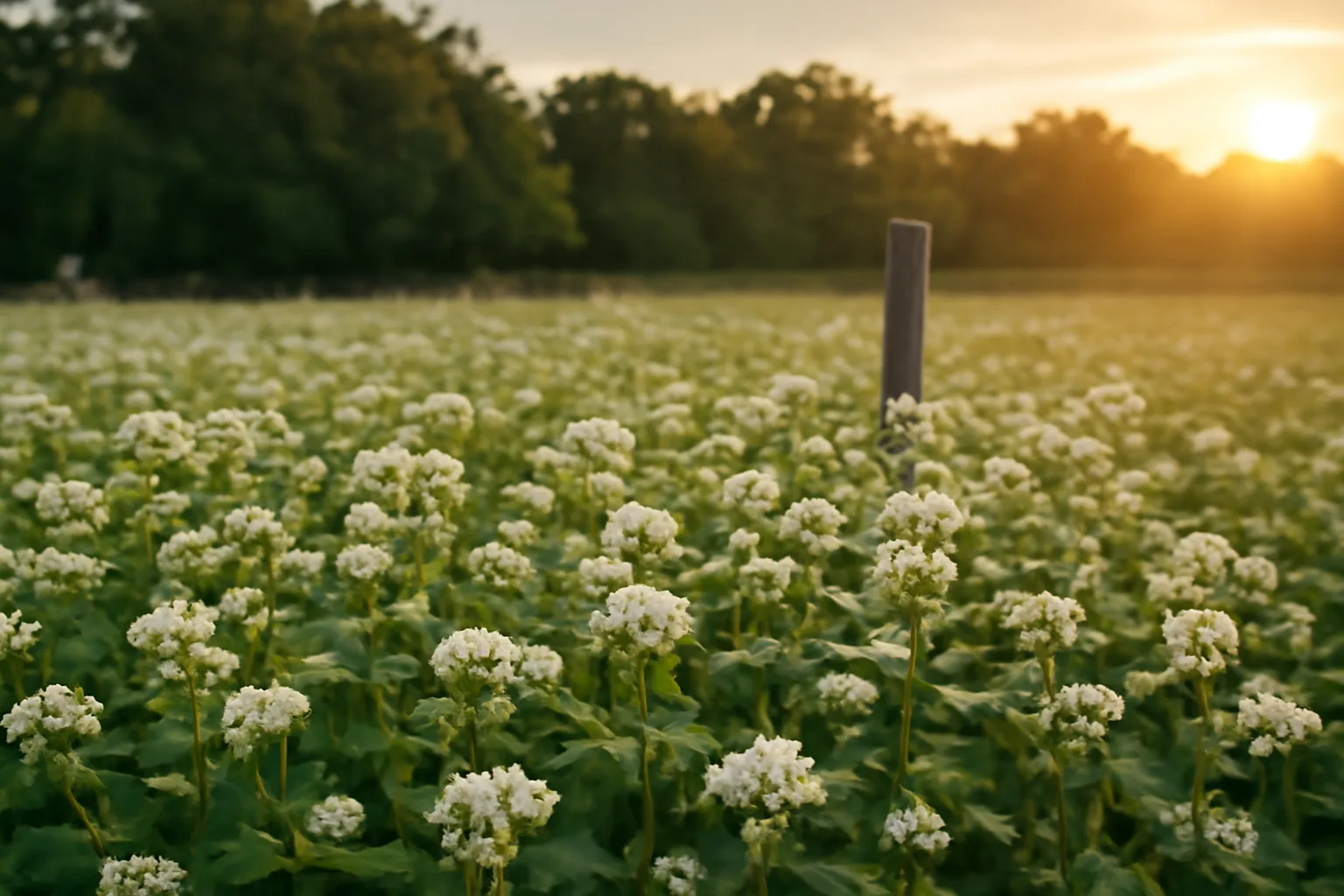
Buckwheat is a solid short-term choice for soil building, weed suppression, and early summer deer attraction, but it dies at the first frost and can't carry a plot into hunting season. Use it as a nurse crop or soil-rebuild step before planting clover, brassicas, or a fall grain blend.
Is buckwheat actually good for deer food plots?
Buckwheat works well for specific jobs, but it's not a fall hunting plot on its own. It germinates in 3 to 5 days, grows fast enough to choke out summer weeds, and deer will eat the tender shoots and later the seed heads. The catch is timing: buckwheat is a warm-season annual that dies at the first hard frost, so it's finished right about when deer season gets interesting [1]. Most experienced plotters use it as a bridge crop. Plant it in early summer to smother weeds and add organic matter, then terminate it and drill a fall blend of brassicas, cereal grains, or clover into the residue. Cornell's field crop guidance notes buckwheat is often grown specifically as a smother crop between other plantings because of how fast the canopy closes [2]. If your goal is a plot deer are hammering in October and November, buckwheat by itself won't get you there. If your goal is fixing compacted or depleted dirt before you plant something that will get hunted over, it's one of the better cheap tools available. For a broader look at which species actually fit a hunting-season plot, see food plot whitetail and deer food plot seed.
What is a food plot, exactly?
A food plot is a planted patch of forage or grain, usually somewhere from a quarter acre to several acres, established specifically to feed and attract deer or other wildlife on a property. It's not the same as a farm field, even though the equipment and seed can overlap. Most state wildlife agencies treat food plots as a wildlife management tool rather than agriculture, and many state hunting regulations distinguish planted food plots from baiting or feeding, though the line differs by state. Michigan's DNR, for example, defines baiting as placing feed to attract game but generally allows food plots as a standard land management practice, while some other states have specific plot-size or visibility rules baked into their baiting statutes [3]. Always check your own state wildlife agency's current baiting and feeding regulations before you plant near a stand, because rules on this vary and change. A basic plot needs four things: decent soil (or corrected soil), the right seed for your region and season, some way to get seed into the ground, and a plan for when to plant it. That last piece trips up more people than bad seed does. If you want a plan that accounts for your zone, soil test, and equipment instead of guessing, that's the whole reason we built the $99 Custom Food Plot Plan. One-time cost, no subscription, and it's built around what you actually have to work with.
What are deer's favorite foods?
Deer are opportunistic browsers, and their preferences shift by season, region, and what's available. That said, several crops show up again and again as high-preference food plot species. Clover, especially white clover varieties like ladino, is one of the most consistently preferred food plot forages across the whitetail's range because it's high in protein (often 25 to 30 percent crude protein in vegetative growth) and stays palatable through most of the growing season [4]. Soybeans and cowpeas rank high during summer for the same protein-heavy reason. Brassicas like turnips and radishes get preferred hard after a frost, once cold temperatures convert starches to sugars in the leaves and bulbs. In fall and winter, acorns often beat anything you plant, when they're available in a mast year. That's not something you control, but it's worth knowing your plot is competing with the woods, not replacing it. Bottom line: there's no single "favorite," it changes with the calendar. A property with clover for summer, brassicas for post-frost, and a grain component for winter covers more of the year than any one species can. For seed selection across that whole calendar, deer food plots and food plot seed break down species by season.
Do deer eat clover, and do they actually like it?
Yes, deer eat clover readily, and it's one of the most reliable food plot species available. White clover (Trifolium repens) varieties like ladino and Durana are staples of food plot mixes because they're perennial (lasting 3 to 5 years with good management), tolerate mowing and grazing pressure, and keep producing protein-rich forage through spring, summer, and fall [4]. University of Tennessee Extension notes that clover food plots can sustain heavy browsing pressure better than many annuals because the plant regrows from the crown after grazing, unlike a soybean or brassica plant that gets grazed out once and doesn't come back [4]. That's a big part of why clover shows up in nearly every perennial plot mix on the market. The tradeoff is establishment. Clover seed is tiny, needs shallow planting (1/4 inch or less) and firm seed-to-soil contact, and it's slow to get going compared to a grain. It also needs a soil pH around 6.0 to 7.0 to perform well, which is where a soil test earns its keep before you plant a dime of seed.
When should you plant food plots for deer?
| Deep South (zone 8-9) | Late March to April | Late September to October | |
|---|---|---|---|
| Mid-South / Transition | April to early May | Early to mid-September | |
| Upper Midwest / Northeast | Mid-May to early June | Mid-August to early September | |
| Northern tier / Canada | Late May to mid-June | Early to mid-August | These are general windows, not guarantees, since local frost dates and soil temperature swing year to year. Your county cooperative extension office publishes local frost date tables, and that's a better source than any national chart for nailing down the exact week to plant in your specific county. |
Timing splits into two windows: spring/summer plantings for warm-season annuals and perennials, and late summer/early fall plantings for cool-season annuals that peak during hunting season. Warm-season plots (soybeans, cowpeas, buckwheat, clover establishment) generally go in after your last frost date, which varies enormously by region, anywhere from early April in the Deep South to early June in the northern tier and Canada-adjacent states. Cool-season plots (brassicas, cereal grains, clover overseed) go in 6 to 10 weeks before your area's first killing frost, so the plants have time to establish before growth slows. Here's the general breakdown by region: | Region | Warm-season plot window | Cool-season plot window |
When should you plant oats for deer plots?
Oats go in as a fall cool-season planting, typically 60 to 90 days before your first expected frost, so they establish before cold weather slows growth. In most of the whitetail's range that lands somewhere between mid-August and mid-September. Oats are a favorite fall attractant because they're fast to germinate (often 5 to 10 days), tolerate cooler soil temperatures better than many legumes, and deer hit them hard in the first 6 to 8 weeks after emergence while the leaves are still tender. Purdue Extension research on forage oats notes that oats produce high-quality forage in fall but winterkill in most of the Midwest once temperatures drop into the mid-teens or lower, so they're generally a one-season fall plot rather than a plant-it-once perennial [5]. A lot of plotters mix oats with a brassica like turnips or a cereal grain like wheat or rye in the same fall blend. The oats germinate fast and give deer something to eat right away while the slower brassicas bulb up, and the wheat or rye keeps producing into winter after the oats have died back from cold.
When should you plant turnips for deer?
Turnips are a fall brassica, and timing is less flexible than most people think: plant them 70 to 90 days before your first hard frost so the bulbs have time to size up before deer start hitting them hard. That generally means late July through August across most of the whitetail range, earlier in northern states, later in the South. Plant too late and you get small bulbs and thin leaf mass right when you wanted a big fall draw. Plant too early in hot weather and germination and seedling survival both suffer. The reason turnips are worth the timing precision is the frost-trigger effect: cold weather converts starches in the leaves and bulbs to sugars, which is why a turnip plot that deer mostly ignore in October can get hammered in late November and December once a few hard frosts hit it [6]. If you're hunting late season, this is one of the more predictable food plot behaviors out there, not a guarantee, but a well-documented pattern. Seeding rate matters too. Most turnip blends run 2 to 5 pounds per acre broadcast, and going heavier doesn't necessarily help since turnips need room to bulb.
Do deer eat sorghum?
Yes, deer eat sorghum, both the grain heads and to a lesser extent the foliage, but it's more of a late-season and winter food source than a hunting-season draw. Grain sorghum (milo) produces seed heads that mature in fall and stand up well through winter weather, which makes it valuable as a standing grain source when other crops are gone. Sorghum is drought-tolerant and grows in soils and heat that would stress corn, which is part of why it shows up in food plot mixes for the Southern Plains and parts of the Midwest. It's rarely a deer's first choice when clover or soybeans are available nearby, but once softer forages get grazed out or go dormant, standing sorghum grain becomes a real winter food source, and turkey and other wildlife use it heavily too. One practical note: sorghum can produce cyanogenic compounds (prussic acid) in young, stressed, or frost-damaged growth, a known risk in forage sorghum and sudangrass documented by university extension forage programs, generally a livestock grazing concern rather than a food plot concern for deer, but worth knowing if you're also running cattle or goats near the same ground [7].
Do deer like honey, and does that matter for food plots?
Deer aren't drawn to honey in any food plot or attractant sense that matters practically. This question usually comes up because of "honey hole" terminology (a hunter's best spot) or confusion with mineral and molasses-based attractants, not because deer seek out honey itself. White-tailed deer are herbivores built around a rumen digestive system suited to fibrous plant material, not concentrated sugars in the form deer would encounter honey. Where sugar and molasses show up legitimately in deer attraction is in mineral licks and some commercial attractant products, and even there, the draw is more about salt and mineral content than sweetness. If you're trying to boost fall attraction, your money is far better spent on brassicas (which sweeten naturally after frost, see the turnip section above) or a proven grain like oats than on anything marketed around honey or sugar. And again, check your state wildlife agency's rules before putting out any supplemental attractant, since bait and mineral regulations vary widely and some states restrict them entirely near hunting areas [3].
How does buckwheat fit into a plot rotation with clover, oats, and turnips?
Buckwheat's real value is as a setup crop, not a standalone plot. Here's a rotation that uses it the way most successful plotters actually do. Start in late spring or early summer once soil temps hit the mid-50s: broadcast or drill buckwheat at 50 to 70 pounds per acre. It germinates fast, canopies over in about 3 weeks, and outcompetes most summer weeds without a drop of herbicide. Deer will browse the young growth some, but the real job here is smothering weeds and adding organic matter as it decomposes. About 6 to 8 weeks later, mow or terminate the buckwheat before it goes to hard seed (or let it, since deer and turkey will eat the seed too), then drill your fall blend, oats, turnips, and clover, straight into the residue. The buckwheat has already done the work of breaking up light weed pressure and adding a flush of organic matter, and your fall planting goes into cleaner, softer ground than it would have without the summer step. This is exactly the kind of sequencing question a soil test and a season-by-season plan solve better than a bag of seed and a guess. That's the gap our $99 Custom Food Plot Plan is built to close: you get a plan sequenced to your zone, your soil test results, and the equipment you've already got, not a generic bag recommendation. Your soil test lab is still the authority on exact lime and fertilizer rates; the plan works from those numbers, it doesn't override them. For more on picking species that fit specific plot roles across the year, see deer food plots and domain food plot seed.
What soil and fertility does buckwheat need compared to clover or brassicas?
Buckwheat is one of the least demanding food plot crops out there, which is another reason it's a good fit for rough or newly broken ground. It tolerates soil pH from about 5.0 to 7.0, well below the 6.0 to 7.0 range clover generally needs to perform, and it doesn't need heavy nitrogen since it's not trying to build a deep root system or a perennial stand. Cornell's field crop guidance describes buckwheat as well-suited to low-fertility soils and notes it's often used specifically because it doesn't require the fertility investment other crops do [2]. That's the flip side of the coin, though: because it's not pulling a lot of nutrients, it's not building much for you either beyond organic matter and structure. If your soil test comes back needing serious lime or phosphorus work, buckwheat won't fix that, it just tolerates it while you get the real fertility program dialed in for whatever you plant next. Follow your soil test lab's specific lime and fertilizer recommendations regardless of what crop you're using to bridge the season.
Where does buckwheat make sense, and where should you skip it?
Buckwheat earns its keep in three specific situations: new plot ground that's weedy or compacted, a summer gap between a spring planting and a fall hunting plot, and low-budget soil building where you can't afford a cover crop mix or a herbicide program. Skip it if your only plot window is a single fall planting for hunting season. In that case, put your seed budget straight into oats, brassicas, or a cereal grain and clover blend, since buckwheat dying at first frost means it contributes nothing to your stand-time forage. It's also a poor choice on ground you can't get back into for a second planting. Buckwheat by itself, left to die back with nothing planted after it, mostly just becomes standing dead stalks by hunting season, not a food source. For most properties, the honest answer is: buckwheat is a good tool, used at the right time, for the right job. It's not a fall food plot crop on its own, and nobody selling it as one is giving you the full picture.
Frequently asked questions
Is buckwheat good for deer food plots?
It's a good short-term tool for soil building, weed suppression, and early summer deer attraction, but it's a warm-season annual that dies at the first frost. Use it as a nurse crop ahead of a fall blend (oats, turnips, clover), not as your only planting for hunting season.
Do deer eat sorghum?
Yes. Deer eat sorghum grain heads and some foliage, mostly as a late-season and winter food source once softer forages are gone or dormant. It's drought-tolerant and holds up standing through winter weather, but it's rarely a deer's first choice when clover or soybeans are available nearby.
Do deer eat clover?
Yes, and it's one of the most reliable food plot species available. White clover varieties like ladino run 25 to 30 percent crude protein in vegetative growth and stay palatable spring through fall, which is why clover shows up in nearly every perennial food plot mix on the market [4].
When should you plant food plots for deer?
Warm-season plots (soybeans, buckwheat, clover establishment) go in after your last frost date, roughly April in the South to early June up north. Fall plots (brassicas, oats, cereal grains) go in 6 to 10 weeks before your area's first killing frost so plants establish before growth slows.
Do deer like clover?
Yes, clover is consistently one of the highest-preference food plot forages across the whitetail's range. It's high in protein, regrows after grazing (unlike most annuals), and stays productive spring through fall once established, which is why it's a staple in perennial plot mixes.
When should you plant oats for deer?
Plant oats 60 to 90 days before your first expected frost, generally mid-August to mid-September across most of the whitetail range. Oats germinate fast (5 to 10 days), give deer an early fall food source, and winterkill once temperatures drop hard, so they're a one-season fall planting, not a perennial.
When should you plant turnips for deer?
Plant turnips 70 to 90 days before your first hard frost, generally late July through August depending on your region. Timing matters here because turnips need that window to bulb up before frost sweetens the leaves and bulbs, which is what triggers the strong late-season deer draw.
What is a food plot?
A food plot is a planted area, usually a quarter acre to several acres, established specifically to feed and attract deer or other wildlife. It requires suitable soil (often corrected with lime or fertilizer), region-appropriate seed, planting equipment, and correct timing for your zone's growing season.
What are deer's favorite foods?
There's no single favorite; it shifts by season. Clover and soybeans rank high in summer for protein, brassicas like turnips get preferred hard after frost, and acorns often beat any planted crop in a good mast year. A property with multiple food types covers more of the calendar than one species can.
Do deer like honey?
Not in any practical food plot sense. Deer are herbivores built around fibrous plant material, not concentrated sugars like honey. Where sugar or molasses shows up in deer attraction, it's in mineral licks or commercial attractant products, and even then the draw is mostly salt and mineral content, not sweetness.
Can you plant buckwheat and clover together?
Not really as a long-term mix. Buckwheat grows fast and shades out slower-establishing clover seedlings, then dies at first frost and leaves the clover stand thinner than if it had established alone. Better practice: plant buckwheat first as a summer smother crop, terminate it, then drill clover afterward.
How long does a buckwheat food plot last?
About 10 to 12 weeks from planting to frost kill in most regions, since it's a fast-growing warm-season annual. It flowers around 5 to 6 weeks after planting and can produce mature seed by 10 to 12 weeks, but a hard frost ends the stand regardless of growth stage.
Does buckwheat need fertilizer for a deer plot?
Very little. Buckwheat tolerates low-fertility soils and a pH range of roughly 5.0 to 7.0, well below what clover needs, and it doesn't require heavy nitrogen. That's part of why it's used on rough or newly broken ground; it's more about tolerating poor soil than building major fertility itself.
Sources
- USDA NRCS Plant Guide, Buckwheat (Fagopyrum esculentum): Buckwheat is a fast-germinating, frost-sensitive warm-season annual
- Cornell University Cover Crop Guide, Buckwheat: Buckwheat is used as a smother crop for weed suppression and tolerates low-fertility soils
- Michigan DNR, Baiting and Feeding Regulations: State agencies distinguish food plots from baiting/feeding under wildlife regulations, which vary by state
- University of Tennessee Extension, Establishing and Managing Wildlife Food Plots: White clover is high-protein (roughly 25-30% crude protein) and a preferred food plot forage
- Purdue University Extension, Forage Oats: Oats produce fast fall forage but winterkill in most of the Midwest once temperatures drop significantly
- Mississippi State University Extension, Brassicas for Deer: Frost converts starches to sugars in brassica leaves and bulbs, increasing deer preference in late season
- University of Missouri Extension, Prussic Acid Poisoning: Sorghum and sudangrass can produce cyanogenic (prussic acid) compounds under young, stressed, or frost-damaged growth