Last updated 2026-07-25
TL;DR
Plant brassicas (turnips, radishes, rape, kale) 60 to 90 days before your first killing frost, usually late July through early September depending on your zone. Broadcast or drill into a firm, weed-free seedbed at 3 to 5 lbs per acre, keep pH near 6.0 to 6.5, and expect deer to ignore the tops until a hard frost sweetens the sugars.
what is a food plot, and where do brassicas fit in?
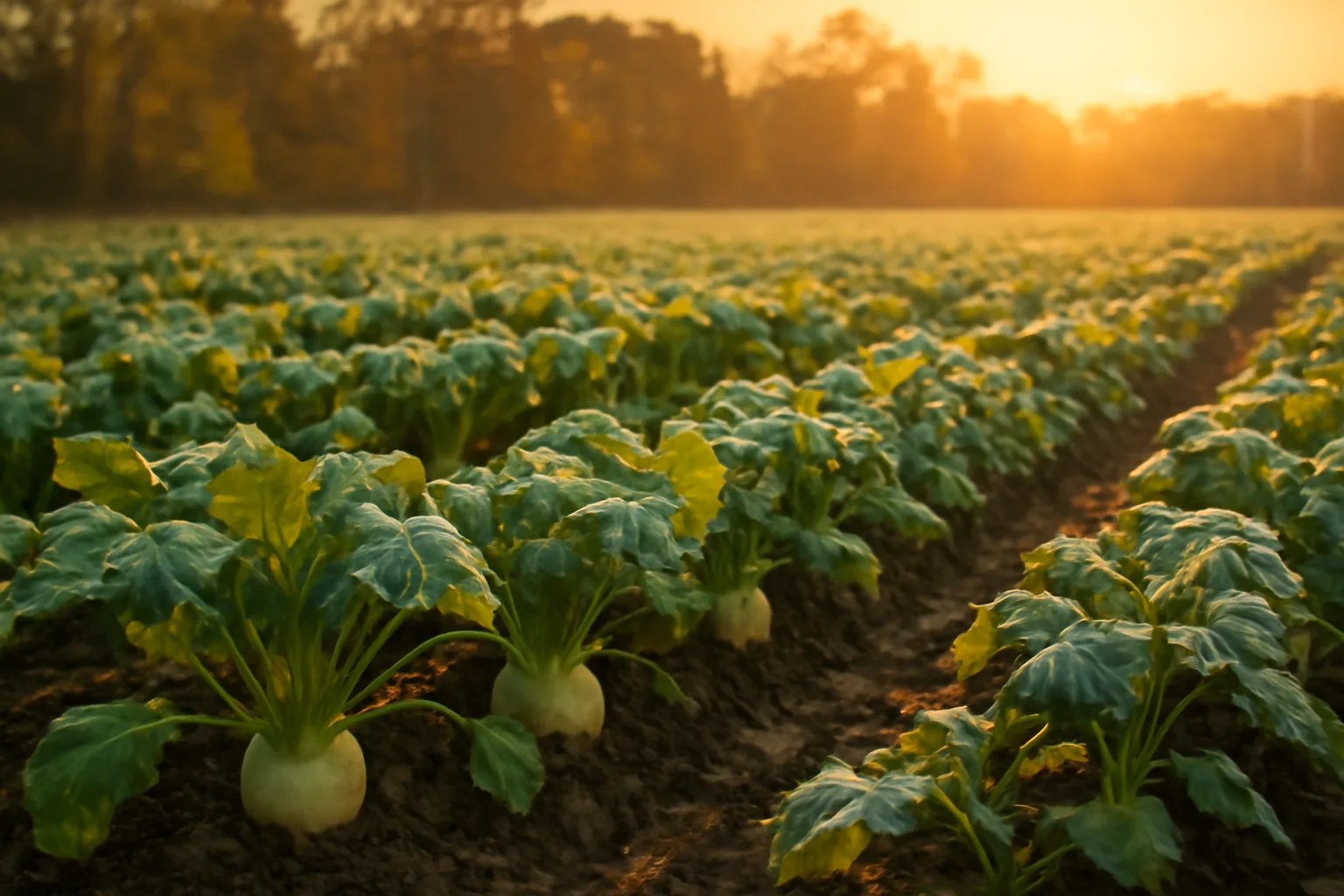
A food plot is a planted area, usually somewhere between a quarter acre and several acres, designed to give deer and other wildlife a concentrated food source and give hunters a place to observe or hunt over. Most serious plotters run two kinds: a perennial clover or alfalfa plot for spring and summer protein, and an annual fall plot built around brassicas, cereal grains, or a blend of both. Brassicas are the cabbage family: turnips, radishes, rape, kale, canola, and swede all fall under this umbrella. They're grown as fall and winter food plots because they hold up to hard frost and even snow cover far better than clover or beans, and because deer preference for them actually increases as temperatures drop. That's the opposite of what a lot of new plotters expect. You plant it in August, it sits there mostly untouched through September and October, and then it becomes a magnet in November and December. Brassicas show up repeatedly in university and USDA forage guidance as a cool-season option prized for cold tolerance and tonnage per acre. If you're planning a whole property, more than one plot, it helps to see how brassicas stack up against clover, cereal grains, and other options side by side, which is covered on food plot whitetail.
why do deer eat brassicas better after a frost?
Brassica leaves and roots store energy as starch during warm weather. When a hard frost hits, the plant converts that starch to sugar as a natural antifreeze, which makes the forage sweeter and more palatable. This is a documented physiological response in brassica species, not folklore, and it's why deer often walk past a lush green turnip plot in September and then mow it to the dirt in December. Practically, this means you should not judge a brassica plot's success in October. Wait until temperatures have dropped into the 20s a few times before deciding whether deer are using it. Some hunters get nervous when a brassica plot looks totally undisturbed heading into bow season. That's normal. The tuber and bulb portions especially don't get touched until deer have exhausted easier browse and the plant has sweetened up from cold.
when to plant food plots for deer, brassicas specifically?
| North (Zone 3-4) | Northern Midwest, New England, Upper Great Lakes | Mid-July to early August | |
|---|---|---|---|
| Transition (Zone 5-6) | Central Midwest, Mid-Atlantic, Ohio Valley | Late July to mid-August | |
| South (Zone 7-8) | Deep South, Southern Plains, lower Southeast | Late August to mid-September | Missouri Department of Conservation guidance recommends planting brassica food plots roughly 60 to 90 days prior to the first expected killing frost in your area, which for much of the Midwest lands in late July through mid-August [1]. If you plant too early in hot, dry conditions, germination suffers. Too late, and the plants never bulb up or reach full tonnage before frost locks things down. |
Brassicas need roughly 80 to 90 days from planting to full maturity, and you want that maturity window lining up with your first hard frost and the start of your hunting season, not before. Working backward from your average first frost date is the most reliable method. Here's a general planting window by region. These are starting points, not guarantees, and your local extension office will have the best frost data for your specific county. | Zone | Region example | Brassica planting window |
when to plant turnips for deer specifically?
Turnips are planted on the same general schedule as other brassicas: 60 to 90 days ahead of your first killing frost. In most of the whitetail's range, that means late July to late August, with northern states planting earlier in that window and southern states planting later. Turnips are one of the fastest-maturing brassicas, often bulbing in 60 to 70 days, so they have a little more planting flexibility than a slower crop like rape or kale. A common mistake is planting turnips too early in July heat with no rain in the forecast. Seed sitting in dry soil for two or three weeks loses viability and germination percentage drops. Seeding rate for turnips alone runs 4 to 6 lbs per acre broadcast, or 2 to 4 lbs per acre if drilled, since drilling gets better seed-to-soil contact and needs less seed to hit the same stand count. Planting depth should stay shallow, around a quarter inch, since turnip seed is tiny and buried too deep it won't emerge.
how do you actually plant a brassica plot, step by step?
Start with a soil test. This is the one step people skip and regret. Brassicas are heavy nitrogen feeders and they're sensitive to low pH, so guessing at lime and fertilizer rates wastes money and often produces a thin, yellow, disappointing plot. Your soil test lab is the real authority here on exact lime and fertilizer amounts for your dirt; treat any general numbers below as a starting point, not a prescription. Most land-grant extension guidance targets a soil pH of 6.0 to 6.5 for brassica food plots, since brassicas struggle to take up nitrogen and other nutrients efficiently in acidic soil. If your test comes back below 6.0, get lime down as early as possible since it takes months to fully react with the soil. Here's the basic sequence: 1. Kill existing vegetation with glyphosate 2 to 3 weeks before planting, or disk it under if you're working an old field. 2. Apply lime per your soil test if pH is low. Fall lime applications react slowly, so earlier is better. 3. Work the seedbed to a firm, fine texture. Brassica seed is small and needs good seed-to-soil contact; a fluffy, loose seedbed leads to poor germination. 4. Broadcast seed at 3 to 5 lbs per acre for a straight brassica blend, or drill at 2 to 3 lbs per acre. 5. Cultipack or drag lightly after broadcasting to press seed into the soil. Don't bury it deep. 6. Fertilize according to your soil test, typically 40 to 60 lbs of nitrogen per acre plus phosphorus and potassium per test recommendations. 7. Watch for flea beetles and cutworms in the first two to three weeks; that's when seedlings are most vulnerable. If you're building out a full plot rotation and more than one brassica patch, it helps to look at deer food plot seed options and how brassicas pair with cereal grains in a blend.
should you plant brassicas alone or in a blend?
Straight brassica plots work, but a lot of experienced plotters blend brassicas with a cereal grain like winter wheat, oats, or rye. The cereal grain germinates faster and gives deer something to eat early in the season while the brassica bulbs and leaves are maturing, then the brassica takes over as the preferred food once frost hits. A common blend ratio is 60 to 70 percent cereal grain by seed count with 30 to 40 percent brassica, though exact ratios vary by product and region. This also spreads your risk. If deer numbers are so high in your area that they hammer the brassica seedlings before they get established, the cereal grain component still gives you a stand and some tonnage. For a deeper look at how brassicas compare to clover, cereal grains, and other annual and perennial options across a whole planting calendar, deer food plots covers the tradeoffs in more depth.
when to plant oats for deer, and how do they fit with brassicas?
Oats are typically planted in late summer for fall food plots, generally August into early September depending on zone, similar timing to brassicas. Oats germinate fast, often within 5 to 10 days, and provide green forage within a few weeks, which makes them a good companion to slower-maturing brassicas in a blend. Oats are less cold-hardy than winter wheat or rye, so in far northern climates they'll often winterkill after repeated hard freezes, while wheat and rye persist. If you want fall attraction plus some late-winter forage, pairing brassicas with winter wheat or rye holds up better than oats alone once temperatures really drop. Seeding rate for oats in a blend runs 50 to 100 lbs per acre if planted alone, or scaled down proportionally when mixed with brassica seed.
do deer eat sorghum?
Yes, deer will eat sorghum, particularly the grain heads, but it's more commonly planted as a summer annual for cover and as a component of dove fields or bird habitat than as a primary deer attractant. Grain sorghum produces seed heads that deer and turkey will feed on, and the standing stalks provide good screening cover through fall and winter. Sorghum isn't in the same tier as brassicas, clover, or soybeans for pure deer attraction and tonnage of preferred forage. If you're choosing between the two for a fall plot, brassicas will generally draw more consistent deer use, especially after frost. Sorghum makes more sense as a screening or bedding cover crop, or mixed into a diverse summer plot, than as a stand-alone fall deer plot.
do deer eat clover, and do deer like clover?
Yes, deer eat clover readily and it's one of the most consistently preferred forages across the whitetail's range. White clover and red clover are both high in protein, and forage testing has generally shown clover running in the 20 to 30 percent crude protein range during vegetative growth stages, which makes it valuable during spring green-up, antler growth, and lactation for does. Clover is a perennial, meaning a well-maintained stand can produce for 3 to 5 years or longer with proper mowing and fertility, unlike brassicas which are annuals you replant every year. The tradeoff is that clover goes dormant or gets buried under snow in the coldest months in northern climates, which is exactly when brassicas are hitting peak palatability. That's why a lot of properties run both: clover for spring and summer, brassicas for late fall and winter. If clover is your main plot type, food plot seed breaks down clover varieties and how they compare to annual options like brassicas.
what is deer's favorite food, and where do brassicas rank?
There's no single universal favorite food for deer; preference shifts by season, region, and what's available. In general, deer prioritize whatever gives them the best nutrition-to-effort ratio at that time of year. In spring and summer, that's often clover, alfalfa, and soft mast like apples. In fall, acorns frequently outrank any planted food plot when there's a good mast crop on, since deer are hardwired to gorge on high-fat acorns ahead of winter. Brassicas earn their spot in the rotation specifically as a late-season food, when acorns are gone, other browse is thin, and cold weather has sweetened the leaves and bulbs. Soybeans, standing corn, and winter wheat also rank high depending on the region and time of year. There's no data showing brassicas beat every other food source; they're valuable because they hold nutrition and stay available when almost nothing else does, which is a specific and useful niche rather than a universal preference.
do deer like honey?
This one comes up occasionally in food plot forums, usually confused with mineral licks or commercial attractant products that use molasses or sugar-based additives, not actual honey plots. There's no established practice of planting or feeding straight honey to deer, and no wildlife agency or extension publication recommends it. Deer are drawn to sugar and salt generally, which is part of why molasses-based mineral products and frosted brassica bulbs both see heavy use, but honey itself isn't a food plot input or a documented deer food source. If you're seeing 'honey' show up in attractant marketing, it's typically a flavoring or scent additive in a mineral supplement, not something planted in a plot. Worth checking your state wildlife agency's current regulations before using any mineral, feed, or attractant product near a hunting area, since many states regulate or ban baiting and supplemental feeding for deer hunting.
what soil and fertility does a brassica plot actually need?
Brassicas are nitrogen-hungry plants. University extension fertility guidance for brassica forage crops commonly recommends 50 to 100 lbs of actual nitrogen per acre split between a starter application at planting and a topdress application 4 to 6 weeks later, along with phosphorus and potassium based on soil test levels. pH matters more with brassicas than with some other food plot species. The target range most extension programs cite is 6.0 to 6.5, and brassicas planted into soil below pH 5.5 will show stunted growth and pale, nitrogen-deficient looking foliage no matter how much fertilizer you throw at it, because low pH locks up nutrient availability. Get your soil test done 60 to 90 days before your planting window so lime has time to react if you need a significant pH correction. A same-day soil test right before planting still tells you what to buy, but it won't fix pH in time for this season's crop; think of it as informing next year's plan too.
what mistakes ruin most brassica plots?
The most common failure is planting too early into hot, dry August soil with no rain in the forecast, which leaves tiny brassica seed sitting ungerminated until it loses viability. Check a 10-day forecast before you plant and try to time seeding just ahead of a rain window if at all possible. The second most common mistake is planting into a rough, cloddy seedbed. Brassica seed is small, often smaller than a pinhead for turnip and rape varieties, and it needs firm seed-to-soil contact. Cultipacking before and after broadcasting solves this on most equipment setups. Third is skipping the soil test and guessing at lime and fertilizer. Brassicas will grow in mediocre soil but they won't thrive, and a pH problem doesn't show up as an obvious symptom until the plant is already stunted. Fourth is judging the plot too soon. If you check in October and see untouched turnip tops, that's not failure, that's brassicas doing exactly what they do before a hard frost. If you want a plan built around your specific zone, acreage, and equipment rather than general guidance, that's exactly what the $99 one-time Custom Food Plot Plan is built to do, though the fertility numbers your soil test lab gives you always take priority over any general plan.
what equipment do you need to plant brassicas?
You can plant brassicas with equipment ranging from a hand spreader and ATV to a full no-till drill. A basic setup for a half-acre to two-acre plot is an ATV or small tractor, a disk or tiller, a broadcast spreader, and a cultipacker or drag to firm the seedbed. No-till drills let you skip the tillage step entirely on some sites, planting directly into killed sod or a terminated cover crop, which saves time and reduces erosion risk on sloped ground. They cost more to buy or rent but they're worth it if you're planting multiple plots across a larger property. For smaller or first-time plotters, a simple broadcast-and-cultipack approach on a properly prepped seedbed works fine and is what most extension planting guides describe as the standard method [1]. You don't need a drill to grow a good brassica plot; you need a firm, weed-free seedbed and decent timing.
Frequently asked questions
Do deer eat sorghum?
Yes, deer eat sorghum grain heads, but it's used more often as summer cover or dove field habitat than as a top-tier deer attractant. Brassicas, clover, and soybeans generally draw more consistent fall deer use than sorghum does.
Do deer eat clover?
Yes, clover is one of the most preferred whitetail forages, running roughly 20 to 30 percent crude protein in vegetative growth. Deer favor it especially in spring and summer for antler growth and lactation, though it goes dormant or gets buried under snow in the coldest winter months.
When should I plant food plots for deer?
Timing depends on species and goal. Spring and summer plots (clover, soybeans) go in after last frost, typically April to May. Fall brassica and cereal grain plots go in 60 to 90 days before your area's first killing frost, usually late July through early September.
When should I plant turnips for deer?
Plant turnips 60 to 90 days before your first expected killing frost, which lands in late July to mid-August for most of the Midwest and northern states, and late August into September for southern regions. Turnips mature in 60 to 70 days, faster than most other brassicas.
When should I plant oats for deer?
Oats go in late summer, typically August into early September depending on zone, timed similarly to brassicas. They germinate fast and give deer green forage within weeks, but they're less cold-hardy than winter wheat or rye and often winterkill in far northern climates.
What is a food plot?
A food plot is a planted patch, usually a quarter acre to several acres, established to give deer or other wildlife a concentrated food source and give hunters a place to hunt or observe. Common types include perennial clover plots and annual brassica or cereal grain plots.
What is a deer's favorite food?
There's no single favorite; it shifts by season and region. Acorns often outrank food plots in fall when there's a good mast crop. Clover leads in spring and summer, and brassicas become highly preferred in late fall and winter after frost sweetens the forage.
Do deer like honey?
There's no established practice or evidence of deer being fed or attracted with actual honey. This is often confused with molasses-based mineral or attractant products. Deer are drawn to sugar and salt generally, which is part of why frosted brassicas and mineral licks both see heavy use.
Why don't deer touch my brassica plot until winter?
Brassica leaves and bulbs store starch that converts to sugar after a hard frost, making them far more palatable in cold weather. Deer commonly ignore brassica plots through September and October, then hit them hard once temperatures drop into the 20s a few times.
What's the right seeding rate for a brassica food plot?
For a straight brassica blend, broadcast 3 to 5 lbs of seed per acre, or drill at 2 to 3 lbs per acre since drilling improves seed-to-soil contact. Turnips alone run 4 to 6 lbs per acre broadcast; keep planting depth shallow at about a quarter inch.
Should brassicas be planted alone or mixed with other seed?
Many experienced plotters blend brassicas with a cereal grain like oats, wheat, or rye at roughly 60 to 70 percent grain to 30 to 40 percent brassica by seed count. The grain gives early forage while the brassica matures and takes over as the preferred food after frost.
What pH does a brassica food plot need?
Most extension guidance targets a soil pH of 6.0 to 6.5 for brassica food plots. Below pH 5.5, brassicas often show stunted, pale growth from poor nutrient uptake regardless of fertilizer applied, so correcting pH with lime ahead of planting matters more than for many other plot species.
Sources
- Missouri Department of Conservation, "Food Plots for Wildlife": Brassica food plots should be planted 60 to 90 days prior to the first expected killing frost
- USDA Natural Resources Conservation Service, Plant Fact Sheet: Forage Turnip (Brassica rapa): Forage brassicas including turnip are recognized as cool-season options valued for cold tolerance and forage tonnage
- University of Wisconsin-Madison Division of Extension, "Brassicas for Grazing" A4113: Brassica forage crops require adequate nitrogen fertility and a soil pH in the 6.0 to 6.5 range for best production
- USDA NRCS Plant Guide, Rape/Canola (Brassica napus): Standard seedbed preparation for small-seeded forage species like brassica includes a firm, fine seedbed and shallow planting depth
- Iowa State University Extension and Outreach, "Corn and Soybean Field Guide" reference to brassica and cover crop nitrogen response: Nitrogen application in the range of 50 to 100 lbs per acre supports brassica forage growth when split between planting and topdress timing