Last updated 2026-07-25
TL;DR
Perennial food plot species (clover, chicory, alfalfa) hold the same ground for 3-5 years and cost less per year over time, but they need mowing, weed control, and decent soil pH. Annuals (turnips, oats, sorghum) grow faster and fit poor soil or short leases better. Most hunters plant perennials in spring or late summer depending on region and let soil test results, not guesswork, drive lime and fertilizer decisions.
what is a food plot, exactly?
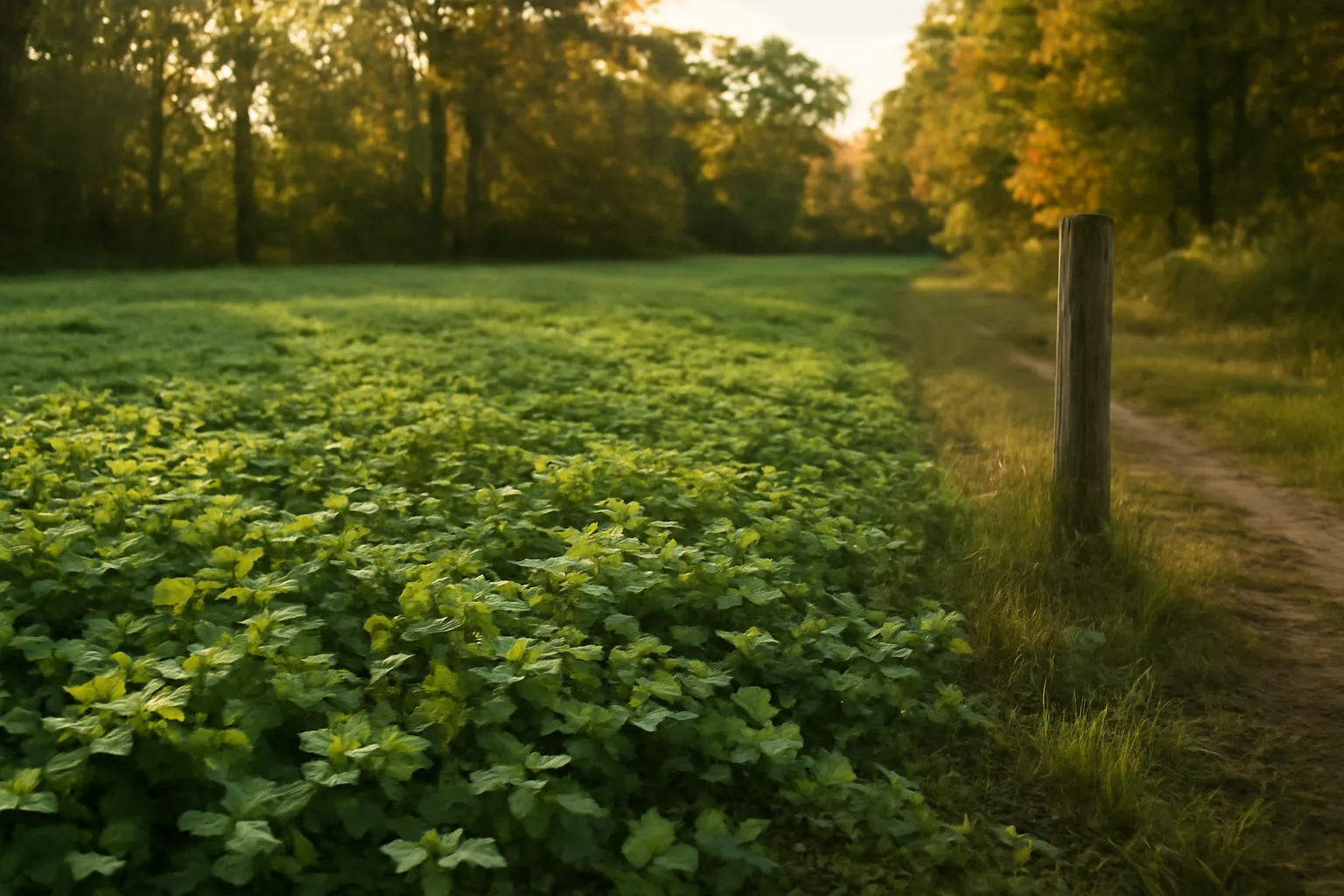
A food plot is a planted area, usually somewhere between a quarter acre and several acres, seeded with forage that deer and other wildlife will eat. It's not a garden and it's not landscaping. The goal is nutrition and, for hunters, a predictable spot to set up near or along the travel routes leading to it. Most plots fall into two categories: annuals that you replant every year (brassicas, cereal grains, soybeans) and perennials that regrow from the same root system for multiple seasons (clover, chicory, alfalfa). A lot of good plot programs run both, using perennials as the anchor and annuals to fill gaps in the calendar or hit specific hunting windows like early bow season. State wildlife agencies generally treat food plots as a land management practice, not baiting, as long as the plant is growing in the ground where it was planted. That distinction matters a lot legally. Once you pile up harvested grain, apples, or minerals in a spot to attract deer, you've likely crossed into baiting territory, which plenty of states restrict or ban outright. Check your state wildlife agency's regulations before you plant or supplement anything, because the rules genuinely vary state to state and sometimes county to county.
what's the difference between annual and perennial food plot species?
| Stand life | 3-5 years | 1 season |
|---|---|---|
| Time to maturity | 60-90 days | 21-45 days |
| Yearly cost | Lower after year one | Full seed cost every year |
| Maintenance | Mowing, spot spraying, annual fertility | Tillage and reseeding each cycle |
| Best soil pH | 6.0-7.0 for clover | Tolerates wider range, brassicas prefer 6.0-7.5 |
Annuals complete their life cycle in one growing season and die. Perennials come back from the crown or root system year after year, usually for 3 to 5 years before you need to reseed. That single fact drives almost every other decision about cost, labor, and equipment. Perennial clover typically holds a stand for 3 to 5 years with proper mowing and fertility maintenance, and it's well suited to spring seeding across most of the whitetail range according to Penn State Extension's forage guidance. Compare that to brassicas or cereal grains, which you're buying and planting again every single fall. The tradeoff is upfront effort. Perennials need cleaner seedbeds, more attention to soil pH, and they're slower to establish, often taking 60 to 90 days to reach a mature, deer-ready stand. Annuals like oats or winter peas can be grazable in 3 to 4 weeks. If you've got one season on a new lease and you're not sure you'll have access next year, annuals are the lower-risk bet. | Trait | Perennials (clover, chicory, alfalfa) | Annuals (brassicas, oats, sorghum) |
when to plant food plots for deer?
Timing depends on species and region, not a single calendar date. Spring plantings (April through June in most of the whitetail range) suit perennial clover, chicory, and alfalfa because they need a full growing season to establish a root system before winter. Late summer plantings (mid-August through September in the Midwest and South, a few weeks earlier up north) suit annual brassicas, cereal grains, and fall food sources meant to peak right as hunting season opens. Soil temperature and moisture matter more than the date on a bag of seed. Land-grant extension programs generally recommend seeding cool-season perennials like clover when soil temps sit in the 50s to low 60s Fahrenheit and there's reliable rainfall in the forecast, which is why early spring and late summer are the two workable windows in most zones [1]. If you're planning multiple plots, stagger them. Put perennials in your biggest, most accessible field since you won't be tilling it again for years. Save smaller, harder-to-reach plots for annuals you rotate.
do deer like clover, and is it actually their favorite food?
Yes. Clover is one of the most consistently preferred food plot forages across the whitetail range, and it's also one of the most forgiving to grow. It's high in crude protein, often tested in the 25 to 30 percent range for well-managed stands, which matters most during spring green-up when does are lactating and bucks are growing antlers. There's no single documented "favorite food" for deer nationwide; preference shifts by region, season, and what's locally available. Acorns are frequently cited as a top natural preference in fall because of their fat content, and agricultural crops like soybeans and corn draw heavy use where they're available. But among planted food plot species specifically, clover shows up again and again in university trial data and deer-use studies as one of the top picks, largely because it's tender, high-protein, and available almost the entire growing season [2]. White clover (Ladino types) tends to be more shade-tolerant and lower-growing, good for smaller wooded plots. Red clover grows taller, handles poorer drainage a little better, and often persists slightly longer in marginal soil. Most seed blends mix the two.
do deer eat sorghum?
Yes, deer will eat sorghum, particularly the grain heads once they mature, and sorghum also works well as a screening or standing-crop cover option through winter. It's not typically a top-tier preference forage compared to soybeans or clover, but it's drought-tolerant and cheap, which makes it a practical choice on poor, sandy, or low-rainfall ground where better options struggle. Grain sorghum is planted as a warm-season annual, generally after soil temperatures hit 60 degrees Fahrenheit and the frost risk has passed, similar timing to corn. It's more commonly used in plot mixes as a nurse crop or cover component alongside soybeans than as a stand-alone attractant, since deer tend to hit the beans first and clean up sorghum heads later in the season.
when to plant oats for deer?
Oats are a cool-season annual, and most hunters plant them in that same late-summer window as brassicas, roughly mid-August to mid-September in northern and transition zones, and into early October in the Deep South. That timing gets oats up and growing before frost slows things down, and they'll often stay green and palatable well into early winter, sometimes surviving light snow cover. Oats can also go in as a spring planting, but they're mostly used that way as a nurse crop for establishing perennial clover, not as a primary fall attractant. Oats germinate fast (often within a week in good soil moisture) and provide quick cover and forage while slower perennials get established underneath. One practical note: oats lose a lot of palatability once they head out and mature past the vegetative stage, so if you want deer using them into late fall, don't plant so early that they're fully mature and starting to dry down by opening weekend.
when to plant turnips for deer?
Turnips go in as a late-summer planting, generally 90 to 100 days before your first hard frost, since they need that runway to bulb out and reach peak size and sugar content. In most of the Midwest and mid-South, that lands somewhere between late July and mid-August. Further north, aim for the earlier side of that window; in the Deep South you can push into September. Deer often ignore turnip bulbs and even the leaves early on, then switch hard to them after the first couple of frosts. That's not folklore, it's chemistry: frost converts starches in the bulb to sugars, which is why turnip plots frequently get hammered in late November and December rather than October. If your hunting season peaks earlier than that, plant turnips as a companion to something deer will eat immediately, like oats or clover, rather than relying on turnips alone for early-season action. Soil test first if you can. Brassicas including turnips generally want a pH between 6.0 and 6.5 and respond heavily to nitrogen, so a soil test through your local extension office will tell you exactly how much lime and N you actually need instead of guessing [3].
do deer like honey, and does it belong in a food plot?
Deer aren't drawn to honey the way people sometimes assume from hunting forums and viral posts. There's no meaningful body of wildlife research showing honey as an effective deer attractant, and it's not a food plot input at all since it's not a plant you seed or grow. If you're thinking of sweet attractant products, most commercial versions rely on molasses, apple, or persimmon scent compounds, not literal honey, and their effectiveness varies a lot by product and by state legality. More importantly, pouring out any liquid attractant, honey included, may legally count as baiting in states that define bait broadly (anything placed to attract game, more than grain piles). Some states explicitly restrict scent and liquid attractants near stands during season. Always check your state wildlife agency's current baiting definition before using any product like this, since the legal line varies by state and sometimes changes year to year.
which perennial species should you actually plant?
Clover is the default for good reason: it's cheap, it's proven, and it produces from spring through fall in most regions. White clover suits shaded or smaller plots and handles some browse pressure well because it spreads via stolons. Red clover grows more upright, tolerates wetter or heavier soil slightly better, and often outlasts white clover by a year or two in marginal ground. Chicory is the other perennial worth planting almost everywhere. It's deep-rooted, drought-tough once established, and stays palatable through summer heat when clover can go dormant or get bitter. Most seed companies blend chicory into clover mixes at 10 to 20 percent by weight for exactly this reason. Alfalfa is higher-protein than clover (often 20 percent or higher crude protein) but it's pickier. It wants well-drained soil, a pH close to 6.5 to 7.0, and it won't tolerate standing water or heavy clay the way clover will. It's a great choice on ag ground with good drainage and a poor fit on tight, wet soil. Birdsfoot trefoil and some perennial forage blends show up in mixes too, mostly as filler or for added drought tolerance, but they're a smaller piece of most plot programs compared to clover and chicory.
how do you prepare soil and get a perennial stand established?
Start with a soil test, not a bag of lime. Your local cooperative extension office runs soil tests for a modest fee, usually under $20, and the results tell you your exact pH and nutrient levels instead of a guess [1]. Clover and chicory both want a pH in the 6.0 to 7.0 range; below that, lime is doing more for your plot than any seed blend or fertilizer will. Lime takes time to work, often several months to fully react in the soil, so applying it in fall ahead of a spring planting (or vice versa) gives it a real head start instead of trying to fix pH the same week you seed. Seedbed prep matters more for perennials than annuals because you're living with whatever weeds get established alongside a slow-germinating clover stand for years. A firm, weed-free seedbed, shallow seed placement (clover seed is tiny and shouldn't go deeper than a quarter inch), and a cultipacker pass after seeding to ensure good seed-to-soil contact will do more for establishment success than any amount of fertilizer. Your soil test results are the real authority here, not a general article like this one. Follow what the lab recommends for lime and fertilizer rates on your specific field.
how do you maintain a perennial plot once it's established?
Mowing is the main maintenance perennials need. Clover and chicory both benefit from being clipped back to 4 to 6 inches every few weeks during the growing season, which knocks back weed competition and keeps the forage in a tender, vegetative growth stage that deer prefer over tall, stemmy growth. Annual maintenance fertility is worth budgeting for too. A mature clover stand typically needs a maintenance application of phosphorus and potassium each year (nitrogen less so, since clover fixes its own through root nodules), and again, your soil test will tell you the actual numbers rather than a flat recommendation. Spot-spray broadleaf weeds with a grass-safe herbicide labeled for use in legume stands if weed pressure gets heavy; a thick, healthy clover stand out-competes most weeds on its own once established, so the first year or two after planting matters most for weed control. By year 4 or 5, most perennial clover stands start thinning out regardless of how well you maintained them. That's normal. Plan on a reseed or a full rotation into an annual crop for a season before going back to perennials, which also helps break any disease or pest cycle that built up in the soil.
how do you decide between annuals, perennials, or both?
If you've got long-term access to the ground (owned land or a multi-year lease) and at least one plot big enough to justify the establishment work, put perennial clover and chicory in your best field. It's the lowest-labor, lowest-cost-per-year option once it's established, and it feeds deer nearly year-round rather than just during a hunting window. If you're working short-term leased ground, marginal soil, or you want a plot timed specifically to peak the week before gun season opens, annuals give you more control over timing. Brassicas and cereal grains let you dial in exactly when the plot gets attractive, which perennials can't really do since they're producing more evenly across the whole season. Most experienced plotters end up running both: perennials as the year-round anchor plot, annuals rotated through smaller fields for season-specific timing. If you want a starting point built around your specific soil test, region, and acreage rather than a generic split, that's exactly the kind of decision a Custom Food Plot Plan is meant to sort out for $99, one time, no subscription.
what equipment do you actually need for perennial plots?
Less than you'd think for small plots, more than you'd think for anything over an acre or two. A soil test kit or extension mailer, a way to spread lime and fertilizer (a tow-behind or ATV spreader handles most food plot acreage fine), and a cultipacker or roller for seed-to-soil contact are the core tools for establishing clover or chicory. You don't need a tractor to start a food plot. Plenty of hunters establish half-acre to acre-sized perennial plots with a UTV, a hand or tow-behind spreader, and a rented or borrowed disc or tiller for initial ground prep. Where it gets harder is maintenance mowing on larger acreage; a brush hog or rotary cutter sized to your tractor or UTV saves a lot of time compared to a standard mower once you're past an acre or so. If you're comparing specific seed blends and want a rundown of what's in different mixes, food plot seed and deer food plot seed both break down common blend ingredients and rates.
Frequently asked questions
Do deer eat sorghum in food plots?
Yes, deer eat sorghum grain heads, especially after other preferred forages thin out in late fall and winter. It's more commonly used as a drought-tolerant cover crop or nurse crop alongside soybeans than as a stand-alone attractant, since deer typically prefer beans, corn, or clover when those are available.
Do deer eat clover, and is it worth planting?
Yes, clover is one of the most consistently preferred food plot forages nationwide. It's high in crude protein (often 25-30 percent), regrows for 3-5 years once established, and produces forage from spring through fall, making it one of the lowest-maintenance, highest-value perennial options available.
When should you plant food plots for deer?
Perennials like clover and chicory go in during spring (April-June) so they can establish a root system before winter. Annuals like brassicas, oats, and cereal grains go in late summer (mid-August to September in most regions) so they mature right as hunting season opens.
Do deer actually like clover more than other plants?
Clover ranks among the top preferred food plot species across most of the whitetail range, though true preference shifts by region and season. Deer also readily use soybeans, acorns, and standing corn where available. Clover's advantage is season-long availability and high protein content, not necessarily being the single top preference everywhere.
When should you plant oats for deer food plots?
Plant oats as a cool-season annual in mid-August through mid-September in most northern and transition zones, later (into October) in the Deep South. Oats germinate within about a week and stay palatable into early winter, though they lose appeal once fully mature and headed out.
When is the best time to plant food plots overall?
There are two main windows: spring (April-June) for perennials like clover, alfalfa, and chicory, and late summer (mid-August to September) for annuals like brassicas, oats, and cereal grains. Exact timing shifts with your region's frost dates and rainfall pattern, so check your local extension office's planting calendar.
When should you plant turnips for a deer food plot?
Plant turnips 90 to 100 days before your area's first hard frost, generally late July through mid-August in the Midwest and mid-South. Deer often ignore turnips until after a couple of hard frosts convert the bulb's starches to sugar, so peak use typically comes in late November or December.
What is a food plot, in simple terms?
A food plot is a planted patch of forage, usually a quarter acre to several acres, seeded specifically to feed deer and other wildlife and to create a predictable spot for hunting. It differs legally from baiting because the food is growing in place, not piled or scattered.
What is a deer's favorite food overall?
There's no single universal favorite; it depends on region, season, and availability. Acorns are a commonly cited top fall preference due to fat content, and agricultural crops like soybeans and corn draw heavy use. Among planted food plot species, clover consistently ranks as one of the top choices.
Do deer like honey or sweet attractant products?
There's no solid research showing honey itself as an effective deer attractant, and it's not a food plot species since it's not planted. Commercial sweet attractants generally use molasses or fruit-scent compounds instead. Some states classify liquid attractants as bait, so check your state wildlife agency's rules before using any.
How long does a perennial clover plot last before you need to reseed?
Most well-managed clover stands hold up for 3 to 5 years with proper mowing and annual fertility maintenance, according to university extension guidance. After that, thinning stands and weed pressure typically make reseeding or rotating to an annual crop for a season the better move.
Is it legal to use food plots instead of bait piles for deer?
Generally yes; most states treat a growing, planted food plot differently from a bait pile of grain, minerals, or feed. But definitions of baiting vary significantly by state and sometimes by county, so check your specific state wildlife agency's current regulations before assuming a practice is legal.
Sources
- Michigan Department of Natural Resources, Wildlife Conservation Order, Part 2: Deer: Baiting and feeding regulations for deer are defined by state wildlife orders and food plots are generally treated differently from bait piles
- Mississippi State University Extension Publication 2111, Establishing and Maintaining Wildlife Food Plots: Cool-season food plot species including clover and brassicas have specific soil pH ranges and planting windows tied to soil temperature and frost dates
- USDA Natural Resources Conservation Service, Plant Fact Sheet: White Clover (Trifolium repens L.): White clover is a widely used, high-value forage species for wildlife food plots
- University of Missouri Extension, Guide G9160, Growing Deer Food Plots in Missouri: Brassica food plot species including turnips require a planting window tied to first frost date and respond to nitrogen fertility
- University of Georgia Extension: Recommendations on soil preparation, liming, and fertilization for establishing wildlife food plots