Last updated 2026-07-26
TL;DR
For East Texas, the best combo is a fall blend of arrowleaf or crimson clover with oats or wheat planted late September to early November, plus a summer plot of cowpeas or lablab planted April through June. Clover carries the plot into spring; oats and cereal grains give quick fall tonnage. Soil pH matters more than seed choice on most East Texas ground.
what is a food plot, exactly
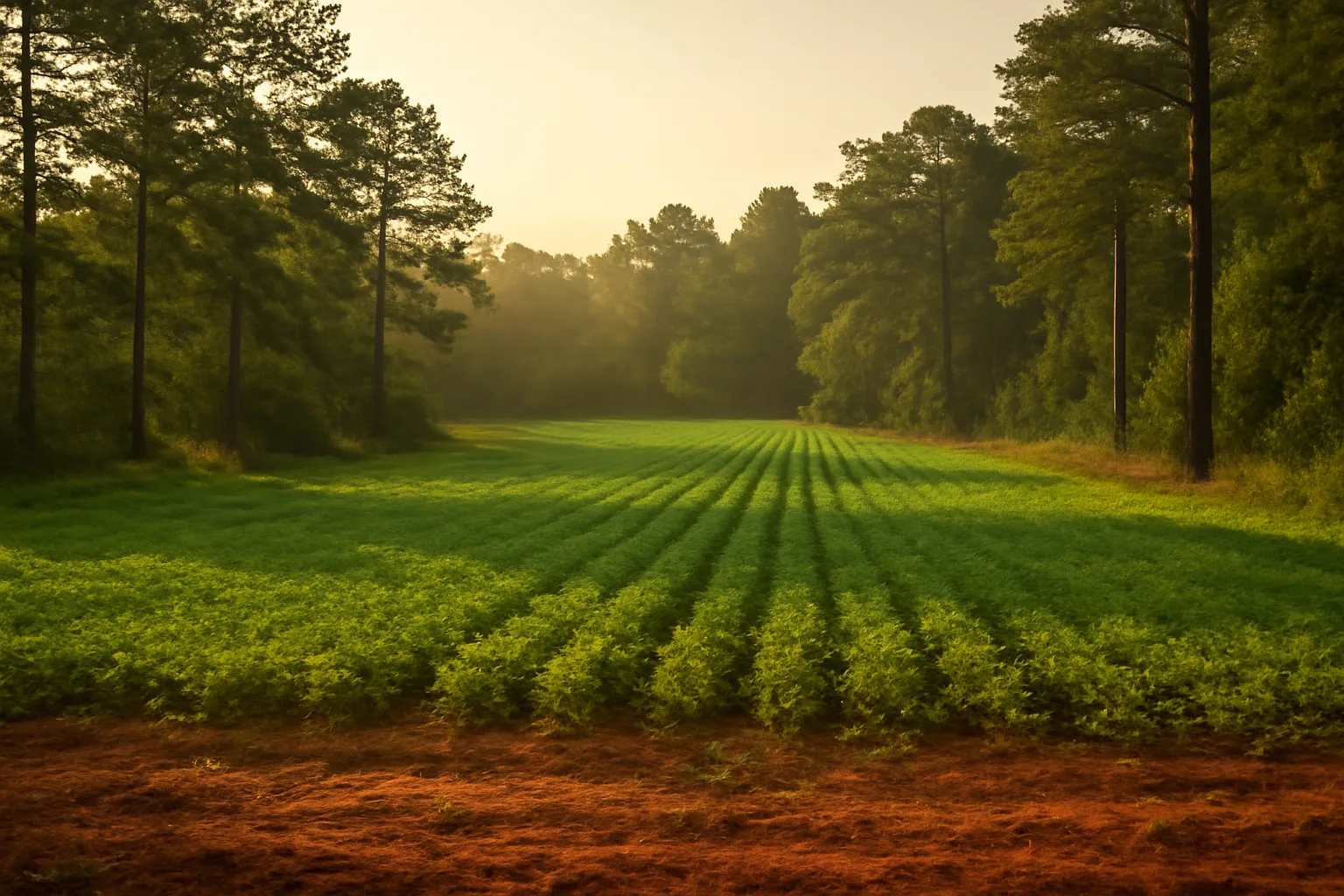
A food plot is a planted patch of forage, usually somewhere between a quarter acre and a few acres, put in specifically to feed and hold deer on a property. It's not the same as a wildlife opening left to native weeds, and it's not a mineral site. A real food plot gets soil tested, limed if needed, fertilized, and planted with something deer actually want to eat at that time of year. In East Texas the goal usually splits into two jobs. A cool-season plot (clover, oats, wheat, brassicas) feeds deer from fall through spring when native browse is thin and acorns run out. A warm-season plot (cowpeas, lablab, soybeans, some sorghum blends) feeds deer in summer when does are lactating and bucks are growing antler, and it also holds up under heavy browse pressure better than most people expect. The Texas Parks and Wildlife Department treats food plots as a habitat management tool, not a substitute for managing native vegetation. Their guidance is blunt about it: plots work best as a supplement to good habitat, not a replacement for it [1]. If your property is mostly closed-canopy pine plantation with no native forb response, a plot or two won't fix that on its own.
what do deer actually prefer to eat in east Texas
Deer in East Texas eat a mix that shifts hard by season: acorns and browse in fall and winter, forbs (broadleaf weeds) and new growth in spring, and a mix of browse, forbs, and mast through summer. Ask ten hunters what a deer's favorite food is and you'll get ten answers, but the honest answer is: it depends on what's available and what season it is. In terms of planted forage, deer show strong, repeatable preference for clovers and cowpeas in preference trials, often browsing them down before touching grasses or brassica leaves in the same plot [2]. Soybeans and lablab (a vining legume, sometimes sold as tropical or hyacinth bean) also rank high in summer. Acorns deserve a mention because in a lot of East Texas hunting camps, a good white oak or red oak year will pull deer off your plot entirely for three or four weeks. That's normal. Nobody has beaten Mother Nature's mast crop with a food plot, and you shouldn't try. Plan your plot to carry deer through the gaps, not to compete with a bumper acorn crop.
do deer like clover, and is it worth planting in east Texas
Yes, deer like clover, and it's one of the most reliable food plot plantings for East Texas if your soil pH is in range. Clover is a legume, so it fixes nitrogen and doesn't need heavy nitrogen fertilizer once established, which keeps the annual cost down after the first year. The catch in East Texas is soil pH. Much of the region sits on acidic sandy loam or clay soils, often in the 4.5 to 5.5 range naturally, and clover struggles below pH 6.0. Texas A&M AgriLife Extension recommends getting a soil test before planting and liming to bring pH up toward 6.0 to 6.5 for clover to perform. If you skip the lime, you can plant perfect seed into perfect conditions otherwise and still get a thin, yellow stand. Arrowleaf clover and crimson clover are the two annual clovers most commonly recommended for the Southeast and East Texas specifically, because they tolerate acidic, sandy soils better than perennial white clovers like Ladino. Arrowleaf reseeds itself decently if you let it go to seed and don't mow too early, which saves money in year two. White clover (Ladino types) works better on heavier, more fertile bottomland soils if you have them. For a deeper look at clover options and blends, see food plot whitetail and deer food plot seed.
do deer eat sorghum
Yes, deer eat sorghum, but it's not usually the main draw in a food plot mix. Grain sorghum (milo) produces a seed head deer and other wildlife will hit hard once it matures and dries down in late summer and fall, similar to how they hit corn. Deer will also browse young sorghum leaves some, though less eagerly than legumes. Where sorghum earns its place in East Texas is as a nurse crop or a companion planting with cowpeas or other summer legumes. The sorghum stands up as structure for vining plants like cowpeas or lablab to climb, and it adds tonnage and standing grain for fall and winter. Some commercial food plot blends use forage sorghum or grain sorghum specifically for that reason, not because it's the top preference item. If you're planting sorghum as a standing grain plot for fall, remember two things: it's slow to mature relative to a spring clover planting, needing roughly 100 to 120 days depending on variety, and in a lot of counties, a standing grain plot that gets harvested or knocked down changes the legal picture around hunting over it. Check the baiting and feeding rules for your specific situation before you assume a plot works the same as a bait pile.
when should you plant food plots for deer in east Texas
| Cool season | Oats, wheat, rye | Late Sept to early Nov | |
|---|---|---|---|
| Cool season | Arrowleaf/crimson clover | Late Sept to late Oct | |
| Cool season | Brassicas (turnips, radish) | Aug 15 to Sept 15 | |
| Warm season | Cowpeas, lablab | Mid-April to June | |
| Warm season | Soybeans | April to mid-June | |
| Warm season | Grain sorghum | April to mid-June | Don't plant clover and brassicas on the same calendar. Brassicas want to go in a few weeks earlier than clover and grains, generally mid-August to mid-September, so they have time to bulk up roots and leaves before the first real cold snap. |
East Texas splits into two main planting windows because the region runs two forage seasons: a cool-season window in fall and a warm-season window in spring. Get the timing wrong and you'll fight the heat, the cold, or the drought instead of growing a plot. Cool-season plots (clover, oats, wheat, rye, brassicas) go in from mid-September through early November across most of East Texas, timed so seedlings establish before the first hard freeze but after summer heat breaks enough for germination. Texas A&M AgriLife's forage guidance for small grains in the region generally points toward planting once soil temperatures cool and fall rains arrive, commonly late September into October for oats and wheat in this part of the state. Warm-season plots (cowpeas, lablab, soybeans, sorghum, buckwheat) go in from mid-April through June, after the last frost date and once soil has warmed. East Texas typically sees its last spring frost somewhere between mid-March and early April depending on how far north or south you sit in the region, per NOAA climate normals for the area [3]. Planting too early into cold, wet soil is one of the most common reasons a summer legume plot fails to come up evenly. Here's a simple reference table: | Planting window | Species | Typical dates (East Texas) |
when to plant oats for deer in east Texas
Plant oats in East Texas from late September through early November, with most guidance favoring the first three weeks of October as the sweet spot. Oats germinate fast, often within 5 to 10 days in warm, moist soil, and they green up quickly, which makes them one of the most reliable early-season draws once bow season opens. Oats have one real weakness in East Texas: winter hardiness. Straight oats can get knocked back hard by a heavy freeze, more so than wheat or cereal rye. If your property regularly sees nights below 20°F, consider blending oats with wheat or rye so you've got a fallback forage if the oats take a hit. A lot of commercial fall blends already do this for exactly that reason. Oats also work well as a nurse crop for clover. Planting oats and clover together in the same pass gives you fast fall growth from the oats while the clover establishes underneath, then the clover carries the plot once the oats die back or get grazed out.
when to plant turnips for deer in east Texas
Plant turnips in East Texas from mid-August through mid-September, earlier than most cool-season plantings, because turnips need roughly 80 to 90 days to bulb up before the first hard freeze locks them in as a stored food source. Miss that window and you'll get leafy top growth without much of a bulb, which is still edible but less of a late-season draw. Turnips are a brassica, in the same family as radishes and rape, and deer typically hit the leaves first in early fall, then switch to digging up and eating the bulbs after a couple of hard frosts sweeten the starches into sugars. That's a real, well-documented pattern with brassicas generally, not something specific to turnips alone. One caution: brassica plots can be a slow build with deer that have never seen them. In areas where turnips aren't traditionally planted, it can take a season or two for local deer to start using them heavily. Don't panic if a brand-new turnip plot gets ignored the first fall. Blend turnips with oats or wheat in the same plot so you've got an immediate draw while the deer figure out the turnips.
does soil test data matter more than seed choice
Yes, and it's not close. A cheap bag of the wrong seed planted into corrected, fertile soil will usually outperform an expensive premium blend planted into unlimed, acidic dirt. Soil pH controls how available nutrients are to the plant, and most food plot legumes and clovers want a pH between 6.0 and 6.5 to use fertilizer efficiently. A soil test from your county extension office or a private ag lab typically costs somewhere in the $10 to $20 range and tells you your current pH, phosphorus, potassium, and organic matter. Texas A&M AgriLife Extension runs a soil, water, and forage testing lab that serves the whole state and is the standard reference point for East Texas landowners [4]. Your results come back with specific lime and fertilizer recommendations in pounds per acre, tailored to whatever crop you tell them you're planting. Lime takes time to work. Agricultural lime needs to react with soil moisture over months to shift pH, so if your test comes back needing 1 to 2 tons of lime per acre (common on acidic East Texas ground), get it applied as early as you can, ideally a full season before you expect peak plot performance. Fertilizer, by contrast, acts fast but doesn't fix a pH problem. You can dump nitrogen and phosphorus on acidic soil all day and still get a mediocre stand because the plant can't access it. Your soil test lab is the authority on your specific lime and fertilizer rates. A general planting guide like this one can tell you what species and windows work regionally, but only your test results, run on your dirt, tell you exact pounds per acre.
what's the best single food plot mix for east Texas if you can only plant one
If you can only plant one plot a year in East Texas, plant a fall blend of arrowleaf or crimson clover with oats or wheat, seeded mid-October. This combination covers the longest stretch of the season, feeding deer from early bow season through the following spring green-up, and it's forgiving of a slightly imperfect seedbed. The oats or wheat germinate fast and give you a green plot within two to three weeks, which matters if you're trying to have something growing by opening weekend of archery season. Check current TPWD hunting regulations for exact season dates in your county [5]. The clover then takes over as the wheat or oats mature, die back, or get grazed hard, carrying the plot through winter and into spring when it's often the only green thing on the property. If you can swing a second planting, add a summer cowpea or lablab plot in April or May. That gives you a full-year rotation: legume and grain for fall/winter, legume for summer, with the fall clover often surviving into early summer if rainfall cooperates. For blend options built around this kind of rotation, see deer food plots and domain food plot seed.
do deer like honey, and does it belong in a food plot
Deer don't seek out honey the way people sometimes assume from social media videos of deer licking honey off a tree or feeder. Deer have some sweet taste preference, which is part of why sugar beets, molasses-treated mineral, and sweetened supplements get marketed to hunters, but honey itself isn't a forage crop and it has no place in a planted food plot. More importantly, pouring honey, syrup, or other attractants on the ground or on vegetation to draw deer crosses into baiting in a lot of jurisdictions, and Texas has specific rules about what counts as bait versus what's a legitimate agricultural planting. Texas Parks and Wildlife Department guidance draws a real distinction between a food plot (a planted crop left standing or grazed naturally) and baiting (placing food, minerals, or other attractants to lure game), and the legality of hunting over each differs by area and season . If you're unsure whether a practice on your lease crosses that line, check current TPWD regulations for your specific county before doing it, because rules on baiting and supplemental feeding vary and get updated.
what's the difference between a fall plot and a spring or summer plot
A fall plot is built to feed deer through the lean months of late fall, winter, and early spring, when native browse is dormant and acorns eventually run out. A summer plot is built to support lactating does and antler-growing bucks during the highest nutritional demand of the year, roughly April through August in East Texas. Fall plots lean on clovers, cereal grains (oats, wheat, rye), and brassicas because these species tolerate cooler soil temperatures and some are frost-tolerant or frost-sweetened (brassicas especially). Summer plots lean on warm-season legumes (cowpeas, lablab, soybeans) because they fix nitrogen, grow fast in hot weather, and pack in the protein deer need for milk production and antler growth. The mistake a lot of new plotters make is planting a single mix and expecting it to cover both seasons. It doesn't work that way in East Texas' climate. Clover planted in October will slow way down or go dormant in the peak of a July heat wave, and cowpeas planted in April will get killed by the first fall frost. Plan for two plantings a year if you want year-round coverage, or accept that a single planting will only carry part of the year.
how big should an east Texas food plot be, and where should you put it
Most East Texas food plots run somewhere between a half acre and 3 to 5 acres, with smaller plots (under an acre) tucked into timber openings for bedding-adjacent bow hunting, and larger plots in old fields or cleared pine ground for broader herd support. There's no single right size; it depends on your goal (attract-and-hunt versus feed-the-herd) and how much open ground you actually have. Soil and sun matter more than shape. East Texas' heavy pine cover means a lot of potential plot ground sits in partial shade for part of the day. Most food plot species, clover and cowpeas especially, want at least 6 hours of direct sun to produce well. A plot ringed by tall pines on the south side will get shaded out fast as the trees mature, so factor tree height and plot orientation into where you clear ground. Drainage is the other big local factor. A lot of East Texas soil is heavy clay or has a hardpan layer that holds water after rain. Standing water for more than a day or two will kill clover and most legumes. If a spot floods after normal rain, it's a poor plot site regardless of how good the sun exposure looks. For equipment and prep guidance suited to smaller acreages typical of East Texas lease ground, see food plot seed and deer for food.
Frequently asked questions
Do deer eat sorghum in food plots?
Yes. Deer eat both the seed heads of mature grain sorghum and, to a lesser extent, young sorghum leaves. It's most useful in East Texas as a companion crop with climbing legumes like cowpeas, providing structure and fall grain, rather than as a standalone attractant.
Do deer like clover more than other food plot plants?
In preference studies, clover ranks among the top choices deer browse first in mixed plots, especially arrowleaf and crimson clover in the Southeast. Preference varies by season and by what else is available, but clover is a consistently reliable East Texas planting when soil pH is corrected to 6.0 to 6.5.
When should you plant food plots for deer in East Texas?
Plant cool-season plots (clover, oats, wheat, brassicas) from mid-September through early November. Plant warm-season plots (cowpeas, lablab, soybeans) from mid-April through June, after the last frost. Brassicas need to go in earlier, mid-August to mid-September, to bulb up before frost.
When is the best time to plant oats for deer?
Late September through early November, with the first three weeks of October usually the sweet spot in East Texas. Oats germinate in 5 to 10 days in warm, moist soil and green up fast, but they're less winter-hardy than wheat or rye, so blend them if hard freezes are common on your property.
When should you plant turnips for deer?
Mid-August through mid-September in East Texas, earlier than most fall plantings, because turnips need 80 to 90 days to develop a bulb before the first hard freeze. Planting too late gives you leafy growth without much bulb, which reduces the late-season draw.
What is a food plot, in simple terms?
A food plot is a planted patch of forage crops, typically a quarter acre to several acres, established to feed and hold deer on a property through soil testing, liming, fertilizing, and planting species suited to the season. It's different from a native wildlife opening or a mineral site.
What are deer's favorite foods overall?
Deer diets shift heavily by season, with forbs, browse, and acorns making up most of the diet by volume across the year, and strong preference for clover and cowpeas among planted forages. A good mast (acorn) year can pull deer off food plots for weeks.
Do deer like honey or sweet attractants?
Deer show some preference for sweet tastes, but honey isn't a real forage crop and has no place in a planted food plot. Pouring syrup or sweeteners on the ground to draw deer can also cross into baiting under state rules, so check current regulations before trying it.
What's the best food plot combo for East Texas if you only plant once a year?
A fall blend of arrowleaf or crimson clover with oats or wheat, planted around mid-October, covers the longest useful season. Oats give a fast fall green-up while the clover establishes underneath and carries the plot through winter into spring green-up.
How much lime does East Texas soil usually need for a food plot?
It varies by site, but East Texas soils commonly test acidic (pH 4.5 to 5.5), and clover or legume plots often need 1 to 2 tons of agricultural lime per acre to reach the target pH of 6.0 to 6.5. Only a soil test from your county extension office or an ag lab gives you your exact rate.
Can deer live on food plots alone in East Texas?
No. Texas Parks and Wildlife Department guidance treats food plots as a supplement to native habitat, not a replacement for it. A property with poor native browse and forb diversity won't be fixed by a plot or two; plots work best alongside broader habitat management like thinning and prescribed fire.
Is it legal to hunt over a food plot in Texas?
Generally yes, a standing planted crop is treated differently from bait under Texas rules, but specifics on baiting, feeding, and hunting over supplemental feed vary by area and can change. Check current Texas Parks and Wildlife Department regulations for your county before hunting over any planted or supplemental food source.
Sources
- Texas Parks and Wildlife Department, Food Plots for White-tailed Deer: Food plots are a supplement to native habitat management, not a replacement for it
- NOAA National Centers for Environmental Information, U.S. Climate Normals 1991-2020: East Texas last spring frost dates typically fall between mid-March and early April
- Texas A&M AgriLife Extension, Soil, Water and Forage Testing Laboratory fee schedule: Soil testing for East Texas landowners typically costs in the $10 to $20 range and provides pH and fertilizer recommendations
- Texas Parks and Wildlife Department, Outdoor Annual hunting regulations: Archery deer season timing and county-specific dates are set in the annual Outdoor Annual regulations
- Texas Parks and Wildlife Code, Section 62.0125, Hunting Over Bait: Texas regulations distinguish between planted food plots and baiting practices, with rules varying by area