Last updated 2026-07-26
TL;DR
There's no single best food plot for Florida, because our state runs two growing seasons back to back. For fall through spring, oats and clover carry most properties. For summer, cowpeas, soybeans, and grain sorghum handle the heat and sandy soil better than anything else on the shelf.
What is a food plot, and why does Florida need a different playbook?
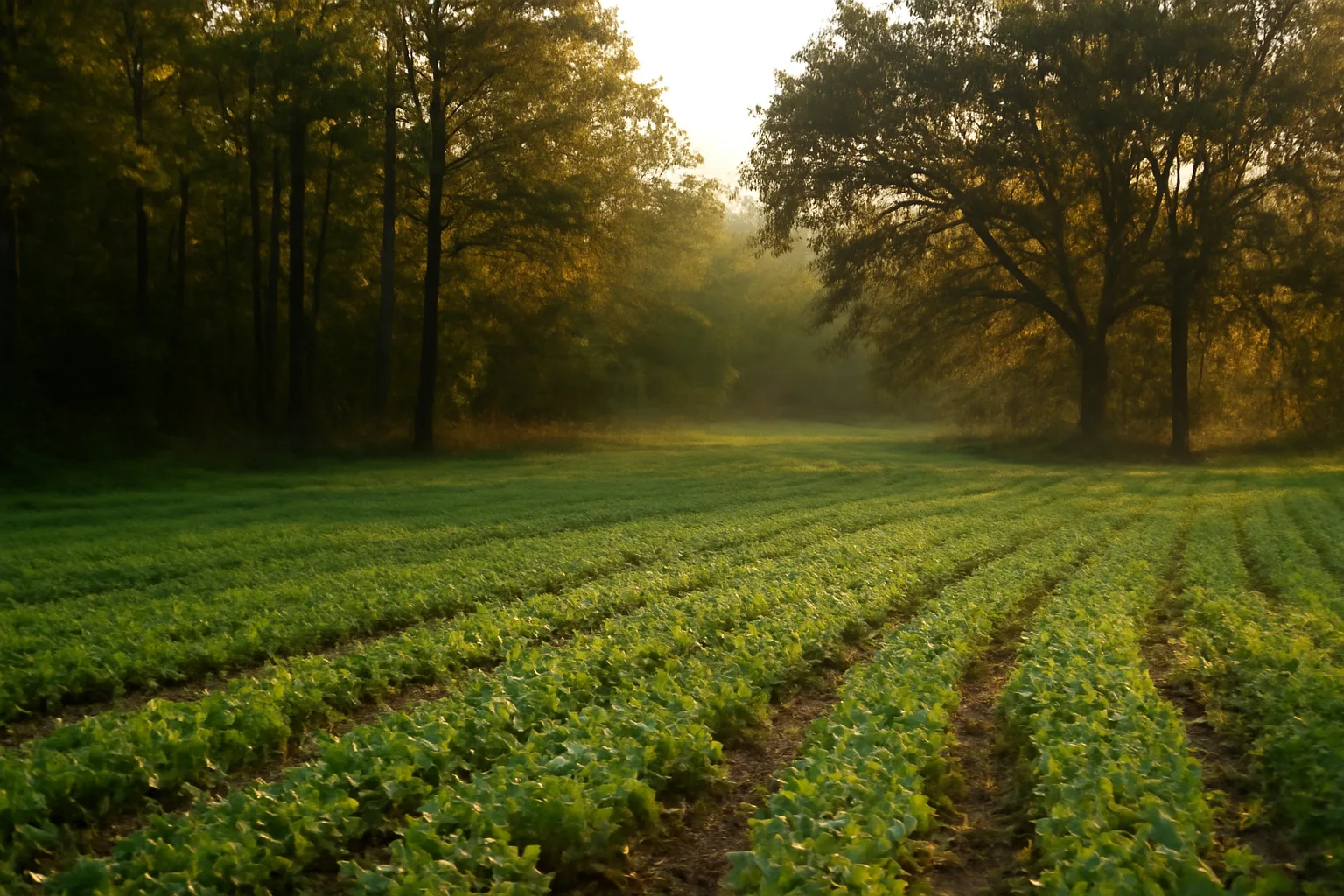
A food plot is a planted patch of forage or grain on your land, built specifically to feed and hold deer, not a garden and not a pasture. Most plots run anywhere from a quarter acre to a few acres, tucked into a clear-cut, a field edge, or a cleared spot inside timber. Florida throws three curveballs at food plot planning that most of the popular advice, written for the Midwest, doesn't account for. First, our soils are mostly deep sand with almost no organic matter and very low natural fertility. University of Florida IFAS Extension research on Florida's flatwoods and ridge soils describes them as predominantly Spodosols and Entisols, sandy soils with low water and nutrient holding capacity that need regular lime and split fertilizer applications to support crop growth [1]. Second, we don't get a hard winter that kills off warm-season weeds and pests the way northern states do, so competition from bahiagrass, torpedograss, and nutsedge is relentless almost year-round. Third, Florida actually runs two distinct food plot seasons, cool-season (roughly October through March) and warm-season (April through September), and the species that thrive in one will die in the other. That means "best food plot for Florida" isn't one answer. It's a rotation. Get the soil right first, then match your species list to the season you're planting in and the zone you're in. North Florida panhandle soils and rainfall patterns are meaningfully different from south Florida flatwoods and muck ground.
When to plant food plots for deer in Florida?
Cool-season plots (clover, oats, wheat, brassicas) go in the ground from mid-September through November in north Florida, and can push into December in central and south Florida where first frost comes later or not at all. Warm-season plots (cowpeas, soybeans, grain sorghum, American jointvetch) go in April through June, after soil temps warm and the risk of a late frost has passed. The FWC's general hunting season structure is a useful backstop. Archery generally opens in October in much of the state, with general gun season running into January depending on zone, and you want your cool-season plot mature and attractive by early October. That means planting no later than early September in north Florida and pushing that back slightly further south. Florida Fish and Wildlife Conservation Commission publishes zone-specific season dates each year on its hunting season page, and it's worth checking those exact dates for your zone before you set a planting calendar [2]. Rainfall matters more than the calendar in Florida. UF/IFAS Extension guidance on establishing forage crops notes that seed needs consistent soil moisture to germinate, and it recommends planting warm-season forages after the onset of reliable summer rainfall rather than by a fixed date, because sandy soils drain fast and a seed sitting in dry sand simply won't sprout [3]. Many Florida plotters wait for a named tropical system or a solid summer rain event to trigger warm-season planting rather than sticking to a rigid date. For cool-season plots, watch the forecast for the first real cold front pushing through in September or October, since that often brings the first meaningful rain after a dry late summer.
When to plant oats for deer in Florida?
Plant oats in Florida from late September through early November, timed so they germinate ahead of the first cool snap. Oats are one of the most forgiving cool-season grains for Florida sand: they germinate fast, tolerate acidic soil better than wheat, and put on quick green growth that deer hit hard in October and November when it's the newest thing on the landscape. Oats do have a ceiling here. They're not frost-hardy the way winter wheat or rye is, so in north Florida a hard freeze in January can knock them back or kill them outright. That's a real trade rather than a flaw: oats are your early-season, high-attraction option, not a plot you count on to feed deer through February. Many Florida plotters blend oats with a cereal rye or wheat and a clover, so the oats bring early palatability, the rye or wheat carries through cold snaps, and the clover takes over once the grain matures out. Seeding rate for oats broadcast alone typically runs 80 to 100 lbs per acre based on standard cool-season cereal forage rates used across southeastern extension guidance; drilled rates run lower, closer to 60 to 80 lbs per acre. Check the specific product bag for the blend you buy, since rates shift with seed size and germination percentage.
Do deer like clover? Do deer eat clover in Florida?
Yes, whitetails eat clover readily, and it's one of the highest-protein, most consistently attractive forages you can plant, but Florida's heat and sand make clover a harder plant to keep alive here than in Kentucky or Ohio. Clover forage quality studies commonly cite crude protein in the 20 to 30 percent range for actively growing clover, which is well above what native browse offers most of the year. The catch in Florida: most clovers (white clover, red clover) are cool-season perennials or biennials that go dormant or die back once summer heat and humidity set in, and they need better soil moisture retention and higher soil pH than raw Florida sand naturally has. Arrowleaf clover and crimson clover, both reseeding annuals, tend to perform better in Florida than perennial white clovers because they're bred to push hard growth in a single cool season and don't need to survive our brutal, humid summer. Ladino white clover can work in north Florida on better-drained, amended soils with irrigation or consistent rainfall, but expect it to struggle in a dry spring or in deep sand without lime and phosphorus correction. Bottom line for clover in Florida: plant it, but plant it as a fall-seeded annual or reseeding annual, correct your soil pH first (most clovers want a pH close to 6.0 to 6.5), and don't expect a perennial white clover stand to carry you cleanly through a Florida summer the way it might further north.
Do deer eat sorghum? Where does grain sorghum fit in a Florida plot?
Yes, deer eat grain sorghum, both the standing grain heads and the green forage, and it's one of the better warm-season options for Florida because it tolerates heat, drought, and poor sandy soil better than corn does. Grain sorghum (milo) needs less water and less soil fertility than corn to produce a usable grain crop, which matters directly on Florida's sandy, low-organic-matter ground. Sorghum works two ways in a Florida plot. Standing sorghum left in the field through fall and winter gives you a slow-release grain source deer and turkey both hit once cooler weather arrives, similar to how it's used in wildlife food plot mixes across the Southeast. Sorghum planted and cut earlier as a forage crop gives you tonnage during the brutal mid-summer stretch when native browse quality drops and deer need something green. One planning note: sorghum is often planted in a blend with cowpeas or soybeans rather than alone, since the legume adds protein and nitrogen fixation while the sorghum adds structure and drought tolerance. If you're planning a warm-season plot for Florida, sorghum plus a legume is a more reliable combination than a corn monoculture, which needs more fertility and water than most Florida food plotters want to put into a small acreage plot.
When to plant turnips for deer in Florida?
Plant turnips and other brassicas in Florida from mid-September through October, giving them 80 to 90 days to bulb and mature before you expect heavy deer use in December and January. Brassicas are a cool-season crop only; they will not survive Florida's summer heat, so timing them with the rest of your fall plot rotation matters. The well-known quirk with turnips applies in Florida too. Deer often ignore the leafy tops and bulbs early in the season, then hit them hard once a couple of frosts sweeten the plant's starches into sugars. In north Florida that shift can come in December or January. In central and south Florida, where hard frosts are rare or absent, that sugar-conversion trigger may never happen the same way, which is one reason turnips are a less reliable pick the further south you plant them. If you're in south Florida, brassicas are worth trying in a blend but shouldn't be your sole cool-season plot. Brassicas also want better soil fertility and a higher pH than raw Florida sand offers naturally; a soil test before planting is the only way to know how much lime and phosphorus your specific field needs, since brassica yield drops fast in acidic soil below roughly pH 5.5.
What are deer's favorite foods in Florida?
Native Florida deer diets lean heavily on browse (greenbrier, blackberry, and other woody leaf and stem growth), acorns when they're dropping, and forbs, with agricultural forage and food plot plantings supplementing rather than replacing that natural diet. Research from the University of Florida on white-tailed deer habitat and nutrition in the Southeast has documented that browse and soft mast make up the bulk of year-round intake in much of the state's woodland habitat [4]. Within food plot species specifically, clover, cowpeas, and soybeans consistently rank as the most readily eaten plantings across the Southeast, largely because of their protein content and palatability compared to grasses and grain crops. Acorns are arguably the single most important natural food source in fall. In years with a strong mast crop, deer will often walk past a food plot to hit a dropping white oak or live oak, which is a normal, expected pattern rather than a sign your plot failed. The honest answer here: "favorite food" changes by season and by what's available. Spring and summer favor high-protein legumes and new browse growth. Fall favors mast and high-energy grain. There's no single plant that outperforms everything else across all twelve months, which is exactly why a two-season rotation beats a one-and-done plot.
Do deer like honey? (And other odd food plot questions)
Deer don't eat honey in any meaningful dietary sense, and there's no research or wildlife agency guidance suggesting honey as a deer attractant works better than standard mineral or feed products where legal. This question likely comes up because hunters confuse it with commercial "honey hole" branding or sweet liquid attractant products, not actual raw honey bait. If you're looking for a genuine sweet attractant, some commercial mineral and protein products include molasses as a binder and flavor enhancer, and that's a documented, common practice in wildlife feed formulation. Before using any attractant, mineral, or supplemental feed in Florida, check current FWC rules on baiting and supplemental feeding for hunting purposes. Florida Administrative Code sets specific conditions on baiting for game, including waiting periods after bait removal before hunting over a formerly baited site, and rules can differ by method of take and by whether you're on public or private land [5]. A planted food plot is not classified as bait under most state definitions, but loose grain, mineral blocks, and feeders often are regulated differently, so don't assume a rule that applies to one applies to the other.
How do I fix Florida's sandy soil for a food plot?
Start with a soil test, every time, before you buy seed or fertilizer. UF/IFAS Extension operates a soil testing lab through its Extension Soil Testing Laboratory, and a basic test typically costs a modest fee and takes a couple of weeks to turn around results with lime and fertilizer recommendations specific to the crop you tell them you're planting [6]. Florida sand's core problems are low pH (often acidic without correction), almost no cation exchange capacity to hold nutrients, and very little organic matter to retain moisture. That combination means fertilizer you apply can leach through the soil profile fast, especially after a heavy summer rain, so split applications (some at planting, more as a topdress later) often outperform a single big application on sandy ground. Lime is usually the first and biggest fix. Most food plot species want a soil pH between 6.0 and 6.5, and Florida's native sand frequently tests well below that without amendment. Your soil test report is the actual authority here, not a blanket recommendation, since lime needs vary by field, by how acidic your specific sand is, and by what you're planting. Follow what your test says, not what a generic online guide says your pH "should" be. Organic matter matters more in Florida than almost anywhere else in the whitetail's range. Even a light application of compost, or leaving crop residue on the field after a warm-season planting instead of tilling it under immediately, helps sandy soil hold both water and nutrients a little longer between rain events.
What's the best fall food plot mix for Florida?
For most Florida properties, a blend of oats, a cereal grain like wheat or rye, and a clover (arrowleaf or crimson for straight annual performance, ladino white clover on better ground with irrigation) covers the widest window of attraction from October through the following spring. This isn't a single silver-bullet species; it's a stacked blend where each component covers a different part of the season. Oats and wheat germinate fast and give you green growth within two to three weeks of a good rain, which matters for early bow season attraction in October. The clover component is slower to establish but becomes the backbone forage that carries into December, January, and beyond, especially once the grains mature past their most palatable growth stage. Brassicas can be added to this mix on better-drained ground with corrected pH, giving you a late-season bulb and leaf source once frost sweetens them up. Seeding rate and blend ratio depend heavily on your specific soil test results and field drainage, which is exactly the kind of site-specific call a general article can't make for you. If you want a written plan built around your actual soil test, acreage, and zone rather than a generic blend, that's the whole idea behind the Custom Food Plot Plan, a $99 one-time plan built off the numbers on your soil report rather than a one-size-fits-all bag of seed.
What's the best summer/warm-season food plot for Florida?
A cowpea and grain sorghum blend, planted April through June, is the most consistently reliable warm-season combination for Florida sand, because cowpeas fix nitrogen and tolerate drought and heat, while sorghum adds structure and a grain component that holds through fall. Soybeans are a strong protein source too and deer eat them readily, but soybeans generally need better soil fertility and more consistent moisture than cowpeas to produce well, and they're more attractive to deer as a young plant, which means heavy browsing pressure in a small plot can wipe out a soybean stand before it ever matures on Florida sand. Cowpeas (also called southern peas or iron-clay peas) evolved for exactly this kind of low-fertility, high-heat growing condition and tend to survive browsing pressure better while still delivering strong crude protein numbers during the stress months of July and August when native browse quality is at its lowest. American jointvetch is a less commonly planted but genuinely useful warm-season legume for Florida wetter sites, since it tolerates the seasonally wet flatwoods soils found across much of central and south Florida better than cowpeas or soybeans do.
How does Florida's food plot calendar differ by zone?
| North Florida | Mid-September to early November | April to June | Widest window; occasional hard frost helps brassicas | |
|---|---|---|---|---|
| Central Florida | Late September to late October | April to July | Milder frosts; clover and oats still strong | |
| South Florida | October (narrow) | March to August | Rare hard frost; brassicas less reliable, warm-season window longer | These windows are general guidance built around typical frost and rainfall patterns for each region, not a guarantee for your specific property. Local rainfall in any given year, and even your field's elevation and drainage, will shift the ideal planting date by a couple of weeks in either direction. Checking a soil test and watching your actual local forecast beats going strictly by a calendar date. |
North Florida (panhandle and areas bordering Georgia and Alabama) gets the closest thing to a real winter the state offers, with occasional hard frosts and the widest planting windows for both cool-season and warm-season crops. Central Florida has a shorter, milder cool season and a longer warm-season window, with brassicas and clover performing less reliably the further south you go within this zone. South Florida rarely sees a hard frost, which limits brassica performance (no sugar-conversion trigger) and shortens the practical cool-season window to a narrower fall stretch, while warm-season crops can often be planted earlier and later than in the north. | Region | Cool-season planting window | Warm-season planting window | Notes |
What food plot equipment do I actually need in Florida?
For most food plotters working under 5 acres, a decent ATV or UTV with a pull-behind disc or harrow, a broadcast spreader, and a cultipacker (or a drag section of chain-link fence, which works fine as a cheap substitute) covers seedbed prep and planting for both cool-season and warm-season crops. A no-till drill is nice to have but not required for a small food plot, especially on sandy ground that's already easy to work with a disc. Florida sand is genuinely easier to till than heavy clay soils further north, which is one small advantage: you don't need heavy tillage equipment to break a seedbed here. The tradeoff is that sand doesn't hold a seedbed shape well, so a cultipacker pass after broadcasting seed (to press seed-to-soil contact) matters more in Florida than it might on a loam soil that naturally settles better. A soil probe or a simple garden trowel, plus sample bags for your local extension office, rounds out the minimum kit. That $15 to $20 investment in a proper soil test before you spend money on seed and fertilizer is the single highest-return purchase in the entire food plot process.
Frequently asked questions
Do deer eat sorghum in Florida food plots?
Yes. Deer eat both the green forage and mature grain heads of grain sorghum (milo). It's a strong warm-season option for Florida because it tolerates heat, drought, and low-fertility sandy soil better than corn, and it's often planted alongside cowpeas or soybeans to add protein back into the blend.
Do deer eat clover, and does it grow well in Florida?
Deer readily eat clover, and it's one of the highest-protein forages available. It grows in Florida but performs best as a fall-seeded annual (arrowleaf or crimson clover) rather than a perennial, since Florida heat and sandy, often acidic soil make perennial white clover harder to sustain through summer without irrigation and soil correction.
When should I plant food plots for deer in Florida?
Cool-season plots (oats, wheat, clover, brassicas) go in mid-September through November, earlier in north Florida and later further south. Warm-season plots (cowpeas, soybeans, sorghum) go in April through June, timed around consistent rainfall rather than a fixed calendar date, since sandy soil needs steady moisture to germinate seed.
When should I plant oats for deer in Florida?
Plant oats from late September through early November so they germinate ahead of the first cool front. Oats grow fast and tolerate Florida's acidic sand better than wheat, but they're not frost-hardy, so pair them with rye, wheat, or clover if you want forage to carry through a hard winter cold snap.
When should I plant turnips for deer in Florida?
Plant turnips mid-September through October, giving them 80 to 90 days to bulb before peak deer use in December and January. Turnips need frost to sweeten their starches into sugar, so they're less reliable in south Florida where hard frosts rarely occur; blend them with clover or brassicas in southern zones rather than relying on turnips alone.
What is a food plot?
A food plot is a planted area, usually a fraction of an acre to a few acres, seeded specifically to attract and feed deer rather than for commercial harvest. Common food plot crops include clover, oats, brassicas, cowpeas, soybeans, and grain sorghum, chosen and timed to match the local growing season and hunting calendar.
What are deer's favorite foods overall?
Native browse (greenbrier, blackberry, and woody leaf growth), acorns during fall mast drop, and high-protein legumes like clover, cowpeas, and soybeans rank among the most consistently eaten foods. There's no single favorite year-round; deer preference shifts by season based on what's available and what offers the best protein or energy at that time.
Do deer like honey?
No, honey isn't a meaningful part of deer diet or a documented attractant. This question usually comes from confusion with sweet mineral or protein supplement products that use molasses, not raw honey. Check Florida FWC baiting and feeding rules before using any mineral, feed, or attractant product, since regulations vary by method of take.
What's the best food plot for deer in Florida overall?
There's no single best plot because Florida runs two growing seasons. A fall blend of oats, wheat or rye, and clover covers cool-season attraction from October through spring. A summer blend of cowpeas and grain sorghum covers the warm season. Running both, timed to your zone, beats picking one species and planting it once.
Do I need to lime my food plot soil in Florida?
Almost certainly yes. Florida's native sand is frequently acidic, often well below the 6.0 to 6.5 pH most food plot species prefer. A soil test through your county extension office or a private lab will tell you the exact lime rate your specific field needs; don't guess or apply a blanket rate without testing first.
How much does a soil test cost in Florida?
UF/IFAS Extension's Soil Testing Laboratory charges a modest per-sample fee for a standard test, with results typically back within a couple of weeks. It's one of the cheapest steps in the whole food plot process and the only way to get an accurate lime and fertilizer recommendation for your ground.
Can I grow a perennial clover food plot in south Florida?
It's harder than in north Florida. Perennial white clovers struggle with south Florida's heat, humidity, and lack of a true winter dormancy period unless the site has good drainage, irrigation, and corrected soil pH. Most south Florida plotters get more reliable results from reseeding annual clovers like arrowleaf or crimson planted fresh each fall.
Sources
- University of Florida IFAS Extension, EDIS AG439, "Water and Nutrient Management for Forage Production in Florida": Florida's dominant sandy soils have low organic matter and low nutrient and water holding capacity
- Florida Fish and Wildlife Conservation Commission, Hunting Season Dates: Florida archery and general gun deer season dates vary by zone
- University of Florida IFAS Extension, EDIS AG180, "Establishing Forage Crops in Florida": Seed germination requires consistent soil moisture, and warm-season forages should be planted after reliable summer rainfall begins
- Florida Administrative Code, Rule 68A-15.007, Taking Game with the Aid of Bait: Florida sets specific conditions and waiting periods around baiting for game hunting
- University of Florida IFAS Extension Soil Testing Laboratory, EDIS SL181, "UF/IFAS Extension Soil Testing Laboratory (ESTL) Analytical Procedures": UF/IFAS offers soil testing with lime and fertilizer recommendations for a modest per-sample fee
- University of Florida IFAS Extension, EDIS WEC200, "White-tailed Deer Nutrition and Feeding": Browse and soft mast make up the bulk of year-round whitetail diet in much of Florida's woodland habitat