Last updated 2026-07-25
TL;DR
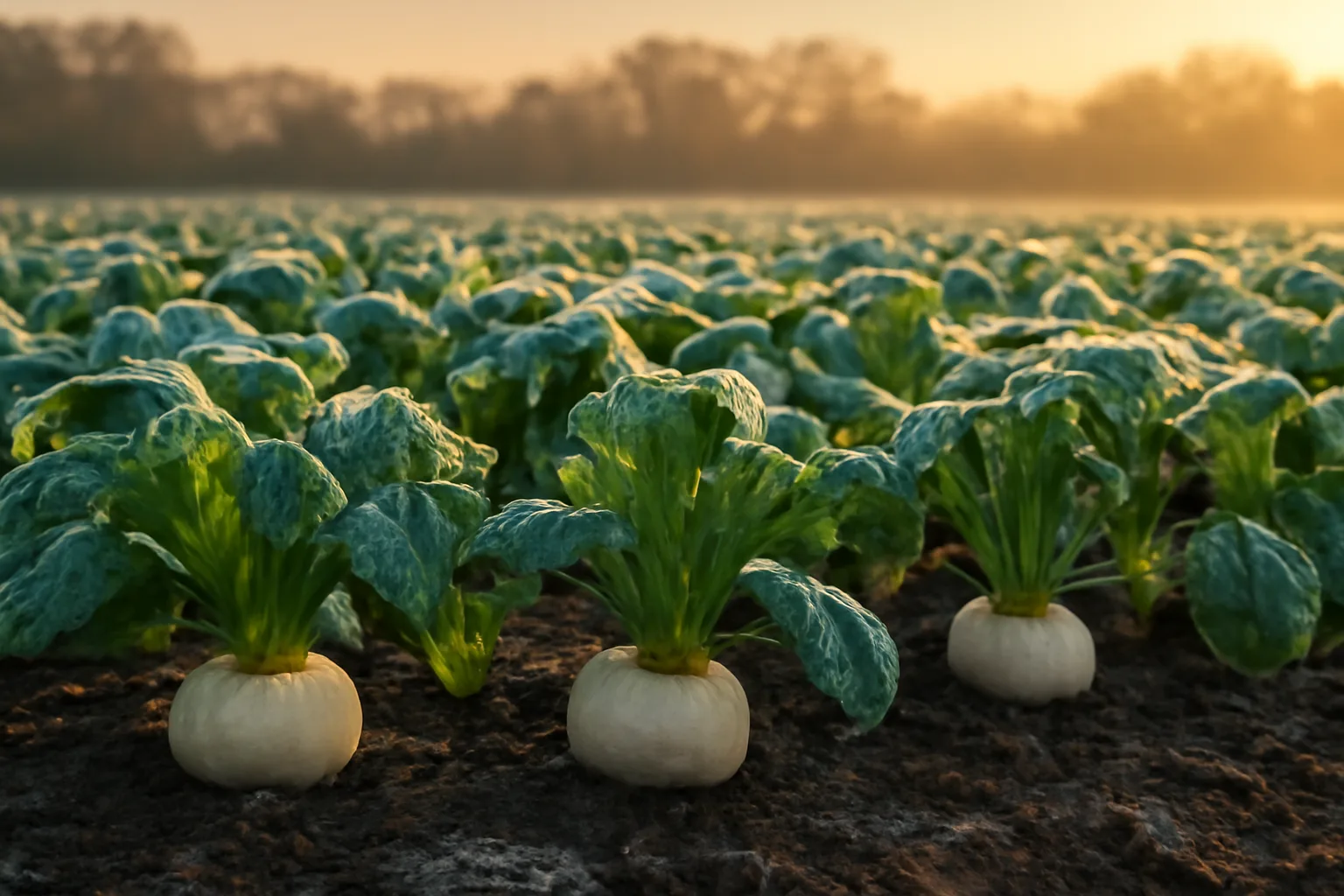
Brassicas (turnips, radishes, rape, kale) are cold-tolerant plants that pull deer hard in late fall once frost sweetens their sugars. Plant 45-90 days before your first killing frost, keep soil pH between 6.0 and 7.0, and expect deer to ignore leaves early season before hammering bulbs and tubers after repeated frosts.
What is a food plot, and where do brassicas fit in?
A food plot is a planted patch of ground, usually somewhere between a quarter acre and a few acres, managed specifically to feed and hold deer on a property. It's not a lawn and it's not a crop field meant for harvest and sale. The goal is deer nutrition and deer attraction, sometimes both at once. Brassicas are a plant family that includes turnips, radishes, rape, kale, and canola. In the food plot world, they're the fall specialists. Where clover and alfalfa give you spring and summer tonnage, brassicas are built to peak in October, November, and December, right when hunting season is happening and natural browse is dying back. The reason brassicas work so well late is simple plant biology. Cold temperatures trigger the plant to convert starches into sugars as a kind of natural antifreeze. A brassica plot that deer walked past in September can turn into the hottest spot on the property by Thanksgiving, once a few hard frosts have hit it. That's not folklore. It's how the plants cope with cold, and forage radish research from USDA plant materials programs documents the same freeze tolerance mechanism in tillage radish stands [1]. If you're weighing brassicas against other plot types for your property, it helps to look at the broader picture of food plot whitetail strategy before locking in your seed order.
When to plant food plots for deer, in general terms?
| Deep South (zone 8-9) | Mid-August to mid-September | |
|---|---|---|
| Mid-South / transition (zone 7) | Early August to mid-September | |
| Upper Midwest / Northeast (zone 5-6) | Late July to mid-August | |
| Canada border states / far north (zone 3-4) | Mid-July to early August | Those ranges are generalized. NOAA's climate data centers publish average first freeze date tables by station, and that's the number to plan around, not a national average [2]. If you want a plan built around your specific coordinates and soil test, that's exactly the kind of thing a $99 Custom Food Plot Plan is built to sort out instead of guessing. |
Timing depends entirely on what you're planting and what your first frost date looks like, not a single calendar date that works nationwide. Warm-season plots (soybeans, corn, most clovers as summer annuals) go in after your last spring frost. Cool-season plots, brassicas included, go in during late summer so they mature right as temperatures drop. As a rule of thumb, most extension programs recommend counting backward from your average first fall frost date. Brassicas need roughly 45 to 90 days of growing time depending on the species and blend, so you plant in that window before frost, not after. Here's the practical breakdown most planners use: | Region (rough zone) | Brassica planting window |
When to plant turnips for deer specifically?
Turnips are planted 60 to 90 days before your first expected fall frost, which for most of the whitetail range falls between late July and early September. Plant too early and the bulbs get woody and the plants bolt in summer heat. Plant too late and you get leaves but no bulb development before the ground freezes. Purple top turnips are the classic plot variety, and they're forgiving. They germinate fast, usually within 5 to 10 days given decent moisture, and they tolerate a wide soil pH range better than most brassica cousins, though they still perform best in the 6.0 to 7.5 range. One thing a lot of first-time planters get wrong: deer often ignore turnip tops and bulbs for the first month or two after planting, then switch on almost overnight after the first hard frost. Don't panic if your turnip plot looks untouched in October. That's normal, not a failure. Seeding rate for turnips alone usually runs 4 to 6 pounds per acre when broadcast, per most university forage guides, though blended bags will have their own rate printed on the tag.
When to plant oats for deer?
Oats go in during the same late summer window as brassicas, generally 60 to 75 days before your first killing frost, because oats are a cool-season annual grass that grows fast and tolerates light frost well before finally dying out in hard winter cold. Oats are often mixed into brassica blends for a reason. They germinate in 3 to 5 days, giving deer something green to eat almost immediately while the turnips and radishes are still developing bulbs underground. That fast germination also helps oats act as a nurse crop, holding soil and outcompeting some early weeds while the brassicas get established. In the Southeast, oats can also be planted again in early spring as a quick green-up option, though that's a separate planting window from the fall food plot use most hunters care about. Oats do not survive extended deep freezes the way winter wheat or rye can, so in far northern zones they'll typically die back well before spring.
Do deer eat sorghum?
Yes, deer eat sorghum, particularly the grain heads once they mature and dry down in late summer and fall, but sorghum is more of a supplemental grain and cover crop than a primary attractant plant. It's more commonly planted as a warm-season grain for turkey and quail habitat, or as a screening/cover crop for deer, than as the centerpiece of a whitetail attraction plot. Grain sorghum (milo) does get browsed by deer, especially in winter when other food sources are scarce, and it holds up well in dry conditions where corn might fail. Some plot managers use sorghum as a shorter, cheaper alternative to standing corn for screening and late-season grain. It's rarely the top choice, though, when turnips, soybeans, or standing corn are options on the same ground. If sorghum is in the discussion, it's usually paired with other species in a diverse planting rather than planted alone as the whole plot.
Do deer like clover, and do deer eat clover?
Deer eat clover heavily and readily, and it's one of the most consistently preferred food plot plants across the whitetail's range. Clover is a legume, not a brassica, but it's worth covering here because most brassica plots get planned alongside a clover plot on the same property, and hunters constantly ask how the two compare. White clover (including Ladino types) and red clover both show up on nearly every deer preference study and extension forage list as high-value, high-protein forage. Clover also has the advantage of being a perennial in many blends, meaning a well-established stand can produce for 3 to 5 years with proper mowing and fertility, compared to brassicas which are annuals you replant every year. The tradeoff: clover goes mostly dormant or gets buried under snow in northern winters, right when brassicas are hitting peak palatability. That's why a lot of experienced plot managers run both, clover for spring through early fall, brassicas for the late season crunch. If you're building out a full-season plan, deer food plot seed selection usually means picking complementary species rather than one silver bullet.
What soil and fertility do brassicas actually need?
Brassicas want a soil pH between 6.0 and 7.0, and they're genuinely picky about it. Below pH 5.5, aluminum and manganese toxicity can start limiting root and bulb development even if you throw fertilizer at the problem, because nutrient uptake gets locked up in acidic soil regardless of what's actually in the ground. A real soil test, not a guess, is the starting point. Most land-grant extension labs run a basic soil test for somewhere in the range of $10 to $20 and will tell you your current pH, phosphorus, potassium, and organic matter, plus give lime and fertilizer recommendations. Brassicas are heavy nitrogen feeders, more so than clover, which fixes its own nitrogen through root nodules. A common baseline fertilizer recommendation for brassica plots is somewhere around 300 to 400 pounds per acre of a balanced blend like 19-19-19, or a split application with nitrogen topdressed 3 to 4 weeks after planting once the plants are established, though exact rates depend entirely on what your soil test says you're starting with. Lime takes months to fully react with soil, so if your test comes back needing 2 tons per acre of lime, that lime needs to go down as early as possible, ideally the season before you plant, not the week before. This is one of the most common brassica plot failures: acidic soil that never got corrected because lime went down too late to matter.
What are deer's favorite food, and where do brassicas rank?
There's no single universal favorite, because deer preference shifts by season, region, and what's locally available, but research and field data consistently point to a short list: acorns (especially white oak group), soybeans, clover, and, in late fall, brassicas once frost has sweetened them. Acorns are usually the top natural preference where oaks are present, because of their high fat content. Among planted forages, soybeans and clover generally outrank brassicas during the growing season when deer have a choice, largely because of protein content and palatability before any frost has hit. Brassicas' advantage isn't that deer prefer them over everything else all year. It's timing. When soybeans have been browsed down or gone dormant and acorns have been picked clean, a frosted turnip or radish plot becomes one of the few remaining high-energy food sources on the landscape in November and December. That's a timing advantage, not necessarily a flavor preference, and it's why brassicas get planted specifically to peak during hunting season.
Do deer like honey?
This one comes up more than you'd expect, and the honest answer is: there's no real data showing deer specifically seek out honey, and it's not a legitimate food plot ingredient in any sense. Deer are herbivores built to digest plant fiber through a four-chambered rumen system, not concentrated sugar syrup. What's probably happening when people ask this is confusion with mineral or molasses-based attractant products, some of which use molasses (not honey) as a binder or scent additive in mineral licks. Even then, those are attractant products, not food plot plants, and their legality varies enormously by state. More importantly: baiting and feeding regulations differ state by state and sometimes county by county, and using honey, molasses, or any feed-based attractant where baiting is banned can turn a legal hunt into a violation fast. Always check your own state wildlife agency's current baiting and feeding regulations before using any attractant, mineral, or supplemental feed product, brassica plot or otherwise.
Which brassica species should you actually plant?
Turnips, radishes (especially forage/tillage radish types), and rape are the three you'll see in almost every commercial blend, and each does something a little different. Turnips give you a balance of leafy forage early and a bulb that develops later, and they're generally the most consistently grazed brassica once frost hits. Forage radishes, particularly daikon-type tillage radishes, grow an aggressive taproot that can punch 12 inches or more into compacted soil, which makes them useful for soil structure even in plots where deer only eat the tops. Rape (and its cousin kale) tends to produce more leaf tonnage and less bulb, and it holds up a bit better under heavy repeated browsing pressure than turnips do. Many commercial blends mix all three plus oats or winter peas, on the logic that a diverse planting hedges against one species underperforming due to soil, weather, or grazing pressure. If you're comparing bagged blends versus building your own mix, deer food plot seed and food plot seed comparisons are worth reading before you buy in bulk.
What equipment do you actually need to plant brassicas?
Brassica seed is tiny, similar in size to clover seed, which means depth control is the single biggest mechanical variable in a successful plot. Most brassica seed should be planted no deeper than a quarter inch, and broadcasting followed by a light cultipack or drag is the most common method, rather than drilling deep like you would corn or soybeans. For smaller plots (under 2 acres), a hand-crank broadcaster or an ATV-mounted spreader, followed by dragging a section harrow, chain link fence, or even a heavy mat behind a four-wheeler, works fine to get seed-to-soil contact without burying it too deep. For larger acreage, a no-till drill set to a shallow depth setting handles brassica seed well and improves germination consistency over broadcasting alone. A soil test kit or sample bag, a pH-adjusted lime spreader pass if your test calls for it, and a basic fertilizer spreader round out the minimum gear list. You don't need a tractor to grow a good brassica plot on an acre or two. You do need accurate depth control and decent seed-to-soil contact, which matters more than horsepower.
How do you compare brassicas against other plot options?
| Brassicas (turnip/radish/rape) | Late fall to early winter | Annual, replant yearly | Post-frost high energy draw | |
|---|---|---|---|---|
| Clover (white/red) | Spring through early fall | 3-5 years perennial | Season-long protein source | |
| Soybeans | Summer through early fall | Annual | High protein, heavy tonnage | |
| Cereal grains (oats, wheat, rye) | Fall through early winter | Annual | Fast green-up, nurse crop, cold tolerance | A lot of the strongest properties run at least two of these in rotation or side by side, rather than betting everything on one plot type. If you're still deciding what mix fits your acreage, deer food plots and food plot whitetail both break down whole-property planning in more depth than a single species article can. |
Brassicas fill a specific late-season window that other plot types don't cover as well, but they're not a replacement for spring and summer forage. Here's how they stack up against the other common plot categories most hunters are choosing between. | Plot type | Peak season | Typical lifespan | Best use |
What common mistakes ruin brassica plots?
The single biggest killer of brassica plots is planting too late for the local frost date, followed closely by ignoring soil pH. Both mistakes are avoidable and both show up constantly in extension troubleshooting guides. Planting into acidic soil (below pH 5.5) without correcting it first is probably the most common and most fixable failure. Lime takes months to change soil chemistry, so a soil test result that says "add 2 tons of lime per acre" needs action well before planting day, not the week of. Other frequent issues: seeding too deep (brassica seed wants a quarter inch, not an inch), skipping a nurse crop like oats in plots prone to erosion or crusting, and expecting deer activity the moment plants emerge instead of waiting for the post-frost sugar conversion that makes brassicas attractive in the first place. None of these are exotic problems. They're the same handful of mistakes showing up on different properties every year.
Frequently asked questions
Do deer eat sorghum in food plots?
Yes, deer will eat sorghum grain, especially once it dries down in late summer and fall, but it's typically planted as a cover crop or turkey/quail habitat plant rather than a primary deer attractant. Most plot managers pair it with other species rather than planting it alone as the main draw.
Do deer eat clover, and do deer like clover?
Deer eat clover readily and it's consistently rated among the most preferred food plot forages. White and red clover both perform well, though clover goes dormant in northern winters, which is why brassicas are often added for late-season coverage.
When should I plant food plots for deer?
It depends on species. Warm-season plots like soybeans go in after your last spring frost. Cool-season plots like brassicas and cereal grains go in 45-90 days before your first fall frost so they mature as temperatures drop. Check NOAA's climate data for your local station's average first freeze date for exact timing.
When should I plant turnips for deer?
Plant turnips 60 to 90 days before your expected first fall frost, generally late July through early September depending on your region. Planting too early causes bolting in summer heat; planting too late leaves bulbs undeveloped before winter.
When should I plant oats for deer plots?
Oats go in during the same late-summer window as brassicas, roughly 60-75 days before first frost. They germinate in 3-5 days and are often mixed with brassicas as a fast-growing nurse crop that gives deer green forage while turnips and radishes develop underground.
What is a food plot?
A food plot is a planted area, usually a quarter acre to several acres, managed specifically to provide deer forage and improve hunting or habitat conditions on a property. It differs from a commercial crop field because the goal is deer nutrition and attraction, not harvest for sale.
What do deer prefer to eat most?
There's no single universal favorite. Acorns, especially white oak acorns, generally top natural preference due to fat content. Among planted forages, soybeans and clover typically outrank brassicas during the growing season, while brassicas become a top draw specifically after frost sweetens them in late fall.
Do deer like honey?
There's no real evidence deer seek out honey specifically. They're herbivores built to digest plant fiber, not concentrated sugar. People are often thinking of molasses-based mineral or attractant products, which are separate from honey and subject to state baiting regulations that vary widely.
What pH do brassicas need for a food plot?
Brassicas grow best between pH 6.0 and 7.0. Below pH 5.5, aluminum and manganese can become toxic to roots and bulbs, limiting growth even with adequate fertilizer. A soil test from a land-grant extension lab is the reliable way to know your starting point before planting.
Why aren't deer eating my brassica plot yet?
This is normal, not a failure. Deer often ignore brassica leaves and bulbs for the first month or two after planting, then switch on heavily after the first hard frost converts plant starches to sugars. Patience through October is common; peak activity usually shows up in November and December.
Can I plant brassicas and clover in the same plot?
Yes, though they're usually planted as separate plots or in rotation rather than mixed together, since clover is a perennial legume and brassicas are annuals with different fertility needs. Many properties run clover for spring-through-fall forage and dedicate separate acreage to brassicas for late-season attraction.
How much seed do I need per acre for turnips?
Turnips planted alone are typically seeded at 4 to 6 pounds per acre when broadcast, according to university forage guides. Blended bags containing turnips, radishes, and rape together will list their own recommended rate on the label, usually lower per component since it's a mix.
Sources
- USDA NRCS Plant Materials Program, Forage/Tillage Radish plant materials release notes: cold-tolerant brassicas convert starches to sugars after frost, increasing palatability
- NOAA National Centers for Environmental Information, Freeze/Frost Occurrence Data: planting windows should be counted back from local average first fall frost dates
- University of Wisconsin-Madison Extension, Oat Forage/Cover Crop publication (A3868): oats as a fast-germinating cool-season nurse crop with limited winter hardiness
- USDA NRCS Plant Guide, White Clover: white clover forage quality and perennial stand persistence
- University of Missouri Extension, Soil Testing for Lime and Fertilizer Needs (guide sheet G9111): brassica pH requirements and typical soil test cost through a land-grant lab