Last updated 2026-07-26
TL;DR
Soil testing for deer food plots means pulling a 6-8 inch core sample from several spots in the field, sending it to a land-grant or state lab, and using the pH and nutrient results to decide lime and fertilizer rates before you plant. Most plots run acidic and low in phosphorus and potassium without it.
What is a food plot, and why does soil testing matter for it?
A food plot is a planted area, usually somewhere between a quarter acre and several acres, established specifically to feed deer and other wildlife and to give hunters a place to watch them feed. It's not a garden and it's not a hayfield, though it's managed with a lot of the same tools: a soil test, lime, fertilizer, a disk or drill, and a planting calendar tied to your region. Soil testing matters because most of the ground hunters plant was never meant to grow a crop. It's an old logging landing, a reclaimed pasture corner, a strip cut out of timber. That dirt is very often acidic, often in the 4.5 to 5.5 pH range in the eastern half of the country, and low in phosphorus and potassium. Clover, brassicas, and cereal grains all want a pH closer to 6.0 to 7.0. Plant into acidic soil without correcting it and you can lose 30 to 50 percent of your yield potential even with perfect seed and perfect rain, according to extension agronomy guidance from Penn State. A soil test costs $10 to $20 through most university extension labs or state department of agriculture labs, and it's the cheapest insurance policy in the whole food plot budget. Compare that to $150-plus for a bag of quality clover seed or fertilizer, and skipping the test to save $15 is backwards math. If you want a plan built around your actual test results and your region's planting windows, PlotSeason's Custom Food Plot Plan is a $99 one-time build that turns a soil report into species picks, rates, and a calendar. It's general guidance built on your numbers, though. Your soil-test lab is still the final word on lime and fertilizer rates for your specific dirt.
How do I actually pull a soil sample for a food plot?
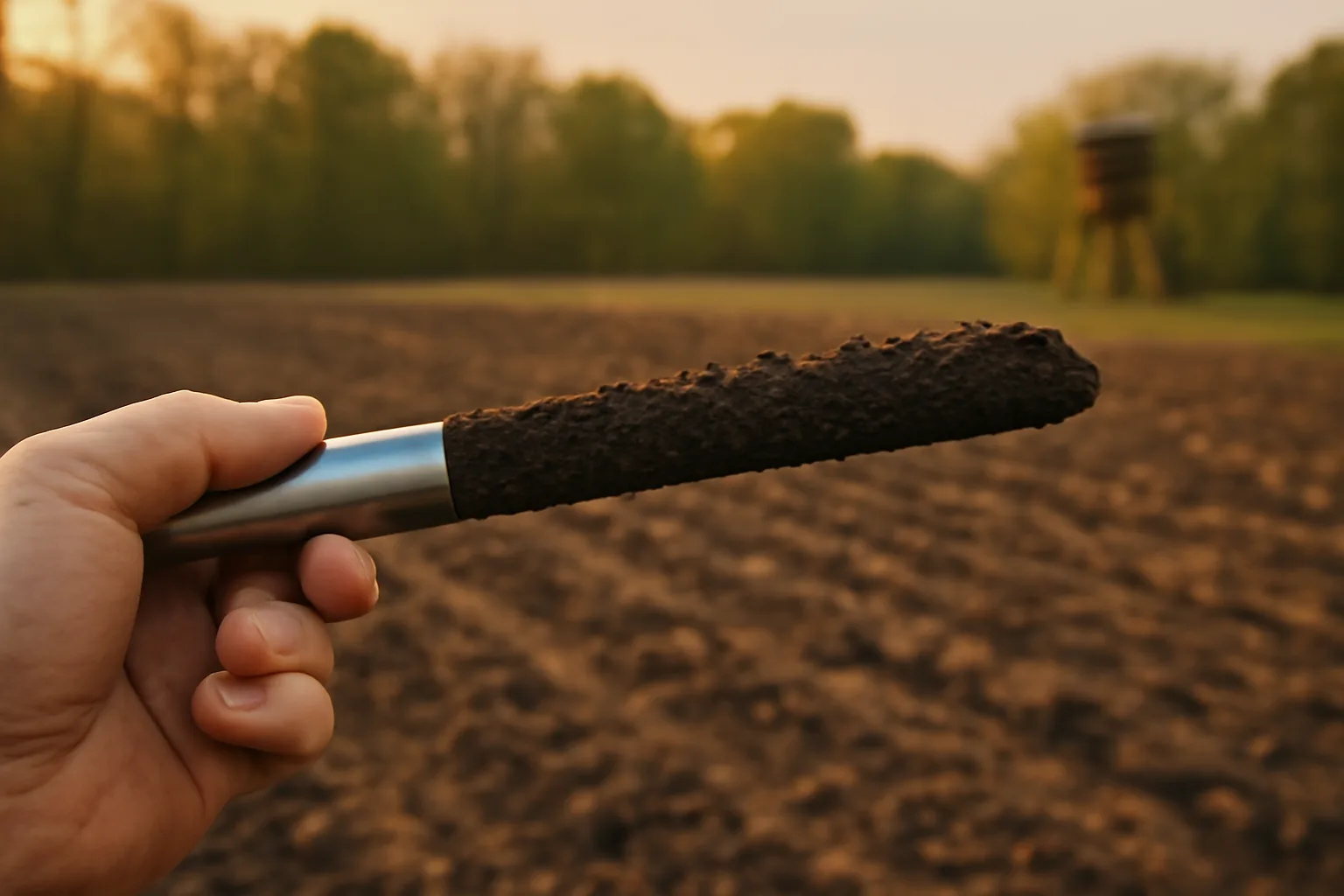
Pull 8 to 12 small cores from across the plot at a depth of 6 to 8 inches, mix them in a clean bucket, and send about a pint of the composite as one sample. Walking a zigzag or W pattern across the field gives a fairer average than grabbing one shovelful near the gate. Avoid sampling right after lime or fertilizer application, right next to a deer feeder or mineral site, or along the exact edge of the woods where leaf litter skews pH. If your plot has an obviously wet low spot and a dry high end, that's arguably two different soils and worth two separate samples if you're serious about it. Most state land-grant extension offices (University of Tennessee, Mississippi State, Purdue, and similar) will run the test for a flat fee and mail or email results in one to two weeks [1]. Some private labs turn results around in days for a bit more money. Either way, do this in late summer or early fall, well before your planting window, so lime has time to react in the soil. Pelletized lime needs time to break down and move pH; broadcasting it the same week you plant does almost nothing for that season's crop.
What do my soil test results actually mean?
Your report will show pH, plus levels of phosphorus (P), potassium (K), and sometimes magnesium, calcium, and organic matter. Most labs also print a lime recommendation in tons per acre and a fertilizer recommendation in pounds of N-P-K per acre for whatever crop you tell them you're planting. pH is the number to fix first. Clover and alfalfa want 6.5 to 7.0. Brassicas like turnips and radishes tolerate down to about 5.3 but do noticeably better above 6.0. Cereal grains (oats, wheat, rye) are the most forgiving, often fine down to 5.5, which is part of why they're a common first-year crop on rough new ground. Lime recommendations commonly run 1 to 3 tons per acre on newly broken food plot ground in the Southeast and Midwest, according to extension fertility guides from Mississippi State University Extension [2]. That's a real cost, often $30 to $60 a ton delivered and spread depending on your region, so budget for it rather than being surprised. Phosphorus and potassium show up as low, medium, high, or very high on most reports, sometimes with a raw ppm number. Low or medium means you need to add fertilizer even if the field looks green and healthy right now; nutrient deficiency in a food plot often shows up as stunted growth or poor regrowth after grazing pressure, not obvious yellowing.
When to plant food plots for deer: what's the actual calendar?
Timing splits into two windows almost everywhere in the whitetail's range: a spring/summer planting for warm-season annuals and perennials, and a late-summer/early-fall planting for cool-season annuals. Which window you use depends entirely on what you're planting. Spring plots (usually April through June depending on latitude) are for soybeans, corn, sorghum, and summer annual clovers or perennial clover establishment. These need warm soil, generally above 65 degrees F, and a longer frost-free window to mature. Fall plots (roughly late July through September, again shifting with latitude) are for brassicas, cereal grains like oats and wheat, and cool-season clover overseeding. The general rule taught by most extension wildlife programs is to plant brassicas and turnips 60 to 90 days before your first expected hard frost, and cereal grains 45 to 60 days before frost, so they're established and palatable heading into hunting season [3]. The honest answer to "when to plant food plots for deer" is: it depends on your zone and your species, not a single date. A grower in southern Georgia and a grower in northern Minnesota are working from calendars six to eight weeks apart. Check your local frost dates through the NOAA/NWS climate normals or your state extension's planting guide before locking in a date.
When to plant oats for deer, specifically?
Plant oats for deer food plots 45 to 60 days before your area's average first fall frost, which for most of the whitetail's range lands somewhere between mid-August (northern states) and early October (Deep South). Oats germinate fast, often in 5 to 10 days with good soil moisture, and they're one of the most reliably attractive cool-season annuals because deer hit tender oat shoots hard as soon as they emerge. Oats winterkill in most of the country once temperatures drop into the low teens or single digits for extended periods, which is fine if you're using them as an early-fall attractor. If you want green forage into late winter, pair oats with winter wheat or cereal rye in the same mix; rye in particular tolerates cold far better and will often green back up in late winter even after oats have died back. A light seeding of oats, around 60 to 100 pounds per acre broadcast, drilled slightly less, gives quick cover of bare dirt and works well as a nurse crop over a fall clover seeding, according to standard extension forage seeding rate tables [3].
When to plant turnips for deer, and do deer actually eat them?
Plant turnips for deer 80 to 90 days before your first expected hard frost, generally late July through mid-August in the northern half of the whitetail range and into early September in the Deep South. Turnips need that lead time to bulb out before deer start using them heavily, and the leafy tops become highly palatable after the first couple of frosts convert starches to sugars. Deer will often ignore turnip bulbs early in the season and hammer the tops, then switch to digging up and eating bulbs once cold weather sets in and sugar content rises. That's a well-documented pattern in wildlife extension brassica guides, not a myth: deer preference for brassica forage increases measurably after a frost sweetens the plant. Seeding rate for turnips alone runs 4 to 6 pounds per acre; most plotters blend them with radish or a cereal grain rather than planting a pure stand, since a straight turnip monoculture can get bitter and can leave bare, eroding dirt in early fall before the canopy fills in.
Do deer eat clover, and do deer like clover?
Yes. Clover is one of the most consistently preferred food plot forages across the whitetail's range, and it's the closest thing to a default first choice most wildlife biologists recommend for a perennial plot. White clover varieties (Durana, Patriot, Ladino types) and red clover both get heavy use throughout spring, summer, and fall. Clover's appeal comes down to protein and digestibility. Good clover forage runs 25 to 30 percent crude protein at the right growth stage, which is well above most warm-season grasses and competitive with soybeans, per forage quality data compiled by university forage extension programs. Deer, especially lactating does in summer and bucks growing antlers, need that protein density. The tradeoff is clover takes more from you upfront. It wants a pH near 6.5 to 7.0, needs a firm, well-prepared seedbed since the seed is tiny, and won't tolerate standing water or heavy shade. A perennial clover stand, properly maintained with mowing and occasional herbicide for grass competition, can produce for three to five years before needing to be renovated or reseeded, which makes the upfront soil work worth it. If you're picking your first plot species, deer food plot seed breaks down clover against the other common options in more depth.
Do deer eat sorghum, and is it worth planting?
Yes, deer eat sorghum, primarily the grain heads and to a lesser degree the leaves, but it's more of a fall and winter food source than a season-long attractant. Grain sorghum (milo) is planted like corn, generally late spring once soil temps hold above 60 to 65 degrees F, and matures over a long summer. Sorghum's real value in a food plot program is standing winter forage. The stalks hold up well through snow and ice better than corn in a lot of regions, and the grain provides carbohydrate energy deer need in late winter when protein-heavy forage is gone. It's commonly planted as a mix with other warm-season species rather than alone, both for deer and for the cover value it gives to other wildlife. One real caution: sorghum species contain compounds that can produce prussic acid (cyanide) under certain stress conditions like frost damage or drought stunting, a documented risk in forage sorghum covered by land-grant forage safety guidance [4]. It's mostly a livestock grazing concern rather than a deer food plot issue since deer browse selectively and lightly, but it's worth knowing if you're also running cattle or goats on the same ground.
What are deer's favorite foods, really?
There's no single universal answer, because deer preference shifts by season, region, and what's available naturally, but the forages that show up again and again at the top of preference studies and extension recommendations are soybeans, clover, and standing corn or acorns depending on the time of year. In spring and summer, deer key in on high-protein, high-digestibility forage: clover, soybeans, alfalfa, and cowpeas. In fall, energy and carbohydrates matter more as deer build fat reserves; that's when acorns, corn, and brassica bulbs get heavy use. In late winter in northern climates, deer will eat almost anything with calories left, including woody browse, because most planted annuals are gone or frozen out. Regional forage availability studies from state wildlife agencies consistently rank soybeans and clover among the top preferred food plot plantings when deer have a choice, largely because of protein content and digestibility rather than any single micronutrient [5]. If you're planning a full property rather than one plot, food plot whitetail and deer food plots both cover how to lay out multiple food sources across a season instead of betting on one crop.
Do deer like honey? Where does that question even come from?
There's no research or wildlife agency guidance suggesting deer seek out honey in the wild or that it's used in any legitimate food plot or attractant program. Deer are herbivores built to digest plant fiber through a four-chambered rumen system; a thick sugar syrup like honey isn't part of their natural diet and isn't something extension or wildlife agencies recommend using as bait or attractant. What's likely happening with this search is confusion with mineral licks, molasses-based supplements, or commercial "deer candy" style attractant products that use sugar, salt, and sweet scents to draw deer to a specific spot. Those products exist and deer do use them, but that's a different category from honey specifically, and most states regulate or outright ban baiting and supplemental feeding for hunting purposes. Before using any mineral, sugar-based, or scent attractant near a plot or stand, check your state wildlife agency's baiting and feeding regulations directly, since rules vary widely and change year to year; several states ban baiting outright for disease control reasons tied to chronic wasting disease management.
How much lime and fertilizer does a typical plot actually need?
| Clover (perennial) | 6.5-7.0 | 1-3 tons/acre | 0-20-20 to 0-30-30 lbs/acre | |
|---|---|---|---|---|
| Brassicas/turnips | 5.3-6.8 | 1-2 tons/acre | 40-60 lbs N, moderate P-K | |
| Oats/cereal grains | 5.5-7.0 | 0.5-2 tons/acre | 30-50 lbs N at planting | |
| Soybeans | 6.0-6.8 | 1-2 tons/acre | Low N (fixes own), moderate P-K | |
| Sorghum/milo | 5.8-7.0 | 1-2 tons/acre | 50-80 lbs N | Source ranges compiled from Penn State Extension and Mississippi State Extension agronomy fertility guides [2]. Your actual numbers will vary. This table is a starting sanity check, not a rate sheet to skip your own soil test for. |
Here's a rough picture of what a soil test commonly turns up on unimproved food plot ground, compared to what the crop wants. These are typical extension-cited ranges, not a substitute for your own test results. | Crop | Ideal soil pH | Typical lime need on new ground | Typical N-P-K starter rate |
When should I actually pull the sample relative to my planting date?
Test in late summer or early fall for a fall plot, and in late winter or early spring for a spring plot, giving yourself at least 4 to 8 weeks between getting results and planting so lime has time to start working. Lime is slow. It can take a full growing season or more to fully move soil pH, which is why a lot of experienced plotters test a full year ahead on brand new ground and accept that year one is a transition crop, not the final stand. If you're short on time and testing right before planting, don't skip it anyway; a late test still tells you fertilizer needs even if lime won't fully react before this season's crop goes in. You can always apply pelletized (fast-acting) lime for a partial, faster effect, though it costs more per ton than standard ag lime. Retest every 2 to 3 years on established plots, or every year on ground you're actively correcting from a low pH. Once a perennial clover stand is holding a good pH and fertility level, testing becomes more of a maintenance check than a diagnostic tool.
Where do I send a soil sample, and what does it cost?
Most state land-grant universities run a soil testing lab open to the public, usually for $8 to $15 per sample for a basic fertility test (pH, P, K, sometimes lime index), with results back in one to two weeks during the growing season and possibly longer during peak spring or fall submission rushes [1]. Some states add a small mailing or handling fee. County extension offices, listed through your state's Cooperative Extension System, will usually give you the sample bag, the submission form, and instructions for free, and can walk you through reading the results if the report format is confusing. Private ag labs and some farm co-ops offer faster turnaround for a higher price, sometimes $20 to $40, and are a fine option if you're testing right up against a planting deadline. Whichever lab you use, tell them specifically what you're planting (clover, brassica, corn, etc.) when you submit the sample. The lime and fertilizer recommendations they print are calculated against a target crop, and "food plot mix" isn't specific enough for the software to give you an accurate number.
Frequently asked questions
Do deer eat sorghum?
Yes. Deer eat both the grain heads and leaves of sorghum, especially in fall and winter when it's one of the few standing carbohydrate sources left. It's usually planted as part of a mix rather than alone, and mainly valued for winter standability and energy content rather than early-season attraction.
Do deer eat clover?
Yes, heavily. Clover is one of the most preferred food plot forages in the whitetail's range because of its high crude protein content, often 25 to 30 percent at good growth stages. Deer use it from spring green-up through fall, making it one of the most common perennial plot choices nationwide.
When to plant deer food plots?
It depends on the species and your region. Warm-season plots (soybeans, corn, summer clover) go in April through June once soil warms above 65°F. Cool-season plots (brassicas, oats, wheat) go in late July through September, timed 45 to 90 days before your area's first fall frost depending on the crop.
Do deer like clover?
Yes, and it's frequently ranked among the top preferred food plot forages by wildlife extension programs, largely due to its protein and digestibility. Deer use clover through spring, summer, and fall, though it needs a pH near 6.5 to 7.0 and good seedbed prep to establish well.
When to plant oats for deer?
Plant oats 45 to 60 days before your area's average first fall frost date, generally mid-August in northern states and into early October in the Deep South. Oats germinate fast, often within 5 to 10 days, and deer typically hit the tender new growth hard as soon as it emerges.
When to plant food plots for deer in general?
Split your calendar into two windows: spring (April-June) for warm-season crops like soybeans, corn, and summer clover, and late summer to early fall (late July-September) for brassicas, cereal grains, and clover overseeding. Exact dates shift 4 to 8 weeks depending on your latitude and local frost dates.
When to plant turnips for deer?
Plant turnips 80 to 90 days before your area's first hard frost, usually late July through mid-August up north and into early September in the South. That lead time lets bulbs size up before deer switch from eating tops to digging up and eating the sweetened bulbs after frost.
What is a food plot?
A food plot is a planted patch, usually a quarter acre to several acres, established to feed deer and other wildlife and give hunters a spot to observe or hunt over. It's managed with soil tests, lime, fertilizer, and a species and planting calendar matched to the region, similar to a small farm field.
What are deer's favorite foods?
There's no single universal answer since preference shifts by season and region, but soybeans, clover, and acorns/corn consistently rank at the top. Deer prioritize protein-rich forage like clover and soybeans in spring and summer, then shift to carbohydrate-dense foods like acorns, corn, and brassica bulbs in fall and winter.
Do deer like honey?
There's no wildlife research or extension guidance indicating deer seek out honey; it isn't part of their natural rumen-based herbivore diet. The question likely stems from confusion with molasses or sugar-based mineral and attractant products, which are a separate category and are restricted or banned as bait in many states.
How much does a food plot soil test cost?
Most university or state land-grant labs charge $8 to $15 per basic fertility sample (pH, phosphorus, potassium, lime recommendation), with results in one to two weeks. Private ag labs run $20 to $40 for faster turnaround. It's the cheapest input in a food plot budget relative to seed and fertilizer costs.
How often should I retest food plot soil?
Retest every 2 to 3 years on an established, well-limed plot, or annually if you're actively correcting a low pH or building fertility on new ground. Once pH and nutrient levels stabilize in the target range for your crop, testing shifts from diagnostic to routine maintenance.
Can I plant a food plot without testing the soil first?
You can, but you're guessing at lime and fertilizer needs, which are the two biggest levers on yield. Extension research shows uncorrected acidic soil can cut yield potential by 30 to 50 percent even with good seed and rainfall, so skipping a $10-20 test to save money is poor math.
Sources
- Mississippi State University Extension, Soil Testing: University soil testing labs process samples for a modest per-sample fee with turnaround typically within one to two weeks
- Mississippi State University Extension, Establishing Wildlife Food Plots: Lime recommendations of 1 to 3 tons per acre are common on newly established food plot ground
- University of Tennessee Extension, Wildlife Food Plots: Cool-season food plot species like brassicas and cereal grains should be planted 45 to 90 days ahead of first frost depending on species
- Purdue University Extension, Prussic Acid Poisoning in Livestock: Sorghum species can develop prussic acid risk under frost or drought stress conditions
- Mississippi State University Extension, Deer Food Habits and Preferences: Soybeans and clover rank among top preferred forages for white-tailed deer when available