Last updated 2026-07-26
TL;DR
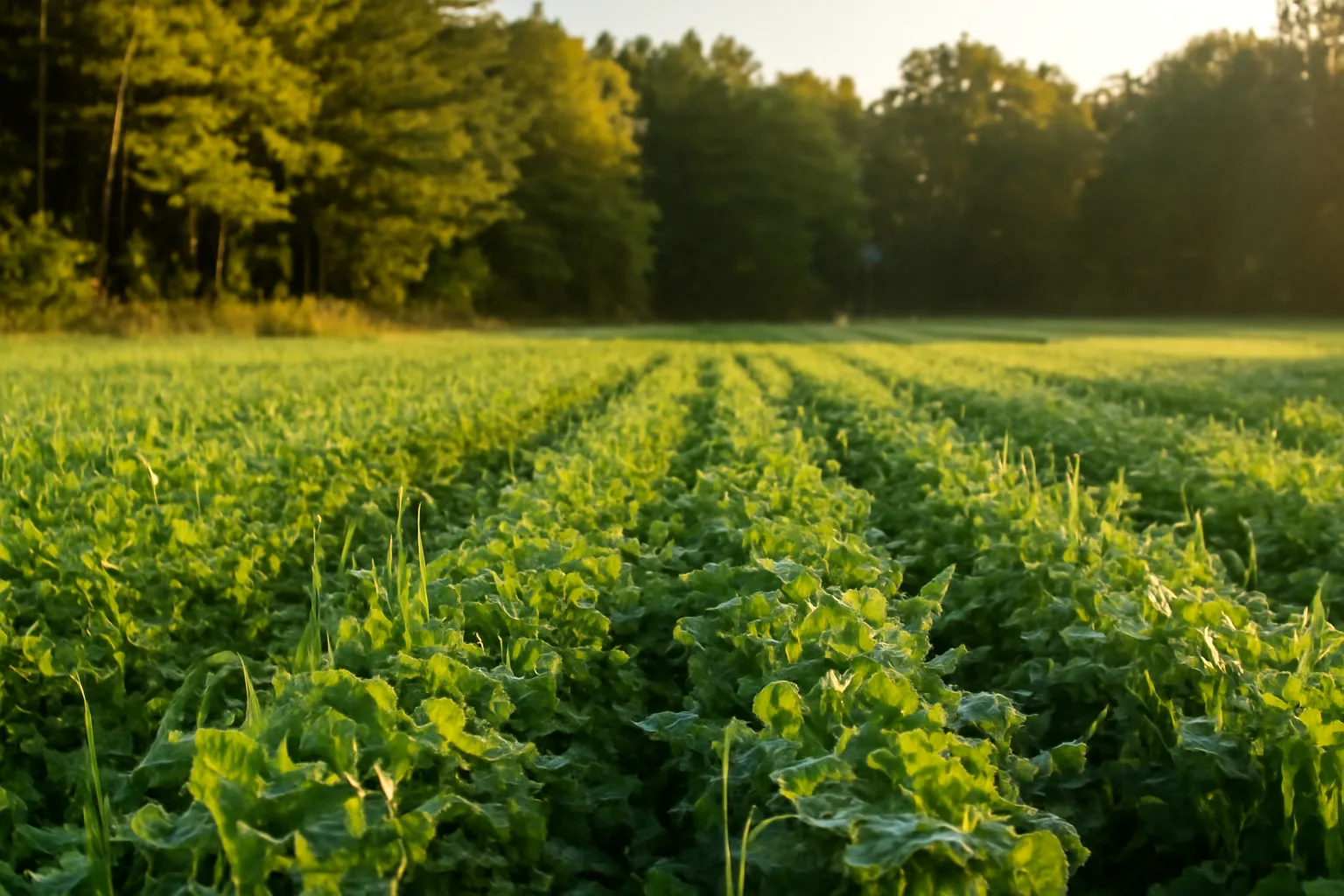
For Alabama, plant cool-season blends of oats, wheat, crimson clover, and brassicas between mid-September and early November for most of the state, with the Gulf Coast counties planting a bit later. Warm-season plots (soybeans, cowpeas, sorghum) go in April through June. Clover works well as a perennial base almost everywhere in Alabama.
What is a food plot, exactly?
A food plot is a planted area, usually a half acre to a few acres, put in specifically to feed and attract deer or other wildlife. It's not a lawn and it's not a crop field meant for harvest and sale. The goal is deer nutrition and, for most hunters, a place to hunt over. Food plots generally fall into two buckets: annuals you replant every season (oats, wheat, brassicas, soybeans) and perennials that come back for two to five years with maintenance (clover, chicory, alfalfa). Alabama hunters typically run both, a perennial clover plot near a stand for early season and late season hunting, and annual plots of grain or brassica for fall and winter draw. The Alabama Department of Conservation and Natural Resources (ADCNR) reminds landowners that supplemental feeding and baiting rules differ from food plots. Planted food plots are legal statewide and are not considered baiting under Alabama law, but check current regulations before setting out any loose grain, mineral, or feed products, since those rules can and do change by county and season [1]. If you want a plan built around your specific soil test and property instead of guessing at a seed tag, that's exactly what the food plot whitetail guide and a custom plan can help with.
When should you plant food plots for deer in Alabama?
| North Alabama (Tennessee Valley, Sand Mountain) | Sept 15 to Oct 15 | April 15 to June 1 | |
|---|---|---|---|
| Central Alabama (Black Belt, Piedmont) | Sept 20 to Oct 25 | April 20 to June 10 | |
| South Alabama / Gulf Coast | Oct 1 to Nov 5 | May 1 to June 15 | The Alabama Cooperative Extension System recommends timing fall plantings so plants have 45 to 60 days of growth before hard freezes, which for most of the state means getting seed in by mid-October [2]. Waiting until Halloween to plant in north Alabama is a common mistake. Plots that go in too late never fill in before deer start hammering them in December, and you end up with a picked-over stubble field by Christmas. |
Cool-season plots go in from mid-September through early November across most of Alabama, timed so seedlings get established before the first hard frost and before deer season pressure builds. Warm-season plots go in April through June once soil temperatures warm and the last frost risk passes. Alabama spans two USDA winter hardiness zones for practical purposes, zone 7b in the north and zone 8a-8b along the Gulf Coast, with average first frost dates ranging from mid-November in the north to early December near Mobile and Baldwin counties. That frost gap matters. A north Alabama planter in Madison or Jackson County should be in the ground by early to mid-October to beat frost and get real growth before deer season peaks in November. A coastal planter in Baldwin or Mobile County can push cool-season plantings into early November and still be fine. Here's a rough split by region: | Region | Cool-season planting window | Warm-season planting window |
What's the best food plot seed for Alabama soils?
The best seed for Alabama depends on your soil pH and drainage more than anything else. Alabama has a lot of acidic, clay-heavy soil, especially in the Piedmont and parts of the Black Belt, and most food plot species (clover, brassicas, soybeans) want a pH between 6.0 and 6.8 to really produce [3]. If your soil test comes back at 5.2, no seed blend fixes that. Lime does. With that said, here's what performs consistently well across Alabama when pH and fertility are in range: Clover (crimson and white/ladino) is close to a default answer for Alabama food plots. It tolerates the state's humidity and rainfall pattern better than a lot of other perennials, fixes its own nitrogen once established, and Alabama deer hit it hard from fall green-up through spring. Oats and wheat are cheap, fast, and forgiving of a late planting date, and they're a good nurse crop mixed with clover. Brassicas (turnips, radishes, rape) do well in Alabama's clay soils once pH is corrected, though they need that correction more than clover does since they're heavier feeders. Iron and clay cowpeas and forage soybeans are the go-to warm-season options; they handle Alabama's summer heat and humidity far better than a lot of northern soybean varieties bred for shorter, cooler seasons. Cereal rye is underused in Alabama plots. It's more cold and drought tolerant than oats, grows later into spring, and works well as a low-cost fall planting on ground you're not ready to commit clover to yet.
Do deer eat sorghum?
Yes, deer eat sorghum, primarily the grain heads in fall and winter, though it's rarely their first choice next to soybeans, clover, or acorns. Sorghum works better as a screening and structure crop, or as a late-winter grain source, than as a primary attractant plot. Whitetail deer will browse young sorghum shoots and eat the grain once heads mature and dry down, and turkeys and other wildlife use it heavily too. In Alabama, grain sorghum (milo) planted in a summer plot can hold up through August heat better than corn on marginal ground, and it doesn't demand the fertility corn does. But if your goal is maximum deer attraction and nutrition, sorghum is a supporting player, not the headline. Most Alabama food plotters use it mixed into a summer blend with cowpeas and soybeans rather than as a standalone plot.
Do deer like clover, and do they actually eat it?
Yes, deer eat clover heavily and it's one of the most reliable food plot species in Alabama. Clover is a preferred forage with crude protein commonly measured between 20 and 30 percent in good stands, and it stays palatable through most of the growing season, unlike a lot of annuals that mature past their prime window [4]. White clover (Durana, Ladino) and crimson clover are the two most planted types in Alabama food plots. White clover is a perennial that, with mowing and light fertility maintenance, can produce for three to five years off one planting. Crimson clover is a reseeding annual that establishes fast, handles Alabama's mild winters well, and often gets mixed with white clover or oats as a nurse crop. The tradeoff with clover is establishment patience and weed control. Clover seed is small and needs good seed-to-soil contact and a firm seedbed, and it's slow out of the gate compared to oats or wheat. Alabama Extension guidance on forage legumes notes that proper lime and phosphorus application before planting is one of the biggest factors in stand success, since clover is far more sensitive to low pH than cereal grains are [5]. If you're planting clover on ground that hasn't been limed in years, budget for that lime application and don't expect a first-year stand to look like the seed bag photo.
When should you plant oats for deer in Alabama?
Plant oats for deer in Alabama between mid-September and late October, depending on your region, so they establish before the first hard frost. Oats are one of the most frost-tolerant cool-season grains available and they green up fast, often within 7 to 10 days of a good rain. In north Alabama, aim for the September 15 to October 15 window. In south Alabama and along the coast, you can push into early November. Oats are a common choice for hunters who want quick fall cover and forage without waiting on a slower-establishing legume, and they pair well as a nurse crop with clover, since the oats give you visible green growth and light shade while the clover gets its roots down. One real limitation: oats aren't as cold hardy as wheat or cereal rye. A hard freeze below the mid-teens can set oats back badly or kill them outright, which matters more in north Alabama's colder pockets like Sand Mountain or the Appalachian foothills than it does near Mobile.
When should you plant turnips for deer in Alabama?
Plant turnips for deer in Alabama between mid-August and mid-September, earlier than most other cool-season plots, because turnips need a longer growing period (roughly 80 to 90 days) to bulb out before deer start using them heavily in late fall and winter. This is one of the most common timing mistakes Alabama food plotters make. Turnips planted in October alongside clover and oats will produce leafy tops but rarely get the chance to bulb properly before frost slows growth, and deer in Alabama often ignore turnip bulbs entirely until after several frosts sweeten the starches into sugars, typically late November into December. So the real sequence is: plant turnips in August, let them mature through fall, and expect the bulb feeding to peak well into hunting season, sometimes not until after Thanksgiving. Brassica blends (turnip, radish, rape mixed) are popular because the radish and rape green up fast for early season browsing while the turnip bulbs mature for the late-season push. Just don't expect a turnip plot planted at the same time as your clover to perform the same way.
What are deer's favorite foods, and does that change by season?
Deer's food preferences shift constantly with the season and what's available, but across most of the whitetail's range, acorns, soybeans, clover, and other legumes rank as consistently preferred foods. In Alabama specifically, white oak acorns are often the single most preferred natural food when they're dropping, and deer will frequently walk past a planted plot to hit a good acorn flat in October. That's worth remembering when you're planning plots: you're more than competing with the neighbor's plot, you're competing with whatever mast is on the ground that year. In a heavy acorn year, plot use can drop noticeably in October and November before picking back up in December and January once acorns are gone. In a light mast year, plots get hit hard from opening day. Outside of mast, the general pecking order most Alabama food plotters observe is: soybeans and cowpeas in summer, clover nearly year-round when available, brassicas and grain in late fall and winter, and browse (honeysuckle, greenbrier, native forbs) filling gaps everywhere else. If you want a deeper species-by-species comparison, the deer food plot seed guide breaks down palatability and nutrition by crop.
Do deer like honey, or is that a myth?
No, deer don't seek out honey as a food source in any meaningful way, and there's no wildlife agency or extension guidance recommending it for food plots or attractants. Deer are herbivores built to digest cellulose and plant material through a four-chambered rumen system, not concentrated sugars like honey [4]. This question usually comes up because of "honey hole" terminology (a great hunting spot) or because some commercial deer attractant sprays include sweet, molasses-based scents that deer will investigate out of curiosity, not because honey itself is a preferred food. If you're looking to add a sugar or mineral draw to a plot, actual research-backed options are things like a mineral lick placed where it's legal, or simply a well-timed brassica plot that sweetens naturally after frost. Save the honey for your coffee.
What are the best warm-season and cool-season blends for Alabama specifically?
| White clover | Sept-Oct or Feb-March | Perennial base, spring/fall | 6.0-6.8 | |||||||||||||||||||||
|---|---|---|---|---|---|---|---|---|---|---|---|---|---|---|---|---|---|---|---|---|---|---|---|---|
| Crimson clover | Sept-Oct | Fall/winter annual, nurse crop | 6.0-6.8 | |||||||||||||||||||||
| Oats | Sept 15-Oct 25 | Fast fall cover/forage | 5.8-6.5 | Wheat | Sept 20-Nov 1 | Cold-hardy fall grain | 5.8-6.5 | Brassicas (turnip/radish) | Aug 15-Sept 15 | Late fall/winter bulb & leaf | 6.0-6.5 | Iron/clay cowpeas | April 15-June 15 | Summer forage, browse-tolerant | 6.0-6.8 | Forage soybeans | April 20-June 1 | Summer forage, high protein | 6.0-6.8 | Grain sorghum | May-June | Screening, late-winter grain | 5.5-6.5 | If a soil test isn't in hand yet, get one before buying seed. The deer food plots overview walks through soil sampling basics, and Alabama Extension's soil testing lab processes samples for a modest per-sample fee through county Extension offices [3]. |
For Alabama's climate, the best cool-season blend is usually a mix of oats or wheat, crimson clover, and a brassica like turnip or radish, planted in the September to October window depending on region. The grain gives fast cover and early forage, the clover carries the plot through winter and into spring, and the brassica adds a late-season bulb and leaf source. For warm-season plots, iron and clay cowpeas, forage soybeans (like Eagle or Tecomate forage varieties bred for southern heat), and a little grain sorghum mixed in handle Alabama's humidity and deer pressure well. Straight soybean plots can get hammered flat by browsing pressure on smaller acreage, especially under 3 to 5 acres, so mixing in cowpeas (which regrow faster after browsing) helps the plot survive through summer instead of getting wiped out by July. Here's a simple comparison of common Alabama plot options: | Species | Planting window (AL) | Best use | Soil pH target |
How much lime and fertilizer does an Alabama food plot actually need?
It depends entirely on your soil test results, and there's no honest way around that answer. Alabama's soils vary hugely by region, from sandy Coastal Plain ground to heavy Black Belt clay to acidic Piedmont soils, and lime needs can range from zero to over 2 tons per acre depending on starting pH [3]. What's consistent is the target: most food plot species want pH between 6.0 and 6.8, and Alabama Extension soil test reports come back with specific lime and fertilizer recommendations in pounds per acre based on your actual sample, not a generic seed-bag suggestion [3]. Lime takes months to fully react in the soil, which is why fall soil sampling for a spring warm-season plot, or spring sampling for a fall plot, gives lime time to work before you plant. Your soil test lab is the real authority here, not a seed tag or a blog post. If you've already got results in hand and want help translating them into an actual planting plan for your property, that's the specific gap a $99 Custom Food Plot Plan is built to fill, matching species and rates to your zone, your acreage, and your test numbers instead of a one-size-fits-all bag mix.
What equipment do you actually need to plant a food plot in Alabama?
At minimum, you need a way to kill existing vegetation, break or scratch the soil surface, spread seed, and get seed-to-soil contact. That can mean anything from a tractor with a disc and cultipacker down to a UTV, a hand spreader, and a lot of sweat equity on a half-acre plot. For small plots under an acre, a lot of Alabama hunters get by with a sprayer (backpack or UTV-mounted) for burndown herbicide, a hand-crank or ATV broadcast spreader for seed, and a drag harrow or even a chain-link section dragged behind a UTV to work seed into loose soil. For clover and brassica seed especially, seed-to-soil contact matters more than depth, since both germinate best from shallow planting or even just a light cultipacking pass. For larger plots, a disc harrow and a cultipacker (or a no-till drill if you've got access to one) make a real difference in stand consistency, especially on Alabama's clay soils that can crust hard after rain. No-till drills are worth renting or borrowing if your county Extension office or a local co-op has one available, since they cut down dramatically on erosion and moisture loss compared to full tillage on sloped ground, which matters given how much of Alabama's food plot ground sits on rolling Piedmont or foothill terrain. For a full breakdown of gear by plot size and budget, see food plot seed and domain food plot seed for species-specific planting depth and rate guidance.
Frequently asked questions
Do deer eat sorghum?
Yes, deer eat grain sorghum heads in fall and winter and will browse young shoots, but it's usually a secondary food behind soybeans, clover, and acorns. Most Alabama hunters use sorghum mixed into summer blends for screening and late-winter grain rather than as a standalone attractant plot.
Do deer eat clover?
Yes, deer eat clover heavily and prefer it over many other forages. Clover commonly tests at 20 to 30 percent crude protein and stays palatable through much of the growing season, making it one of the most reliable food plot species planted in Alabama.
When should I plant food plots for deer in Alabama?
Cool-season plots go in mid-September to early November depending on region (north Alabama earlier, Gulf Coast later); warm-season plots go in April through June. Timing follows your area's average first frost date and last frost date.
Do deer like clover more than other food plot crops?
Deer generally rank clover among their top preferred forages, often above brassicas and most grains, though acorns and soybeans can outrank clover in season. Preference shifts with what natural food is available, so clover use often drops during a heavy acorn fall.
When should I plant oats for deer in Alabama?
Plant oats between mid-September and late October in most of Alabama, earlier in the north (by October 15) and later near the Gulf Coast (into early November). Oats germinate fast but aren't as freeze-tolerant as wheat or cereal rye.
When is the best time to plant food plots for deer in general?
The best time depends on whether you're planting a cool-season or warm-season plot and where you're located. In Alabama, that's roughly mid-September through early November for cool-season plots and April through June for warm-season plots, timed around your local frost dates.
When should turnips be planted for deer?
Plant turnips 80 to 90 days before you want them mature, which in Alabama means mid-August to mid-September. Turnips planted later, alongside clover or oats, usually produce leafy tops but don't bulb out fully before deer season.
What exactly is a food plot?
A food plot is a small planted area, usually under a few acres, put in specifically to feed and attract deer or other wildlife rather than for harvest or sale. It typically combines annual grains or brassicas with perennial clover or chicory.
What is a deer's favorite food?
Acorns, especially white oak acorns, are often a whitetail's single most preferred food when available, followed closely by soybeans and clover. Preference is seasonal and shifts heavily based on what natural mast and browse are on the ground.
Do deer like honey?
No, deer don't actively seek out honey. They're herbivores adapted to digest plant cellulose through a four-chambered rumen, not concentrated sugars, so honey has no real role in food plot planning or as a deer attractant.
What's the best all-around food plot seed for Alabama?
White or crimson clover is close to a default best answer for Alabama, since it tolerates the state's rainfall and humidity, fixes nitrogen, and stays palatable across most of the year once established with correct soil pH and fertility.
How much does it cost to soil test before planting an Alabama food plot?
Alabama Cooperative Extension System soil testing runs a modest per-sample fee through county Extension offices, generally in the range of a few dollars to around fifteen dollars per sample depending on the test package, far cheaper than guessing on lime and fertilizer.
Is baiting different from planting a food plot in Alabama?
Yes. Planted food plots are legal statewide and are not treated as baiting under Alabama regulations, but loose grain, feed piles, and mineral supplementation follow separate and sometimes shifting rules. Check current ADCNR regulations before setting out any feed products.
Can I plant the same seed blend across all of Alabama?
Not really. North Alabama's earlier frosts mean cool-season seed needs to go in by mid-October, while Gulf Coast counties can wait until early November. Soil pH also varies enough by region (Piedmont acidic clay versus Black Belt versus Coastal Plain sand) that lime rates differ property to property.
Sources
- Alabama Department of Conservation and Natural Resources, Hunting Regulations: Food plots and baiting/feeding rules are governed separately under Alabama hunting regulations
- Alabama Cooperative Extension System, Establishing Wildlife Food Plots: Fall food plot plantings need roughly 45 to 60 days of growth before hard freeze for best establishment
- Alabama Cooperative Extension System, Soil Testing for Lawns, Gardens, and Wildlife Plots: Most food plot species need soil pH between 6.0 and 6.8, and lime/fertilizer needs vary widely by Alabama region
- USDA Natural Resources Conservation Service, Plant Fact Sheet: White Clover: White clover crude protein content commonly falls in the 20 to 30 percent range as a forage legume
- Alabama Cooperative Extension System, Clover for Wildlife Food Plots: Lime and phosphorus application before planting is one of the largest factors in successful clover establishment