Last updated 2026-07-24
TL;DR
Yes, deer eat radishes, both the leafy tops and the exposed bulb, especially after a frost sweetens the plant by converting starches to sugar. Forage radish (often called tillage or daikon radish) is planted in late summer, typically 60 to 90 days before your first hard frost, as a standalone plot or mixed with clover, oats, or brassicas.
Will deer actually eat radishes?
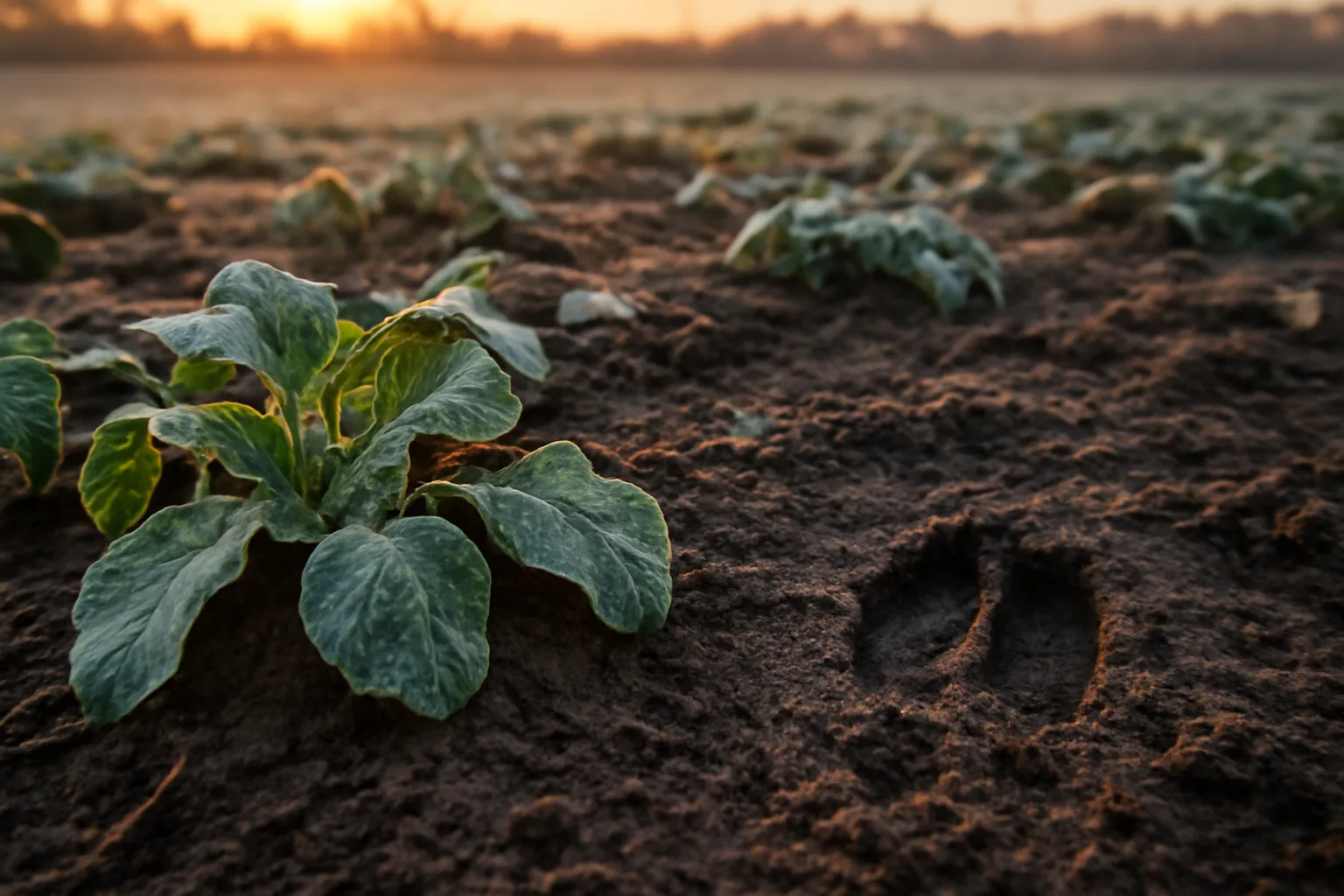
Yes. Deer eat both the leafy green tops and the root itself once the plant softens up. Forage radish, sometimes sold as tillage radish or daikon radish, has become one of the more popular fall food plot plantings over the last 15 years, and for good reason: deer use it hard once cold weather hits. Early in the season, right after germination, deer mostly nibble the leaves. The bulb (technically a taproot, not a true bulb) stays underground and isn't very appealing while it's still full of pungent compounds that give radishes their bite. That changes after a few frosts. Freezing temperatures trigger the plant to convert starches into sugars as a natural antifreeze response, and the radish gets noticeably sweeter and softer. Deer will then dig at partially exposed roots and eat them down to the dirt, sometimes leaving craters in the plot that look like something ran a rototiller through it. Penn State Extension's guidance on brassica forages for deer notes that palatability of radish and turnip improves after exposure to frost, since cold temperatures convert starches to sugars in the plant tissue, which is why most planting guides tell you to time radish plantings around your first expected frost date rather than around calendar convenience.
What is a food plot?
A food plot is a planted area on hunting land, usually a half-acre to a few acres, seeded with forage crops to attract and hold deer and to supplement natural browse. It's not the same as baiting. A food plot is a growing crop; bait is usually piled feed like corn or minerals, and states regulate the two very differently. Most food plots fall into two categories: annual plots (planted new each year, like brassicas, cereal grains, and soybeans) and perennial plots (planted once and managed for multiple years, like clover and chicory stands). Annual plots tend to produce more tonnage per acre and are better for late-season attraction. Perennials spread labor out and provide spring and summer nutrition when deer need it for antler growth and lactation. Before planting anything, check your state's baiting and feeding regulations, because some states classify certain planting practices or supplemental feeding differently depending on whether animals are attracted to a stationary food source versus a growing crop. Rules vary by state and sometimes by county, so your state wildlife agency's hunting regulations page is the actual authority here, not a blog post. If you want help laying out what to plant where based on your soil test and acreage, that's exactly what a food plot whitetail plan is built for.
When to plant food plots for deer?
Timing depends entirely on what you're planting and where you live. Broadly, spring plots (clover, chicory, soybeans) go in after your last frost date, and fall plots (brassicas, cereal grains, radishes) go in 60 to 90 days before your first fall frost. The reason for that fall window is simple: brassicas and radishes need time to establish a root system and leaf canopy before cold weather hits, but you also want that first frost to happen while the plant is still actively growing, so the sugar conversion happens right around hunting season. Cooperative extension planting calendars break the country into rough zones. In the Upper Midwest and Northeast, that often means fall plots go in from late July through August. In the Mid-South and Southeast, growers can wait until late August through September. In the Deep South and Gulf Coast, September into early October is common because frost comes so late. Your local land-grant university extension office publishes zone-specific planting date guides for your exact county, and that's a better source than a national average, since first frost dates can vary by three or four weeks across a single state.
When to plant turnips for deer?
Plant turnips 60 to 90 days before your area's average first fall frost date, which for most of the whitetail's range lands somewhere between late July and early September. Turnips are planted at the same time as radishes because they're both brassicas with similar frost-tolerance and sugar-conversion behavior. A typical seeding rate for turnips alone is 4 to 6 pounds per acre, drilled a quarter inch to half inch deep or broadcast onto a prepared, firm seedbed. Turnip seed is tiny, similar in size to radish seed, so a cultipacker pass after broadcasting helps get seed-to-soil contact without burying it too deep. Deer tend to hit turnip tops earlier in the fall than the bulbs, then switch to digging up bulbs once a hard freeze sweetens them, the same pattern as radishes. NDSU Extension's forage brassica publication describes turnips and radishes as cool-season crops whose bulbs become more palatable to livestock and wildlife after frost due to increased sugar content [1].
Do deer like clover?
Yes, clover is one of the most consistently preferred forages in a deer's diet, and it's arguably the backbone perennial plot for most hunters. Both white clover (including ladino types) and red clover show up in nearly every regional food plot seed mix sold in North America. Clover has a few advantages over annuals. It regrows after grazing, so a well-managed stand can get hit hard in spring and still produce through summer and into fall. It also fixes nitrogen through its root nodules, which cuts your fertilizer bill and improves soil for whatever you plant next in that spot. The tradeoff is that clover takes real maintenance. It needs mowing a few times a season to keep weeds down and to knock back the clover so it doesn't get too rank and stemmy for deer to want to eat it. Soil pH matters a lot too. Clover struggles below a pH of about 6.0, and most extension guides recommend liming to bring pH into the 6.0 to 7.0 range before planting for best establishment and yield. That's a call your soil test lab should make specifically for your field, since lime recommendations depend on your existing pH and buffer index.
When to plant oats for deer?
Plant oats in late summer to early fall, generally 45 to 60 days before your first frost, so they're the same general planting window as radishes and turnips but on the earlier end of it since oats establish fast and deer often hit them within a couple weeks of emergence. Oats are a cereal grain, not a brassica, so they behave differently. They germinate quickly, often within 5 to 10 days in warm soil, and deer will graze the young, tender leaves almost immediately. Oats don't handle hard freezes as well as wheat or rye, so in colder zones they tend to die back after the first serious hard freeze, while wheat and rye keep growing into winter and green back up in spring. A common seeding rate for oats in a food plot setting is 100 to 130 pounds per acre when drilled, a bit higher if broadcast, since broadcasting has lower germination success than drilling. Oats are frequently mixed with brassicas or clover to give deer something to eat immediately while the slower-establishing brassica bulbs are still developing underground.
Do deer eat sorghum?
Yes, deer eat sorghum, primarily the grain heads once they mature, and sorghum is more commonly planted as a summer/fall cover and grain crop than a primary attractant forage. Grain sorghum (milo) produces a seed head that deer, along with turkey and other wildlife, will feed on heavily once it dries down in fall. Sorghum is planted in late spring to early summer, similar timing to corn, since it needs a full warm growing season to mature. It's more drought-tolerant than corn, which makes it a reasonable substitute in dry regions or thin soils where corn yields would disappoint. One practical note: tall sorghum and sudangrass varieties also work well as screening cover along plot edges or access trails, giving deer a comfort corridor to enter a plot in daylight without feeling exposed. That's a secondary benefit worth considering even in plots where sorghum isn't the primary forage.
Do deer like honey?
No. There's no real food plot angle to this one. Deer don't forage for honey in any meaningful way in the wild, and it's not a crop or attractant used in food plot planning. Deer are herbivores built around fermenting plant material in a four-chambered stomach, and their diet is grasses, forbs, browse, mast (acorns, fruit), and agricultural crops, not animal products or sugars in that form. If you've seen this question paired with radishes and clover, it likely comes from search patterns rather than any actual deer behavior worth planning around. There's no cooperative extension guidance recommending honey as a deer attractant because it isn't one.
What are deer's favorite foods?
| Soybeans | Summer through early fall | High protein, heavily browsed while green | |
|---|---|---|---|
| Clover | Spring through fall | Regrows after grazing, needs mowing | |
| Acorns (natural mast) | Fall | Not planted, but often the top preference where available | |
| Brassicas (radish, turnip) | Late fall through winter | Palatability jumps after frost | |
| Corn | Fall through winter | High energy, good winter standing crop | |
| Winter wheat/rye | Fall through spring | Cold hardy, greens up early | |
| Oats | Early fall | Fast germination, early attraction | The Quality Deer Management Association (now the National Deer Association) has long noted that whitetail forage selection tracks nutritional need across the year, with protein-rich plants favored during spring antler growth and lactation, and energy-dense foods like mast and grain favored heading into winter. No single "favorite" food holds across all seasons, which is why a smart plot plan usually mixes forage types rather than betting on one species. |
Deer preference shifts by season, but across most of the whitetail's range, acorns, soybeans, clover, and standing corn rank at or near the top when available. Preference studies and browse surveys consistently show acorns as a fall favorite because of their high fat and carbohydrate content, which deer need heading into winter. Here's a rough ranking of common food plot forages by how consistently deer key in on them, based on widely cited extension forage trial patterns: | Forage | Season of peak use | Notes |
How do you plant a radish food plot step by step?
Start with a soil test, because radish and brassica plantings respond strongly to phosphorus and potassium levels, and your test results tell you exactly how much to apply rather than guessing. Most soil test labs (often run through your state's land-grant university) will give you specific lime and fertilizer recommendations based on your field's actual pH and nutrient levels. Once you have that back, here's the general sequence: 1. Kill existing vegetation with a burndown herbicide (like glyphosate) 2 to 3 weeks ahead, or till the plot clean. 2. Apply lime if your soil test calls for it. Lime takes months to fully adjust pH, so if you're behind on that, get it down as early in the season as you can, even if it's for next year's benefit. 3. Broadcast or drill radish seed at 4 to 6 pounds per acre if planting alone, or 2 to 3 pounds per acre as part of a brassica blend. 4. Cultipack or lightly drag to ensure seed-to-soil contact. Radish seed is small and shouldn't be buried deeper than a quarter to half inch. 5. Apply fertilizer per your soil test, typically split with some down at planting and possibly a second application if the plot is thin at 30 days. Radishes are frequently mixed with oats, clover, or other brassicas like turnips and rape to extend the plot's attraction window and give deer more variety. If you want a plan tailored to your acreage and soil test, the $99 Custom Food Plot Plan walks through species selection and seeding rates for your specific zone; your soil test lab's lime and fertilizer numbers stay the final word for your dirt, since a general plan can't replace site-specific agronomy.
Do deer prefer radish tops or the bulb?
Deer generally hit the leafy tops first, then shift to the bulb as it sweetens after frost. Early in the growing season, before any cold snaps, the tops are the main food source, since the bulb is still developing underground and hasn't gone through the starch-to-sugar conversion that makes it palatable. After several hard frosts, many hunters see plots where the greens are stripped down and deer have started pawing at exposed bulbs, digging craters where roots have been chewed down to nothing. This pattern is well documented enough that most extension brassica guides specifically recommend planting radish blends timed so peak bulb sweetness lines up with the middle or late portion of your hunting season, not the opening weeks [1]. One caution: heavy digging in a small plot can look destructive, almost like hog rooting, and some hunters mistake this for a plot failure when it's actually a sign deer are using the radishes exactly as intended.
What seed mixes pair well with radishes?
Radishes work well blended with turnips, oats, and cereal rye, since each brings something different to the plot's timeline. A common fall blend is radish, turnip, and oats together, giving deer fast-growing oat leaves within two weeks, turnip greens shortly after, and radish bulbs that peak in appeal once frost hits. Adding a cereal grain like winter wheat or rye to the mix extends the plot's life into late winter and early spring, since those grasses survive hard freezes far better than brassicas or oats do. That gives you green forage available even after the radishes have been dug up and eaten or have rotted into the soil. A rough starting blend for a one-acre plot: 3 pounds radish, 2 pounds turnip, 90 pounds oats, and 50 pounds winter wheat or rye, adjusted based on what your soil test and local extension seeding guide recommend for your region. If you'd rather start from a pre-built regional mix, deer food plot seed blends and straight food plot seed options are worth comparing against a custom build.
Frequently asked questions
Will deer eat radishes right after planting, or only after frost?
Deer will nibble radish tops soon after emergence, but they generally don't dig up and eat the bulbs heavily until after several frosts convert the plant's starches to sugar. Expect light browsing on leaves in early fall and much heavier use, including dug-up craters, once temperatures drop consistently below freezing.
Do deer eat sorghum in food plots?
Yes, deer eat sorghum grain heads once they mature and dry down in fall, and they'll also browse young sorghum leaves earlier in the season. It's typically planted in late spring like corn and works as both a grain source and, in taller varieties, as screening cover along plot edges.
Do deer actually like clover more than other forages?
Clover ranks among the most consistently preferred food plot forages across spring, summer, and fall, largely because it regrows after grazing and stays high in protein. It does need regular mowing and a soil pH near 6.0 to 7.0 to perform well, based on land-grant extension planting guidance.
When should I plant food plots for deer in my area?
Spring plots like clover and soybeans go in after your last frost date; fall plots like brassicas, radishes, and cereal grains go in 60 to 90 days before your first fall frost. Exact dates vary by 3 to 4 weeks even within a single state, so check your local land-grant university extension planting calendar for your county.
When is the right time to plant turnips for deer?
Plant turnips 60 to 90 days before your area's average first fall frost, generally late July through early September depending on latitude. Seed at 4 to 6 pounds per acre on a firm, prepared seedbed, and expect deer to hit the tops first and the bulbs after frost sweetens them.
What exactly is a food plot, and is it the same as baiting?
A food plot is a planted area seeded with forage crops to feed and attract deer over time; it's a growing crop, not a pile of feed. Baiting rules differ by state and sometimes classify plots differently depending on local regulations, so check your state wildlife agency's current hunting regulations before planting near a stand.
When should oats be planted for deer food plots?
Plant oats 45 to 60 days before your first fall frost, generally a bit earlier than radishes and turnips since oats germinate fast and deer graze the tender leaves within one to two weeks of emergence. Oats die back after a hard freeze, unlike wheat or rye, so they work best as an early-season attractant in a mixed blend.
Do deer like honey or sweet attractants?
No, honey isn't part of a deer's natural diet or any recognized food plot strategy. Deer are herbivores that rely on grasses, forbs, browse, and mast like acorns; there's no extension guidance or field data supporting honey as an attractant.
What are deer's favorite foods overall?
Preference shifts by season: acorns and other mast dominate in fall when available, soybeans and clover lead in spring and summer for protein, and brassicas like radish and turnip peak in appeal in late fall and winter after frost sweetens them. No single food ranks first across every season.
Why do I see craters or dug-up dirt in my radish plot?
That's deer digging up sweetened radish bulbs after a hard frost, not a sign of plot failure. Once starches convert to sugar in cold weather, deer paw at partially exposed roots and eat them down, sometimes leaving noticeable holes in a small plot.
Can I plant radishes alone, or should I mix them with something else?
Radishes can be planted alone at 4 to 6 pounds per acre, but most hunters blend them with turnips, oats, and a cereal grain like wheat or rye to extend the plot's usefulness from early fall through late winter. A straight radish plot gives you a strong late-season bulb crop but less to offer in the first few weeks after planting.
How much lime and fertilizer does a radish or clover plot need?
It depends entirely on your existing soil pH and nutrient levels, which is why a soil test matters more than a generic rate. Clover generally needs pH between 6.0 and 7.0, and brassicas respond strongly to phosphorus and potassium; your soil test lab's specific lime and fertilizer numbers for your field are the right numbers to follow, not a blanket rate.
Sources
- North Dakota State University Extension, "Forage Brassicas" (PP1811): Turnips and radishes become more palatable after frost due to increased sugar content in the bulb
- USDA NRCS, "Forage Radish Cover Crop" Plant Materials Technical Note: Forage radish is used as a cover crop that produces a large taproot and rapid fall growth suited to wildlife forage use
- University of Wisconsin-Madison Extension, "Clover for Wildlife Food Plots": Clover establishment and yield are best when soil pH is maintained between 6.0 and 7.0, requiring lime on acidic soils
- Oklahoma State University Extension, "Food Plots for Wildlife" (NREM-5033): Cereal grains like oats germinate quickly and provide early fall forage while slower-establishing brassicas develop
- Michigan State University Extension: Deer preferences for different food plot forages and best practices for planting brassica and legume mixes.