Last updated 2026-07-25
TL;DR
One acre is enough for a solid food plot if you match seed to soil and season. Clover and brassicas work well on small acreage because deer concentrate on them; grain plots like oats or sorghum need more space to survive browse pressure. Test soil first, plant to your frost dates, and expect one acre to realistically support light to moderate deer use, not unlimited herd nutrition.
what is a food plot, exactly
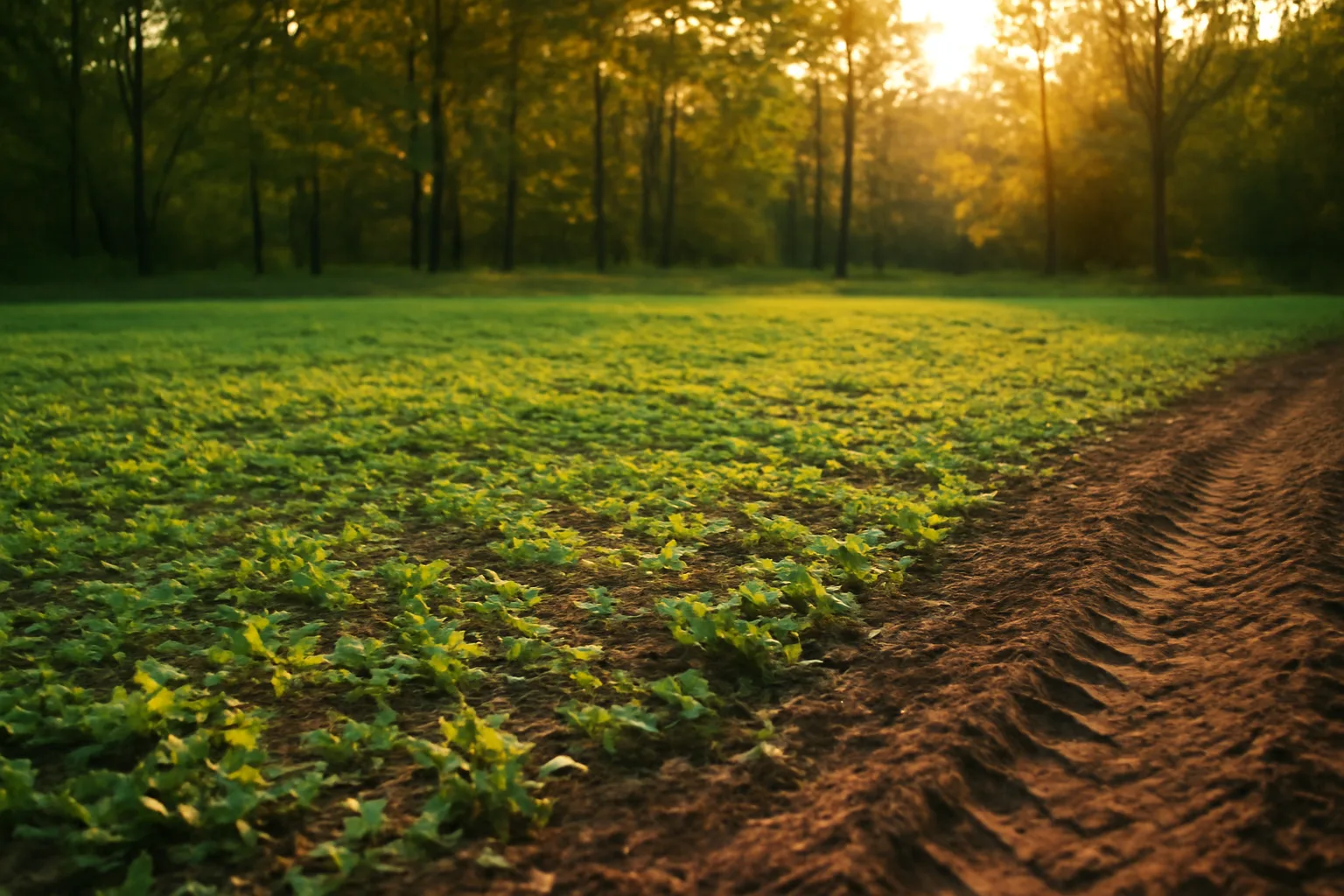
A food plot is a planted patch of forage on a piece of land, usually cleared timber, an old field, or a strip cut into a woodlot, grown specifically to feed and attract deer or other wildlife. It's not a garden and it's not a lawn. Most plots run anywhere from a quarter acre to several acres, planted in clover, brassicas, cereal grains, or a blend of those. The purpose splits two ways. Some plots exist to hold deer on your property and give you a place to hunt over, usually small (under an acre) and tucked into cover near bedding. Others exist to add real nutrition to the herd across a season, and those tend to run bigger, often multiple acres, because deer browse pressure on anything small gets intense fast. A 1 acre food plot sits right in the middle. It's big enough to survive some browsing without getting hammered to dirt, and small enough to fit on a lot of leased or owned parcels without clearing half your timber. State wildlife agencies and university extension programs generally treat food plots as a supplemental habitat tool, not a replacement for natural browse, mast, and cover [1].
how big should a 1 acre plot actually be, and is one acre enough
One acre is 43,560 square feet, roughly the size of a football field without the end zones. For deer, that's a meaningful chunk of ground, but it's not a magic number. Wildlife biologists at Mississippi State University's deer program note that food plots generally work best when they total somewhere between 1% and 5% of total property acreage, split across multiple smaller plots rather than one giant field [2]. So on a 40 acre lease, one acre is already a reasonable chunk (2.5% of the property). On 200 acres, one acre alone won't move the needle much for herd nutrition, but it can still work great as a hunting plot if it's positioned right, near bedding, with good wind access, and not visible from a road. The honest tradeoff: a single 1 acre plot planted in something deer love (clover, brassicas) can get browsed hard, especially in areas with high deer density and few other food sources. If you're seeing your plot get hit to nubs by August, that's not a planting failure, it's a sign the deer density on your ground exceeds what one acre can support. Extension guidance generally recommends either more acreage in plots, better forage variety across the season, or in some cases, harvest management to bring deer numbers in line with the food available [2].
when to plant food plots for deer
Timing depends entirely on what you're planting and what climate zone you're in, but the two windows that matter most are spring (for warm-season plots like soybeans, clover establishment) and late summer into early fall (for cool-season annuals like brassicas, oats, and cereal grains). As a rough framework: warm-season plantings go in after your last frost date, typically April through June depending on latitude. Cool-season plantings, which is most of what deer hunters plant for fall attraction, go in 60 to 90 days before your first fall frost, so the seed has time to germinate and put on growth before it gets cold and before hunting season opens. USDA's plant hardiness zone map is the standard reference for figuring out your frost windows, and most seed bags and extension planting guides key their calendars off it. If you're in zone 5 or 6 (much of the upper Midwest and Northeast), that late-summer window usually falls in August. If you're in zone 7 or 8 (mid-South), you can often push into September. Always check your local extension office's specific planting calendar, because microclimate and elevation shift these dates more than people expect. For a deeper breakdown by region and species, see food plot whitetail and deer food plots.
when to plant oats for deer
Oats are a cool-season cereal grain, and they're planted in late summer to early fall for a fall/winter attractant, generally 6 to 8 weeks before your first killing frost. That timing lets the oats establish enough leaf growth to be palatable and standing when bow season opens. Oats germinate fast, often within 5 to 10 days in good soil moisture, and they tolerate a wider pH range than clover, which makes them a decent choice for plots where you haven't limed yet or where soil test results came back on the acidic side. Cooperative extension guidance from Penn State and other land-grant programs lists oats as one of the most reliable, low-input cereal grains for fall deer plots because of that fast germination and cold tolerance down into the 20s Fahrenheit before they die back. One caution: oats alone don't overwinter in most of the whitetail's range. They'll green up, get hit hard in fall, and then die at the first hard freeze in most zones north of the mid-South. If you want food standing into late winter, pair oats with a brassica or a winter-hardy cereal like winter wheat or cereal rye.
when to plant turnips for deer
Turnips go in the ground roughly 60 to 90 days before your first expected fall frost, which for most of whitetail country lands somewhere in late July through mid-August. Turnips need that runway because the tuber (bulb) takes longer to bulk up than the leaves do, and deer often ignore the bulb early in the season and only start digging for it after a couple of hard frosts sweeten the starches into sugar. That's the single most common mistake with turnip plots: hunters plant too late, expecting an October food source, and get a plot of skinny leaves with no bulb development because there wasn't enough growing season left. Extension trial data from University of Tennessee and similar programs points to 80 to 90 days as a safer target for full bulb maturity in a typical fall brassica plot. Turnips also need decent fertility to bulb out well. Brassicas are heavy nitrogen users, and a soil test is the only honest way to know what your acre needs; guessing on fertilizer for a brassica plot is one of the most common ways people waste a planting season.
do deer like clover, and is it worth planting on one acre
Yes. Clover is consistently one of the most preferred forages in whitetail diet studies and one of the most planted food plot species in North America, and it works well on a 1 acre plot because it's a perennial, meaning you're not replanting every season once it's established [3]. White clover (Ladino types especially) and red clover are the two most common choices. Clover provides protein in the 20 to 30% range on a dry matter basis during active growth, which matters most in spring and early summer when does are lactating and bucks are growing antlers [3]. It also tolerates mowing and light grazing pressure better than most annuals, which is exactly the kind of resilience a small acre plot needs. The catch with clover is soil pH. Clover wants a pH close to neutral, generally 6.0 to 7.0, and it struggles badly below 5.5. If your soil test comes back acidic (very common on old timber ground), you'll need lime, and lime takes months to fully react in the soil, so plan a full season ahead if you're starting from raw dirt. Your soil test lab's recommendation is the authority here, not a general rule of thumb, because lime rates depend on your specific buffer pH and soil type. For species comparisons and blend options, deer food plot seed and food plot seed break down specific mixes.
do deer eat sorghum, and does it belong in a small plot
Deer will eat grain sorghum, but it's not a top preference forage and it's rarely planted as a primary deer attractant on a small acre plot. Sorghum shows up more often in dove field mixes and as a drought-tolerant grain crop for wildlife food plots in the South and Plains, where it holds up to heat and dry stretches better than corn [4]. On one acre, sorghum's biggest practical use is as cover and a standing grain source late in winter after deer have hit softer, higher-preference forages first. It's not a bad choice for diversity in a multi-species plot, but if you're planting a single 1 acre field and want maximum deer draw, clover, brassicas, soybeans, or oats will generally outperform sorghum for pure attraction. Sorghum's real strength is grain yield and drought tolerance, which matters more on larger acreage managed for winter feed than on a small hunting plot.
what are deer's favorite foods, and does that change by season
There's no single favorite; deer preference shifts hard by season and by what's available naturally. In spring and summer, deer key in on high-protein forage: clover, soybeans, and natural forbs. In fall, they shift toward carbohydrates and fat as they build reserves for winter, which is why acorns, standing corn, and sweet brassica bulbs (after frost) become so attractive in October and November. Wildlife research consistently shows that natural browse and mast, especially acorns where available, outcompete almost anything planted when both are on the landscape at the same time. A food plot is a supplement to that natural food base, not a replacement for it. That's part of why timing your plot to be attractive in a window when natural food is scarcer (late summer lull, or post-mast-drop in late fall) tends to produce better results than fighting for attention during a heavy acorn year. Soybeans deserve a mention here too. In terms of raw preference during the growing season, whitetail diet studies frequently rank soybeans and clover among the highest, both in observed use and in crude protein content [3].
do deer like honey, and is it worth using in a food plot setup
There's no research support for deer having any particular preference for honey, and it isn't a recognized food plot or attractant ingredient in any wildlife agency or extension guidance. It sometimes comes up in hunting forums as a mineral-lick or bait additive myth, but it has no agronomic role in a planted plot and no documented role in deer nutrition research. What does show up in real research and real practice is mineral supplementation (sodium, calcium, phosphorus), which several state agencies regulate or restrict as a form of baiting, separate from food plots. If you're considering any supplemental feeding or mineral station, check your state wildlife agency's rules first. Baiting and supplemental feeding laws vary widely; some states allow it outright, some restrict it seasonally, and some ban it entirely, often tied to chronic wasting disease concerns [5]. A planted food plot is treated differently from bait in nearly every state, but the line differs state to state, so check your own state wildlife agency's current regulations before assuming.
how do i pick a species mix for a 1 acre plot
| Season-long perennial | White or red clover | Low reseeding cost, tolerates browse pressure, feeds spring through fall | |
|---|---|---|---|
| Fall hunting attraction | Brassica blend (turnips, radish) | High preference after frost, concentrates deer in a small footprint | |
| Fast fall cover and food | Oats or winter wheat | Fast germination, cheap seed, works on marginal soil pH | |
| Late-season standing grain | Grain sorghum or corn (needs more acreage to survive browse) | Better suited to larger fields, risky as a lone acre | A lot of experienced plotters split their one acre in half or thirds: half in clover as a perennial base, and the rest rotated annually between brassicas and a cereal grain. That gives you spring nutrition, fall attraction, and some insurance if one species has a bad germination year. If you want a plan built around your specific soil test results and property, that's exactly the gap a Custom Food Plot Plan is built to fill, a one-time $99 plan based on what you send in, not a subscription. It's guidance built around your test results and goals; your soil test lab is still the final word on lime and fertilizer rates for your ground. |
Start with your soil test, not the seed bag. A soil test tells you pH and nutrient levels; everything else is guessing. Most land-grant extension soil labs charge $10 to $20 per sample and return results in one to two weeks, and the report includes specific lime and fertilizer recommendations for the crop you tell them you're planting [6]. Once you know your pH and fertility, here's a simple framework for one acre: | Plot goal | Good species choice | Why it fits one acre |
what equipment do i actually need for one acre
One acre is small enough that you don't need a tractor and a full disc setup, though it helps. A lot of one-acre plots get planted successfully with an ATV or UTV, a small pull-behind disc or tiller, a broadcast spreader, and a cultipacker or drag to firm the seedbed. The steps that matter more than the horsepower: kill existing vegetation (herbicide or repeated disking), get a firm seedbed, broadcast or drill seed at the right depth and rate for that species, and pack the soil so seed makes good contact. Brassica and clover seed is tiny and needs to sit near the surface, roughly 1/4 inch deep or less; cereal grains like oats want closer to 1 to 1.5 inches. Planting too deep is one of the most common failure points on small plots, right behind skipping the soil test. For more on species-specific equipment and rates, deer for food and domain food plot seed cover planting depth and rate tables in more detail.
common mistakes on a 1 acre plot
The biggest one is skipping the soil test and guessing on lime. Extension soil labs consistently report a large share of samples coming back needing lime, often at rates most first-time planters never apply, because bagged lime is heavy and unglamorous work [6]. Under-limed clover in acidic soil just sits there stunted no matter how good the seed is. The second is planting too late for the species. Brassicas and clover both need real runway before frost; oats can go in a bit later because they germinate fast, but even oats need a few weeks of growth before a killing freeze to be worth anything. The third is expecting one small plot to hold deer all season with no rest. Some hunters hunt the same acre plot too hard, too early, and burn out the spot before the rut even starts. Giving a small plot a break, hunting the edges instead of right on top of it, and having a second plot or two nearby to rotate pressure tends to produce a better season than hammering one acre from opening day on.
Frequently asked questions
Do deer eat sorghum?
Yes, deer will browse grain sorghum, but it's not a high-preference forage compared to clover, soybeans, or brassicas. It's more commonly planted for drought tolerance and as a standing winter grain source on larger acreage than as the main draw on a small one-acre plot.
Do deer eat clover?
Yes, clover is one of the most preferred and most planted whitetail food plot forages in North America. White and red clover offer 20 to 30% crude protein during active growth, which is especially valuable in spring and summer for lactating does and antler growth.
When should you plant deer food plots?
Warm-season plots (soybeans, some clover establishment) go in after your last spring frost. Cool-season plots (brassicas, oats, cereal grains) go in 60 to 90 days before your first fall frost. Exact dates depend on your USDA hardiness zone and local extension planting calendar.
Do deer like clover more than other forages?
Clover consistently ranks among the top-preferred forages in whitetail diet studies, often alongside soybeans, and it's popular because it's a perennial that regrows after grazing. Preference does shift seasonally though; in fall, deer often favor carb-rich foods like acorns and frosted brassica bulbs over clover.
When should you plant oats for deer?
Plant oats 6 to 8 weeks before your area's first fall killing frost. Oats germinate fast, often in 5 to 10 days, and provide quick fall forage, but they generally die back after a hard freeze and don't reliably overwinter in most whitetail range north of the mid-South.
When should you plant turnips for deer?
Plant turnips 60 to 90 days before your first fall frost, usually late July to mid-August in most whitetail range. The bulb needs that time to fully develop; deer typically don't dig up the bulb until after a few hard frosts sweeten the starches.
What is a food plot?
A food plot is a planted area, usually a quarter acre to several acres, grown specifically to provide forage for deer or other wildlife. Plots either serve as small hunting locations near bedding cover or larger fields meant to supplement herd nutrition across a season.
What are deer's favorite foods?
There's no single favorite; preference shifts by season. Spring and summer favor clover, soybeans, and forbs (all high protein). Fall favors carb and fat sources like acorns, corn, and frosted brassica bulbs, as deer build reserves for winter.
Do deer like honey?
There's no research support for deer having a specific preference for honey, and it has no role in food plot planning or recognized deer nutrition science. It's a common forum myth, not a documented attractant or agronomic ingredient.
Is one acre big enough for a food plot?
Yes, for many properties. Extension guidance generally suggests food plots total 1% to 5% of property acreage across multiple smaller fields. One acre works well as a hunting plot on most leases; for herd-wide nutrition on large acreage, you'd want several plots totaling more than one acre.
How much does a soil test cost before planting a food plot?
Most land-grant university soil testing labs charge $10 to $20 per sample and return results within one to two weeks, including specific lime and fertilizer recommendations for the crop you plan to plant. It's the cheapest insurance you can buy for a food plot.
Can you plant a food plot without a tractor?
Yes. Many one-acre plots are planted successfully with an ATV or UTV pulling a small disc or tiller, plus a broadcast spreader and a cultipacker or drag to firm the seedbed. A tractor helps on tougher ground but isn't required at this size.
Is baiting deer with food plots legal?
A planted food plot is treated differently from bait piles in nearly every state, but supplemental feeding and mineral rules vary widely and some states restrict them, often due to chronic wasting disease concerns. Always check your specific state wildlife agency's current regulations before adding any bait or mineral supplement.
Sources
- USDA NRCS, Wildlife Habitat Management: Food plots are treated as a supplemental habitat tool alongside natural browse and cover
- Mississippi State University Deer Lab: Food plots generally work best totaling 1% to 5% of property acreage across multiple smaller plots
- University of Georgia Extension, Wildlife Food Plots: Clover provides 20 to 30% crude protein on a dry matter basis during active growth
- USDA NRCS Plant Guide, Grain Sorghum: Grain sorghum is valued for drought tolerance and used in wildlife food plot mixes, particularly in the South
- Association of Fish and Wildlife Agencies, CWD baiting and feeding regulations overview: Baiting and supplemental feeding rules vary by state and are often tied to chronic wasting disease management
- University of Missouri Extension, Soil Testing: Land-grant soil testing labs typically charge $10 to $20 per sample with results in one to two weeks