Last updated 2026-07-24
TL;DR
White clover is a perennial food plot legume that deer readily eat spring through fall, tolerates repeated grazing, and can last 3-5 years or longer with proper mowing and fertility. Plant late summer to early fall in the North, or early spring/early fall in the South, at 6-8 lbs per acre broadcast into a firm, weed-free seedbed.
What is a food plot, and where does white clover fit in?
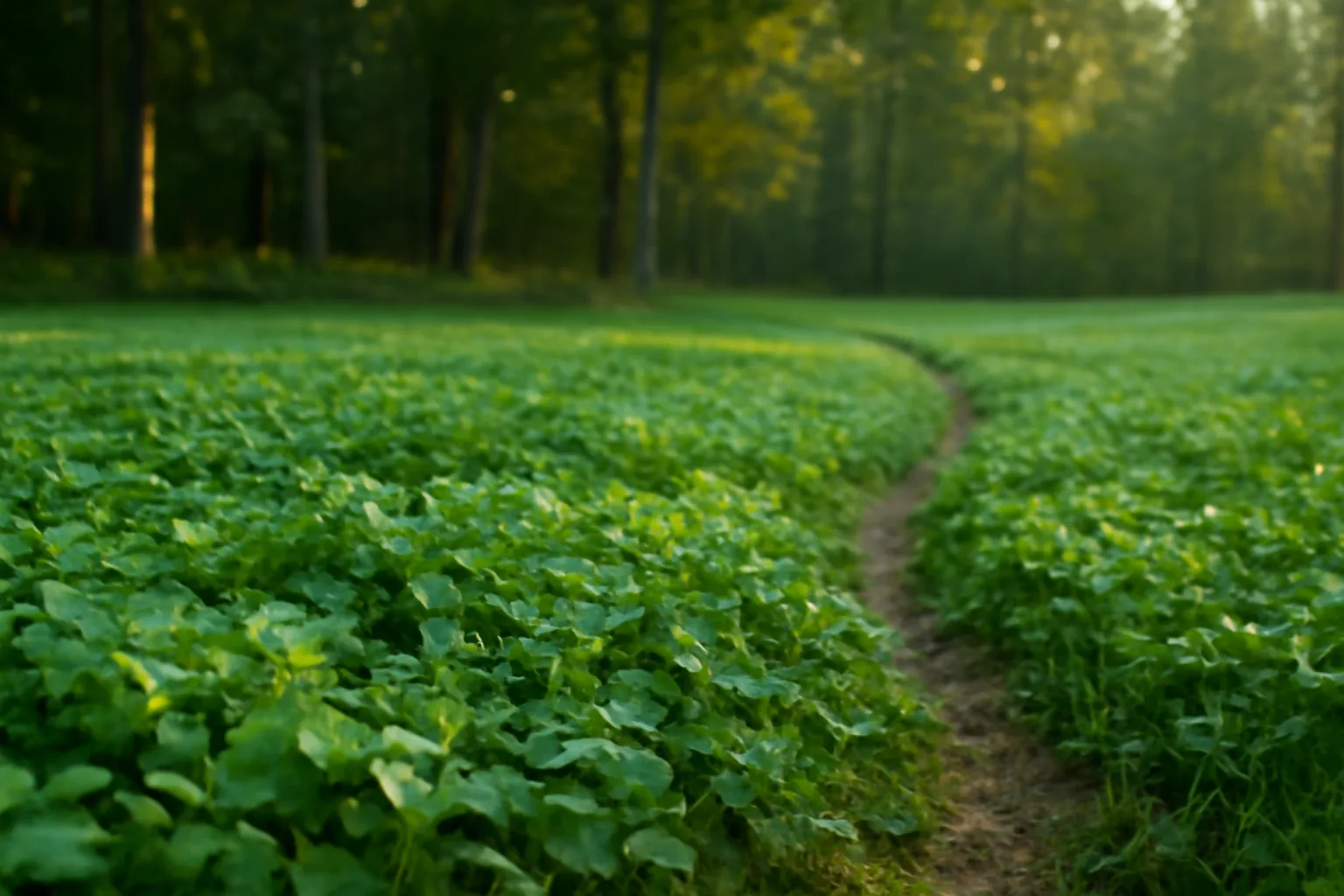
A food plot is a planted area of land, usually a fraction of an acre up to several acres, designed to attract and feed deer and other wildlife with forage that's more nutritious or more available than what grows naturally. Landowners plant food plots for a mix of reasons: better antler and body condition, easier bow season observation, and drawing deer to a spot where hunting pressure is low. White clover (Trifolium repens) is one of the most planted perennial food plot species in North America, and for good reason. It's a legume, meaning it fixes nitrogen from the air through bacteria in its root nodules, which cuts down on fertilizer costs over time [1]. Once established, a stand can produce forage for three to five years or longer if you keep weeds down and mow it a few times a season. Compare that to annual plots like brassicas or cereal grains, which you replant every year. White clover costs more time up front (seedbed prep, sometimes an inoculant, patience while it establishes) but less money and labor per year over its lifespan. If you're building a permanent plot on owned or long-term leased ground, it's usually the smarter perennial anchor. For rotating annual plots or short-term leases, annuals still make more sense. See our breakdown of food plot whitetail strategy for how perennials and annuals fit together on the same property.
Do deer like clover?
Yes. Clover is consistently one of the most preferred forages in food plot studies and browse surveys, and white clover specifically ranks near the top of deer preference trials conducted by several land-grant universities [2]. It's high in crude protein, often 25-30% in the leaf tissue during active growth, which matters most in late spring and summer when does are lactating and bucks are growing antlers [1]. Deer will hit a well-established clover plot hard in spring green-up, taper off some in the heat of summer when clover growth slows, then come back strong in fall once temperatures drop and other food sources thin out. It's rarely the single food source deer key on all year, but it's one of the most reliable ones, which is why so many food plot systems build around it as a base perennial.
What are deer's favorite foods, and how does clover compare?
There's no single universal answer here because deer preference shifts by region, season, and what's locally available, but research and long-term browse surveys point to a consistent short list: acorns (especially white oak family), soft mast like apples and persimmons, agricultural crops like soybeans and corn, and among planted forages, clover and other legumes rank at or near the top [3]. University extension forage trials and browse studies generally rank clover and alfalfa above most brassicas and cereal grains for palatability, though brassicas and grains can outperform clover in raw tonnage of food produced per acre late in the season [2]. Acorns, when available in volume during a good mast year, will often pull deer off a clover plot entirely for weeks. That's normal, not a sign your plot failed. The honest answer is that deer preference isn't fixed. It's driven by nutritional need (protein in spring/summer, energy and fat in fall/winter) and by what's easiest to find. Clover wins in spring and early fall. Standing corn, acorns, and high-carb annuals like brassicas and cereal grains often win in late fall and winter when deer are trying to pack on fat reserves before winter stress periods.
When to plant food plots for deer, in general terms?
| Northern (zone 3-5, e.g. MN, WI, upper MI, ME) | Late April-May, or Aug 1-15 | Fall window is tight; don't miss it | |
|---|---|---|---|
| Transition (zone 6, e.g. southern IA, OH, PA, VA) | April-May, or Aug 15-Sept 15 | Widest flexibility | |
| Southern (zone 7-8, e.g. AL, GA, TX, FL panhandle) | Sept-Oct, or Feb-March | Fall planting often preferred to dodge summer heat stress | Check your local frost dates through the USDA's plant hardiness resources and your state extension office, since a single state can span two or three planting zones [4]. |
Timing depends entirely on what you're planting and where you live, but the two broad windows are spring (for warm-season annuals and perennial establishment in southern zones) and late summer to early fall (for cool-season annuals and perennial establishment in most of the whitetail's range). As a rule, perennials like clover and chicory go in either early spring, once soil temps hit the mid-50s Fahrenheit, or in late summer/early fall, roughly 60-90 days before your first killing frost, so the plant has time to establish a root system before winter dormancy. Annual cereal grains and brassicas are typically planted in late summer, timed so they mature into October and November hunting season. A simplified planting calendar by zone: | Region | Clover planting window | Notes |
When is the best time to plant white clover specifically?
For most of the whitetail's range, the best window is late summer to early fall, roughly six to eight weeks before your average first frost date. This lets the clover germinate, establish a root system, and go into winter dormancy strong, then explode with growth the following spring. A late-summer planting also avoids competing with the flush of warm-season weeds that hammer spring plantings. Spring planting works too, especially in northern climates where the fall window is short and risky. Plant as soon as the soil is workable and frost risk has passed, typically April into May depending on latitude. The tradeoff is more weed pressure and slower establishment because clover seedlings compete with everything else trying to grow at the same time. Southern growers (zone 7 and warmer) often prefer fall planting, September into October, because summer heat and drought stress can kill young clover seedlings before they root deep enough to survive. A mild, wet fall gives clover its best shot in the Deep South [5]. Whatever window you pick, don't plant white clover into a seedbed that hasn't been tested. A basic soil test tells you your pH and nutrient levels, and your soil test lab is the final word on how much lime and fertilizer you actually need; nobody selling seed online knows your dirt better than the lab that tested it.
How do you plant and establish a white clover plot correctly?
Start with a soil test 60-90 days before planting so you have time to apply lime if your pH is low; clover wants a pH between 6.0 and 7.0, and most food plot soils that haven't been limed in years sit well below that [6]. Lime takes months to fully react with soil, so testing early matters more for clover than for almost any other food plot species. Seedbed prep is simple but non-negotiable: kill existing vegetation with glyphosate two to three weeks before planting, then till or disk lightly (clover seed is tiny and needs to sit near the surface, not buried deep) and firm the seedbed with a cultipacker or roller. Broadcast at 6-8 lbs per acre for white clover alone, or 4-6 lbs per acre if blending with chicory or a cereal grain nurse crop. Cover seed lightly, no more than a quarter inch deep, then cultipack again to ensure good seed-to-soil contact. Inoculant matters. White clover needs a specific rhizobium bacteria strain to fix nitrogen effectively, and many seed retailers already coat the seed with it. If yours isn't pre-inoculated, buy the correct clover inoculant and mix it in right before planting; don't do it days ahead, since the bacteria die off quickly once exposed. For seed sourcing and blend options, see deer food plot seed and general food plot seed selection guidance.
How do you maintain an established clover plot?
Mow it. Clover left unmowed gets shaded out by taller weeds and grasses, and mature clover stems get woody and less palatable. Mow every four to six weeks during the growing season, keeping the clover around 6-8 inches tall (don't scalp it below 3-4 inches or you stress the plant). Spray for grass competition using a grass-selective herbicide like clethodim, which won't harm the clover since it's a legume, not a grass. Broadleaf weeds are trickier since most broadleaf herbicides also kill clover; 2,4-DB is one of the few labeled for use in clover stands, but read the label and rate carefully since timing and clover maturity matter . Fertility maintenance is lighter than for annuals because of the nitrogen-fixing benefit, but clover still needs phosphorus and potassium (P and K) to thrive, and it needs that pH held in the 6.0-7.0 range over years, which means periodic lime applications based on follow-up soil tests. Most established clover stands need a maintenance application of 0-20-20 or similar P/K blend once or twice a year depending on what your soil test shows. This is exactly the kind of decision where your soil test lab's specific recommendation should override generic advice, including this article's.
Do deer eat sorghum?
Yes, deer eat sorghum, particularly grain sorghum (milo) heads in fall and winter, and they'll also browse the leaves of forage sorghum types earlier in the season. Sorghum is more commonly planted as a summer annual for its drought tolerance and standing grain value late in the season rather than as a primary deer attractant, but it does get used, especially in warmer, drier regions where corn struggles. Sorghum isn't typically a first-choice food plot species for whitetail-specific plots the way clover, soybeans, or brassicas are. It's more of a secondary or blend component, sometimes planted alongside cowpeas or sunflowers in a summer food plot mix for turkey and deer both. If your main goal is a dedicated deer plot, clover, soybeans, or a brassica/cereal grain blend will outperform sorghum in preference and tonnage for the effort.
When to plant oats for deer?
Oats are a cool-season cereal grain, typically planted in late summer to early fall, six to eight weeks before your first frost, so they're in the tender, high-sugar growth stage right as deer season opens. In most of the whitetail range that means a planting window from mid-August through mid-September, though it shifts later in southern states and earlier in the far North. Oats are winter-hardy in the South but usually winterkill in harder northern climates once temperatures drop into the teens or lower for extended periods, so northern growers often treat oats as a fall-only annual, not a plant that carries deer through winter. They're commonly blended with clover, brassicas, or winter peas since oats germinate fast and give deer something to eat while slower species establish underneath.
When to plant turnips for deer?
Turnips are planted in mid-to-late summer, generally 80-90 days before your first expected hard frost, since they need that runway to bulb out and reach peak tonnage before deer season. For most of the Midwest and Northeast that lands in the late July through mid-August window; the Deep South can push planting into September. Turnips are a classic late-season food plot play because deer often ignore the leaves and bulbs early on, then hit them hard after a few hard frosts convert starches to sugars, making the plant taste sweeter. That means a turnip plot might look untouched in October and get hammered in December, which is exactly the point. Turnips pair well as part of a brassica blend alongside radishes and rape, but they don't replace a clover plot; they're a late-season energy source, while clover is more of a spring-through-fall protein source. See deer food plots for how to sequence multiple plot types across a season.
Do deer like honey?
There's no real evidence deer seek out honey in the wild or that it's a meaningful food plot or attractant strategy, and it's not something wildlife agencies or extension programs recommend or study as deer forage. Deer are herbivores built around browsing plants, forbs, mast, and agricultural crops; honey isn't part of their natural diet or foraging behavior. If you're thinking of using honey, molasses, or sugar-based products as a scent or taste additive on mineral sites or supplemental feed, check your state's baiting and feeding regulations first. Many states restrict or fully prohibit baiting and supplemental feeding for deer, particularly in areas managing chronic wasting disease, and the rules vary significantly by state and even by county or zone within a state . Some states allow feeding outside of hunting seasons but ban it during season; others ban it outright year-round in CWD management zones. Check your state wildlife agency's current regulations before adding any bait or attractant, honey included, to your property.
How much does a white clover food plot cost per acre?
Costs vary by region and whether you're starting from bare dirt or working ground that's already reasonably fertile, but a rough per-acre budget for a new clover plot commonly runs somewhere in the range of $75-200 per acre for seed, lime, and fertilizer combined, not counting equipment costs or fuel. Seed alone typically runs $4-8 per pound, and at a 6-8 lb/acre rate that's $25-60 per acre just in seed. Lime is often the biggest surprise line item. If your soil test comes back needing 2 tons of lime per acre to correct pH, and bulk ag lime runs $30-50 per ton delivered and spread in many regions, that alone can be $60-100 per acre before you've bought a single clover seed. This is exactly why testing soil early, and following your lab's specific lime and fertilizer recommendation rather than guessing, saves real money over the life of a perennial stand that's supposed to last three to five years. If you want a structured, personalized starting point rather than piecing together generic rate recommendations, PlotSeason's $99 one-time Custom Food Plot Plan at /plot-plan-builder builds a plan around your soil test results, region, and property goals. It's general guidance built for your inputs, not a replacement for your soil lab's specific lime and fertilizer numbers, but it's a useful starting framework if you're planning multiple plots or mixing perennials and annuals across a property.
What equipment do you need to plant white clover?
At minimum you need a way to kill existing vegetation (a sprayer, even a small ATV-mounted or backpack unit works for smaller plots), a way to disturb the soil surface lightly (a disk, harrow, or even a heavy drag works since clover doesn't need deep tillage), a broadcast spreader (handheld or ATV-mounted for small plots, tractor PTO spreader for larger ones), and a cultipacker or roller to firm the seedbed after broadcasting. A no-till drill set to a very shallow depth is an alternative to broadcasting and can improve seed-to-soil contact, but clover seed is so small that many drills struggle to meter it accurately without a specific small-seed attachment. For most food plotters working a half-acre to a few acres, broadcast-and-cultipack is simpler, cheaper, and works fine. If you're deciding between building out your own equipment shed versus contracting the work, our equipment and methods coverage and general seed selection guides can help you scale the investment to your acreage.
Frequently asked questions
Do deer eat sorghum?
Yes, deer eat grain sorghum heads and will browse forage sorghum leaves, especially in fall and winter. It's more often used as a secondary summer plot species for drought tolerance rather than a primary deer attractant like clover or soybeans.
Do deer eat clover?
Yes, clover is one of deer's most preferred food plot forages, ranking near the top in university preference trials. It's high in crude protein (often 25-30%), which supports lactation in does and antler growth in bucks during spring and summer.
When should you plant deer food plots?
Timing depends on species. Perennials like clover go in spring or late summer/early fall (60-90 days before first frost). Annual cereal grains and brassicas typically go in late summer so they mature into hunting season. Check your specific USDA hardiness zone and state extension calendar.
Do deer like clover more than other forages?
Clover ranks at or near the top of most deer preference studies, especially compared to brassicas and cereal grains, though acorns and standing corn often outcompete it in fall and winter when deer prioritize energy over protein.
When should you plant oats for deer?
Plant oats six to eight weeks before your first fall frost, generally mid-August through mid-September in most of the whitetail range. Oats grow fast and often winterkill in harsh northern climates, so they're mainly a fall-season annual, not a winter-long food source.
When is the best time to plant white clover?
Late summer to early fall, roughly 60-90 days before your first frost, is ideal in most regions. Spring planting (April-May) works too, especially in the North where fall windows are tight, but expect more weed competition.
When should you plant turnips for deer?
Plant turnips 80-90 days before your first hard frost, usually late July through mid-August in the Midwest and Northeast, later in the South. Deer often ignore turnips until after a few hard frosts sweeten the bulbs and leaves.
What exactly is a food plot?
A food plot is a planted area, from a fraction of an acre to several acres, designed to provide deer and other wildlife with concentrated, nutritious forage. Hunters use them to improve deer health, concentrate deer sightings for hunting, and offset gaps in natural food availability.
What are deer's favorite foods?
Preference shifts by season and region, but consistent favorites include acorns (especially white oak), soft mast, soybeans and corn, and among planted forages, clover and alfalfa rank near the top. No single food is a year-round favorite everywhere.
Do deer like honey?
There's no evidence deer seek out honey as a food source; it isn't part of their natural browsing diet. If considering sugar-based attractants near feed sites, check your state's baiting and supplemental feeding regulations first, since many states restrict this, especially in CWD zones.
How long does a white clover food plot last?
A well-maintained white clover stand commonly lasts three to five years, sometimes longer, before thinning enough to need reseeding. Regular mowing, grass-selective herbicide use, and periodic lime and fertilizer applications based on soil tests extend the stand's productive life.
What soil pH does white clover need?
White clover grows best in soil with a pH between 6.0 and 7.0. Most untested food plot soils run more acidic than that, so a soil test and lime application, if needed, well before planting is one of the highest-value steps in establishing a productive clover plot.
Sources
- USDA NRCS Plant Guide: White Clover (Trifolium repens L.): White clover is a legume that fixes atmospheric nitrogen through root nodule bacteria
- Oklahoma State University Extension, Food Plots for White-tailed Deer (PSS-2118): Clover and legumes rank highly in whitetail deer forage preference compared to many brassicas and grains
- University of Tennessee Extension PB1769, Establishing and Managing Wildlife Food Plots: Perennial food plot species should be planted with enough lead time to establish roots before dormancy or summer stress
- University of Georgia Extension Bulletin 1391, Wildlife Food Plots: Fall planting is often preferred for clover establishment in the Deep South to avoid summer heat and drought stress
- University of Kentucky Cooperative Extension AGR-98, Soil Testing: White clover requires soil pH in the 6.0 to 7.0 range for optimal growth and nitrogen fixation
- Clemson Cooperative Extension, Clover Weed Control in Forage and Food Plots: 2,4-DB is one of few labeled broadleaf herbicides safe for use in established clover stands