Last updated 2026-07-25
TL;DR
Good whitetail food plot design starts with a soil test, matches species to your zone's planting window, and shapes plots (long and curved, 1/4 to 2 acres for destination plots) to fit how deer actually move and feed. Clover, brassicas, oats, and cereal grains cover most needs. Skip guesswork; test soil first, then pick seed and dates.
What is a food plot, exactly?
A food plot is a planted area of forage or grain, usually somewhere between a few thousand square feet and a few acres, put in specifically to feed and hold deer (and often other wildlife) on a property. It's not a garden and it's not a crop field meant for harvest and sale, though the agronomy overlaps a lot with farming. The goal is different: attract deer, keep them on your ground, improve their nutrition, and give hunters a place to set up. Food plots generally fall into two working categories. Destination or feeding plots are larger, often 1/2 acre to several acres, planted with high-tonnage forage like clover, brassicas, or beans, meant to pull deer in from a distance and hold them through fall and winter. Kill plots or hunting plots are small, sometimes under a quarter acre, tucked tight to bedding cover, meant to be walked to quietly and hunted with the wind in your favor rather than to produce maximum forage. The USDA Natural Resources Conservation Service treats food plots as a wildlife habitat practice, not a farming practice, and many state cost-share and habitat programs fund them under conservation planning for that reason [1]. That distinction matters for design: you're not optimizing yield per acre, you're optimizing deer behavior and hunter access. If you want a plan built around your actual field shape, soil test, and region rather than a generic template, that's the whole reason a Custom Food Plot Plan exists as a service, but you can absolutely design a solid plot yourself with the information below.
When should you plant food plots for deer?
| Deep South (zone 8-9) | March to April | late Aug to mid-Sept | |
|---|---|---|---|
| Mid-South / transition (zone 7) | April | late Aug to mid-Sept | |
| Midwest / Northeast (zone 5-6) | May | mid-Aug to early Sept | |
| Upper Midwest / North (zone 3-4) | mid-May to June | early to mid-Aug | These are starting points, not gospel. Always cross-check with your county extension office. |
Planting dates depend entirely on your USDA plant hardiness zone, your first and last frost dates, and whether you're planting a spring/summer plot or a fall plot. There's no single national date, and any article that gives you one date for the whole country is wrong. As a rule of thumb from land-grant extension guidance: spring plots (clover, chicory, soybeans, alfalfa) go in after soil temperatures warm and frost risk passes, typically April through May in the upper Midwest and Northeast, and as early as March in the deep South. Fall plots (brassicas, cereal grains, annual clover blends) are planted 60 to 90 days before your average first killing frost, so the plants have time to establish before deer start hammering them and before cold shuts down growth. Penn State Extension recommends checking your specific county frost dates rather than guessing, since a location in northern Pennsylvania and one 200 miles south in the same state can differ by three or more weeks on first frost. The same logic applies everywhere: pull your county's average frost date from your local extension office or NOAA climate data before you set a calendar date. General zone-based windows (adjust for your actual local frost data): | Region example | Spring plot window | Fall plot window |
When to plant oats for deer
Oats are a fall annual for most whitetail plots, planted 60 to 90 days ahead of your first frost so they can establish a leafy stand before cold weather. In much of the Midwest that means mid-August through early September; in the South it can run into late September or even October. Oats germinate fast, often in 7 to 10 days under good moisture, and they're one of the most attractive early-season fall forages because deer key in on the tender regrowth after each frost. The catch: oats aren't very cold-hardy compared to wheat, rye, or triticale. A hard freeze in the low 20s (F) or below tends to kill oat forage outright, so in northern climates oats give you great September and October hunting but often play out by December [2]. Many successful fall blends mix oats with a cereal rye or winter wheat. The oats provide the fast, attractive early growth; the rye or wheat carries the plot through winter after the oats die back. That's a design decision as much as a seed decision: you're planning for two different windows of the season with one planting.
When to plant turnips for deer
Turnips and other brassicas go in the ground 80 to 100 days before your first expected frost, which for most of the whitetail range lands somewhere between late July and early September. Plant too early and they bolt or get overwhelmed by summer weeds and heat; plant too late and they don't have time to bulb up before growth stops. Turnips are a slow build. Deer often ignore the plant for the first month or two of growth, then hit it hard once a hard frost or two converts starches in the leaves and bulbs to sugars, which is why turnip plots often look untouched in October and get hammered in December. That frost-triggered palatability shift is well documented by extension forage programs and is the main reason turnip plots are a late-season strategy, not an early-October draw [2]. A practical note: don't plant pure turnips if you want early bow season action. Blend them with oats, radish, or a cereal grain if you want attraction across more of the season, and expect the turnip bulbs and tops to become the main event only after a few freezes have swept through.
Do deer like clover, and do deer actually eat clover?
Yes, and it's one of the most reliable food plot species there is. Clover, particularly white clover varieties like Ladino, is a perennial legume that regrows after grazing, fixes its own nitrogen (cutting your fertilizer bill), and provides protein-rich forage from spring through fall. University of Tennessee and Mississippi State extension both list clover among the top-performing, most consistently grazed food plot forages for whitetail deer, largely because it tolerates repeated browsing better than almost anything else you can plant [3] [2]. Clover's protein content typically runs 20 to 30% crude protein in vegetative growth, which lines up well with a lactating doe's or antler-growing buck's nutritional needs in late spring and summer [3]. It's also relatively shade-tolerant compared to brassicas or grains, so it works in smaller, timbered plots where full sun is limited. The tradeoff is establishment time and weed pressure. Clover is slow out of the gate compared to annual grains, and a new stand needs mowing and sometimes herbicide to keep grass and broadleaf weeds from choking it out in year one. Once established, a good clover stand can produce for 3 to 5 years before needing to be reseeded, which makes it one of the better costs-per-year investments in a plot rotation.
What are deer's favorite foods?
There's no single universal answer because it shifts by season, region, and what's available naturally, but wildlife research consistently points to a short list. Acorns are near the top almost everywhere whitetail range overlaps with oak forest, prized for their fat content heading into winter. Agricultural crops like soybeans and corn rank high where available. Among planted forages, clover, soybeans, and brassicas (after frost) consistently show up as preferred in browse studies and extension forage trials [3] [2]. A useful way to think about it: deer are selecting for whatever gives them the most digestible energy or protein for the least effort, and that target moves through the year. Spring and summer, they want protein for antler growth and lactation, so clover, alfalfa, and soybeans get hit hard. Fall, they shift toward carbohydrates and fat to build reserves, so acorns, corn, and standing soybeans become priorities. Late season, especially after a hard frost, brassica tubers and tops (with their frost-sweetened sugars) and any remaining grain become the draw. Do deer eat sorghum? Yes, deer will eat grain sorghum (milo), both the seed heads and, to a lesser degree, the foliage, and it's used in some food plot blends as a drought-tolerant grain component, particularly in the South and Southern Plains where corn struggles without irrigation [2]. It's not typically a first-choice attractant compared to corn or soybeans, but it holds up in poor soil and low rainfall better than most other grain options, and standing sorghum offers late-season cover and food together. Do deer like honey? There's no real biological basis for feeding deer honey, and it isn't a recognized food plot or supplemental feed practice in any wildlife agency or extension guidance. Deer are herbivores built around browsing plants, forbs, mast, and agricultural forage; there's no established research showing deer seek out honey in the wild, and it's not a product used in any legitimate food plot program. Treat any claim about it skeptically.
How do you design a food plot layout for how deer actually move?
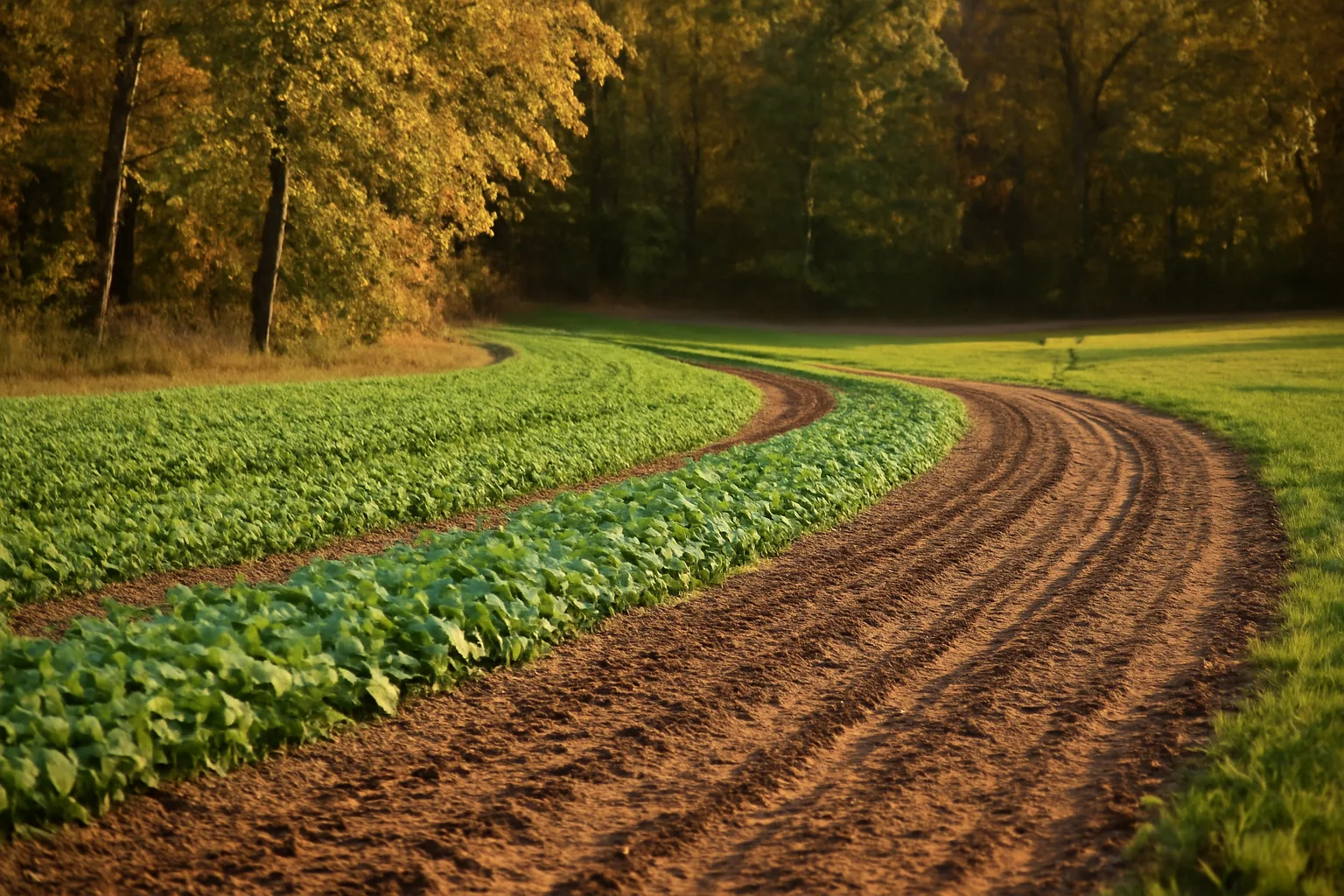
Design starts with shape and placement, not seed. A long, curved or kidney-shaped plot almost always outperforms a square one for hunting purposes, because it lets you position stands where deer entering from either end are within range, and the curve breaks sightlines so deer feel comfortable stepping out in daylight. Size depends on the plot's job. A destination plot meant to hold deer and produce real tonnage of forage generally runs 1/2 acre to 2 acres or more; smaller than that and heavy browsing pressure can wipe out the stand before it matures, especially with clover or beans on a property with a dense deer herd. A kill plot, meant purely to get a shot at a deer moving between bedding and a larger food source, can be as small as a tenth of an acre, sometimes just a wide travel corridor planted in a strip. Access matters as much as shape. If you can't get in and out of a plot without blowing deer out of bedding cover, the design has already failed regardless of what's planted. Extension wildlife programs consistently recommend locating hunting plots downwind of likely entry points and pairing them with a low-impact access trail, ideally one that lets you approach and leave using terrain or standing cover as a screen. A few practical layout rules that hold up across most properties: - Keep kill plots small and tucked near bedding; keep destination plots larger and more open, often nearer field edges or ag ground.
- Curve or angle plot edges instead of running straight lines; straight edges create long, exposed sightlines that make deer hesitant in daylight.
- Plan at least one all-weather access route that doesn't cross the plot itself or the deer's likely approach.
- Leave a screen of standing cover, switchgrass, or a hinge-cut edge between your access trail and the plot so you're not visible walking in.
How do you pick the right food plot species for your goals?
| White/Ladino clover | Perennial legume | Spring or late summer | Spring through fall protein | Fixes nitrogen; 3-5 yr stand life [3] | |
|---|---|---|---|---|---|
| Soybeans | Annual legume | Late spring | Summer/fall high protein and pods | Needs deer-exclusion or large acreage to survive browsing | |
| Brassicas (turnip, radish, rape) | Annual | 80-100 days before frost | Late season, post-frost draw | Ignored until frost sweetens them [2] | |
| Oats | Annual cereal grain | 60-90 days before frost | Early-to-mid fall attraction | Fast germination, low cold tolerance [2] | |
| Winter wheat / cereal rye | Annual cereal grain | Same window as oats, or slightly later | Winter-long forage | Cold-hardy, carries plot through frost | |
| Grain sorghum (milo) | Annual grain | Late spring | Standing grain, drought/heat tolerant regions | Good in low-rainfall soils, doubles as cover [2] | A workable strategy for most properties is a rotation: perennial clover in your best-drained, most accessible plot for spring and summer, paired with a fall annual blend (oats plus brassica plus a cereal grain) in a second plot to cover archery season through late winter. That combination fills almost the entire calendar without overcomplicating your seed budget. |
Match the species to the calendar window you're trying to fill and the soil you actually have, not to whatever bag looks best at the farm store. Below is a rough comparison of the most common whitetail plot species. | Species | Type | Planting window | Best use | Notes |
How much does soil testing and fertility actually matter?
It matters more than the seed you buy. A $10-20 soil test tells you your pH and nutrient levels; without it you're fertilizing blind, and most food plot failures trace back to low pH rather than bad seed. Clover and most legumes struggle badly below a pH of 6.0, and University of Missouri Extension notes that at a pH of 5.5, nitrogen-fixing rhizobia bacteria on legume roots become far less effective, choking off the natural nitrogen supply clover depends on [4]. Lime takes time to work, often 3 to 6 months to fully adjust soil pH depending on soil type and how well it's incorporated, so extension programs recommend testing and liming well ahead of planting, not the week before [4]. If your test comes back needing 2 tons of lime per acre, plan on that being a fall or early spring application ahead of a summer planting, not a same-season fix. Your soil test report itself is the authority on exact lime and fertilizer rates for your field. Labs base recommendations on your specific soil type, current nutrient levels, and target crop, and that's information a generic article (including this one) can't replace. Follow what your test says over any blanket rate you read online. For more detail on matching seed selection to soil and moisture conditions, see food plot seed and deer food plot seed.
What equipment do you actually need to build a food plot?
The minimum viable setup is smaller than most first-timers assume. A soil test, a way to kill existing vegetation (herbicide and a sprayer, or repeated disking), a way to work the seedbed (disk, tiller, or drag), a broadcast spreader, and a way to firm the seed into contact with soil (cultipacker, drag, or even driving over it with a light ATV) covers the basics for most small forage plots under an acre or two. For larger destination plots or anyone doing this on more than a few acres a year, a tractor in the 25-45 horsepower range with a disk, drag, and a PTO-driven sprayer starts paying for itself quickly, either owned or through custom hire from a local farmer. Renting or hiring equipment for a day or two a year is a completely reasonable way to handle plots under 5 total acres; buying a full line of tillage equipment for two plots a year rarely pencils out. Don't skip the firming step. Broadcasting seed onto loose, fluffy soil and walking away is one of the most common plot failures; small seeds like clover and brassica need firm soil contact and shallow coverage (often 1/4 inch or less) to germinate reliably, while larger seeds like beans and cereal grains need to be planted deeper, generally 1 to 1.5 inches. A cultipacker or even a lightly weighted drag solves most of this cheaply. For a broader rundown of tools and methods by plot size and budget, see deer food plots and food plot whitetail.
What state rules and baiting laws should you check before planting?
Food plots themselves are legal planting practices in every state and are not considered baiting, but the line between a food plot and an illegal bait pile gets blurry with some practices, like broadcasting corn or minerals in a pile versus planting a standing crop. Baiting and supplemental feeding rules vary a lot by state, and some states restrict or ban feeding deer outright for chronic wasting disease (CWD) management reasons, regardless of hunting season status [5]. Michigan, for example, has feeding and baiting restrictions tied to CWD management areas that change from year to year, and the Michigan DNR publishes updated baiting and feeding orders annually [5]. Wisconsin similarly restricts baiting and feeding in counties with CWD detections . A planted food plot, left standing and growing, is treated differently from a pile of feed or minerals in essentially every state, but always confirm with your state wildlife agency before assuming a practice is legal, especially if you're near a CWD management zone or considering supplemental feed alongside your plots. Check your state wildlife agency's current regulations directly rather than relying on a hunting forum or last year's rule; these change often, sometimes mid-season.
How do you put a design plan together for your specific property?
Walk your property with three things in hand: a soil test, an aerial map or app like onX, and a rough idea of where deer are bedding and where they're entering from ag ground or neighboring cover. From there, mark 2 to 4 candidate plot locations, favoring spots with reasonable access, at least a half day of sun for destination plots, and a natural pinch point or funnel for kill plots. Then sequence the work: soil test first, lime and fertilize per that test's recommendation, choose species based on your planting window and goals (spring protein versus fall attraction versus late-season carbs), and only then buy seed and rent or borrow equipment. Doing it in the reverse order, buying seed first and testing soil later, is the single most common way plot budgets get wasted. If you'd rather not build this out field by field yourself, a Custom Food Plot Plan is a $99 one-time service that takes your soil test results, property layout, and region and turns them into a specific seed and fertility plan for your ground. It's general planning guidance built for your inputs, not a replacement for your soil test lab's specific lime and fertilizer recommendations, which remain the final word on your exact field chemistry. For more on matching plot type to property size and goals, see food plot seed and domain food plot seed.
Frequently asked questions
Do deer eat sorghum?
Yes. Deer eat both the grain heads and some foliage of grain sorghum (milo), and it's used in food plot blends as a heat- and drought-tolerant grain, especially in the South and Southern Plains. It's not usually a top attractant compared to corn or soybeans, but it holds up in poor, dry soils better than most alternatives and provides late-season standing cover along with food.
Do deer eat clover, and do deer like it?
Yes, clover is one of the most reliably grazed food plot forages available. White/Ladino clover offers 20-30% crude protein in vegetative growth and regrows repeatedly after browsing, which extension research credits for its consistent performance in whitetail food plots across spring, summer, and fall [5][6].
When should you plant food plots for deer?
It depends on your zone. Spring plots (clover, soybeans, chicory) go in after your last frost, typically March in the deep South to May or June farther north. Fall plots (brassicas, oats, cereal grains) go in 60-100 days before your first fall frost, so pull your county's average frost date from your local extension office before setting a date.
When to plant oats for deer?
Plant oats 60-90 days before your area's average first frost, generally mid-August through early September in the Midwest and later into September or October in the South. Oats germinate fast (7-10 days) but aren't very cold-hardy, so many hunters blend them with rye or wheat to carry the plot through winter after the oats die back.
When to plant turnips for deer?
Plant turnips 80-100 days before your first expected frost, usually late July through early September depending on region. Turnips are often ignored by deer until after a hard frost converts leaf and bulb starches to sugar, so expect little activity in early fall and heavy use in December and later.
What is a food plot?
A food plot is a planted area, usually a few thousand square feet to a few acres, seeded specifically to feed and attract deer or other wildlife rather than to produce a crop for sale. The USDA treats food plots as a wildlife habitat practice, distinct from row-crop farming, often eligible for conservation program support [1].
What are deer's favorite foods?
It shifts by season and region. Acorns and agricultural crops like soybeans and corn rank consistently high where available. Among planted forages, clover, soybeans, and frost-treated brassicas show up repeatedly in extension forage research as preferred whitetail food plot species [5][6].
Do deer like honey?
There's no established research or wildlife agency guidance showing deer seek out honey, and it isn't part of any recognized food plot or supplemental feeding program. Deer are herbivores adapted to browse, forbs, mast, and forage crops; treat any claim about deer and honey as unsupported.
How big should a whitetail food plot be?
Destination or feeding plots generally run 1/2 acre to 2+ acres so heavy browsing pressure doesn't wipe out the stand before it matures. Kill plots, meant for close-range hunting near bedding, can be as small as a tenth of an acre. Match size to the plot's job, not a fixed rule.
What shape should a food plot be for bowhunting?
Long, curved, or kidney-shaped plots generally work better than square ones. Curves break sightlines, which makes deer more comfortable entering in daylight, and they let you position a stand where deer entering from either end stay within range.
Is planting a food plot considered baiting?
In essentially every state, a standing planted food plot is treated differently from a bait pile of corn or minerals, and food plots are legal. But baiting and feeding rules vary by state and some restrict supplemental feeding outright for CWD management, so check your state wildlife agency's current regulations before combining plots with any supplemental feed [10][11].
Why isn't my clover food plot growing well even though I planted good seed?
Most clover failures trace back to soil pH, not seed quality. Legumes and their nitrogen-fixing rhizobia bacteria struggle badly below pH 6.0, and extension research notes rhizobia effectiveness drops sharply near pH 5.5 [9]. Get a soil test, apply lime according to that test's recommendation, and give it time; lime can take 3-6 months to adjust soil pH.
What's the difference between a kill plot and a destination food plot?
A destination plot is larger (often 1/2 acre or more), planted with high-tonnage forage like clover or brassicas, meant to attract and hold deer from a distance. A kill plot is small, sometimes under a tenth of an acre, tucked near bedding cover, and designed purely to give a hunter a close-range shot opportunity rather than to maximize forage production.
Sources
- USDA Natural Resources Conservation Service, Wildlife Habitat practices: Food plots and wildlife habitat plantings are treated as a conservation/habitat practice, distinct from row-crop farming, under USDA cost-share programs
- University of Tennessee Extension, Wildlife Food Plots: White/Ladino clover crude protein content and its performance as a spring-through-fall whitetail forage
- University of Missouri Extension, Soil pH and nutrient availability guidance: Legume rhizobia nitrogen-fixing effectiveness drops sharply as soil pH falls toward 5.5, and lime takes months to adjust pH
- Michigan Department of Natural Resources, Baiting and Feeding Regulations: Michigan restricts baiting and feeding of deer in CWD management areas, with orders updated by the state agency
- Wisconsin Department of Natural Resources, Baiting and Feeding Restrictions: Wisconsin restricts baiting and feeding of deer in counties with CWD detections