Last updated 2026-07-25
TL;DR
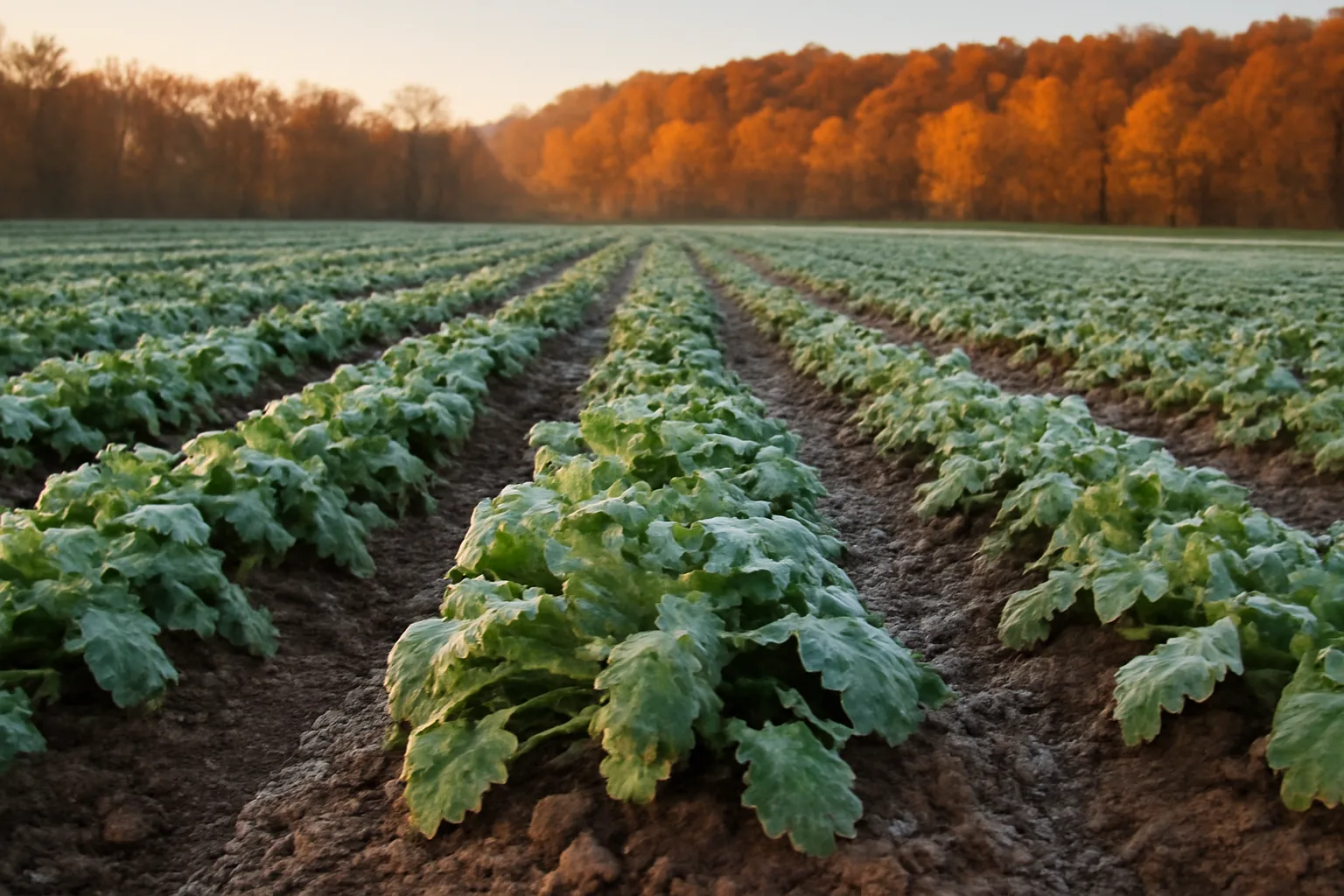
"White gold" is a marketing name, not a botanical species. It's typically a brassica-heavy blend (turnips, radish, sometimes clover) sold under that trade name by various seed companies. Deer favor it in fall for its sweet, high-sugar leaves and roots after a frost. Plant it 60 to 90 days before your first killing frost, same window as any brassica or turnip mix.
What is white gold food plot seed, exactly?
"White gold" is not a plant species. It's a product name used by several food plot seed companies for blends built around brassicas, usually turnips and radish, sometimes with clover or rape mixed in. If you flip the bag over and read the tag, you'll see the actual seed composition listed by percentage weight, which is required under most state seed laws [1]. That tag is the only place you'll find the real answer for the bag you bought. The "gold" in the name usually refers to the color the plot turns in late fall, when turnip and radish tops yellow and the roots swell white underground. It sounds proprietary. It isn't. Any turnip-radish-clover blend does roughly the same thing agronomically, whatever the label says. This matters because pricing on branded blends varies widely, often $15 to $40 more per bag than buying straight brassica seed and mixing it yourself. You're not getting a different plant. You're getting a marketing story and, in fairness, sometimes a decent pre-mixed ratio that saves you from doing your own math on seeding rates. If you want a food plot seed guide to compare blend types generally, that's a good place to start before you commit to any branded bag.
What's actually in a brassica or clover-brassica blend?
Most "white gold" style blends lean on three plants: turnips (Brassica rapa), forage radish (Raphanus sativus), and sometimes purple top or daikon types bred for a large white root. Some versions add red clover or crimson clover for spring tonnage and nitrogen fixation, since clover species can fix meaningful nitrogen for a following crop depending on stand density and species, with university agronomy guides commonly citing figures in the range of 70 to 200 pounds of nitrogen per acre annually for well-nodulated legume stands [2]. Turnips and radish germinate fast, tolerate poor soil better than most legumes, and produce two feeding structures: leafy tops deer hit in September and October, and a starchy root that gets sweeter and more attractive after a hard frost converts starches to sugars. That's the same physiological trick that makes carrots taste better after frost. A straight brassica blend won't persist past one season without reseeding. If your bag has clover in it, that portion can come back for two to four years depending on species and how well you maintain fertility and mowing.
Do deer eat sorghum?
Yes, but it's not a top-tier food plot choice for most whitetail programs. Deer will browse young sorghum shoots and eat the grain heads once they mature, and sorghum is more commonly planted as a screen, a nurse crop for other seedlings, or a component in dove and quail habitat work than as a primary deer food plot species [3]. Grain sorghum (milo) has decent protein in the seed head, roughly 8 to 11%, but whitetails generally prefer softer forages like soybeans, clover, and brassica leaves when those are available. Where sorghum earns its place is as a tall screening crop around plot edges or as part of a summer blend that also includes cowpeas or soybeans for actual forage value. If you're choosing between sorghum and a legume or brassica for pure deer nutrition, the legume or brassica wins almost every time.
Do deer eat clover, and do deer like clover?
Yes, clover is one of the most consistently preferred whitetail forages across the country. University extension research on food plot forage quality regularly ranks clover among the highest crude protein plantings available to hunters, commonly in the 20 to 30% crude protein range in vegetative stages [4]. Deer use it heavily from spring green-up through fall, and it's one of the few plot types that provides food across most of the growing season rather than a single narrow window. White clover (Trifolium repens), including Ladino types, and red clover (Trifolium pratense) are the two most planted species. White clover tends to persist longer and tolerates closer grazing pressure, which matters on smaller plots getting hammered by a resident herd. Red clover grows taller, produces more tonnage per cutting, but thins out faster under heavy browse. Clover's downside is establishment. It needs decent soil pH, generally 6.0 to 6.5 for good nodulation and nitrogen fixation, and it's slow the first 60 days compared to brassicas or cereal grains [2]. That's why a lot of blends, including most "white gold" style bags, pair clover with a fast-germinating brassica or cereal grain as a nurse crop. For a broader look at species selection across plot types, deer food plot seed covers how clover stacks up against grains, brassicas, and legumes side by side.
When to plant food plots for deer
| Deep South (LA, MS, AL, GA) | Late Aug to late Sep | Mar to early Apr | |
|---|---|---|---|
| Mid-South / Transition (TN, AR, KY, VA) | Aug 1 to Sep 1 | Apr to mid-May | |
| Midwest (IA, IL, MO, IN, OH) | Late Jul to mid-Aug | Late Apr to May | |
| Upper Midwest / Northeast (MN, WI, MI, NY, PA) | Mid-Jul to early Aug | May to early Jun | Your state wildlife agency's private lands habitat program often has a planting calendar tuned to that state specifically. Check yours before you commit to a bag date. |
Timing splits into two windows depending on whether you're planting a spring/summer plot or a fall plot, and both are driven by your local frost dates, not a calendar date that works nationwide. NOAA's National Centers for Environmental Information publishes freeze/frost occurrence data by station that state land-grant extension programs point growers toward for local planning [5]. Spring plots (soybeans, cowpeas, clover establishment) generally go in after your last spring frost, once soil temps hit about 55 to 60 degrees F, commonly late April through May in the Midwest and Northeast, March through April in the South. Fall plots (brassicas, cereal grains, most "white gold" blends) get planted 60 to 90 days before your average first fall frost so the crop has time to establish before growth slows. In much of the whitetail range that lands somewhere between late July and early September. Southern states can push into September; far northern states often need to plant by early August. Here's a rough regional table. Treat it as a starting point, not gospel, since elevation and microclimate shift things by two to three weeks even within a state. | Region | Fall brassica/blend planting window | Spring plot window |
When to plant oats for deer
Oats go in during the same fall window as brassicas, roughly 60 to 90 days before first frost, because oats are a cool-season annual grain that grows fast, tolerates light frost, and dies out completely in hard winter cold in most of the whitetail range. That's actually a feature for hunters: dead oat residue breaks down and feeds soil biology for whatever you plant next. Oats can also go in as a spring planting in northern climates for a quick early-season green-up plot, planted as soon as soil is workable, often March or early April. Oats pair well with brassicas and clover in a blend because the oats germinate in 5 to 10 days and give deer something to eat while the slower brassica roots and clover stands establish underneath. Purdue Extension's cover crop guidance recommends small grains like oats specifically as a companion or nurse crop planted with slower-establishing species for exactly this reason [6].
When to plant turnips for deer
Turnips go in 70 to 90 days before your first expected frost, which for most of the whitetail range is late July through late August. Plant too early and the tops get gangly and go to seed before the root bulks up. Plant too late and you get leafy growth but no root development before winter shuts things down. Seeding rate for pure turnips is typically 4 to 6 pounds per acre broadcast, shallow covered at about a quarter inch, into a prepared seedbed with decent fertility. Turnips are heavy feeders; without adequate nitrogen and phosphorus, tops stay thin and roots stay small. This is exactly where a soil test earns its keep, since turnip response to fertility is dramatic compared to a legume that can fix some of its own nitrogen. Deer typically ignore the roots until after a hard frost sweetens them through starch-to-sugar conversion, then dig up and eat the whole thing through winter. That late-season root feeding is the main reason brassica blends like "white gold" exist as a category: they're built to feed deer in December and January when almost nothing else green is left standing.
What is a food plot?
A food plot is a planted area, usually somewhere between a quarter acre and several acres, established specifically to grow forage that attracts and feeds deer or other wildlife, typically on land the planter owns, leases, or manages for hunting. It's agriculture aimed at a wildlife outcome instead of a commodity sale. Food plots serve a few practical purposes for hunters: supplemental nutrition during stress periods (late winter, antler growth in summer), a draw that concentrates deer movement near a stand or blind, and in some cases habitat diversity that benefits turkey, rabbits, and pollinators as a side effect. They range from small "kill plots" tucked into timber, sized at a quarter acre or less specifically to bring a deer into bow range, up to large agricultural-scale plantings of several acres meant for herd-level nutrition rather than a single hunt setup. The food plot whitetail overview breaks down plot sizing and placement strategy in more depth. It's worth flagging that in many states, planted food plots are treated differently under law than piles of bait like corn or mineral. Rules vary a lot: some states regulate standing crops loosely while banning bait piles outright, others put distance and visibility restrictions on both. Check your state wildlife agency's current hunting regulations before you assume a food plot is automatically legal to hunt over.
What are deer's favorite foods?
There's no single universal answer, because whitetail food preference shifts by season, region, and what's locally available, but research and long-term food plot trials point to a consistent short list: acorns (especially white oak group), soybeans, clover, and, seasonally, brassica roots after frost. Acorns are usually the single most preferred natural food where they're available in volume, and white oak acorns are generally preferred over red oak acorns due to lower tannin content, a pattern documented in wildlife management research on deer mast use [7]. When acorns are dropping heavy in a good mast year, deer will often walk past a planted plot to hit the woods instead. That's not a plot failure, that's just deer being deer. Among planted crops, soybeans rank at or near the top for both tonnage and protein, commonly cited around 30 to 40% crude protein in the leaf during the growing season, though whole-plant analysis varies by growth stage [4]. Clover is close behind and has the advantage of multi-year persistence. Brassicas round out the list as the late-season specialist, less preferred in September, heavily preferred in December once frost sweetens the roots. Corn gets mentioned a lot too, mostly because of its role as a high-energy late-winter food and because it's a common bait/attractant, but as a planted forage it's expensive, fertility-hungry, and lower in protein than legumes.
Do deer like honey?
Deer don't eat honey in any meaningful wild foraging sense, and it's not a food plot input at all. This question usually comes from confusion with "honeysuckle" or "honey locust," both of which deer do browse. Japanese honeysuckle is a preferred browse in the Southeast, and honey locust pods are a fall/winter food source deer will eat readily where the trees grow. Some hunters use honey or sugar-based sprays as a scent or taste additive on plots or mineral sites, marketed as an attractant boost. There's no strong peer-reviewed evidence this changes deer visitation meaningfully compared to a well-fertilized, palatable plot on its own, and it adds cost for uncertain return. Spend that money on lime or fertilizer instead; a soil-corrected plot will pull deer better than any spray-on additive.
How do brassica blends compare to clover and cereal grain plots?
| Brassica/turnip blend ("white gold" style) | Fast (5-10 days) | Late fall to winter, post-frost | None, annual reseed | High (heavy feeder) | |
|---|---|---|---|---|---|
| White/red clover | Slow (establishment year) | Spring through fall | 2-4 years | Moderate, needs pH 6.0-6.5 | |
| Oats/cereal rye | Very fast (5-7 days) | Early fall, green-up | None (annual), rye can reseed lightly | Low to moderate | |
| Soybeans | Moderate | Summer through early fall | None, annual | Moderate, fixes own N once nodulated | A lot of hunters run a fall brassica blend for the December push, a perennial clover field for spring and summer nutrition, and a small cereal grain nurse crop mixed into whatever they plant in late summer. That layered approach covers more of the calendar than any single bag can, branded or not. If you're trying to figure out species mix and acreage split for your specific ground, that's exactly the kind of planning question a soil test and a written plan solve better than guessing off a bag label. PlotSeason's $99 Custom Food Plot Plan pulls your soil test results and property goals into a specific seed and fertility recommendation; you can start one at /plot-plan-builder. Your soil test lab remains the final word on lime and fertilizer rates for your specific dirt, the plan works from that data rather than replacing it. |
Each plot type has a different job. Brassicas peak late, clover feeds long, cereal grains establish fast and cheap. Most experienced plotters run more than one type across their property instead of betting everything on one blend. | Plot type | Establishment speed | Peak attraction window | Multi-year persistence | Soil fertility demand |
What does the seed tag actually tell you, and how do you read it?
Every legally sold bag of food plot seed in the US carries a seed tag with required disclosures: species and variety, percentage by weight of each component, germination percentage, test date, and weed seed content, governed at the state level under laws modeled on the Federal Seed Act and administered by each state's department of agriculture [1]. Read the germination percentage first. Anything below about 85% for common brassica and clover species is getting old or was tested a while back; that number has a real shelf life and older stock germinates worse. Compare the percentage-by-weight breakdown to what the marketing name implies. A blend claiming to be brassica-forward should show the bulk of its weight in turnip, radish, or rape, not filled out with cheap annual ryegrass as a weight-cheap filler. This is the fastest way to figure out if a branded bag like "white gold" is worth the premium over buying components separately: compare the tag percentages to what you'd get mixing your own turnip, radish, and clover seed at your local farm co-op. Sometimes the convenience and pre-mixed ratio is worth it. Sometimes you're paying for a name.
What's a realistic budget and timeline for a first-time food plot?
Seed alone typically runs $15 to $40 per acre for a straight cereal grain, $30 to $60 per acre for clover, and $25 to $50 per acre for a brassica blend, though branded bags with marketing names often price higher per acre than generic component seed at similar quality. Add lime and fertilizer costs on top, which for a first-year plot on acidic or depleted soil can easily double your input cost. A soil test costs $10 to $20 through most state land-grant university extension labs and is the single best dollar you'll spend before buying any seed, because it tells you exactly how much lime and fertilizer your specific ground needs rather than guessing off a bag's generic rate [8]. Most extension soil test recommendations come back in about two to three weeks, so submit early, ideally 60 or more days before your planting window opens, since lime needs time to react with soil before pH actually shifts. For readers weighing a first plot against continuing to hunt over standing ag fields or public land edges, the deer for food and deer food plots guides both cover the basic cost-versus-benefit case in more depth.
Frequently asked questions
Do deer eat sorghum?
Yes, deer will browse sorghum shoots and eat mature grain heads, but it's not a top forage choice compared to soybeans, clover, or brassicas. Sorghum is more often used as a screening plant or a summer blend component than as a primary deer food plot crop, since whitetail preference research consistently ranks legumes and brassica leaves higher.
Do deer eat clover, and do deer like clover?
Yes, clover is one of the most preferred whitetail forages available, with crude protein commonly measured in the 20 to 30% range during active growth. Deer use it from spring through fall, making it one of the few plot types that feeds across most of the growing season instead of a narrow window.
When to plant deer food plots?
Spring plots go in after your last frost once soil hits about 55 to 60 degrees F. Fall plots, including brassicas and cereal grains, go in 60 to 90 days before your first fall frost. Exact dates shift by state and even by county, so check your local extension frost date tool before committing.
When to plant oats for deer?
Oats are typically planted in the fall window, 60 to 90 days before first frost, alongside brassicas and clover as a fast-germinating nurse crop. In northern climates oats can also go in as a quick spring green-up plot as soon as soil is workable, usually March or early April.
When to plant turnips for deer?
Plant turnips 70 to 90 days before your first expected fall frost, generally late July through late August across most of the whitetail range. Planting earlier risks the plant bolting to seed before the root develops; planting later leaves leafy growth without enough time to bulk up the root before frost.
Do deer like honey?
No, honey isn't a real wild forage for deer and confusion usually stems from honeysuckle or honey locust, both actual browse plants. Sugar or honey-based scent additives are sold as attractants but have no strong evidence behind them; money is better spent on soil correction and fertilizer.
What is a food plot?
A food plot is a planted area, from a quarter acre kill plot to several acres of agricultural-scale planting, established to feed and attract deer or other wildlife on land a hunter owns, leases, or manages. It's farming with a wildlife management goal instead of a commodity sale.
What are deer's favorite foods overall?
Acorns, especially white oak group, are generally the most preferred natural food where available in volume. Among planted crops, soybeans and clover rank highest for protein and tonnage, while brassicas become highly preferred specifically in late fall and winter after frost sweetens the roots and leaves.
Is white gold food plot seed a specific species?
No, it's a marketing name used by various seed companies, not a botanical species. It's typically a brassica-based blend, often turnip and radish with clover, and the exact composition varies by brand. Always check the seed tag on the specific bag for the real percentage breakdown by weight.
Is it legal to hunt over a food plot?
It depends on the state. Many states treat standing planted crops differently than bait piles, but rules on visibility, distance, and what counts as a food plot versus supplemental feeding vary widely. Check your state wildlife agency's current hunting regulations before assuming a plot is legal to hunt over.
How much does food plot seed cost per acre?
Cereal grains like oats or rye typically run $15 to $40 per acre, clover $30 to $60 per acre, and brassica blends $25 to $50 per acre, with branded bags sometimes priced higher for the same core species. Add lime and fertilizer costs, which can double first-year input expenses on depleted soil.
Do I need a soil test before planting a food plot?
Yes, a soil test is the single best dollar spent before buying seed. It costs $10 to $20 through most land-grant university extension labs and tells you the actual lime and fertilizer your ground needs, instead of guessing off a generic rate printed on a seed bag.
Sources
- USDA Agricultural Marketing Service, Federal Seed Act overview: Seed tags disclosing species, purity, and germination percentage are required under seed labeling law
- USDA NRCS, Cover Crop Termination Guidelines and legume nitrogen credit references, Technical Note (Plant Materials): Legume cover crops including clover can fix substantial nitrogen for following crops depending on species and stand density
- USDA NRCS Plant Guide, Sorghum: Sorghum's common wildlife habitat uses include screening cover and grain for birds, with grazing/browse as secondary use
- Mississippi State University Extension, Publication 2111: Food Plots for White-tailed Deer in Mississippi: Clover and soybean forage crude protein levels commonly measured in the 20-40% range depending on species and growth stage
- NOAA National Centers for Environmental Information, Freeze/Frost Occurrence Data: Average first and last frost dates vary by station and are the standard timing reference for fall planting windows
- Purdue University Extension publication AY-352-W, Cover Crops for Indiana: Oats and other small grains are commonly recommended as fast-germinating companion or nurse crops planted with slower-establishing species
- USDA Forest Service, Fire Effects Information System species review: Quercus alba (white oak): White oak group acorns are generally preferred by deer over red oak group acorns due to lower tannin content
- University of Missouri Extension, Soil and Plant Testing Laboratory services: Standard soil test costs and turnaround through university extension labs, and their role in determining lime and fertilizer rates