Last updated 2026-07-24
TL;DR
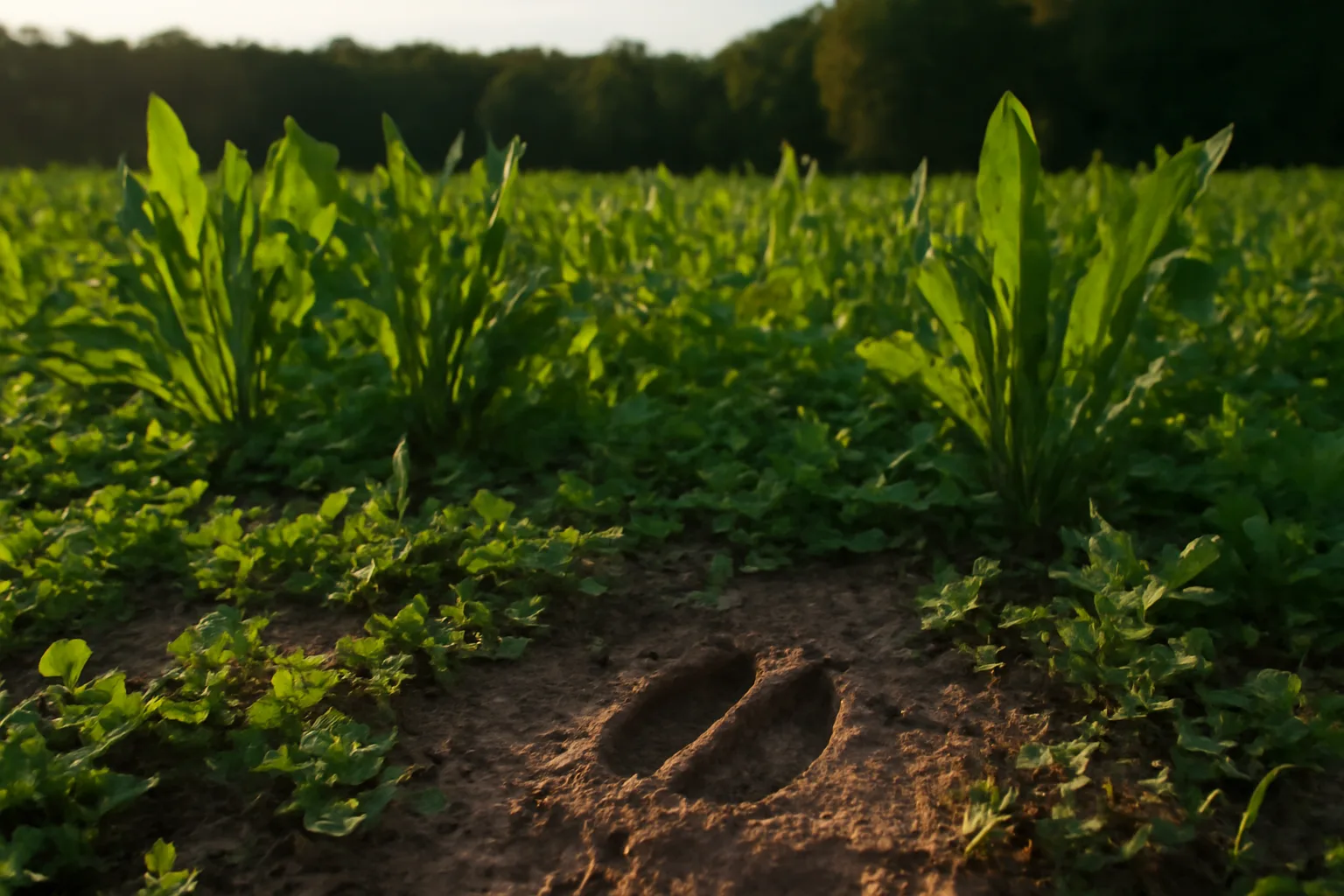
Chicory is a perennial broadleaf that tolerates drought and mowing far better than clover, staying palatable and green through summer heat. Plant it spring through late summer at 1/4 to 1/2 inch deep, 4-8 lbs/acre alone or 2-3 lbs/acre mixed with clover, on a properly limed soil. It can produce for 3-5 years with good management.
what is chicory as a food plot crop
Chicory is a perennial forb in the same plant family as dandelion and lettuce, and it has become one of the most planted food plot species in the country because it does something clover struggles to do: it keeps growing through hot, dry summer stretches when other forages go dormant or get scorched. The plant sends down a deep taproot, often 2 feet or more in mature stands, which lets it pull moisture other plants can't reach [1]. That taproot is also why chicory handles repeated grazing pressure so well. Deer hammer the leaves down to a nub and the plant just pushes new growth from the crown. Most food plot chicory sold today is an improved forage type, commonly a variety like Puna II, bred for higher leaf-to-stem ratio and better regrowth after grazing than the wild roadside chicory you see with the blue flowers. Crude protein in vegetative chicory leaf tissue commonly runs 20-32%, which is in the same range as high-quality clover. If you're weighing chicory against other perennial and annual options for your specific property, the broader food plot seed overview covers how it stacks up against clover, brassicas, and cereal grains side by side.
do deer like chicory as much as clover
Deer generally prefer clover in spring when both are tender and new, but chicory often wins in the heat of summer when clover growth slows and gets tougher. Most experienced plotters run the two together rather than picking one. University forage trials and extension grazing studies on livestock (the closest good data we have, since dedicated deer-preference chicory trials are limited) consistently show chicory holds digestibility and protein better than clover through summer stress periods. Whitetail research out of Mississippi State and other land-grant deer programs has documented chicory as a preferred plot forage, especially July through September. So which one is the deer's favorite? There's no single answer, and the honest response is that it depends on the month and the alternative forage available on the landscape. In spring, clover and new browse usually pull deer first. In August drought, a chicory stand that's still green often gets hit harder than a stressed clover field.
do deer like clover, and how does it compare to chicory
| Drought tolerance | High (deep taproot) | Moderate to low |
|---|---|---|
| Stand life | 3-5 years | 2-4 years |
| Peak palatability | Summer | Spring and fall |
| Mowing tolerance | High | High |
| Seeding rate (alone) | 4-8 lbs/acre | 6-10 lbs/acre |
| Shade tolerance | Low to moderate | Low to moderate |
Yes, deer like clover, and it's the most planted perennial food plot forage in the country for good reason: it's cheap, easy to establish, and highly palatable in spring and fall [2]. But clover has a weakness chicory doesn't share as badly: heat and drought stress. White clover in particular can go semi-dormant in a hot, dry July, especially on thin or sandy soils. Chicory's taproot keeps pulling water from deeper in the profile, so a mixed stand often looks like two different plots by midsummer: the clover thinning and yellowing, the chicory still standing tall and green. The standard approach most seed companies and extension agronomists recommend is a blend, not a choice between the two. A typical mix runs something like 6-8 lbs/acre of clover with 2-4 lbs/acre of chicory, giving you clover's spring draw and chicory's summer persistence in the same field [3]. | Trait | Chicory | White clover |
when to plant food plots for deer, generally
Timing depends on whether you're planting a perennial like chicory and clover or an annual like brassicas or cereal grains, and it depends on your region. As a rule, perennials go in spring through late summer and cool-season annuals go in late summer through early fall. For most of the whitetail's range, spring planting windows for perennials run April through May once soil temps warm and frost risk passes, and a second window opens in late summer, roughly mid-August through early September, for fall establishment [4]. Extension calendars built around your specific frost dates are the most reliable guide, since a north Wisconsin date and a south Georgia date can be six to eight weeks apart. A general framework hunters use: - Perennials (chicory, clover, alfalfa): spring (April-May) or late summer (mid-August to early September)
- Cool-season annuals (brassicas, cereal grains, oats): late summer to early fall, timed 60-90 days before first frost
- Warm-season annuals (soybeans, sorghum, cowpeas): late spring after soil hits 60°F For a full breakdown by region and species, the food plot whitetail guide walks through zone-specific calendars in more depth.
when is the best time to plant chicory specifically
Chicory germinates and establishes best when soil temperatures are between 60-80°F, which usually means late spring or midsummer in most of the country. A late-summer planting, roughly 60-90 days before your first hard frost, also works well and lets the plant get its taproot established before winter [1]. Spring seeding (April-May in the North, March-April in the South) gives chicory a full growing season to build root reserves before its first winter, which generally produces the strongest, longest-lived stand. Late-summer plantings work too, but the plant has less time to establish before cold weather, so it's more vulnerable in a rough first winter, especially in zones 3-5. Whichever window you pick, don't rush it. Chicory seed is small and shallow-planted (1/4 to 1/2 inch), so it needs consistent moisture right after seeding. A dry spell in the two weeks after planting is the single biggest cause of chicory plot failures reported by extension forage agronomists [3].
how do you plant chicory (seedbed, rate, depth)
Chicory wants a firm, clean seedbed, similar to clover. Broadcast planting works fine as long as you can get good seed-to-soil contact, which usually means a cultipacker pass before and after broadcasting, or a no-till drill set to 1/4-1/2 inch. Seeding rates run 4-8 lbs/acre if you're planting chicory alone, or 2-4 lbs/acre when it's mixed into a clover blend. Don't plant deeper than 1/2 inch. Chicory seed is tiny (roughly 400,000 seeds per pound) and buried too deep, it simply won't come up. A basic planting sequence: 1. Test soil and correct pH to 6.0-7.0 with lime as your soil test recommends (chicory tolerates a wider pH range than alfalfa but performs best above 6.0) 2. Kill existing vegetation with glyphosate 2-3 weeks ahead, or till a clean seedbed 3. Broadcast seed or drill at 1/4-1/2 inch 4. Cultipack to firm the seedbed and ensure seed-to-soil contact 5. Fertilize per soil test recommendations, typically light nitrogen and adequate phosphorus/potassium 6. Mow at 6-8 inches through the first season to control weed competition Your soil test lab's specific lime and fertilizer recommendation is the authority here, not a generic rate off a bag. Soil pH and nutrient levels vary enough field to field that a blanket rate can leave you short or waste money on nutrients you don't need [5].
what is a food plot, and where does chicory fit in the plan
A food plot is a planted area, usually somewhere between a quarter-acre and several acres, established specifically to provide forage for deer or other wildlife, either to supplement natural browse, hold deer on a property, or create hunting opportunity near a stand [6]. Food plots range from small hidey-hole kill plots tucked in timber to large destination fields meant to feed a herd through winter. Chicory typically fits into a perennial plot plan as the summer anchor: it's planted alongside or in rotation with clover to cover the season clover struggles with, then it gets grazed hard again once fall annuals like brassicas and cereal grains come online. Most well-designed multi-plot properties run a mix: a perennial clover/chicory field for spring through summer draw, and an annual brassica or cereal grain plot for fall and hunting season. For a broader look at how a whole property plan comes together, deer food plots covers plot sizing, placement, and how many acres you actually need relative to herd density.
do deer eat sorghum, and how does it fit with a chicory plot
Yes, deer eat sorghum, particularly the grain heads once they mature, and sorghum is more commonly planted as a warm-season annual grain or as a screening/cover crop than as a primary summer forage plot like chicory. Deer will browse young sorghum leaves too, but the bigger draw comes later in the season when grain heads fill and drop [4]. Sorghum isn't really a substitute for chicory. Chicory is a perennial broadleaf grazed leaf-first through the growing season; sorghum is an annual grass grown mainly for its grain and for the screening cover its height provides. Some hunters plant sorghum on plot edges as visual cover while running chicory or clover in the plot interior. That's a design choice, not a forage substitution.
when to plant oats for deer
Oats are a cool-season annual, typically planted in late summer to early fall, roughly 60-90 days before your average first frost date, so deer have tender, high-protein forage right as hunting season opens. In the South, that often means September planting; in the northern Midwest, it can mean as early as mid-August. Oats germinate fast, often within 7-10 days in warm soil, and they're one of the most attractive early-season annual forages available, frequently outdrawing brassicas in September and October before a hard freeze changes deer preference toward turnips and other brassicas that get sweeter after frost. Oats don't overwinter reliably north of about zone 6-7, so in colder regions they're a fall-only annual, not a perennial like chicory. In milder southern zones they can persist and provide some winter grazing.
when to plant turnips for deer, and how they compare to chicory
Turnips are planted in late summer, typically 80-90 days before your first expected hard frost, since they need that runway to bulb out and reach peak palatability. Frost actually improves turnips: cold converts starches to sugars, and deer preference for turnip bulbs and tops often spikes noticeably after the first couple of frosts. Turnips and chicory serve completely different roles in a plot rotation. Chicory is a multi-year perennial that peaks in summer heat. Turnips are a single-season annual planted specifically to peak in late fall and winter, often becoming the most attractive food source on a property in December and January once other browse is picked over. Many hunters run chicory/clover perennial plots for spring-through-summer and rotate a separate field into brassicas (turnips, radishes, rape) for the late-season push. It's rarely either/or; it's usually both, on different acreage.
do deer like honey, and does it matter for food plots
This one comes up in searches but doesn't really connect to food plot planning. Deer are not drawn to honey in any documented, meaningful way as a food plot attractant, and there's no established forage or attractant product built around honey for whitetail deer. If you've seen this claim somewhere, it's likely confused with mineral licks or sweet-scented attractant sprays, which are a different category entirely and subject to state baiting and feeding regulations. Before using any attractant, mineral, or supplemental feed product, check your state wildlife agency's baiting and feeding rules. Many states, including Michigan and Pennsylvania, restrict or ban baiting for deer hunting, and rules differ sharply between agricultural food plots (generally legal) and placed bait piles or mineral sites (often restricted or seasonal) . Your state fish and wildlife agency's regulations page is the only reliable source here; rules change year to year.
how long does a chicory plot last, and how do you maintain it
A well-established chicory stand, properly maintained, commonly produces for 3-5 years before it needs to be reseeded or rotated, which is longer than most clover varieties and much longer than any annual [1]. Maintenance through those years is mostly mowing and fertility. Mow at 6-8 inches whenever the stand starts bolting to flower stalks (chicory will flower and go to seed if left ungrazed and unmowed, which reduces leaf production and palatability). Keep an eye on grass competition; a light grass-selective herbicide application can knock back competing grasses without hurting the chicory. Fertility matters more than most hunters expect. Chicory responds well to nitrogen applications (dial this to your soil test), and potassium and phosphorus levels should be checked annually since a heavily grazed plot pulls nutrients out fast. If you want a starting point tailored to your specific soil test results and acreage, a Custom Food Plot Plan at PlotSeason runs a flat $99 one-time and turns your soil numbers into a straight species and fertility plan, though your soil lab's specific lime and nutrient recommendations should always take priority over any general guidance. By year 4 or 5, most stands thin out enough that a full kill-and-reseed makes more sense than trying to patch it. That's a normal part of the perennial plot cycle, not a sign you did something wrong.
what mistakes ruin a chicory plot the fastest
The number one killer is planting too deep. Chicory seed is small, and burying it more than half an inch means a lot of it simply never emerges. Broadcast-and-cultipack, don't disc it in. Second is letting weeds or grass take over in year one. Chicory establishes slower than annual grains, and a thick weed flush in the first 60 days can shade it out before the taproot gets going. Mowing high (6-8 inches) during establishment controls weeds without hurting the young chicory. Third is skipping the soil test and guessing on lime. Chicory tolerates a wider pH range than alfalfa, generally fine from 5.5 to 7.5, but it performs noticeably better closer to neutral, and a soil that's badly acidic will cap yield no matter how good the seed genetics are [5]. A soil test costs $10-20 through most land-grant university extension labs and pays for itself many times over versus guessing. For readers comparing chicory against a full slate of other species before committing acreage, deer food plot seed and domain food plot seed both break down blends and single-species options in more detail, and deer for food covers the basics of matching plot goals to property size.
Frequently asked questions
Do deer eat sorghum in food plots?
Yes. Deer eat sorghum, especially the grain heads once mature, though it's more commonly used as a warm-season grain crop or screening cover than a primary forage like chicory or clover. Young sorghum leaves get browsed too, but the main draw comes once grain heads fill later in the season.
Do deer like clover more than chicory?
It depends on the season. Deer generally prefer clover in spring and fall when it's tender, but chicory often outperforms clover in summer heat and drought because of its deep taproot. Most hunters plant both together in a blend rather than choosing one over the other.
When should you plant food plots for deer?
Perennials like chicory and clover go in during spring (April-May) or late summer (mid-August to early September). Cool-season annuals like brassicas and cereal grains go in late summer to early fall, roughly 60-90 days before your area's first frost. Exact windows shift by region, so check your state land-grant extension calendar.
When is the best time to plant oats for deer?
Late summer to early fall, typically 60-90 days before your first frost date. That's often mid-August in the northern Midwest and September farther south. Oats germinate in 7-10 days and provide fast, high-protein forage right as hunting season opens, though they rarely overwinter north of zone 6-7.
When should you plant turnips for deer?
Plant turnips 80-90 days before your area's first hard frost, usually in late summer. Frost sweetens the bulbs and tops by converting starches to sugar, which is why turnip preference often spikes in December and January rather than right after planting.
What exactly is a food plot?
A food plot is a planted area, usually a quarter-acre to several acres, established to provide forage for deer or other wildlife. It can supplement natural browse, help hold deer on a property, or create a hunting setup near a stand. Plots range from small timber kill-plots to large destination fields.
What are deer's favorite foods overall?
There's no single universal favorite; it shifts by season and region. Acorns are consistently a top preference in fall where available. Soybeans, clover, and chicory rank high through the growing season, and brassicas like turnips become highly preferred after frost. Native browse still makes up the bulk of a deer's diet most of the year.
Do deer like honey as an attractant?
No documented evidence supports honey as a meaningful deer attractant, and it isn't used in any established food plot product. This likely gets confused with mineral licks or sweet-scented sprays, which are a separate category and may be restricted under your state's baiting and feeding regulations.
How deep should you plant chicory seed?
Plant chicory 1/4 to 1/2 inch deep. It's a small seed (roughly 400,000 seeds per pound), and planting deeper than half an inch is one of the most common reasons chicory plots fail to establish. Broadcast and cultipack rather than disc it in.
How long does a chicory food plot last before you need to replant?
A well-maintained chicory stand typically produces for 3-5 years, longer than most clover varieties. Mowing to prevent bolting, controlling grass competition, and maintaining fertility per your soil test all extend stand life. By year 4-5, most stands thin enough that a full reseed makes more sense than patching.
Can you plant chicory and clover together in the same plot?
Yes, and it's the most common approach among experienced plotters. A typical blend runs 6-8 lbs/acre clover with 2-4 lbs/acre chicory, giving spring and fall palatability from the clover and summer drought tolerance from the chicory's deep taproot.
What soil pH does chicory need?
Chicory tolerates a fairly wide range, generally 5.5 to 7.5, but performs best closer to neutral, around 6.0-7.0. Your soil test lab's specific lime recommendation should guide how much to apply, since acidic soil caps yield regardless of seed quality.
Sources
- USDA NRCS Plant Guide, Chicory (Cichorium intybus): Chicory develops a deep taproot and tolerates drought and repeated grazing
- USDA NRCS Plant Guide, White Clover (Trifolium repens): White clover palatability and widespread use as a forage species
- University of Tennessee Extension, Establishing Wildlife Food Plots: Blended clover-chicory seeding rate guidance and moisture needs after planting
- Oklahoma State University Extension, Soil Testing Basics: Recommendation to soil test and correct pH with lime based on lab results rather than guessing
- University of Georgia Extension, Wildlife Food Plots: Definition and purpose of a wildlife food plot
- Michigan Department of Natural Resources, Baiting and Feeding Regulations: State-level restrictions on baiting and feeding deer, distinct from agricultural food plots