Last updated 2026-07-25
TL;DR
Yes. Too much seed crowds seedlings, causing them to compete for light, water, and nutrients before they establish roots. Overseeded plots often look thin, not thick, because weak seedlings damp off or get outcompeted. Stick to the bag's recommended rate (usually given in lbs/acre) and use a spreader setting, not a guess.
can you put too much seed on a food plot?
Yes, and it's one of the most common mistakes hunters make on new ground. More seed feels like insurance, especially after spending a Saturday dragging a disc around a five-acre field. But seed rates on every bag, whether it's clover, brassica, or a cereal grain, are calculated based on germination percentage and expected seedling survival. Dump on double or triple that rate and you get crowding, not a thicker stand. Overseeded plots show a specific pattern: fast, dense germination followed by a die-back as seedlings compete for the same patch of soil moisture and sunlight. The survivors end up spindly and shallow-rooted because they never had room to build a real root system. Clover and brassica are especially sensitive to this because their seed is tiny and cheap per pound, so it's easy to way overshoot rate just by eyeballing a hand-crank spreader. The fix is boring but it works: read the bag, weigh out your seed for the plot size, and use a spreader with a calibration chart or a known GPA (gallons or pounds per acre) setting. University research on forage legume stands has long shown that seeding rates above the recommended range increase seedling competition without increasing usable yield, which is exactly why land-grant extension programs publish specific rate tables by species rather than a single blanket number [1].
what actually happens when you overseed a food plot?
Too much seed in the ground means too many seedlings fighting for the same finite resources. Every germinated seed needs sunlight, water, and root space, and a food plot only has so much of each per square foot. When seedling density is too high, you get etiolation (seedlings stretching thin trying to reach light), increased disease pressure from lack of airflow, and eventually a die-off that thins the stand anyway, just later and uglier than if you'd planted right the first time. With small-seeded species like clover, this shows up fast, sometimes within two to three weeks of germination. You'll see a carpet-thick flush of tiny clover leaves that looks great for about ten days, then goes patchy and yellow as the weaker plants lose the competition for root space. With cereal grains like oats or wheat, overseeding causes a different problem: lodging. Too many stems per square foot means thin stalks that can't support their own seed heads, and a hard rain or wind event flattens the whole plot. Oklahoma State University Extension's small grains guidance points out that seeding rates for wheat and oats are set partly to balance stand density against lodging risk [2]. Agronomy research on legume establishment has repeatedly found that doubling a recommended seeding rate doesn't double stand density in any useful way, and in a rough or poorly prepared seedbed it can actually reduce total forage yield compared to planting at the recommended rate, because the extra seedlings simply compete each other into weaker, thinner plants [3].
what is a food plot, exactly?
A food plot is a planted area, usually somewhere between a quarter acre and several acres, seeded with forage species that deer and other wildlife will eat. It's different from a garden or a crop field mainly in intent: the goal isn't harvest for people, it's attraction and nutrition for deer, plus (for a lot of hunters) a good ambush location near travel corridors. Food plots generally fall into two categories. Annual plots get replanted every year (brassicas, cereal grains, annual clovers, sorghum, corn), while perennial plots (red or white clover, alfalfa, chicory) can produce forage for three to five years off one planting if you maintain them with mowing and periodic fertilization. State wildlife agencies generally treat food plots as a habitat management practice, not supplemental feeding, as long as you're planting and growing the crop rather than just dumping loose grain or minerals on the ground. That distinction matters because a lot of states regulate baiting and feeding separately from food plots. Always check your state wildlife agency's specific rules before you plant, since baiting definitions vary a lot state to state and can affect hunting legality on or near a plot.
how much seed per acre is actually right?
| White clover | 2-3 lbs | USDA NRCS Plant Fact Sheet, White Clover [1] | |
|---|---|---|---|
| Red clover | 8-12 lbs | USDA NRCS Plant Guide, Red Clover [3] | |
| Oats (forage) | 100-130 lbs | Oklahoma State University Extension [2] | |
| Winter wheat | 90-120 lbs | Oklahoma State University Extension [2] | |
| Brassica (turnip blends) | 4-6 lbs | University of Tennessee Extension [4] | |
| Grain sorghum | 8-10 lbs (drilled) | Kansas State University Extension [5] | These are broad ranges, and the bag you actually buy will have its own printed rate based on that specific blend's germination rate and seed count per pound. Always default to the bag over a chart like this one. If you're blending your own mix, cut the rate of each individual species down since combined stand density is what matters, not each species independently at full rate. |
It depends entirely on species, and this is the single biggest factor in avoiding overseeding. Below are commonly cited broadcast seeding rates from land-grant extension sources. Drilled rates are usually lower than broadcast rates because drilling gets better seed-to-soil contact. | Species | Broadcast rate (lbs/acre) | Source |
when to plant food plots for deer
Timing splits into two windows almost everywhere in the whitetail's range: spring plots (late April through June depending on latitude) for warm-season annuals and perennials, and late-summer to fall plots (mid-August through September, sometimes into early October in the South) for cool-season annuals like brassicas and cereal grains. Spring plantings work for clover, chicory, soybeans, corn, and sorghum, all of which need warm soil (generally above 50-55°F) to germinate reliably. Fall plantings work for brassicas, oats, wheat, rye, and winter peas, species that thrive in cooling temperatures and can tolerate frost. The exact date depends heavily on your zone. A plot in northern Minnesota needs its fall brassica seed in the ground by mid-August to get enough growth before frost, while a plot in central Georgia can wait until late September or even October. Check your local frost dates and your state extension's planting calendar, most land-grant universities publish one specific to their state.
when to plant oats for deer
Oats for deer food plots go in during two possible windows: late summer to early fall (mid-August to mid-September in northern states, September into early October in the South) for a fall/winter attraction plot, or early spring for a quick warm-season forage that won't survive summer heat. Most hunters plant oats in the fall window because oats are extremely palatable to deer right after germination and through early winter, and they pair well in a mix with brassicas or winter peas. Oats generally aren't as cold-hardy as winter wheat or rye, so in harsher northern climates they'll often die back hard after a few good freezes, while wheat and rye keep growing into winter. Oklahoma State University Extension recommends fall oat seeding roughly six to eight weeks before the first killing frost to allow adequate root and tiller development before winter dormancy [2].
when to plant turnips for deer
Turnips go in the ground in late summer, generally 90 to 100 days before your area's first hard frost, since turnips need that runway to bulb out and reach peak palatability. For most of the whitetail's range that lands somewhere between late July and early September. Deer often ignore turnip bulbs and even leaves early in the fall, then hit them hard after the first couple of frosts convert starches to sugars, making the plant sweeter and more palatable. That's why turnip plots planted too late, say October, often get ignored entirely; the plant never gets big enough or sweet enough before deer lose interest or the season ends. University of Tennessee Extension recommends planting brassicas including turnips 60 to 90 days before the first expected frost date to allow full bulb development [4]. Seed at 4-6 lbs/acre broadcast, and resist the urge to bump that number up. Turnip seed is small and cheap, so overseeding here is extremely common and it just produces a mat of undersized, non-bulbing plants competing with each other.
do deer eat clover, and do they actually like it?
Yes, deer eat clover readily and it's one of the most consistently used food plot forages across the whitetail's range. Both white clover (Trifolium repens) and red clover (Trifolium pratense) show up constantly in food plot seed mixes because they're perennial, high in protein (often 25-30% crude protein in vegetative growth), and deer return to established clover stands repeatedly through spring, summer, and into fall. Do deer like clover more than other options? It ranks near the top of most preference studies, though preference shifts seasonally. In spring and early summer, when clover is at its most tender and protein-rich, it's often a top choice. In late summer heat, clover can go semi-dormant and deer use may drop off until it recovers with fall rain and cooler temperatures. A well-maintained clover plot can produce usable forage for three to five years before you need to reseed, according to general perennial forage management guidance from university extension programs, though annual mowing and periodic lime/fertilizer applications (based on your soil test) extend stand life.
do deer eat sorghum?
Yes, deer eat sorghum, both the leaves and stalks as forage while it's growing, and the grain heads later in the season once they mature. Grain sorghum (milo) is a warm-season annual that's more drought-tolerant than corn, which makes it a decent option in drier soils or regions with unreliable summer rainfall. Deer use of sorghum tends to increase after the grain heads mature and dry down some in late summer and fall, similar to how deer key in on standing corn later in the season. Kansas State University Extension's grain sorghum production guidance lists seeding rates of roughly 8-10 lbs/acre drilled, adjusted based on row spacing and soil moisture conditions [5]. Sorghum isn't usually anyone's first pick as a stand-alone attractant crop; it's more commonly used as a drought-tolerant component in a diverse plot or as cover/screening alongside more preferred forages.
what are deer's favorite foods, and does that include honey?
Deer preference varies by season, region, and what's available, but agricultural crops and high-protein forages consistently rank at the top. Soybeans, clover, and standing corn show up repeatedly as preferred food sources in deer diet studies, along with acorns during fall mast years, which deer will often choose over planted forage entirely when a good acorn drop is available. Do deer like honey? Deer don't eat honey in any meaningful, documented way, this isn't a real food source or attractant for whitetails. Deer are herbivores built to digest plant fiber through a four-chambered rumen system, and there's no established wildlife research or extension guidance recommending honey as a deer attractant or food plot ingredient. If you're seeing this claim somewhere, it's not backed by any wildlife agency or university source. Deer occasionally chew on or lick unusual things out of mineral craving or curiosity, but that's different from honey being a preferred food. For a real answer on what to plant, food plot seed selection should follow your soil test results and regional climate, not internet rumors about odd attractants.
how do you fix a food plot that's already overseeded?
Once seed is in the ground and germinating too thick, you generally can't un-plant it. Your options are limited and mostly about damage control rather than a true fix. First, don't panic-mow immediately. Let the stand sort itself out somewhat; nature will thin overcrowded seedlings on its own through competition, though that process wastes some of the germination you paid for. If it's a perennial like clover, a light mowing once plants reach 6-8 inches can reduce competition for light and give surviving plants more room, according to general perennial forage clipping guidance from extension forage programs. Second, take it as a calibration lesson for next season. Weigh your seed before you spread it, know your plot's actual acreage (not your guess at acreage), and use a spreader with a known output rate rather than cranking a hand-spreader until it feels right. Third, if the overseeding was severe enough to cause a real stand failure (heavy lodging in grain plots, mass die-off in legumes), you may need to disc it under and replant at the correct rate once you're back in the right planting window for that species.
what tools help you avoid overseeding?
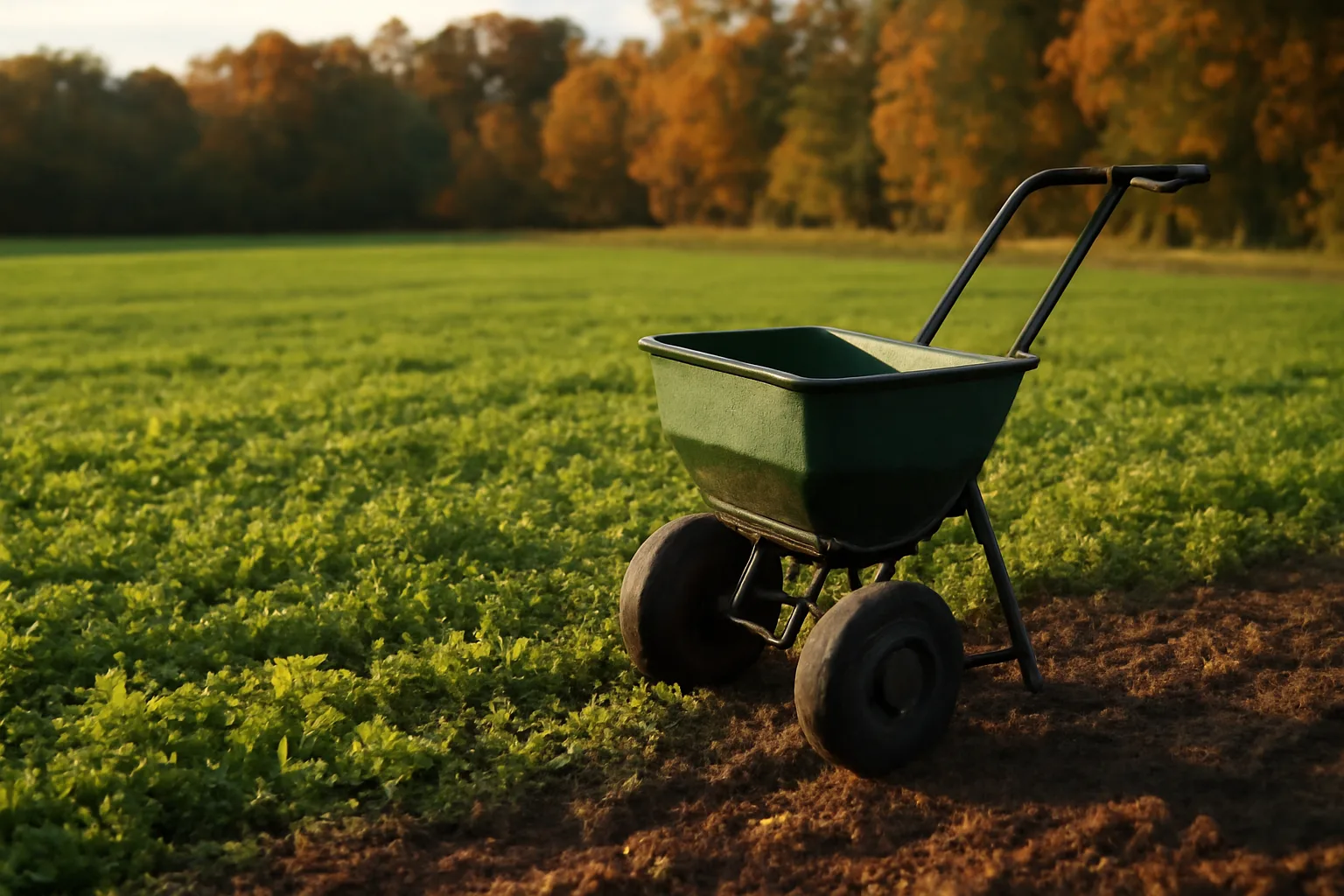
A basic kitchen or luggage scale to weigh out seed by the pound beats eyeballing scoops every time. Most seeding mistakes happen because someone estimates plot size and seed volume instead of measuring both. A GPS-based acreage measurement, even a free phone app that traces your plot boundary, gets you a real acreage number instead of a guess. Combine that with the seeding rate printed on your bag (in lbs/acre) and basic multiplication gets you the exact weight of seed you need. Broadcast spreaders with published output charts (many ATV and UTV tow-behind spreaders include a calibration table by setting number) take a lot of the guesswork out, though it's worth doing a bucket test: run the spreader over a tarp for a known distance and weigh what comes out to confirm the chart matches your actual unit and seed type. Seed size and shape affect flow rate, so a chart calibrated for corn won't be accurate for clover. If you're staring at a soil test report and a stack of seed options trying to figure out what actually fits your ground, that's exactly the gap a Custom Food Plot Plan is built to close, a $99 one-time plan based on your soil test, region, and goals, though your soil test lab remains the authority on your specific lime and fertilizer recommendations.
what's the real cost of overseeding, in dollars and results?
Seed isn't free, and doubling your rate roughly doubles your seed cost for a plot that performs the same or worse than one planted correctly. On a half-acre clover plot at the recommended 2-3 lbs/acre broadcast rate, that's maybe 1-1.5 lbs of seed. Double it accidentally and you've bought a second bag's worth of seed for no yield benefit, sometimes a yield loss. The bigger cost is usually a wasted planting window. Fall brassica and cereal grain windows are short, often just four to six weeks in a given region. If overseeding causes lodging or die-back and you have to replant, you may miss the window entirely for that season, leaving the plot bare or weed-choked through hunting season instead of producing forage. More seed in the bag doesn't mean more deer on the plot. It means more competition below the soil line that you're paying for twice: once at the seed store, and again in lost time if the stand fails.
Frequently asked questions
Can you put too much seed on a food plot?
Yes. Overseeding causes seedlings to compete for light, water, and root space, which weakens or kills a portion of the stand. The result is often a thinner, patchier plot than if you'd used the recommended rate printed on the seed bag, plus wasted seed cost.
Do deer eat sorghum?
Yes, deer eat both the leaves and stalks of growing sorghum as forage, and the grain heads once mature, similar to how they use standing corn. Grain sorghum drilled rates run roughly 8-10 lbs/acre according to Kansas State University Extension [5].
Do deer eat clover, and do deer like clover?
Yes, clover is one of the most reliably used food plot forages for whitetails. Both white and red clover rank high in most deer preference observations, especially in spring and early summer when clover protein content (often 25-30% crude protein) is highest.
When should you plant food plots for deer?
Spring (late April through June) for warm-season annuals and perennials like clover, soybeans, and sorghum. Late summer to fall (mid-August through September, later in the South) for cool-season annuals like brassicas, oats, and wheat. Exact dates depend on your local frost dates.
When should you plant oats for deer?
Plant fall oats roughly six to eight weeks before your area's first killing frost, generally mid-August to mid-September in northern states and into September or October farther south, per Oklahoma State University Extension guidance [2].
When should you plant turnips for deer?
Plant turnips 60 to 90 days before your area's first expected frost, generally late July through early September depending on latitude. Turnips need that time to bulb out, and deer often prefer them more after a frost sweetens the plant.
What is a food plot?
A food plot is a planted area, usually a quarter acre to several acres, seeded with forage crops like clover, brassicas, or cereal grains specifically to attract and feed deer and other wildlife, distinct from a crop field grown for human harvest.
What are deer's favorite foods?
Preference shifts by season and region, but soybeans, clover, standing corn, and acorns consistently rank as top choices in deer diet observations. Acorns during a heavy mast year often pull deer away from planted food plots entirely.
Do deer like honey?
No, honey isn't a real or documented deer food. Deer are herbivores with a four-chambered rumen built for plant fiber, and no wildlife agency or extension source recommends honey as deer food or an attractant.
How much clover seed should you broadcast per acre?
General land-grant guidance lists roughly 2-3 lbs/acre for white clover and 8-12 lbs/acre for red clover when broadcast [1]. Always check the specific rate on your seed bag first, since blends and germination rates vary.
What happens if a food plot is overseeded?
Overseeded plots often germinate thick and fast, then thin out as seedlings compete for light and root space. Cereal grains can lodge (fall over) from overly dense, thin stems, and legumes like clover can show patchy die-back within a few weeks.
Can you fix an overseeded food plot after planting?
Not fully. You can mow a thick perennial stand once it reaches 6-8 inches to reduce competition, or let natural thinning occur, but you generally can't undo overseeding. Severe cases, especially lodged grain plots, may need discing and replanting in the next proper window.
Sources
- USDA Natural Resources Conservation Service, Plant Fact Sheet: White Clover (Trifolium repens L.): Overseeding legume-grass mixes causes excessive seedling competition and clover/red clover broadcast seeding rate ranges
- Oklahoma State University Extension, Small Grain Forage Production: Wheat and oat seeding rates and lodging risk, and recommended fall planting window before first killing frost
- USDA NRCS, Plant Guide: Red Clover (Trifolium pratense L.): Doubling recommended legume seeding rates does not proportionally increase stand yield and can reduce it in poor seedbeds
- University of Tennessee Extension, Forage Brassicas (SP731-C): Turnip and brassica seeding rate and 60-90 day pre-frost planting window recommendation
- Kansas State University Extension, Grain Sorghum Production Handbook (C-687): Grain sorghum drilled seeding rate of roughly 8-10 lbs/acre