Last updated 2026-07-26
TL;DR
There's no single date. No-plow plot timing follows soil temperature and first frost, not the calendar. Plant clover and oats in late summer to early fall (roughly 60-90 days before your first killing frost), turnips and brassicas 60-90 days before frost too, and spring plots of clover or oats once soil hits 50-55°F. Check your local extension frost date map first.
What is a no-plow food plot, exactly?
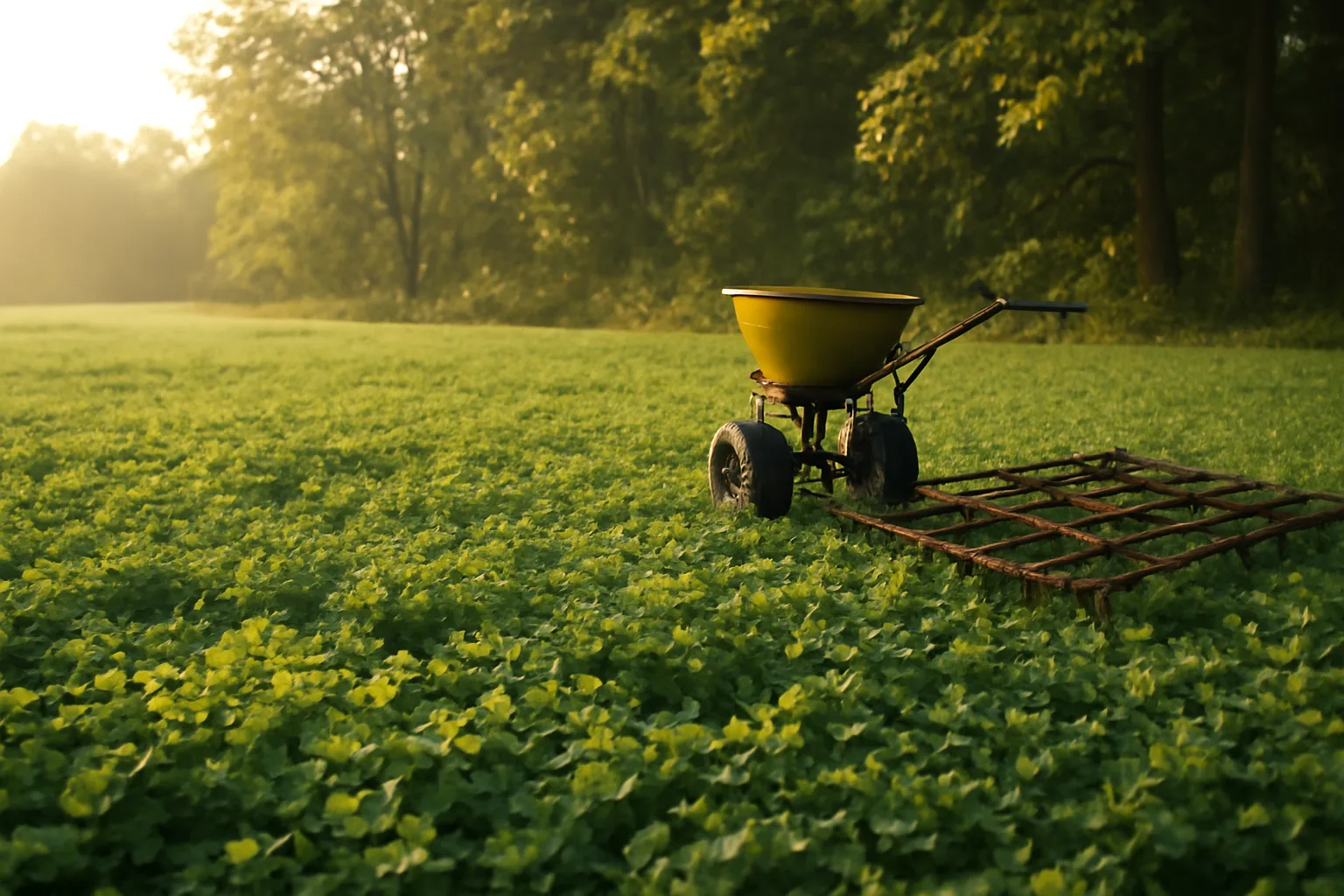
A no-plow food plot is a plot you plant without tilling or turning over the soil first. Instead of disking or plowing, you kill existing vegetation (usually with herbicide, sometimes by mowing and smothering), then broadcast seed directly onto the soil surface or into a light scratch made with a drag harrow or ATV disc set shallow. The method leans on no-till or minimum-till principles that soil scientists have pushed for decades because tillage burns organic matter, increases erosion, and wakes up dormant weed seed banks. USDA's Natural Resources Conservation Service has documented for years that reduced tillage and no-till systems improve soil aggregate stability and reduce sheet and rill erosion compared to conventional tillage [1]. For food plotters, the practical upside is less gear, less time, and a plot that holds moisture better through a dry August. No-plow plots work best for small-seeded species like clover, chicory, and brassicas that don't need deep seed placement. Corn, soybeans, and sorghum generally still want some soil disturbance or a proper drill, because those seeds want to be buried an inch or more deep. If you're building a whole-property plan and want a sense of which species fit which plot type, the breakdown on food plot whitetail strategy is a good next stop.
When should you plant food plots for deer overall?
Food plot timing splits into two windows: late summer/early fall for perennials and cool-season annuals, and spring for warm-season annuals and some clover establishment. Which window you use depends on species and your region's first and last frost dates, not a fixed date on the calendar. For fall plots (clover, oats, wheat, rye, brassicas, turnips), the standard advice from most land-grant extensions is to plant somewhere between 60 and 90 days before your area's average first frost. That gives cool-season plants enough growing season to establish a root system and canopy before winter dormancy, while still hitting peak palatability right as hunting season opens. For spring plots (clover frost-seeding, spring oats, warm-season annuals like soybeans or sorghum), timing follows soil temperature more than frost date. Soybeans want soil temps at or above 50°F for germination, with more reliable, faster emergence closer to 60°F. That's why most Midwest planting guides point to mid-May through early June depending on latitude [2]. Your exact dates will vary by 100+ miles of latitude and by elevation if you're hunting mountain ground. The single best free tool is your state's cooperative extension frost date map or NOAA's climate normals data for your county [3].
When should you plant oats for deer?
Plant oats for deer 60 to 90 days before your first fall frost, which lands most of the Midwest and Mid-South in the August 15 to September 15 window, and the Deep South closer to late September through October. Oats germinate fast (often within 5-10 days in warm soil) and deer will hit young oat shoots almost immediately, which is part of why oats are a staple in fall no-plow blends. Oats are not winter-hardy in most of the whitetail range. A hard freeze in the teens will usually kill oats outright, unlike wheat, rye, or triticale, which survive winter and regrow in spring. That's a feature, not a bug, for hunters who want peak tonnage and palatability during archery and firearm season and don't care if the plot dies in January. Spring oats are also an option in northern climates, planted as soon as soil is workable, generally April into May, mainly as a fast cover crop or early green forage before summer annuals take over. Most whitetail hunters skip spring oats entirely and put their planning time into the fall planting instead.
When should you plant turnips for deer?
Plant turnips 60 to 90 days before your area's first killing frost, which for most of the whitetail range falls between late July and early September. Turnips need a real frost or two to convert starches to sugars in the bulb and leaves, which is exactly why deer often ignore turnip plots in October and then hammer them in December. That sugar conversion shows up consistently in cool-season forage crop research on brassicas: freezing temperatures trigger starch-to-sugar conversion in leaf and bulb tissue, which is why brassica plots often see delayed but heavy use after the first hard frosts of the season. If you plant turnips too early in hot summer soil, expect poor germination and disease pressure. Too late, and you won't get bulb development before the ground freezes. Turnips do fine in a no-plow system as long as you get decent seed-to-soil contact. A light drag or cultipacking after broadcasting helps a lot, since turnip seed is tiny and won't germinate well sitting on top of thick thatch.
Do deer eat sorghum?
Yes, deer eat sorghum, both the grain heads and, to a lesser extent, the leaves, though it's rarely their first choice compared to soybeans, corn, or a lush clover plot nearby. Sorghum works best as a standing grain crop for late-season food and cover rather than an early-season attractant, and it's a solid warm-season option for no-till drills since the seed can be broadcast into a light disturbance. One real caution here. Sorghum, milo, and related sudangrass species can produce dhurrin, a compound that breaks down into cyanide (prussic acid) under stress conditions like drought, frost, or heavy grazing pressure. Extension forage guidance on sorghum and sudangrass species consistently flags this risk, mainly for livestock grazing young or stressed regrowth [4]. Wild deer browsing mature standing grain in a field is a different exposure than penned cattle grazing frosted regrowth, but it's worth knowing the crop carries that chemistry. Most food plot use of sorghum is as a mature grain crop harvested by frost, which sidesteps the worst of the risk window.
Do deer eat clover, and do deer actually like it?
Yes, deer eat clover heavily, and most wildlife biologists rank it among the top perennial forages for whitetails because of its protein content and long season of availability. Extension forage testing on clover stands commonly reports crude protein in the 20-30% range during active growth, which rivals or beats most other food plot options [5]. Clover also has the advantage of persistence. A well-maintained stand of ladino or red clover can produce forage for 3-5 years before you need to reseed, compared to annual replanting for oats, brassicas, or beans. That makes clover one of the best fits for a no-plow system, since you're not disturbing soil every season, just mowing, spot-spraying grass competition, and topdressing fertilizer based on your soil test results. For species selection across a whole property, deer food plot seed options and blends are worth comparing before you commit acreage to one thing.
When is the best time to plant clover for a no-plow plot?
Plant clover in late summer/early fall (roughly August to mid-September in most of the whitetail range) or in early spring as a frost-seeding once soil is workable but still cold, typically February through April depending on latitude. Fall planting gives clover a full growing season before it has to compete hard with summer weeds, and it's the preferred window for most Midwest and Southeast hunters. Spring frost-seeding works by broadcasting seed onto frozen or thawing ground; the freeze-thaw cycle works the seed into the soil surface without any tillage at all, which is about as no-plow as it gets. University of Wisconsin forage extension programs describe frost-seeding as a decades-old, low-cost way to thicken thin clover and legume stands in pastures without disking [6]. One timing note that trips people up: new clover seedlings are slow and weak. If you fall-plant clover, do it early enough (60+ days before frost) that it has a real root system before winter. If you spring-plant, expect weed pressure and be ready to mow high a few times through the first summer.
When to plant food plots for deer, by region and season
| Northern (MN, WI, MI, ME, upper NY) | Late July to mid-August | Mid-April to late May | |
|---|---|---|---|
| Mid-South/Midwest (MO, KY, IN, OH, VA) | Mid-August to mid-September | Late April to mid-May | |
| Deep South (AL, MS, GA, LA, FL) | Mid-September to late October | March to April | These windows come from stacking the 60-90 day pre-frost rule for fall annuals against USDA plant hardiness zone data across the whitetail range. If you're in zone 4-5 country, you're planting fall plots in late July while zone 8-9 hunters are still planting into late October. Nobody has a single national planting calendar that works. That's part of why so many bag-of-seed instructions say 'consult local conditions,' and they mean it. For a full breakdown by hunting season and region, the deer food plots planning guide covers zone-specific calendars in more depth than a general timing framework can. |
Here's a rough seasonal framework. Actual dates shift with your local frost dates, so treat this as a starting point, not gospel. | Region (general) | Fall plot window | Spring plot window |
How does no-plow timing differ from conventional tillage timing?
No-plow timing runs slightly earlier or the same as tilled timing for most species, because you lose a few days of soil warming and weed knockdown that tillage provides instantly. Where tillage buries existing vegetation and exposes bare warm soil right away, a no-plow kill (herbicide or mow-and-smother) needs 1-3 weeks for the existing growth to actually die and break down before you broadcast seed. Practically, that means if you're spraying glyphosate to kill a summer weed field before a no-plow fall plot, spray 2-3 weeks before your target planting date, not the day before. Cool, damp fall weather slows herbicide uptake, so warmer late-summer spray dates work faster than a cold September attempt. The tradeoff is real, though. No-plow systems protect soil structure and organic matter, and NRCS soil health guidance consistently notes that no-till and reduced-till fields hold moisture better in dry spells than freshly tilled ground because surface residue cuts evaporation [1]. On thin upland soils or erosion-prone hillsides common on leased hunting ground, that moisture retention can matter more than the extra planning lead time costs you.
What are deer's favorite foods, and does that change plot species choice?
Deer preference shifts by season and region, but acorns, soybeans, clover, and standing corn consistently rank as top whitetail foods across forage studies. Native browse (honeysuckle, greenbrier, various forbs) fills in heavily outside of ag areas too. There's no single 'favorite food' that holds year-round. Deer are opportunistic and track whatever has the best protein-to-effort ratio at that moment. Early season, deer often prefer soybeans and clover for protein going into the rut. Late season, especially after a hard frost, brassicas, turnips, and standing grain (corn, sorghum) become more attractive as energy needs shift and sugar content in brassicas rises. This is exactly why a lot of no-plow plot plans mix a perennial clover field with an annual brassica/turnip blend nearby: you're covering both halves of the season with one property. Do deer like honey? There's no real research or wildlife management basis for whitetails seeking out honey as a food source; they're not pollinator-adjacent foragers and honey isn't part of any standard whitetail diet study. If you've heard of hunters using honey or sugar-based attractants, that's a mineral/attractant question, not a food plot species question, and it's worth checking your state's baiting rules before using any supplemental attractant, since bait and feeding regulations vary by state and by season. Some states restrict bait during firearm season only; others ban feeding deer for any hunting purpose outright.
What should you check before locking in a planting date?
Check three things before you commit to a planting date: your soil test results, your local frost date, and your state's baiting/feeding regulations if you're near a public boundary or a state with strict rules. None of these substitute for the others. Your soil test is the actual authority on lime and fertilizer needs, not a general planting guide like this one. A land-grant extension soil test (most run $10-20 per sample) will tell you your pH and nutrient levels specific to your dirt. Lime especially needs lead time. Agronomy guidance from land-grant soil testing labs generally recommends applying lime months ahead of planting because it reacts slowly with soil, often needing a full season to fully shift pH [7]. If your test comes back at pH 5.5 and your clover wants 6.5-7.0, planting on schedule without addressing lime first just means a thinner, weaker stand no matter how well you time the seed drop. For a first-pass framework that turns your soil test and property goals into a specific planting plan, a $99 one-time Custom Food Plot Plan gives general species and timing guidance based on your inputs. It's a planning tool, not site-specific agronomy advice, and your soil lab's recommendations should always override generic guidance when the two disagree.
What equipment does a true no-plow plot actually need?
A no-plow plot needs a sprayer (backpack or ATV-mounted), a broadcast seeder, and something to firm seed-to-soil contact, like a drag harrow, chain-link section, or a lawn roller. That's the minimum kit. You don't need a tractor, disk, or plow, which is the entire point of the method. Some hunters add a light no-till drill (even a used one) for larger acreage, since drills place seed at a controlled depth and get better germination rates than pure broadcast-and-drag, especially for anything bigger than clover or brassica seed. But plenty of successful small plots (half acre to a few acres) run entirely on broadcast seeding plus a good spray-kill program. If you're deciding between a full tillage setup and going no-plow, cost is often the deciding factor. A used disk harrow and tractor setup can run several thousand dollars, while a decent backpack sprayer, hand broadcaster, and drag harrow can be assembled for a few hundred dollars total. For a deeper look at gear tradeoffs by plot size, domain food plot seed and general seed selection resources cover how equipment choice interacts with species choice.
Frequently asked questions
Do deer eat sorghum?
Yes. Deer eat sorghum grain heads and some foliage, though it's usually secondary to soybeans, corn, or clover. It works best as a standing late-season grain crop. Note that stressed sorghum/sudangrass can produce prussic acid (cyanide) compounds, a risk extension programs flag mainly for livestock grazing regrowth, not mature standing grain.
Do deer eat clover?
Yes, heavily. Clover is one of the top-ranked whitetail forages, often testing at 20-30% crude protein during active growth. It's palatable spring through fall and, unlike annuals, a good stand can keep producing for 3-5 years with basic mowing and fertility maintenance instead of yearly replanting.
When should you plant food plots for deer?
Fall plots (clover, oats, brassicas): 60-90 days before your area's first frost, roughly late July in the north to late October in the Deep South. Spring plots (soybeans, warm annuals, clover frost-seeding): once soil hits 50-60°F, typically April to June depending on latitude.
Do deer like clover more than other food plot options?
Deer generally rank clover very high, especially in spring and summer when protein demand is high for antler growth and lactation. It doesn't always beat soybeans or standing corn late season, but as a season-long staple, clover is hard to top for consistency and low replanting cost.
When should you plant oats for deer?
Plant oats 60-90 days before your first fall frost, generally mid-August to mid-September across most of the whitetail range. Oats germinate fast and deer often hit them within weeks of emergence. They're not winter-hardy in most regions, so expect the plot to die back after a hard freeze.
When should you plant turnips for deer?
Plant turnips 60-90 days before your first killing frost, generally late July through early September depending on region. Turnips need frost exposure to convert starches to sugars, which is why deer often ignore them early and then feed heavily after the first hard freezes of the season.
What is a food plot?
A food plot is a planted area, usually a fraction of an acre up to several acres, on hunting land specifically to provide supplemental forage for deer or other wildlife. Plots can be annual (replanted each season) or perennial (clover, alfalfa) and are planted with either conventional tillage or no-till/no-plow methods.
What are deer's favorite foods?
Acorns, soybeans, clover, and standing corn are consistently top-ranked in whitetail forage studies, alongside native browse like honeysuckle and forbs. Preference shifts seasonally: high-protein plants dominate spring/summer, while high-energy foods like corn, sorghum, and frost-sweetened brassicas take over in late season.
Do deer like honey?
There's no wildlife research supporting honey as a meaningful whitetail food source; it's not part of any standard deer diet study. If you're considering sugar or honey-based attractants, that's a supplemental attractant question, and you should check your state wildlife agency's baiting and feeding rules first, since they vary widely.
Can you plant a no-plow food plot in existing sod or pasture grass?
Yes, but you need to kill the existing grass first, usually with a glyphosate application 2-3 weeks before planting, or through mowing and smothering over a longer window. Broadcasting seed onto live, thick sod without killing it first usually gives poor germination because new seedlings can't compete for light and moisture.
Do I need to till at all for a no-plow plot to work?
No, that's the point of the method. You kill existing vegetation with herbicide or mowing/smothering, then broadcast seed and use a drag harrow, chain, or roller for seed-to-soil contact. Small-seeded species like clover, chicory, and brassicas do well this way; larger seeds like corn or beans usually still want a drill or light disturbance.
How do I know my exact planting window instead of a general date range?
Look up your county's average first and last frost dates through NOAA climate normals or your state land-grant extension office, then count backward 60-90 days from first frost for fall annuals. Your soil test lab and local extension agent will have more precise, location-specific windows than any national guide.
Sources
- USDA Natural Resources Conservation Service, Soil Quality Indicators: Aggregate Stability: No-till and reduced tillage help maintain soil structure and reduce erosion compared to conventional tillage
- Iowa State University Extension and Outreach, Corn and Soybean Planting Date Considerations (PM 1885): Soybean germination is more reliable and faster as soil temperature approaches 60°F
- NOAA National Centers for Environmental Information, U.S. Climate Normals 1991-2020: Average first and last frost dates by location come from NOAA climate normals data
- Oklahoma State University Extension, Prussic Acid Poisoning in Livestock (PSS-2904): Sorghum, sudangrass, and related species can produce dhurrin which converts to toxic prussic acid under stress conditions
- University of Kentucky Cooperative Extension, Nutrient Requirements of Deer and Their Habitat (FOR-83): Quality clover stands commonly provide crude protein in the 20-30% range during active growth
- University of Wisconsin, Focus on Forage: Frost Seeding Legumes into Pastures: Frost-seeding uses freeze-thaw soil cycles to establish clover and legumes without tillage
- Michigan Department of Natural Resources, Baiting and Feeding Wildlife Conservation Order Summary: State wildlife agencies set specific, varying rules on baiting and feeding deer that hunters should check before using attractants
- University of Missouri Extension, Soil Acidity and Liming (Publication G9101): Lime applications need lead time before planting because lime reacts slowly with soil to shift pH