Last updated 2026-07-26
TL;DR
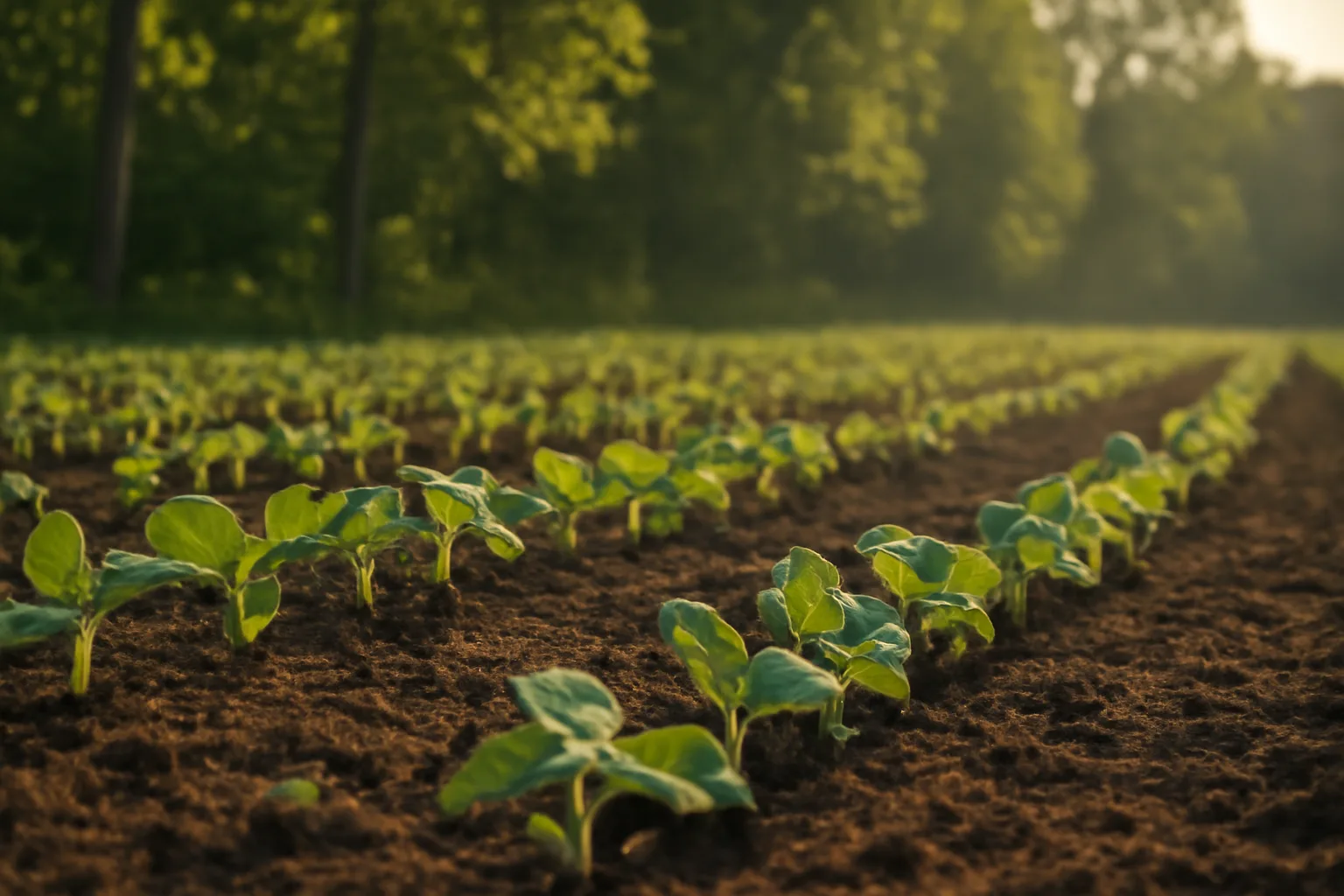
Spring food plots work best with warm-season plantings like soybeans, cowpeas, lablab, sunn hemp, and grain sorghum, planted after your last frost date. Clover, planted the year before or overseeded in early spring, keeps producing through summer. Match species to your soil test and your region's frost-free window, usually April through June depending on latitude.
what is a food plot, exactly?
A food plot is a planted patch of forage, usually somewhere between a quarter acre and several acres, put in on hunting ground to feed deer and other wildlife and to concentrate animal activity in a place you can hunt or observe. It's farming, just at a smaller scale and with a different customer. Most plots fall into one of two categories: annuals you replant every year (soybeans, brassicas, cereal grains, sorghum) or perennials that persist for two to five years with mowing and maintenance (clover, chicory, alfalfa). Spring plots are almost always warm-season annuals or perennial establishments, since cool-season stuff like brassicas and cereal grains gets planted in late summer for fall use. State wildlife agencies regulate food plots differently than bait piles or feeders. In most states, a food plot that's planted and grown in place is legal to hunt over, while dumping corn or minerals on the ground is baiting and is illegal in many states during hunting season. Michigan's wildlife conservation order defines baiting explicitly and treats it as a separate category from a standing crop [1]. Rules vary a lot by state. Check your own state wildlife agency's baiting and feeding regulations before you plant or hunt over anything unusual.
when to plant food plots for deer in spring
| Deep South (zone 8-9) | Mid-April to mid-May | Late January to February | |
|---|---|---|---|
| Mid-South/Lower Midwest (zone 7) | Late April to May | February to March | |
| Upper Midwest/Northeast (zone 5-6) | Mid-May to early June | March to early April | |
| Northern tier/Canada border (zone 3-4) | Late May to mid-June | April | Your state extension office publishes frost-free date maps specific to your county, and those are far more reliable than a national rule of thumb. The NOAA National Centers for Environmental Information publishes freeze/frost occurrence data by station that most extension frost maps are built from [2]. If you want species and timing matched to your specific soil test and coordinates rather than a regional average, that's exactly the kind of thing a custom food plot plan is built to sort out for $99, though the timing windows above will get most hunters most of the way there for free. |
Spring planting timing depends almost entirely on your last frost date, not the calendar month. Warm-season legumes and grains like soybeans, cowpeas, and sorghum need soil temperatures above 60°F and no more frost risk, which in practice means late April in the Deep South, mid to late May through the Midwest, and early to mid June in the northern tier and Canada border states. Cool-season perennials like clover are a different story. Many plot managers actually frost-seed clover in late winter (February to early March) while the ground still has freeze-thaw cycles, because those cycles work the seed into the soil surface without any equipment. If you missed that window, a dormant seeding into a well-prepared, weed-free seedbed in early spring still works, you just want it done before hot weather sets in. A rough national planting window looks like this: | Region | Warm-season annuals (soybeans, sorghum, cowpeas) | Clover frost-seeding/spring seeding |
do deer eat clover, and is it worth planting?
Yes, deer eat clover heavily, and it's one of the most reliable food plot plantings in North America. White clover and red clover both show up constantly in deer diet studies. Clover's crude protein content commonly runs 25 to 30 percent in vegetative growth, which is well above what most native browse offers during summer. The Noble Research Institute's forage legume guidance for wildlife food plots puts white and red clover crude protein in a similar high range during active growth stages [3]. Clover's real strength in a spring plot lineup isn't just deer preference, it's persistence. A well-limed, well-fertilized clover stand can produce from April through the first hard freeze and come back for three to five years with mowing and occasional weed control, so the labor and cost you put in during establishment year pays out over multiple seasons. The catch is soil pH. Clover struggles hard below pH 6.0, and a lot of new plotters plant clover into acidic dirt, watch it fail, and blame the seed. Your soil test report will tell you the lime rate needed to get into clover's comfort zone, usually pH 6.0 to 6.5. That report from your testing lab is the actual authority on how much lime and fertilizer your specific field needs, not a general article like this one. If you're deciding between clover and other spring options, check out food plot whitetail for a broader breakdown of species by season.
do deer eat sorghum, and where does it fit in a spring plot?
Deer eat grain sorghum, both the leaves during the growing season and the seed heads once they mature and dry down in fall. Sorghum isn't usually anyone's first-choice deer food because deer generally rank it below soybeans, cowpeas, or corn in preference, but it earns its place in spring plots for a different reason: drought tolerance and screening. Grain sorghum and forage sorghum both handle heat and dry spells better than corn, which makes them a smart choice for sandy or low-rainfall ground where corn would struggle. Sorghum also grows tall and thick, which gives you standing cover and screening between a food source and a stand or blind, something soybeans and clover can't do. Most sorghum blends get planted from late spring into early summer, generally two to three weeks after your area's last frost date. Kansas State University Research and Extension recommends grain sorghum seeding rates around 4 to 8 pounds per acre for dryland conditions depending on row spacing and moisture, with drilled rates on the lower end of that range [4]. If screening and drought tolerance matter more to you than raw palatability, sorghum earns a spot in the mix. If your ground holds moisture fine and deer preference is your priority, put your acreage into soybeans or cowpeas instead.
what are deer's favorite foods, and does that change in spring?
Deer preference shifts by season because their nutritional needs shift. In spring, does are recovering from winter and heading into late gestation or early lactation, and bucks are starting antler growth, so the whole herd is hunting for protein and easily digestible energy. Across food plot studies and browse surveys, the species that consistently rank near the top of deer preference lists include soybeans, cowpeas, clover, alfalfa, and lablab, all of which run roughly 20 to 30-plus percent crude protein in their vegetative stage. Corn and sorghum rank lower for palatability during the growing season but become valuable later as a standing energy source once the seed heads mature. In native spring vegetation, deer are drawn to new green growth, forbs, and browse tips. Basically anything tender and high in moisture and protein after a long winter of woody browse. That's part of why a spring-planted legume plot gets hit hard almost as soon as it emerges. It's offering exactly what the deer's body is asking for at that point in the year. There's no single universal favorite food. Deer preference varies by region, native forage availability, and even by individual deer population, but soybeans and clover show up near the top of nearly every regional study and food plot trial.
when to plant oats for deer
Oats are primarily a fall food plot planting, not a spring one, and that trips up a lot of new plotters. Oats are a cool-season cereal grain that germinates fast, tolerates a light frost, and produces highly palatable forage in September through November, which is when hunters want fresh green growth in the plot. Spring-planted oats will grow, but they typically bolt to seed head and lose palatability quickly once temperatures climb into the 80s, and they won't persist through summer heat the way a warm-season annual will. If you plant oats in spring, treat them as a quick cover crop or as a nurse crop mixed with clover, not as your primary summer forage. The better spring move, if you like cereal grains, is to hold your oat seed for a late summer planting, typically August in northern areas and September in the South, roughly 6 to 8 weeks before your first fall frost, and use spring for soybeans, cowpeas, or sunn hemp instead. Oats and clover mixes are common in fall plantings specifically because the oats provide fast early cover while the clover establishes underneath.
when to plant turnips for deer
Turnips, like oats, are a fall food plot crop, not a spring one. Turnips and other brassicas (radishes, rape, kale) are planted in mid to late summer, generally 90 to 100 days before your first expected fall frost, so the bulbs and leaves mature right as cold weather hits and sugar content in the plant rises, which is what makes brassicas so attractive to deer in late fall and winter. Planting turnips in spring doesn't work well for two reasons. First, brassicas need that cold-triggered sugar conversion to become palatable; deer often ignore spring or summer brassica growth because it's still bitter. Second, brassicas planted in spring will bolt and flower under long summer daylight before they ever bulb up. If turnips are part of your plan, mark the planting date on your calendar for July or August depending on your zone, and use your spring plot rotation for warm-season species instead. This is one of the most common food plot timing mistakes: planting a fall species in spring because that's when the planter is already hooked up.
what should you actually plant in spring: species by soil and goal
Spring plot selection comes down to three questions: what's your soil pH and drainage, how much sun does the plot get, and are you feeding deer through summer stress or trying to hold a perennial stand for years. Soybeans are the workhorse spring planting almost everywhere east of the Rockies. They handle a range of soil types, deer preference is consistently high, and forage soybean varieties are bred specifically to keep producing leaf tonnage even under heavy browsing pressure, unlike grain soybean varieties that can get browsed out before they ever pod. USDA plant hardiness zone data helps confirm which warm-season legumes will reliably mature in your area before fall frost cuts the season short. Cowpeas (iron and clay varieties are common) do well on sandier, lower-fertility ground where soybeans struggle, and they fix nitrogen, which helps the following crop. Lablab and sunn hemp are more drought-tolerant and heat-tolerant than soybeans, and both hold up well against heavy deer pressure on smaller plots where deer density might mow down soybeans before they establish. Grain sorghum and corn work as spring plantings when your priority is standing cover, screening, or a fall/winter energy source rather than summer forage volume. Clover and chicory are the perennial options, best frost-seeded in late winter or planted early spring into a clean, limed seedbed, and they'll be the lowest-maintenance, longest-running part of your plot rotation once established. A simple, honest spring lineup for most hunters with average soil: soybeans or cowpeas on your best ground, clover on a smaller perennial plot, and sorghum or corn worked in for screening if you need it. For species-specific seed selection and blends, deer food plot seed and food plot seed go deeper on varieties.
do deer like honey, and does it belong in a food plot?
Deer don't eat honey in any meaningful way as part of natural foraging behavior, and it's not a food plot ingredient or attractant with any research backing behind it. Deer are herbivores built to digest plant fiber through a rumen, and honey (a concentrated sugar produced by bees) isn't part of their natural diet or a documented attractant in wildlife agency or extension literature. What probably drives this question is confusion with commercial deer attractant products that use sugary or molasses-based scents and granular minerals, which are a completely different category from a planted food source. Some of those attractant products are legal in some states and classified as baiting in others, so the same regulatory caution applies. Check your state wildlife agency's rules before using any granular, liquid, or scented attractant near a stand. If you're trying to boost plot attraction with something more than seed, the actual research-backed lever is soil fertility. A properly limed and fertilized plot produces more tonnage and higher protein forage, and that's what pulls deer in and holds them, not a sugar source with no dietary relevance to a ruminant.
how much seed and fertilizer does a spring plot actually need?
| Soybeans (forage type) | 90-110 | 60-90 | |
|---|---|---|---|
| Cowpeas | 60-90 | 40-60 | |
| Grain sorghum | 8-12 | 6-10 | |
| White clover | 6-10 | 4-6 | |
| Lablab | 25-35 | 20-25 | Fertility is where a soil test earns its cost back many times over. A basic soil test through most state extension labs runs somewhere in the $10 to $20 range depending on the state and lab. Iowa State University's soil testing lab, for example, lists routine nutrient test fees in that general range for pH, phosphorus, and potassium analysis [5]. That test tells you your exact pH and your phosphorus and potassium levels, which determines your actual lime and fertilizer rate rather than a guess. Broadcasting fertilizer blindly, or skipping lime because a bag of seed says it's not required, is one of the most common ways new plotters waste a planting season. Your soil test lab's recommendation is the final word on how much lime and fertilizer your specific field needs. General articles, including this one, can only give you typical ranges; your local soil chemistry might call for something different. |
Seeding rates vary a lot by species and by whether you're broadcasting or drilling, and getting this wrong (usually by overseeding) wastes money without improving your stand. Here are typical broadcast seeding rates for common spring species, pulled from land-grant extension forage guides [4] [5]: | Species | Broadcast rate (lbs/acre) | Drilled rate (lbs/acre) |
what equipment do you actually need to plant a spring plot?
For most food plot sizes (a half acre to five acres), you don't need a full-size farm tractor. A subcompact tractor or a good ATV/UTV with a disc, cultipacker or roller, and a broadcast spreader will handle the vast majority of spring plot work. The basic sequence is the same regardless of scale: kill existing vegetation (herbicide or disking), work the seedbed, broadcast or drill your seed at the right depth, and firm the seedbed with a cultipacker or roller so seed-to-soil contact is good. Small-seeded species like clover need very shallow planting, often just pressed into the surface, while soybeans and sorghum need real planting depth, typically 1 to 1.5 inches for soybeans and 1 to 2 inches for sorghum. A lot of plot failures aren't a species problem or a soil problem, they're a seed-depth problem: broadcasting a big seed like soybeans without covering it, or drilling clover four inches deep where it never emerges. If you're building out your setup or trying to figure out which tools to buy first, deer food plots and deer for food both cover equipment and setup in more depth.
Frequently asked questions
Do deer eat sorghum?
Yes, deer eat both the leaves of growing sorghum and the mature seed heads, though most deer studies rank sorghum below soybeans, cowpeas, and corn in preference. Sorghum earns its spot in food plots mainly for drought tolerance and its use as standing cover or screening, not top-tier palatability.
Do deer eat clover?
Deer eat clover heavily and consistently across nearly every region of North America. White and red clover run roughly 25 to 30 percent crude protein in vegetative growth, and a well-limed clover stand can produce forage from spring through the first fall freeze for three to five years.
When should you plant food plots for deer?
Warm-season spring plots (soybeans, cowpeas, sorghum) go in after your last frost date, typically mid-April in the Deep South, May in the Midwest, and late May to mid-June in the northern tier. Cool-season fall plots (brassicas, cereal grains) go in 60 to 100 days before your first fall frost.
Do deer like clover?
Yes, clover is one of the most consistently preferred food plot forages for deer, largely due to its high protein content and long production window. It's a common first choice for hunters establishing a perennial plot because of both palatability and multi-year persistence.
When should you plant oats for deer?
Oats are best planted in late summer, roughly 6 to 8 weeks before your first fall frost, so they establish for fall and early winter use. Spring-planted oats bolt and lose palatability quickly once summer heat arrives, so they're a poor primary choice for a spring plot.
When should you plant turnips for deer?
Turnips are a fall crop, planted about 90 to 100 days before your area's first expected fall frost, typically July or August depending on latitude. They need cold-triggered sugar conversion to become palatable, so spring planting produces bitter, unattractive forage and the plants bolt before bulbing.
What is a food plot?
A food plot is a planted area of forage crops, usually a quarter acre to several acres, established on hunting land to provide deer nutrition and concentrate their activity in huntable locations. It's regulated differently from bait or feed in most states, since it's a grown crop rather than dumped feed.
What are deer's favorite foods?
Deer preference varies by region and season, but soybeans, cowpeas, clover, alfalfa, and lablab consistently rank among the top food plot species, largely because they offer 20 to 30-plus percent crude protein in vegetative growth. In native habitat, deer favor tender new browse, forbs, and mast crops like acorns.
Do deer like honey?
No, honey isn't part of a deer's natural diet or a documented food plot attractant. Deer are herbivores that digest plant fiber through a rumen, and there's no wildlife agency or extension research supporting honey as a meaningful deer food source or attractant.
What's the best spring food plot planting for a beginner?
Forage soybeans or iron-clay cowpeas on your best-drained ground, paired with a small clover plot on a separate area, is a reliable starting combination. Both are widely available, well-studied by land-grant extensions, and consistently rank high in deer preference across most regions.
Can you plant clover and soybeans together in spring?
It's uncommon to mix them in the same plot since soybeans grow tall and can shade out young clover, and clover is a multi-year perennial while soybeans are replanted annually. Most plot managers keep them in separate fields or zones so each can be managed on its own timeline.
How big should a spring food plot be?
There's no fixed rule, but many hunters aim for a half acre to two acres for a hidden, huntable plot, and larger destination plots of three to five-plus acres when the goal is season-long feeding rather than a stand-adjacent kill plot. Size should match your equipment, sunlight, and how much pressure the plot needs to absorb.
Sources
- Michigan Department of Natural Resources, Wildlife Conservation Order (Baiting and Feeding): State wildlife orders define baiting separately from standing planted crops, and baiting rules vary by state
- NOAA National Centers for Environmental Information, Freeze/Frost Occurrence Data: Regional frost-free date data underlies the planting windows extension offices publish by county
- Noble Research Institute, 'Legumes for Wildlife Food Plots': Clover and other forage legumes commonly provide high crude protein content during vegetative growth, a preferred deer forage class
- Kansas State University Research and Extension, 'Grain Sorghum Production Handbook' (C-687): Grain sorghum seeding rate guidance and drought tolerance characteristics for warm-season plantings
- Iowa State University Soil and Plant Analysis Laboratory, Soil Testing Fee Schedule: A basic soil test through a land-grant extension lab typically costs in the $10 to $20 range and provides pH and nutrient recommendations