Last updated 2026-07-26
TL;DR
September is the single best month for food plots across most of the whitetail range, especially for brassicas, cereal grains, and clover overseeds. Aim for 60-45 days before your first killing frost for turnips and radishes, and get clover or oats in the ground by mid-to-late September in the Midwest and Northeast so roots establish before cold weather hits.
what is a food plot, exactly
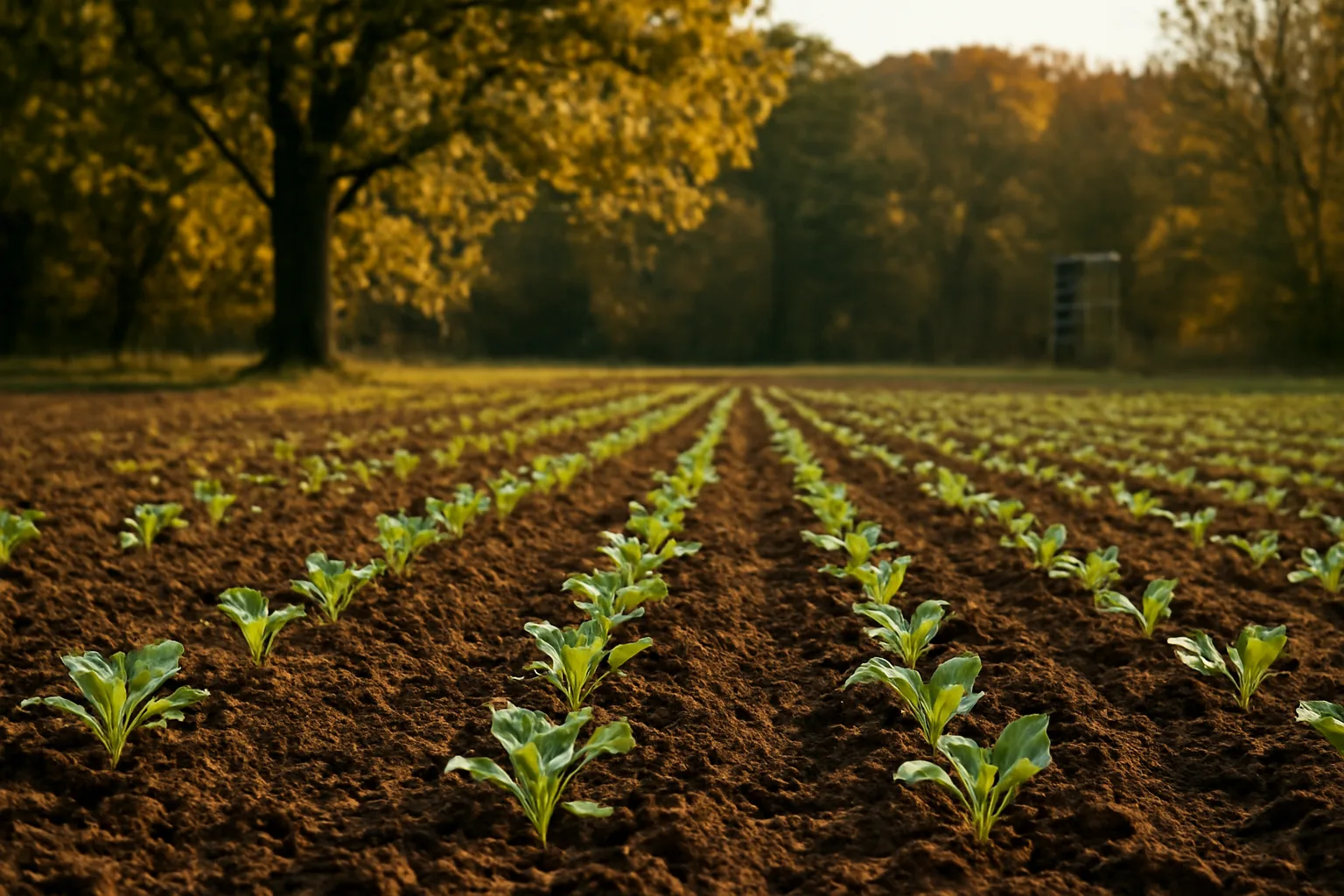
A food plot is a planted patch of forage, grain, or brassica on hunting land, built specifically to feed and hold deer (and often turkey, dove, or other wildlife) rather than to produce a sellable crop. Plots range from a quarter-acre kill plot tucked into a timber opening to a five-acre field of clover or beans on a farm. The goal isn't just tonnage. A good plot balances attraction (something deer want to eat right now), nutrition (protein and energy that help antler growth, lactation, and winter survival), and huntability (a spot with the right wind and access for a stand or blind). The USDA Natural Resources Conservation Service and most state wildlife agencies treat food plots as a wildlife habitat practice, and several states offer cost-share or technical help through programs like the Conservation Reserve Program's wildlife-friendly options [1]. If you're new to the whole idea, food plot whitetail and deer food plots cover the basics of layout, size, and species choice before you get into a calendar.
when to plant food plots for deer
| Northern Midwest / New England | mid-late Sept | Aug 15 - Sept 10 | |
|---|---|---|---|
| Mid-Atlantic / Ohio Valley | mid-late Oct | Sept 1 - Sept 25 | |
| Mid-South / Southern Appalachians | late Oct - mid Nov | Sept 15 - Oct 15 | |
| Deep South / Gulf Coast | Nov - Dec | Oct 1 - Nov 15 | Check your county's average first frost date through the NOAA National Centers for Environmental Information climate normals tool before you lock in a date [4]. |
Timing depends on species and your frost date, not a fixed calendar date. As a rule, perennial clovers and cereal grains go in late summer to early fall across most of the whitetail's range, while spring plots (soybeans, corn, some clover establishments) go in after the last frost. September is the workhorse month for fall plots in the Midwest, Northeast, and Upper South. Purdue University Extension recommends seeding brassicas and cereal grains in late August through September in Indiana, timed so plants have 6 to 8 weeks of growth before a hard frost [2]. The University of Tennessee Extension gives a similar window for the Mid-South, generally September into early October depending on elevation [3]. In the Deep South and Gulf Coast, you can push fall plantings into October or even November because frost comes much later. In the northern tier (Minnesota, Wisconsin, Maine, upstate New York), you want seed in the ground by early-to-mid September at the latest, because the growing window closes fast once nights turn cold. Here's a rough framework, not gospel, since local frost dates and rainfall change the picture every year: | Region | Typical first frost | Best fall planting window |
why september is the sweet spot for fall plots
September plantings hit two things at once: cooling soil temperatures that clovers and brassicas love, and the natural fall spike in deer feeding as they build fat reserves and shift toward the rut. Deer key in on high-quality forage in early fall, and a lush plot planted in September is often at peak palatability right when bow season opens in most states. Soil temperature matters more than the calendar. Brassicas like turnips and radishes germinate well once soil temps drop into the 45-85degF range, and Purdue's guidance ties fall brassica seeding to that late-August-to-September window specifically because it lines up with cooling soil and reliable fall rain [2]. Plant too early in a hot, dry August and you can burn a stand before it establishes. Plant too late and you risk a killing frost before roots bulb up. Rain is the wildcard. September droughts happen, especially in the Midwest, and a lot of failed food plots trace back to drilling seed into bone-dry dirt and hoping. If your local forecast shows a dry stretch, it's worth delaying a week or two rather than rushing a target date.
when to plant turnips for deer
Plant turnips 80 to 90 days before your first expected killing frost, which for most of the whitetail range lands somewhere between late July and early September. Turnips need that lead time to bulb up; if you plant too late, you'll get leafy tops but small or no bulbs. The University of Tennessee Extension recommends turnips and other brassicas be seeded from mid-August through mid-September in Tennessee, adjusting earlier for higher elevations [3]. In the northern Midwest, some growers push turnip seeding into early August to guarantee bulb development before frost. One quirk worth knowing: deer often ignore turnip bulbs and leaves early in the season and hammer them hard after the first frost or two. Cold converts starches in the plant to sugars, and that sweetness is what triggers the late-season feeding frenzy. So don't panic if your September-planted turnip plot looks untouched in October. It's doing its job for a December hunt. Seeding rate for turnips alone runs about 4 to 6 pounds per acre broadcast, and they're commonly blended with radish or rape in a brassica mix. If you're building a blend from scratch, deer food plot seed breaks down common mixes and rates.
when to plant oats for deer
Plant oats for deer in late August through September in most of the country, giving them 6 to 8 weeks before a hard freeze. Oats germinate fast, often in 5 to 10 days under good moisture, and they're one of the most reliably attractive early-fall plantings because deer hit the tender green shoots almost immediately. Oats are a cool-season annual grain, not a true perennial, so they won't overwinter reliably north of the Mid-South; hard freezes in the teens or below usually kill the plant outright, though the forage value already delivered in September and October makes that a non-issue for most hunters. In the Deep South, oats can survive a mild winter and provide grazing into late winter. A common September combo is oats blended with winter wheat or winter rye plus a clover for a mixed plot: the oats give fast early cover and tonnage, the wheat or rye adds cold tolerance, and the clover thickens in as a perennial base for next year. Seeding rate for oats alone runs 100 to 120 pounds per acre drilled, less if broadcast into a mix.
do deer like clover, and when should you plant it
Yes. Clover is consistently ranked among the most preferred whitetail forages by wildlife biologists and extension researchers, largely because of its protein content, which commonly runs 25 to 30 percent crude protein in vegetative growth, and its long grazing window compared to annuals [5]. Clover can go in either spring or late summer/early fall, and September is actually one of the two best windows in much of the country. A late-summer clover seeding (mid-August to mid-September) lets the plant establish a root system before winter dormancy, and it comes back strong the following spring without competing against summer weeds the way a spring seeding often does. The Mississippi State University Extension Service notes that fall-planted clover in the Southeast should go in from September through early October, timed to catch fall rains and avoid the worst of summer heat stress on new seedlings [5]. In colder zones, aim for the earlier end of that window, ideally by mid-September, so plants have 6 or more weeks of growth before a freeze. White clovers (Ladino, Durana) are the most common food plot clovers because they're perennial and can produce for 3 to 5 years with good management. Red clover is cheaper and faster-establishing but usually only lasts 2 to 3 years. If you're overseeding an existing stand rather than starting fresh, September frost-seeding style broadcasts work well because the freeze-thaw cycle through winter helps work seed into the soil.
do deer eat sorghum
Yes, deer eat both the seed heads and the young foliage of grain sorghum, though it's more commonly planted as a screening or standing-crop food source than a primary attractant plot. Sorghum (milo) produces a dense stalk that doubles as bedding cover and wind block, and the grain head matures in fall, giving deer (and turkey, quail, and dove) a standing food source into winter. Sorghum is a warm-season crop, planted in late spring after soil temps hit 60 degF, not a September planting. If you already have a sorghum field from a spring planting, September and October is when it typically matures and starts drawing deer as the grain heads ripen and dry down. Compared to corn, sorghum is more drought-tolerant and needs less nitrogen, which makes it a reasonable choice on marginal ground where corn would struggle. It's not usually anyone's top pick for pure deer attraction, though; corn and soybeans generally out-draw it where you can grow them successfully.
do deer like honey (and does it belong in a food plot conversation)
Deer don't naturally seek out honey in the wild, and it isn't a food plot input or forage species at all, so this one's really a myth-check rather than a planting question. Deer are herbivores built to digest cellulose and plant matter through a four-chambered rumen system; they have no evolved drive to find honey the way bears do. That said, deer are curious and will occasionally lick or nibble something sweet if they stumble across it, and some hunters have tried sweetened mineral or attractant products marketed with honey or molasses as an additive for scent and palatability. There's no research from state wildlife agencies or university extensions establishing honey as an effective attractant, and several states restrict the use of scent or feed attractants under baiting regulations (more on that below), so it's not something we'd recommend spending money or risk on. Stick with real forage. A well-timed brassica or clover plot will out-produce any gimmick attractant, every time.
what are deer's favorite food, ranked by what the research shows
Deer preference shifts by season, region, and what's locally available, but a few plants show up again and again in university forage preference studies and food plot trial data: white clover, soybeans (as a summer forage), brassicas like turnips and radishes (especially post-frost), and native browse like blackberry, honeysuckle, and acorns where mast is available. Acorns deserve a mention because in a heavy mast year, deer will often walk past a planted plot to hit a white oak flat, since acorns can supply more fat and energy per pound than most cultivated forages. That's not a knock on food plots; it's just reality, and it's part of why plot placement near (not on top of) good mast timber tends to work better than an isolated field. Among planted options, soybeans in summer and clover across spring, summer, and fall consistently rank at or near the top in preference trials and grower surveys, largely because of their protein levels. Brassicas rank lower in preference during warm weather and much higher after frost sweetens the plant. If you want a species-by-species comparison for your specific soil and region, food plot seed and domain food plot seed go deeper on matching species to your ground. For a fast, no-guesswork answer, PlotSeason's $99 one-time Custom Food Plot Plan at /plot-plan-builder takes your zip code, soil test, and acreage and hands back a planting plan built around your actual frost dates and soil, rather than a generic national calendar.
how soil and a soil test change your september plan
Your soil test is the real authority here, not a national blog post, and any lime or fertilizer recommendation should come from your test results, not a rule of thumb. Most land-grant extension soil labs (Penn State, Mississippi State, Purdue, and others) return a report with a target pH and specific lime and fertilizer rates for the crop you tell them you're planting. Clover and brassicas both want a pH close to neutral, generally 6.0 to 7.0, and most food plot soils that have never been limed test acidic, often in the 5.0 to 5.8 range in wooded or long-fallow ground. Lime takes months to fully react in the soil, so if you're testing in September for a September planting, you're already behind on pH correction for this year's crop; the lime you apply now mostly benefits next year's plot. It's still worth applying, just don't expect a full pH swing before your fall seeding. Nitrogen, phosphorus, and potassium rates depend on your specific test numbers and the crop, and this is exactly the kind of site-specific call your soil test lab is built to make. As a general pattern, brassicas are heavier nitrogen feeders than clover (which fixes some of its own nitrogen through rhizobia bacteria once established), so a clover-only plot needs less N than an oat/brassica mix.
equipment and seedbed prep for a september planting
A firm, weed-free seedbed with good seed-to-soil contact matters more than any single date on a calendar. Most fall plot failures trace back to seed sitting on top of thatch or dry, cloddy dirt rather than getting real contact with moist soil. For small plots (under an acre), a hand seeder, a light disc or hand tiller, and a lawn roller or ATV tire drag can get the job done. For larger acreage, a tractor with a disc harrow, a cultipacker, and a broadcast spreader or no-till drill speeds things up considerably. Brassica and clover seed is small and shouldn't be buried deep, generally a quarter inch or less, while oats and other grains want closer to an inch of coverage. Kill existing vegetation with glyphosate 2 to 3 weeks ahead of your planting date if you're converting an old field or a weedy plot, since brassicas and clover compete poorly against established grass and weeds early on. If you're working a tight fall calendar and can't wait 2 to 3 weeks for a burndown to fully work, a light disc-and-drag approach can substitute in a pinch, though weed pressure will likely be higher.
baiting and feeding rules you need to check before you plant or hunt over a plot
Food plots are legal everywhere in the US and are treated differently from baiting in nearly every state, but the line between the two varies, and you need to check your specific state wildlife agency's regulations before hunting a plot, especially if you're adding any mineral, salt, or supplemental feed alongside it. Most states define a planted, standing crop (a food plot) as legal to hunt over, while placing separated piles of grain, minerals, or feed on the ground is regulated as baiting and is illegal in a number of states, or legal only outside a certain distance from a stand, or legal only at certain times of year. Michigan, for example, prohibits baiting and feeding of deer in the Lower Peninsula under its Wildlife Conservation Order, with exceptions and restrictions that change periodically, so hunters need to check the current order each season [6]. Other states like Pennsylvania have their own separate feeding and baiting restrictions tied to chronic wasting disease management zones [7]. Because these rules shift by state and sometimes by county or CWD zone, don't assume your neighbor's rules apply to your land. Check your state wildlife agency's current regulations digest before the season, not after you've already got a mineral station next to your plot.
common september planting mistakes worth avoiding
Planting too early into hot, dry August soil is probably the single biggest mistake. Brassica and clover seed can sit dormant for weeks waiting on rain, and by the time it finally germinates, you've lost critical growing days before frost. Skipping the burndown on a weedy field is another one. A gorgeous seed blend broadcast into standing ragweed and foxtail is going to lose that fight most of the time. Ignoring your soil test and guessing at lime and fertilizer rates wastes money either way, over-applying costs you cash for no benefit, and under-applying leaves yield on the table. And planting a full-season commitment like a perennial clover without controlling perennial weeds first sets you up for a mediocre stand that never really cleans up. Finally, don't chase a specific calendar date if the weather isn't cooperating. A plot planted into a two-week September dry spell often does worse than the same plot planted three weeks later into a good rain.
Frequently asked questions
Do deer eat sorghum?
Yes, deer eat sorghum grain heads and young foliage, and standing sorghum also works as cover and a wind screen. It's a spring-planted, warm-season crop that matures in fall, so it's not a September planting itself, though a spring-planted sorghum field often starts drawing deer heavily as heads ripen in September and October.
Do deer eat clover, and is it worth planting?
Yes, clover is one of the most preferred whitetail forages, commonly running 25 to 30 percent crude protein in active growth. It's worth planting almost everywhere in the whitetail range because it produces spring through fall and, as a perennial, can keep feeding deer for 3 to 5 years with basic mowing and fertility upkeep.
When should I plant deer food plots?
It depends on the species. Fall plots (clover, brassicas, oats, wheat) generally go in from mid-August through September in the Midwest and Northeast, and into October in the Deep South. Spring plots (soybeans, corn, some clover) go in after your last frost date, typically April through June depending on region.
When should I plant turnips for deer?
Plant turnips 80 to 90 days before your area's first killing frost, so roughly late July through early September for most of the whitetail range. They need that lead time to bulb up, and deer typically don't hit the bulbs hard until after the first frost sweetens the plant's sugars.
When should I plant oats for deer?
Plant oats in late August through September in most regions, giving them 6 to 8 weeks before a hard freeze. Oats germinate fast, often within 5 to 10 days, and are one of the most reliable early-fall attractant plantings for whitetails.
What is a food plot?
A food plot is a planted area of forage, grain, or brassica on hunting land designed to feed and hold deer and other wildlife. Plots range from a quarter-acre bow-season kill plot to multi-acre clover or soybean fields, and they balance attraction, nutrition, and huntable stand setups.
Do deer like clover more than other food plot options?
In most preference studies and grower observations, clover ranks at or near the top alongside soybeans, largely due to protein content and season-long availability. Preference does shift seasonally though; brassicas often out-draw clover in late fall and winter once frost sweetens them.
What are deer's favorite foods overall?
Across university forage studies and field observation, white clover, soybeans, frost-sweetened brassicas (turnips, radishes), and natural mast like acorns rank as top whitetail foods. Acorns in a heavy mast year can outcompete any planted plot because of their high fat content.
Do deer like honey?
No, deer have no natural drive toward honey the way bears do, and honey isn't a real food plot input or forage. Some attractant products use honey or molasses as a sweetener, but there's no university or state agency research showing it works better than real planted forage.
Is September too late to plant a food plot?
For most of the Midwest, Northeast, and Upper South, September is actually the ideal month, not too late, for clover, brassicas, and cereal grains. In the northern tier (Minnesota, Wisconsin, Maine), aim for early-to-mid September at the latest. In the Deep South, you still have through October or later.
Can I plant a food plot without a soil test?
You can, but you're guessing at lime and fertilizer rates, which often means wasting money or leaving yield on the table. A soil test from your state land-grant extension lab (often $10 to $20) tells you your exact pH and nutrient needs for the specific crop you're planting.
Is it legal to hunt over a food plot?
Yes, in every US state, a planted, standing food plot is legal to hunt over and is treated differently from baiting. However, adding piles of grain, minerals, or supplemental feed near a plot may fall under separate baiting or feeding restrictions that vary by state and sometimes by CWD management zone, so check your state wildlife agency's current rules.
Sources
- USDA Farm Service Agency, Conservation Reserve Program overview: Food plots and wildlife habitat practices are supported through USDA conservation programs
- Purdue University Extension, Food Plots for Wildlife: Brassicas and cereal grains should be seeded late August through September for 6-8 weeks of growth before hard frost
- University of Tennessee Extension, Wildlife Food Plots: Brassicas and turnips should be planted mid-August through mid-September in Tennessee, adjusted for elevation
- NOAA National Centers for Environmental Information, Climate Normals: Average first frost dates by location can be looked up through NOAA climate normal data
- Mississippi State University Extension, Establishing Wildlife Food Plots: White clover is a high-protein, highly preferred forage and fall clover planting window for the Southeast is September through early October
- Michigan Department of Natural Resources, Wildlife Conservation Order: Michigan restricts baiting and feeding of deer in parts of the state under its Wildlife Conservation Order
- Pennsylvania Game Commission, Chronic Wasting Disease regulations: Pennsylvania ties feeding and baiting restrictions to CWD management zones